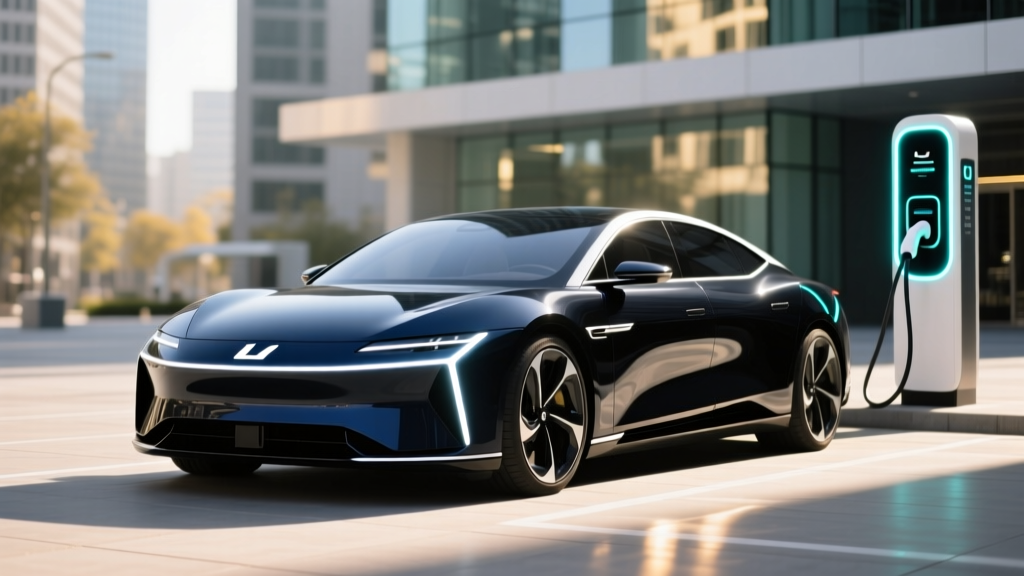
You have likely seen the Lucid Motors logo — a stylized, minimalist "L" set inside a sleek badge — on the trunk of one of the most aerodynamically efficient sedans ever built. But the emblem on the Lucid Air represents more than a brand identity; it signals a fundamentally different approach to electric-vehicle engineering. Where legacy automakers adapted existing platforms for battery power, Lucid designed its powertrain, battery pack, and motor assembly from scratch, resulting in record-breaking efficiency figures that still dominate the luxury EV sedan segment in 2026.
This profile covers the full 2026 Lucid Air lineup — Pure, Touring, Grand Touring, and Sapphire — with exact EPA range figures, real-world range expectations, DC fast-charging curves, battery chemistry, pricing, and federal tax credit eligibility under current IRS §30D rules.
What the Lucid Motors Logo Represents: Engineering-First DNA
Lucid's origins trace back to Atieva, a battery technology company founded in 2007 that supplied battery packs for Formula E race cars before pivoting to consumer vehicles. The Lucid Motors logo — unveiled when the company rebranded in 2016 — reflects that motorsport and engineering heritage. The company's headquarters in Newark, California, and its vertically integrated manufacturing facility (AMP-1) in Casa Grande, Arizona, allow Lucid to control everything from motor winding to battery-pack assembly.
The result is a powertrain so compact that Lucid fits up to 112 kWh of usable battery capacity beneath a sedan floor without compromising interior volume. Their proprietary miniaturized drive units — each roughly the size of a carry-on suitcase — produce up to 620 horsepower per axle in the Sapphire trim, a power density that remains unmatched in production sedans.
2026 Lucid Air Spec Table: Range, Battery, Performance by Trim
| Spec | Pure (RWD) | Touring (AWD) | Grand Touring (AWD) | Sapphire (AWD) |
|---|---|---|---|---|
| EPA Range | 419 mi | 425 mi | 512 mi | 427 mi |
| Battery (usable) | 88 kWh | 92 kWh | 112 kWh | 118 kWh |
| Chemistry | NMC | NMC | NMC | NMC |
| Horsepower | 430 hp | 620 hp | 819 hp | 1,234 hp |
| 0-60 mph | 5.0 sec | 3.4 sec | 3.0 sec | 1.89 sec |
| Drivetrain | RWD (single motor) | AWD (dual motor) | AWD (dual motor) | AWD (tri-motor) |
| EPA Efficiency | 140 MPGe / 24 kWh/100mi | 131 MPGe / 26 kWh/100mi | 130 MPGe / 26 kWh/100mi | 109 MPGe / 31 kWh/100mi |
| Max DC Charge Rate | 220 kW | 250 kW | 300 kW | 300 kW |
| 10-80% DC Time | ~28 min | ~24 min | ~22 min | ~22 min |
| Level 2 Home Charge | 19.2 kW (~72 mi/hr) | 19.2 kW (~72 mi/hr) | 19.2 kW (~72 mi/hr) | 19.2 kW (~72 mi/hr) |
| Base MSRP | $69,900 | $87,400 | $125,600 | $249,000 |
Sources: EPA fueleconomy.gov, Lucid Motors official specs. Specs reflect 2026 model year. Sapphire 0-60 time is manufacturer-claimed with rollout subtracted.
Real-World Range: What to Actually Expect
The Grand Touring's 512-mile EPA estimate is the highest of any production EV sold in the U.S. However, EPA range is a blended-cycle test. Here is what to expect in real-world conditions:
- Mild-weather city/suburban driving: 470–510 mi (Grand Touring) — regen braking and lower speeds maximize efficiency.
- Highway at 70-75 mph: Expect 380–430 mi (Grand Touring). Aerodynamic drag rises exponentially above 65 mph, and the Air's low 0.197 Cd coefficient helps, but cannot eliminate physics.
- Cold weather (below 32°F): Budget for a 20–30% reduction. A Grand Touring in January highway driving may deliver 310–370 mi. Preconditioning the battery while plugged in mitigates some loss.
- Sapphire (high-performance trim): The 427 EPA miles shrink to roughly 280–320 mi on aggressive highway driving. Tri-motor power draw is substantial.
The Air's efficiency advantage comes from its 900-volt electrical architecture and Wunderbox onboard energy management system. Higher voltage means lower current for the same power, reducing resistive losses in the wiring. The result: the Grand Touring achieves 26 kWh/100mi — roughly 15% better than comparable luxury sedans. For context, that translates to roughly $0.04–$0.06 per mile on a national-average residential electricity rate of $0.17/kWh, compared to $0.12–$0.15 per mile for a 30 MPG gas sedan at $3.50/gallon.
Charging Speed: DC Fast Charging & Home Level 2
Lucid's 900V architecture pays its biggest dividend at the DC fast charger. Higher system voltage allows the Air to accept more power without exceeding current limits on the battery cells, which is why the Grand Touring can sustain a peak charge rate of 300 kW — among the highest in production.
| Charging Method | Max Power | Miles Added Per Hour | Notes |
|---|---|---|---|
| Level 1 (120V household) | ~1.4 kW | ~4 mi/hr | Emergency/trickle only; full recharge takes days |
| Level 2 (240V, 48A home) | ~11.5 kW | ~42 mi/hr | Standard home charger; overnight full recharge |
| Level 2 (240V, 80A) | 19.2 kW | ~72 mi/hr | Requires 100A circuit; fastest home option |
| DC Fast Charge (peak) | Up to 300 kW (GT) | ~300 mi in 20 min (GT) | Requires 350 kW-capable station; charge curve tapers above 80% |
Charge curve reality check: Like all lithium-ion batteries, the Air does not hold peak charge rate for the entire session. The Grand Touring peaks near 300 kW up to roughly 30–35% SoC, then steps down to ~220 kW through 60%, and ~150 kW through 80%. The published 10-80% time of approximately 22 minutes accounts for this taper. Charging from 80-100% slows dramatically to protect cell longevity — add another 25–35 minutes if you need a full pack. For daily use, set your charge limit to 80% to minimize degradation.
Connector note: The 2026 Lucid Air uses the CCS1 connector natively. Lucid provides a NACS adapter for access to Tesla Supercharger V3/V4 stalls (150–250 kW). Supercharger access is included with the vehicle, though peak charge rates may be limited by the adapter's throughput and the specific Supercharger generation.
Interior, Cargo, and Tech: What Owners Actually Live With
Lucid's compact drive units free up significant interior volume. The cabin offers:
- Front legroom: 45.3 inches
- Rear legroom: 38.7 inches (class-leading for a sedan with this wheelbase)
- Trunk: 22.1 cu ft (plus 10.0 cu ft frunk)
- Total cargo: 32.1 cu ft — more than most midsize SUVs
The interior design centers on a 34-inch curved glass cockpit display (the "Glass Canopy") that floats above the dashboard. A secondary lower touchscreen handles climate, media, and navigation. The system supports wireless Apple CarPlay and Android Auto, over-the-air updates, and Lucid's DreamDrive Pro ADAS suite.
DreamDrive Pro is a Level 2 driver-assistance system per SAE classification. It includes adaptive cruise control, lane centering, automatic emergency braking, and highway assist. It requires the driver to keep hands on the steering wheel and eyes on the road at all times — it is not autonomous driving. Lucid has not released a hands-free highway system comparable to GM's Super Cruise or Ford's BlueCruise as of early 2026.
DreamDrive Pro is an SAE Level 2 system. The driver is always responsible for vehicle control. It does not handle construction zones, unmapped roads, or severe weather autonomously. Never treat any Level 2 system as self-driving.
Pricing, Trims, and Federal Tax Credit Eligibility
| Trim | Base MSRP | As-Tested (typical) | §30D Credit Eligible? |
|---|---|---|---|
| Pure (RWD) | $69,900 | $72,000–$76,000 | Eligible — under $55,000 sedan cap? No. See note below. |
| Touring (AWD) | $87,400 | $92,000–$98,000 | Not eligible (exceeds $55,000 sedan MSRP cap) |
| Grand Touring (AWD) | $125,600 | $130,000–$140,000 | Not eligible (exceeds $55,000 sedan MSRP cap) |
| Sapphire (AWD) | $249,000 | $255,000+ | Not eligible (exceeds $55,000 sedan MSRP cap) |
Critical tax credit context: Under IRS §30D rules current for 2026, new clean vehicle credits are capped at $55,000 MSRP for sedans (and $80,000 for SUVs/pickups/vans). Because the Lucid Air is classified as a sedan by the IRS, even the base Pure trim at $69,900 MSRP exceeds the cap and does not qualify for the up-to-$7,500 federal tax credit. This is a significant ownership-cost consideration compared to EVs that do qualify.
Additionally, §30D requires:
- Buyer adjusted gross income below $150,000 (single) or $300,000 (joint)
- Battery components and critical minerals meeting North American sourcing thresholds
- Vehicle assembled in North America (the Air is assembled in Arizona — this requirement is met)
The Pure trim's MSRP is the only barrier; all other §30D criteria are potentially satisfied. If Lucid introduces a lower-priced variant or if the IRS reclassifies the Air's body style, eligibility could change. Always verify current rules at irs.gov before purchasing.
Pros and Cons: The Honest Verdict
Pros
- Best-in-class EPA range: 512 mi (Grand Touring) is unmatched by any production EV
- Outstanding efficiency: 24–26 kWh/100mi beats every luxury competitor
- Class-leading rear legroom and cargo volume for a sedan
- 300 kW peak DC charge rate with a 900V architecture
- Compact drive units free up interior and frunk space
- OTA updates continue to improve vehicle post-purchase
Cons
- No federal §30D tax credit due to $55,000 sedan MSRP cap
- DreamDrive Pro lags behind Super Cruise/BlueCruise in hands-free capability
- Service center network is still thin outside major metro areas
- Infotainment learning curve — the Glass Canopy takes adjustment
- High starting price even for the base Pure trim
- Resale value data is still limited (company founded 2007, first deliveries 2021)
Warranty and Long-Term Ownership
Lucid provides the following coverage on the 2026 Air:
- Basic vehicle warranty: 4 years / 50,000 miles
- Battery and powertrain warranty: 8 years / 100,000 miles (covers battery capacity retention above 70% of original)
- Roadside assistance: 4 years / 50,000 miles
The battery pack uses NMC (nickel-manganese-cobalt) chemistry across all trims, chosen for its high energy density. NMC cells degrade faster than LFP (lithium iron phosphate) when regularly charged to 100%, so Lucid recommends a daily charge limit of 80% for routine use and reserving 100% charges for road trips. With proper care, NMC packs typically retain 85–90% capacity after 100,000 miles based on industry-wide fleet data from similar chemistries.
Insurance costs: Luxury EV sedans with 800+ hp carry elevated premiums. Expect $2,500–$4,500/year depending on trim, driving record, and location — roughly 25–40% higher than a comparable BMW 5 Series. Get a quote before purchasing.
Who Should Buy the 2026 Lucid Air?
- Choose the Air Pure if you want the most range-per-dollar in a luxury sedan, commute long distances, and can charge at home nightly. At ~$70K, it undercuts the Mercedes EQS and BMW i7 while offering more range.
- Choose the Air Touring if you need AWD for snow-belt climates, want sub-3.5-second 0-60 performance, and don't need the Grand Touring's maximum range.
- Choose the Air Grand Touring if you road-trip frequently and want to minimize charging stops. 512 EPA miles means most 400-mile trips require zero stops. This is the flagship efficiency play.
- Choose the Air Sapphire if you are a performance enthusiast who wants hypercar acceleration (1.89 sec 0-60) in a four-door daily driver — and budget is not a primary constraint.
- Look elsewhere if federal tax credit eligibility is critical to your purchase math, if you need hands-free highway driving (consider BMW i5 with Highway Assistant or Cadillac Celestiq), or if you need an SUV form factor (consider the Lucid Gravity or Rivian R1S).
Lucid Air vs. Key Competitors
| Spec | Lucid Air Grand Touring | Mercedes EQS 580 | BMW i7 xDrive60 | Tesla Model S Long Range |
|---|---|---|---|---|
| EPA Range | 512 mi | 371 mi | 318 mi | 402 mi |
| Battery (usable) | 112 kWh | 108.4 kWh | 101.7 kWh | 100 kWh |
| Horsepower | 819 hp | 536 hp | 536 hp | 670 hp |
| 0-60 mph | 3.0 sec | 4.1 sec | 4.5 sec | 3.1 sec |
| Max DC Charge | 300 kW | 200 kW | 195 kW | 250 kW |
| Base MSRP | $125,600 | $120,050 | $119,300 | $84,990 |
| Efficiency | 130 MPGe | 97 MPGe | 82 MPGe | 124 MPGe |
The Air Grand Touring wins decisively on range and efficiency. The Tesla Model S undercuts on price and offers Supercharger network access natively. The Mercedes and BMW compete more on brand prestige, interior material luxury, and dealer service networks. If maximum miles per charge is your priority, no competitor comes close to Lucid.
Frequently Asked Questions
What is the real-world range of the Lucid Air?
The EPA rates the Grand Touring at 512 miles, the highest of any production EV. In real-world highway driving at 70–75 mph in mild weather, expect 380–430 miles. In cold weather (below freezing), plan for 310–370 miles. The Pure RWD delivers roughly 350–390 miles on the highway despite its 419-mile EPA rating.
How fast does the Lucid Air charge?
On a 350 kW-capable DC fast charger, the Grand Touring peaks at 300 kW and charges from 10-80% in approximately 22 minutes. At home on a 48A Level 2 charger (11.5 kW), expect roughly 42 miles of range per hour — enough to fully recharge overnight. An 80A Level 2 circuit (19.2 kW) adds about 72 miles per hour.
Does the Lucid Air qualify for the federal EV tax credit?
No, as of 2026. The IRS §30D credit caps sedan eligibility at $55,000 MSRP. Even the base Lucid Air Pure at $69,900 exceeds this cap. State-level incentives may still apply — check your state's energy office for details. Consult a tax professional for personal eligibility.
How much does the Lucid Air cost after tax credits?
Because the Air does not qualify for the federal §30D credit, the purchase price is the MSRP plus options and destination fees. The base Pure starts at $69,900 before any state or utility incentives. Some states (California, Colorado, Massachusetts, and others) offer additional rebates that may apply — check local programs.
Is the Lucid Air worth buying vs. competitors?
If range and efficiency are your top priorities, the Air Grand Touring has no equal. If you value brand heritage, dealer service infrastructure, or hands-free driving tech, the Mercedes EQS or BMW i7 may suit you better. If price is the primary concern, the Tesla Model S Long Range offers 402 miles of range at $84,990 — roughly $40,000 less than the Grand Touring.
What are the biggest pros and cons of the Lucid Air?
Pros: unmatched EPA range, best-in-class efficiency, spacious interior, 300 kW charging, strong OTA update track record. Cons: no federal tax credit, limited service center network, DreamDrive Pro lags competitors in hands-free capability, high insurance premiums on upper trims.
What battery chemistry does the Lucid Air use?
All 2026 Lucid Air trims use NMC (nickel-manganese-cobalt) lithium-ion cells. NMC offers higher energy density than LFP (lithium iron phosphate), enabling the Air's compact pack and long range, but requires an 80% daily charge limit for optimal longevity. The battery and powertrain are warrantied for 8 years / 100,000 miles.
Editorial note: Specifications and pricing reflect the 2026 model year as published by Lucid Motors. Federal tax credit rules under §30D are subject to change. Always verify current eligibility at irs.gov and confirm final pricing with a Lucid advisor before ordering.