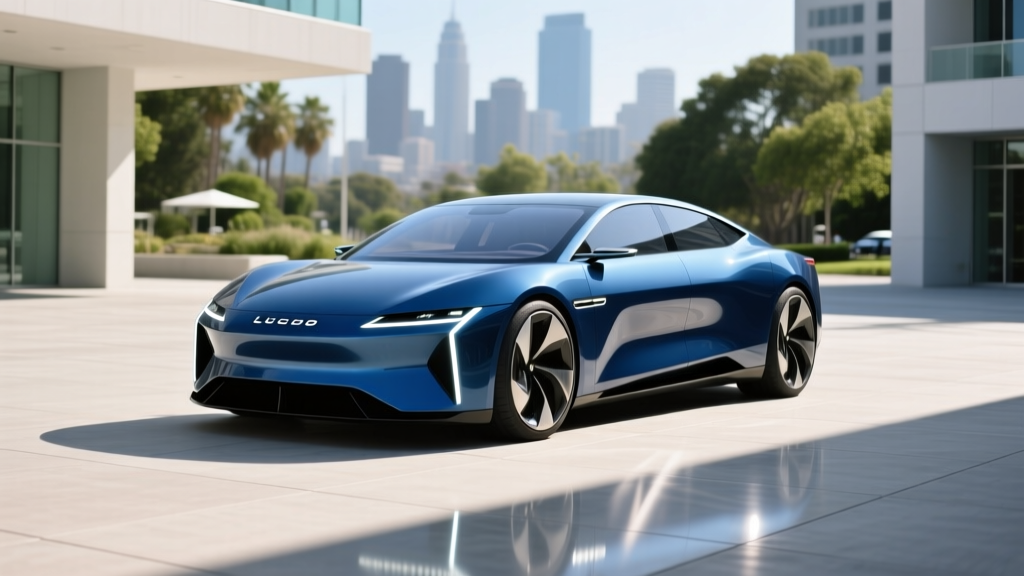
Lucid Motors used the 2025 Monterey Car Week to unveil a concept that points directly at the brand's next chapter: a more compact, more affordable electric SUV intended to slot below the Air sedan and Gravity three-row. While the automaker has not yet confirmed a production name or locked final specifications, the Lucid Motors Monterey Car Week concept gives us the clearest look yet at the platform, proportions, and engineering priorities that will define Lucid's midsize entry — a vehicle aimed squarely at the Tesla Model Y, Porsche Macan EV, and upcoming offerings from Rivian and BMW.
Because this is still a concept and not a vehicle you can order today, every number below is drawn from Lucid's official statements, teardown hints from the platform reveal, and reasonable extrapolation from the current Air and Gravity architectures. Where figures are preliminary, we flag them clearly. If you're weighing a midsize luxury EV purchase in 2026, here's what the concept tells us — and what it doesn't.
Platform, Proportions, and the Midsize Mission
The concept rides on a shortened variant of Lucid's proprietary electric platform, the same skateboard that underpins the Air and Gravity but with a reduced wheelbase and a lower roofline suited to a two-row crossover-coupe silhouette. Lucid CEO Marc Winterhoff has referred to the upcoming production model internally as the midsize platform, with a target starting price in the mid-$50,000 range — a deliberate step down from the Air's ~$70,000 entry point and the Gravity's ~$80,000.
Visually, the concept is shorter than the Gravity by roughly 10 inches and sits on 22-inch wheels with a fastback roofline that sacrifices a small amount of rear headroom for aerodynamic efficiency. The design language is unmistakably Lucid: a low, smooth nose, flush door handles, and a glass canopy roof that stretches nearly the full length of the cabin.
Estimated Range, Battery, and Efficiency
Real-World Expectation: Plan for approximately 290–320 miles in mixed highway driving at 70+ mph. In cold weather (below 32°F / 0°C), expect a 15–25% reduction, bringing effective range to roughly 260–275 miles. Lucid's heat pump system should mitigate some cold-weather loss compared to resistive-heating competitors.
Lucid has historically led the industry in efficiency — the Air Grand Touring achieves an EPA-rated 516 miles from a 112 kWh usable pack, translating to roughly 4.6 miles per kWh. The midsize concept is expected to use a smaller battery, likely in the 85–92 kWh usable range, with Lucid's next-generation NMC (nickel-manganese-cobalt) cells. The company has not confirmed LFP (lithium iron phosphate) for this platform; given the range targets, NMC remains the likely chemistry for higher trims, though an LFP variant could arrive later as a lower-cost option.
| Spec | Estimated / Target |
|---|---|
| Battery Capacity (usable) | 85–92 kWh (NMC) |
| EPA Range (target, top trim) | ~350 mi |
| Efficiency | ~120 MPGe / ~28 kWh/100 mi |
| Drivetrain | RWD (base), Dual-Motor AWD (upper trims) |
| Horsepower | ~400 hp (RWD), ~600 hp (AWD) |
| 0–60 mph | ~5.0 sec (RWD), ~3.4 sec (AWD) |
| Architecture Voltage | 900V nominal |
Lucid's 900-volt architecture, carried over from the Air, is the key enabler here. Higher voltage means lower current for the same power, which reduces heat in the battery and motors, improves efficiency, and enables faster DC charging without oversized cables. For buyers, this translates into best-in-class efficiency figures that should handily beat the Porsche Macan EV's ~30 kWh/100 mi and rival the Tesla Model Y Long Range's ~28 kWh/100 mi.
Charging Speed: DC Fast and Home Level 2
Charging speed is where Lucid's 900V platform pays dividends. Based on the Gravity's demonstrated performance and Lucid's stated goals for the midsize platform, here is what we expect:
| Charging Level | Power / Rate | Time / Miles Added |
|---|---|---|
| Level 1 (120V, 12A) | ~1.4 kW | ~4 mi/hr |
| Level 2 (240V, 48A) | ~11.5 kW | ~34 mi/hr; full charge in ~8 hr |
| DC Fast Charge (peak) | ~250 kW (peak) | |
| DC 10–80% (est.) | ~20 minutes (with preconditioning) |
A few real-world caveats on that 250 kW peak figure: Lucid's charge curve, like all modern EVs, tapers significantly above 80% State of Charge (SoC). In practice, you'll see peak rates only between roughly 10% and 45% SoC, with a gradual taper through 80% and a steep drop-off above that. On a 350 kW Electrify America or Tesla Supercharger V4 stall, the Lucid should sustain above 180 kW through the bulk of the charge session — a meaningful advantage over 400V competitors that peak at 150–175 kW and taper earlier.
For home charging, the 11.5 kW Level 2 rate (on a 48-amp hardwired circuit) means a full overnight replenishment. If your home electrical panel supports a 60-amp dedicated circuit, a licensed electrician can install a Lucid-recommended Level 2 station for roughly $800–$2,000 including equipment and labor, depending on panel proximity and local permit costs. Always confirm final amperage and breaker sizing with your electrician before purchasing hardware.
Interior, Cargo, and Technology
The concept's cabin showcases Lucid's next-generation infotainment system: a curved 34-inch glass cockpit display spanning the driver's instrument cluster and central touchscreen, with a secondary passenger display integrated into the dashboard. Lucid's Surreal Sound audio system with Dolby Atmos is expected to carry over, along with the brand's minimalist physical-control philosophy — climate and volume are managed via the touchscreen and steering wheel toggles, with no traditional center stack buttons.
Space is the open question. The fastback roofline suggests rear headroom will be tighter than the Gravity's, likely in the 37–38 inch range (vs. the Gravity's 39.5 inches). Legroom should be generous thanks to the skateboard platform's flat floor — expect approximately 40 inches rear legroom. Cargo volume behind the second row is estimated at 26–30 cubic feet, expanding to roughly 65–70 cu ft with the rear seats folded. A modest front trunk (frunk) of ~4–5 cu ft is likely, suitable for a charging cable bag and small items.
On the driver-assistance front, Lucid's DreamDrive Pro system will be standard. This is an SAE Level 2 system — it provides adaptive cruise control, lane centering, and automatic lane changes, but the driver must remain fully engaged and supervise the system at all times. It is not self-driving and should not be confused with Level 4 robotaxi services like Waymo. Lucid has not announced plans for a supervised hands-off system comparable to GM's Super Cruise or Ford's BlueCruise for this platform, though hardware pre-wiring for future over-the-air upgrades is likely.
Pricing, Trims, and Federal Tax Credit Eligibility
Lucid has publicly targeted a starting MSRP in the mid-$50,000 range for the base rear-drive trim, with a dual-motor AWD variant likely starting around $62,000–$65,000 and a performance-oriented "Grand Touring" or equivalent trim approaching $75,000. Production is expected to begin in late 2026 or early 2027 at Lucid's Casa Grande, Arizona factory.
| Trim | Est. Base MSRP | §30D Credit Eligibility | Effective Price (if eligible) |
|---|---|---|---|
| Base RWD | ~$55,000 | Likely eligible (under $80K SUV cap) | ~$47,500 |
| AWD | ~$63,000 | Likely eligible | ~$55,500 |
| Grand Touring / Perf. | ~$75,000 | Eligible (under $80K SUV cap) | ~$67,500 |
Tax credit caveats (IRS §30D, 2026 rules): The federal EV tax credit provides up to $7,500, but eligibility depends on several factors that change frequently:
- MSRP cap: SUVs/wagons must be under $80,000; sedans under $55,000. If Lucid classifies the midsize as an SUV, all trims should clear the cap.
- Buyer income limits: Modified adjusted gross income (MAGI) must not exceed $150,000 (single), $225,000 (head of household), or $300,000 (joint filers).
- Battery sourcing: A percentage of critical minerals and battery components must be sourced from the U.S. or free-trade-agreement partners. Lucid's Arizona manufacturing gives it an advantage, but final sourcing determinations are made per model year by the IRS.
- Point-of-sale transfer: As of 2024, buyers can transfer the credit to the dealer at purchase, reducing the upfront price rather than waiting for a tax refund. Confirm with your tax professional before relying on this.
Always verify current eligibility at IRS.gov and fueleconomy.gov before purchasing, as rules are subject to legislative and regulatory changes.
How It Compares: Lucid Midsize vs. Key Rivals
The midsize luxury EV crossover segment is crowded and getting more so. Here is how the Lucid concept's projected specs stack up against the benchmarks it will need to beat:
| Spec | Lucid Midsize (est.) | Tesla Model Y LR (2025) | Porsche Macan 4 EV | BMW iX xDrive50 |
|---|---|---|---|---|
| EPA Range | ~350 mi | 320 mi | 308 mi | 324 mi |
| Battery (usable) | ~90 kWh | 75 kWh | 95 kWh | 105 kWh |
| Peak DC Charge | ~250 kW | 250 kW | 270 kW | 195 kW |
| 10–80% Time | ~20 min | ~25 min | ~21 min | ~31 min |
| 0–60 (AWD) | ~3.4 sec | 4.8 sec | 4.9 sec | 4.4 sec |
| Starting MSRP | ~$55,000 | $48,990 | $80,550 | $87,250 |
| Efficiency (kWh/100mi) | ~28 | 28 | 32 | 34 |
The takeaway: Lucid's projected combination of 350-mile range, sub-$60K pricing, and 900V charging speed would be genuinely competitive — undercutting the Porsche and BMW significantly while offering more range than the Model Y. The risk, as always with Lucid, is execution: production ramp-up timelines, build quality consistency, and service network expansion will determine whether the spec sheet translates into ownership satisfaction.
Warranty and Long-Term Ownership
Lucid's current warranty structure for the Air and Gravity is 8 years / 100,000 miles for the battery pack and electric powertrain, with a basic vehicle warranty of 4 years / 50,000 miles. The midsize model is expected to carry the same coverage. The battery warranty guarantees that the pack will retain at least 70% of its original capacity over the warranty period — a standard threshold in the industry, though some competitors (notably Hyundai/Kia) offer 10-year/100,000-mile coverage.
Lucid's NMC cells, manufactured in partnership with LG Energy Solution and Samsung SDI, have demonstrated strong degradation curves in the Air: real-world owner data suggests approximately 5–7% capacity loss over the first 50,000 miles, with the curve flattening significantly thereafter. For a midsize model with a ~90 kWh pack, 70% retention at 100,000 miles would mean roughly 63 kWh usable — still enough for ~245 miles of real-world range.
Pros, Cons, and Who Should Consider It
Projected Pros
- Best-in-class efficiency (~28 kWh/100 mi target)
- 900V architecture enables fast DC charging with strong sustained rates
- Projected 350-mile range undercuts rivals on price-per-mile of range
- Luxury interior materials and Surreal Sound audio
- Likely full §30D tax credit eligibility across trims
- Arizona-built — strong domestic content for sourcing rules
Projected Cons
- Not yet available — production likely late 2026 or 2027
- Lucid's service center network remains limited vs. Tesla/BMW
- Fastback roofline may compromise rear headroom and cargo versatility
- No confirmed hands-free highway driving feature (DreamDrive Pro is Level 2, eyes-on)
- Resale value uncertainty — Lucid is a young brand with limited depreciation data
- Software and infotainment still maturing vs. Tesla's ecosystem
Who this EV suits best: The Lucid midsize concept targets the buyer who wants a premium, efficient electric crossover with strong range and fast charging but doesn't need three rows or the badge cachet of Porsche. It's well-suited for daily commuters with home charging access, couples who take regular road trips (the 350-mile range and 20-minute DC stops make 600-mile days feasible), and tech-forward buyers who value efficiency metrics over brand heritage. It is not the right pick for buyers who need immediate availability, robust dealer-service infrastructure in rural areas, or hands-free highway driving.
Frequently Asked Questions
What is the real-world range of the Lucid midsize concept?
Lucid targets an EPA rating of approximately 350 miles. In real-world highway driving at 70–80 mph, plan for 290–320 miles. In cold weather (below freezing), expect 260–275 miles effective range. These are projections based on Lucid's stated efficiency goals and the Air's proven performance — final EPA numbers won't be available until production testing is complete.
How fast does it charge at home and on the road?
At home on a 240V, 48-amp Level 2 charger, the Lucid midsize should add roughly 34 miles per hour, achieving a full charge in about 8 hours. On a DC fast charger, it's expected to peak around 250 kW and charge from 10% to 80% in approximately 20 minutes, provided the battery is preconditioned (warmed to optimal temperature via the vehicle's navigation-routed preconditioning feature).
How much does it cost after the federal tax credit?
If the base RWD trim starts around $55,000 and qualifies for the full $7,500 §30D credit (subject to income, sourcing, and MSRP requirements), the effective price drops to approximately $47,500. The AWD trim at ~$63,000 would net roughly $55,500. Always confirm eligibility with a tax professional and check IRS.gov for current-year rules before purchasing.
Is the Lucid midsize worth waiting for vs. buying a Model Y or Macan EV now?
If you need a vehicle in 2026, the Tesla Model Y remains the segment benchmark for availability, Supercharger network access, and software maturity. The Porsche Macan EV offers superior build quality and driving dynamics at a much higher price. The Lucid midsize is worth waiting for if you prioritize range-per-dollar, 900V charging efficiency, and a more distinctive luxury interior — and if you can tolerate a late-2026 or 2027 delivery timeline and Lucid's still-growing service network.
Does it qualify for the federal EV tax credit?
Based on projected pricing (all trims under the $80,000 SUV MSRP cap) and Lucid's Arizona manufacturing footprint, the midsize model is likely to qualify for the full $7,500 §30D credit — assuming the buyer meets income limits ($150K single / $300K joint) and Lucid's battery sourcing meets the IRS critical-mineral and component thresholds for the applicable model year. Final determinations are made by the IRS per model year; verify at fueleconomy.gov before purchase.
Is Lucid's DreamDrive Pro self-driving?
No. DreamDrive Pro is an SAE Level 2 driver-assistance system. It provides adaptive cruise control, lane centering, and automated lane changes, but the driver must keep their eyes on the road and hands available to take over at any time. It is not autonomous. Only Level 4 services like Waymo operate without a human driver — and those are limited to specific geofenced areas in select cities.
The Lucid Motors Monterey Car Week concept is a promise, not a product — but it's a promise backed by the most efficient EV platform on the market today. If Lucid can deliver 350 miles of range, 250 kW charging, and a sub-$60K starting price in a production vehicle by 2027, the midsize luxury EV segment will have a serious new contender. Until then, reservation-holders and interested buyers should watch for the production reveal, expected in the coming months, for finalized specs, confirmed pricing, and the all-important battery-sourcing determinations that will dictate tax credit eligibility.