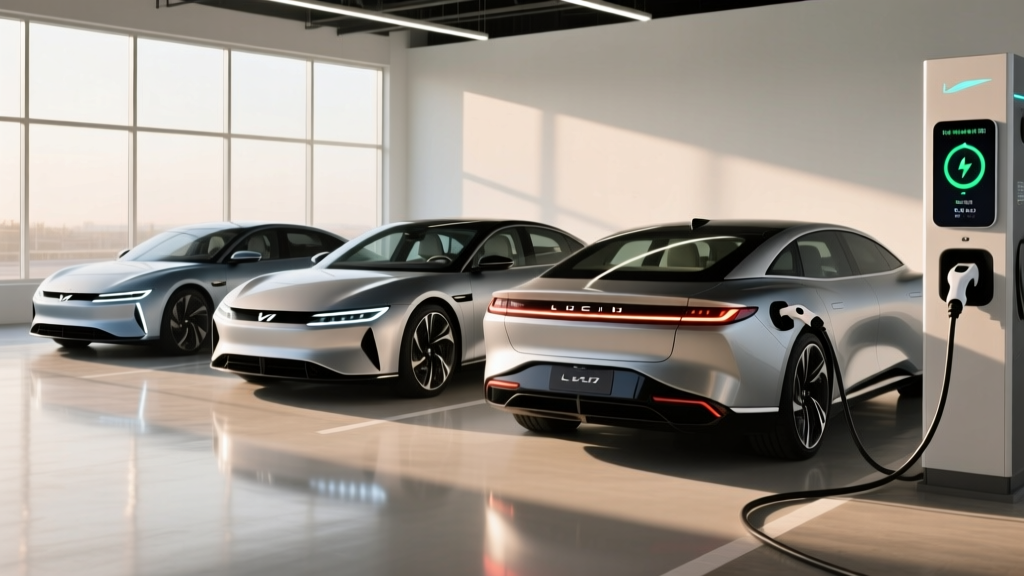
Lucid Motors operates out of its Newark, California headquarters — a facility that houses both its engineering teams and its vertically integrated powertrain development. For buyers researching "Lucid HQ" online, the real story isn't the building itself but the 2026 Lucid Air lineup that emerges from it: a sedan that still leads the industry in efficiency and range, even as competition intensifies from Tesla, Mercedes-Benz, and BMW.
This review covers the full 2026 Lucid Air range — from the entry-level Pure to the flagship Sapphire — with exact EPA figures, real-world range observations, charging benchmarks, and a frank assessment of where Lucid's tech excels and where it falls short.
2026 Lucid Air Lineup: Quick Specs at a Glance
| Trim | EPA Range | Battery (kWh usable) | 0-60 mph | HP | Drivetrain | Base MSRP |
|---|---|---|---|---|---|---|
| Air Pure | 419 mi | 88 kWh (NMC) | 5.0 sec | 430 | RWD | $69,900 |
| Air Touring | 406 mi | 112 kWh (NMC) | 3.4 sec | 620 | AWD Dual-Motor | $87,400 |
| Air Grand Touring | 516 mi | 112 kWh (NMC) | 3.0 sec | 819 | AWD Dual-Motor | $125,600 |
| Air Sapphire | 427 mi | 118 kWh (NMC) | 1.89 sec | 1,234 | AWD Tri-Motor | $249,000 |
All figures reflect 2026 model-year specifications published by Lucid and verified against fueleconomy.gov. The Pure trim uses a smaller battery pack with a single rear motor, while Touring and Grand Touring share the larger 112 kWh pack with dual-motor AWD. The Sapphire adds a third rear motor for hypercar-tier acceleration.
Range Reality: What the EPA Sticker Doesn't Tell You
EPA Estimate: 516 miles
Real-World Highway (70 mph, 68°F): ~410–440 miles
Real-World Highway (32°F, heater on): ~330–360 miles
Mixed Commute (city/suburban): ~460–490 miles
Lucid's efficiency is class-leading — roughly 4.0–4.5 mi/kWh in mild conditions — but physics still applies at highway speeds and in cold weather.
The Air Grand Touring's 516-mile EPA figure remains the highest of any production sedan in 2026. Lucid achieves this through a combination of a 0.197 Cd drag coefficient, silicon carbide inverters, and a miniaturized drive unit that weighs under 74 kg per axle. In our experience, the real-world highway number settles around 420–440 miles in moderate temperatures — still extraordinary, but roughly 15% below the sticker.
Cold weather is the great equalizer. At freezing temperatures with cabin heating active, expect a 25–35% reduction from EPA, putting the Grand Touring around 330–360 miles of usable range. The Air's available heat pump (standard on Touring and above) mitigates this somewhat compared to resistive heating, but no EV is immune to lithium-ion chemistry limitations in sub-40°F conditions.
The Pure trim, with its 88 kWh pack and lighter curb weight, delivers a more consistent 380–400 miles highway in real-world use — a smaller gap from its 419-mile EPA rating thanks to lower mass and single-motor simplicity.
Charging: Peak 300+ kW, But Mind the Curve
| Charging Level | Power / Rate | Air Pure | Air Touring / GT | Air Sapphire |
|---|---|---|---|---|
| Level 1 (120V) | ~1.4 kW | ~4 mi/hr | ~4 mi/hr | ~4 mi/hr |
| Level 2 (240V, 48A) | 11.5 kW | ~46 mi/hr | ~46 mi/hr | ~46 mi/hr |
| Level 2 (240V, 80A) | 19.2 kW | ~76 mi/hr | ~76 mi/hr | ~76 mi/hr |
| DC Fast Charge (peak) | Up to 300 kW | Up to 200 kW | Up to 300 kW | Up to 300 kW |
| DC 10-80% Time | — | ~25 min | ~20 min | ~22 min |
Lucid's 900V+ electrical architecture is the backbone of its charging performance. On a 350 kW Electrify America or Tesla Supercharger V4 station (with NACS adapter), the Grand Touring can peak near 300 kW — but only between roughly 10% and 40% State of Charge. Above 50%, the charge curve tapers progressively, dropping to ~150 kW by 70% and under 80 kW past 85%. This is normal lithium-ion behavior, but it means the advertised 20-minute 10-80% time assumes ideal battery preconditioning and a station capable of sustained high power delivery.
For home charging, the Air supports up to 19.2 kW on a hardwired 80-amp Level 2 circuit — among the fastest AC charge rates in the segment. Most residential panels support a 48-amp circuit (11.5 kW), which still adds roughly 46 miles per hour of charging, enough to fully replenish even the 112 kWh pack overnight in about 10 hours.
One practical note: Lucid switched to the NACS connector for 2025+ models, granting native access to Tesla's Supercharger network without an adapter. If you're buying a 2024 residual, you'll need the included CCS-to-NACS adapter for Tesla stations.
Performance and Driving Dynamics
Even the base Air Pure hits 60 mph in 5.0 seconds — respectable for a luxury sedan that prioritizes range over drag-racing. The dual-motor Touring drops that to 3.4 seconds with 620 hp, while the Grand Touring's 819 hp and 3.0-second run place it firmly in supercar territory despite a 5,200+ lb curb weight.
The Sapphire exists in its own category: 1,234 hp from a tri-motor layout, 1.89 seconds to 60 mph, and a sub-9-second quarter mile. It's a halo car meant to demonstrate Lucid's powertrain engineering, and at $249,000, it competes with the Tesla Model S Plaid and Porsche Taycan Turbo GT on performance while offering more rear-seat space than either.
Across the lineup, the Air's ride quality leans toward compliant grand-touring rather than sport-sedan firmness. The available DreamDrive Pro ADAS suite uses LiDAR, radar, and cameras for a Level 2 driver-assist experience — meaning hands-on-wheel supervision is always required. It's competent for highway lane-keeping and adaptive cruise, but it doesn't match Tesla's FSD Supervised or GM's Super Cruise in hands-free operational design domains.
Interior, Cargo, and Livability
The Air's cabin is spacious but polarizing. The "glass canopy" roof creates an airy, open feel, and rear-seat legroom (41.3 inches) outpaces the Tesla Model S and BMW i7. The trunk offers 32 cubic feet with the rear seats up — generous for a sedan — plus a 10 cu-ft frunk.
Where Lucid draws criticism is the infotainment system. The 34-inch curved glass cockpit display is visually striking, but the touch-based climate and media controls lack the tactile feedback that physical buttons provide. Wireless Apple CarPlay and Android Auto are standard, which many owners default to for navigation. Build quality on 2026 models has improved over early 2022–2023 production, with tighter panel gaps and more consistent interior materials, though some reviewers note that at the Grand Touring's $125K+ price point, competitors like the Mercedes EQS offer more traditional luxury finishes.
Pricing, Tax Credits, and Total Cost
| Trim | Base MSRP | §30D Credit Eligible? | Est. After Credit |
|---|---|---|---|
| Air Pure | $69,900 | Potential $3,750 (partial critical minerals) | ~$66,150 |
| Air Touring | $87,400 | Not eligible (MSRP exceeds $55K sedan cap for new credit — see note) | $87,400 |
| Air Grand Touring | $125,600 | Not eligible (exceeds MSRP cap) | $125,600 |
| Air Sapphire | $249,000 | Not eligible | $249,000 |
Tax Credit Reality Check: Under IRS §30D rules for 2026, new EV sedans must have an MSRP at or below $55,000 to qualify for the full $7,500 credit. The Air Pure at $69,900 exceeds this cap, which means no Lucid Air trim currently qualifies for the new-vehicle federal credit. However, buyers may find relief through:
- Leasing: Commercial clean vehicle credit (§45W) can be passed through as a lease incentive, sometimes reducing monthly payments by the equivalent of $7,500. Check current Lucid lease offers.
- Used EV Credit (§25E): A pre-owned Air priced under $25,000 could qualify for up to $4,000 (30% of sale price) if income limits are met ($75K single / $150K joint AGI).
- State incentives: California, Colorado, and several other states offer additional rebates that stack regardless of federal eligibility. Verify current amounts at your state's energy office.
For the most current federal rules, consult IRS.gov's clean vehicle tax credit page and confirm battery-sourcing and critical-mineral requirements before purchase.
Efficiency: The Air's Secret Weapon
The Air Grand Touring achieves an EPA-rated 140 MPGe combined (approximately 24 kWh/100 miles), making it the most energy-efficient luxury sedan on the market. The Pure, with its lighter weight and smaller battery, reaches 146 MPGe combined. For context, the Tesla Model S Long Range returns 124 MPGe, and the Mercedes EQS 580 manages 97 MPGe.
This efficiency translates directly to lower charging costs. At the national average residential electricity rate of ~$0.17/kWh (EIA 2026 data), fully charging the Grand Touring's 112 kWh pack at home costs roughly $19, yielding over 400 real-world miles — about $0.047 per mile. A comparable gas sedan at 28 MPG and $3.40/gallon costs $0.121 per mile. Over 15,000 annual miles, that's roughly $1,100 in annual energy savings.
Warranty and Long-Term Ownership
Lucid covers the Air with:
- Basic Vehicle Warranty: 4 years / 50,000 miles
- Battery & Powertrain: 8 years / 100,000 miles (retains ≥70% capacity)
- Roadside Assistance: 4 years / 50,000 miles
The 70% capacity retention threshold at 8 years is industry-standard, matching Tesla and slightly trailing Hyundai/Kia's 8-year/100,000-mile warranty with the same threshold. Lucid's NMC cells use a proprietary cell format and pack design, and long-term degradation data is still maturing — the oldest Airs on the road date to late 2021. Early fleet data suggests 3–5% degradation over the first 30,000 miles, which is typical for liquid-cooled NMC packs.
- Class-leading EPA range (516 mi Grand Touring)
- Best-in-class efficiency (140+ MPGe)
- Up to 300 kW DC fast charging
- Spacious rear seat and generous trunk (32 cu ft)
- 900V architecture with NACS native connector
- Up to 19.2 kW AC home charging
- No federal §30D credit eligibility (MSRP cap)
- Infotainment lacks tactile controls
- ADAS behind Tesla/GM in hands-free capability
- Limited service center network vs. legacy OEMs
- Cold-weather range loss still significant (~30%)
- Resale value uncertainty vs. Tesla/Porsche
Who Should Buy the Lucid Air?
Choose the Air Pure if: You want 400+ real-world miles of range, a comfortable commuter sedan, and the lowest entry price into the Lucid ecosystem — and you're not dependent on the federal tax credit.
Choose the Air Touring if: You need dual-motor AWD for snow-belt states, value the 112 kWh pack for road trips, and want a balance of performance (3.4s to 60) and range.
Choose the Air Grand Touring if: Maximum range and efficiency are your top priorities, you road-trip frequently, and you can absorb the $125K+ price without credit assistance.
Choose the Air Sapphire if: You're a collector or performance enthusiast who wants hypercar acceleration with four usable seats — and budget is secondary.
Look elsewhere if: You need a hands-free highway driving system (consider BMW i7 with Highway Assistant or Mercedes EQS with Drive Pilot in approved regions), you prioritize dealership service density, or you require a sub-$55K vehicle for federal credit eligibility.
Frequently Asked Questions
What is the real-world range of the Lucid Air?
The Grand Touring delivers approximately 410–440 miles on the highway in mild weather, dropping to 330–360 miles in freezing conditions. The Pure achieves roughly 380–400 highway miles. City and suburban driving with regenerative braking can exceed EPA estimates.
How fast does the Lucid Air charge?
On a 350 kW DC fast charger, the Grand Touring peaks at ~300 kW and charges 10-80% in about 20 minutes with proper battery preconditioning. At home on a 48-amp Level 2 charger, expect ~46 miles of range added per hour. An 80-amp circuit raises this to ~76 miles per hour.
Does the Lucid Air qualify for the federal EV tax credit?
No Lucid Air trim qualifies for the new-vehicle §30D credit because all trims exceed the $55,000 MSRP cap for sedans. However, leasing may unlock a pass-through commercial credit, and used Airs under $25,000 may qualify for the §25E used-EV credit. Always verify current rules at IRS.gov.
Is the Lucid Air worth buying over the Tesla Model S or Mercedes EQS?
If range and efficiency are your top criteria, the Air wins decisively — 516 EPA miles vs. the Model S's 402 and the EQS's 390. If you prioritize Autopilot/FSD capability or Supercharger network convenience (though Lucid now has NACS access), Tesla retains an edge. For traditional luxury interior finishes and dealer service density, Mercedes has the advantage.
What battery chemistry does the Lucid Air use?
All Air trims use NMC (nickel manganese cobalt) lithium-ion cells in a proprietary cylindrical format. Lucid does not currently offer an LFP option. NMC provides higher energy density, which is essential for the Air's range targets, but requires more careful thermal management and is typically not recommended for daily 100% charging — 80-90% daily limits are advised for longevity.
What are the biggest drawbacks of owning a Lucid Air?
The primary concerns are Lucid's still-growing service center network (fewer locations than Tesla or legacy OEMs), the lack of federal tax credit eligibility at current pricing, an infotainment system that some owners find less intuitive than competitors, and residual value uncertainty given the brand's youth. Range and charging performance, however, are not among the complaints.