Why Lucid Headquarters Matters for EV Buyers in 2026
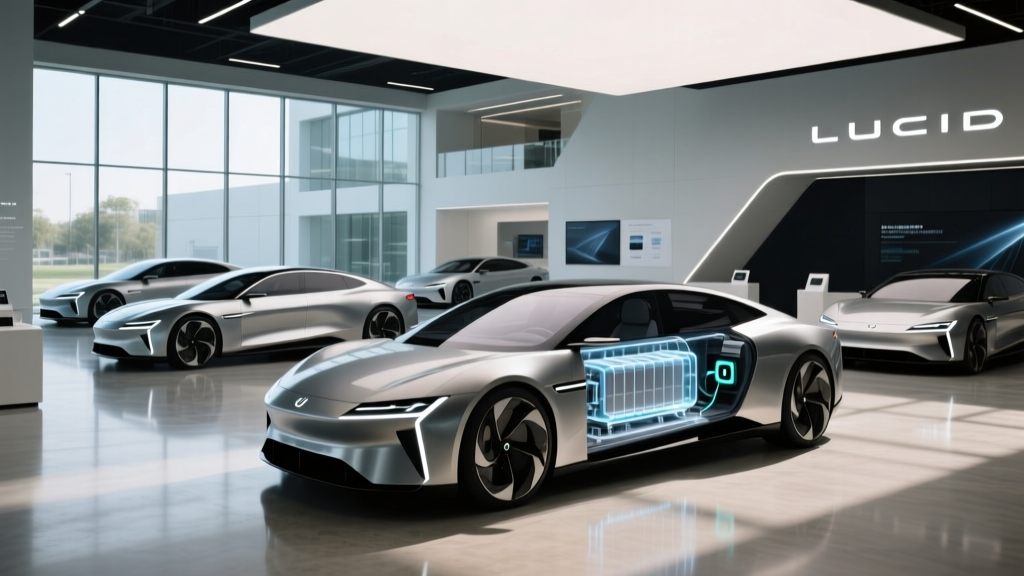
When enthusiasts search for Lucid headquarters, they're usually chasing one of two things: the engineering culture that produced the most efficient production sedan on the road, or a signal of whether the company will still be around to honor its battery warranty. Both are fair questions. Lucid's HQ and primary manufacturing plant sit in Casa Grande, Arizona — a $1.2 billion facility known internally as AMP-1 (Advanced Manufacturing Plant 1) — and it's where every Air sedan is assembled on a vertically integrated line that builds its own battery packs, drive units, and even the compact Wunderbox charger onboard.
For buyers, the real relevance of Lucid headquarters is the engineering output. The Air's miniaturized drivetrain, 900-volt electrical architecture, and class-leading efficiency (up to 5.0 miles per kWh) are not spec-sheet theater — they translate directly into fewer charging stops on I-10 and lower electricity cost per mile than any rival luxury EV. This review evaluates the 2026 Air lineup (Pure, Touring, Grand Touring, and Sapphire) through the lens of what actually shows up in the driveway.
2026 Lucid Air Lineup: Specs at a Glance
| Trim | Drivetrain | Battery (usable kWh) | EPA Range | 0-60 mph | HP | Base MSRP |
|---|---|---|---|---|---|---|
| Air Pure RWD | Rear-Wheel Drive | 88 kWh (NMC) | 419 mi | 5.0 s | 430 | $69,900 |
| Air Touring AWD | Dual-Motor AWD | 112 kWh (NMC) | 425 mi | 3.4 s | 620 | $87,400 |
| Air Grand Touring AWD | Dual-Motor AWD | 112 kWh (NMC) | 516 mi | 3.0 s | 819 | $125,600 |
| Air Sapphire | Tri-Motor AWD | 118 kWh (NMC) | 427 mi | 1.89 s | 1,234 | $249,000 |
All trims share the same 900V+ electrical architecture, NACS charge port (native on 2025+ models, retrofitted to earlier cars via adapter), and the compact Atlas drive unit developed in-house at the Casa Grande facility. Battery chemistry across the lineup is nickel-manganese-cobalt (NMC) — chosen for energy density over the cycle-life advantages of LFP, a trade-off that matters when you're trying to pack 516 miles into a sedan floorpan.
EPA 516 mi (Grand Touring) is the headline, but plan on 420–450 mi at steady 75-mph highway cruise, 350–380 mi in sub-30°F winter conditions with cabin heat, and 470–490 mi in mixed suburban driving. The Air Pure RWD's 419-mi EPA sticker typically delivers 350–370 mi highway. Efficiency, not raw pack size, is where Lucid earns its numbers — the Grand Touring's ~4.8 mi/kWh highway figure beats rivals by 15–20%.
Charging Speed: 900V Architecture in Practice
Lucid's 900-volt platform is the backbone of its charging story. Higher voltage means lower current for the same power, which keeps cable mass down and thermal headroom up. On a 350 kW Electrify America or Ionity charger, the Grand Touring peaks around 300 kW and sustains roughly 250 kW through the 20–60% state-of-charge window before tapering.
| Charging Method | Power | Typical Delivery | Notes |
|---|---|---|---|
| DC Fast Charge (350 kW station) | Peak ~300 kW | 10–80% in ~20 min (Grand Touring); ~25 min (Pure) | Taper steep above 80%; precondition via nav routing |
| DC Fast Charge (150 kW station) | Peak ~140 kW | 10–80% in ~38 min | More common on older highway corridors |
| Level 2 Home (48A / 11.5 kW) | 11.5 kW | ~46 mi/hr added; full charge ~10 hrs | Requires NEMA 14-50 or hardwired 60A circuit |
| Level 2 Home (80A / 19.2 kW) | 19.2 kW (22 kW onboard) | ~75 mi/hr added; full charge ~6 hrs | Lucid's Wunderbox supports 22 kW AC onboard — rare in the segment |
| Level 1 (120V / 12A) | 1.4 kW | ~5 mi/hr | Emergency/trickle only |
A note on the charge curve: like all NMC packs, the Air's peak kW is a ceiling, not a plateau. Expect the final 80–100% top-off to add another 25–30 minutes. For road trips, the 10–80% window is what matters, and the Air's ~20-minute 300 kW session is genuinely competitive with the Porsche Taycan and faster than the Tesla Model S at most real-world chargers.
Home charging is where Lucid quietly wins. The onboard 22 kW AC charger is about double what most EVs accept, meaning a properly spec'd 80A home circuit refuels the pack overnight at nearly 75 miles of range per hour of charge. Most buyers will be fine with a 48A / 11.5 kW wallbox on a 60A breaker — installation typically runs $800–$2,000 depending on panel proximity. Confirm your main panel has capacity; a 200A service is usually required for 80A EV circuits, and older homes may need a $2,500–$4,500 panel upgrade.
Performance and Drivetrain: From Commuter to Hyper-Sedan
The Air Pure's 430-hp rear motor is the efficiency play — a single-motor RWD layout that sacrifices 0-60 bragging rights (5.0 seconds) for the lightest curb weight and best mi/kWh. Step to the Touring and you gain the dual-motor AWD system with 620 hp and a 3.4-second sprint, enough to dispatch most highway merges without drama.
The Grand Touring's 819 hp and 3.0-second 0-60 time put it in the same acceleration bracket as the Taycan Turbo, while delivering more than double the range. And then there's the Sapphire: 1,234 hp from a tri-motor setup (one front, two rear), 1.89-second 0-60, and a sub-9-second quarter mile. It's a halo, not a volume play, and at $249,000 it competes with the Tesla Model S Plaid and Rimac Nevera more than anything in the luxury sedan segment.
Ride quality across the lineup benefits from the multi-link front and rear suspension and a standard air-suspension system (Touring and above). Regenerative braking is adjustable but not quite true one-pedal driving in the strongest mode — the Air will creep at low speeds rather than hold the car at a complete stop without brake pedal input, which some drivers prefer for smoothness and others find frustrating in stop-and-go traffic.
Interior, Cargo, and Daily Livability
The Air's cabin is built around a 34-inch curved glass cockpit display (branded the Glass Canopy) that spans the dash, supplemented by a retractable lower Pilot Panel for climate and secondary controls. The UI is crisp and responsive, though some owners report that burying certain functions behind two taps takes longer than physical knobs would.
Interior room is genuinely limousine-grade. Rear legroom measures 42.2 inches — more than a Mercedes S-Class — and the flat floor (no transmission tunnel) makes the middle seat usable for adults. Cargo space totals 32 cubic feet split between a 22-cu-ft trunk (with a wide, practical opening) and a 10-cu-ft frunk large enough for a carry-on and charging cables.
Driver-assistance is branded DreamDrive Pro and pairs adaptive cruise, lane centering, and automated parking on a sensor suite that includes LiDAR on Grand Touring and Sapphire trims. It's a Level 2 SAE system — meaning the driver must remain attentive and hands-on (or eyes-on, depending on software version). It is not self-driving, and Lucid does not currently offer a hands-off supervised mode comparable to GM Super Cruise or Ford BlueCruise on mapped highways.
Despite LiDAR hardware and advanced sensor fusion, DreamDrive Pro requires active driver supervision at all times. Lane centering can struggle with faded lane markings and construction zones. Plan to keep your hands on the wheel and your attention on the road.
Pricing, Tax Credits, and Ownership Economics
Lucid's pricing ladder spans from $69,900 (Air Pure) to $249,000 (Sapphire). Destination adds $1,500 across the board, and popular packages (Nappa leather, Surreal Sound Pro audio with 21 speakers, ADAS upgrades) typically push a Touring build to $95,000–$100,000 before incentives.
| Trim | Base MSRP | Federal §30D Credit Eligibility | Estimated Out-of-Pocket (before state incentives) |
|---|---|---|---|
| Air Pure RWD | $69,900 | Eligible for up to $7,500 (income + sourcing dependent) | ~$62,400–$69,900 |
| Air Touring AWD | $87,400 | Eligible for up to $7,500 (sedan MSRP cap is $55,000 — verify current IRS rules) | ~$79,900–$87,400 |
| Air Grand Touring | $125,600 | Likely ineligible (above MSRP cap) | $125,600+ |
| Air Sapphire | $249,000 | Ineligible (above MSRP cap) | $249,000+ |
A critical caveat on the IRS §30D credit: under current rules, new EV sedans must have an MSRP of $55,000 or less to qualify, and buyer AGI cannot exceed $150,000 (single) / $300,000 (joint). Battery components and critical-mineral sourcing thresholds also apply and tighten each year. The Air Pure at $69,900 exceeds the $55,000 sedan cap at base MSRP as of the latest IRS guidance — so even the entry Air may not qualify for the full $7,500 credit in 2026. Always verify against fueleconomy.gov and consult a tax professional before relying on the credit at point-of-sale.
Efficiency is where the Air claws back ownership cost. The Grand Touring's ~125 MPGe combined (roughly 20–22 kWh/100 mi) means a full home recharge at $0.16/kWh national average costs about $22 — versus $65+ for equivalent gasoline miles in a BMW 5 Series. Over five years and 75,000 miles, that's a $3,000–$4,000 fuel savings, partially offset by higher insurance premiums (typically 15–25% above comparable ICE sedans) and steeper initial depreciation.
Warranty, Longevity, and the Casa Grande Advantage
Lucid backs the Air with a 4-year / 50,000-mile basic warranty and an 8-year / 100,000-mile battery and powertrain warranty, with a capacity-retention threshold of 70% — meaning if the pack degrades below 70% of original capacity within that window, Lucid will repair or replace it. This is industry-standard and matches Tesla, BMW, and Mercedes-Benz EV coverage.
NMC chemistry typically sees 8–12% degradation over the first 100,000 miles based on fleet data from similar packs (Porsche Taycan, Hyundai Ioniq 5), with the curve flattening thereafter. Lucid's sophisticated thermal management — liquid cooling with active preconditioning — is designed to keep the pack in its ideal 20–40°C window, which is the single biggest predictor of long-term health. Avoid habitual DC fast-charging above 90% SoC and habitual storage at 100% or below 10%, and the pack should comfortably outlast the warranty window.
The Casa Grande headquarters and plant give Lucid an edge in vertical integration: unlike OEMs dependent on Tier-1 suppliers for drive units and packs, Lucid controls the full powertrain stack. That translates to faster iteration on hardware revisions and, in theory, better long-term parts availability — an important consideration for a startup automaker.
- Class-leading efficiency (~4.8–5.0 mi/kWh Grand Touring)
- 516-mi EPA range on Grand Touring — highest of any production EV
- 22 kW onboard AC charging — fastest in segment for home Level 2
- Massive rear legroom (42.2 in) and 32 cu-ft total cargo
- 900V architecture with ~300 kW peak DC charging
- Vertically integrated manufacturing at Lucid headquarters
- Air Pure MSRP likely above §30D sedan cap — limited credit access
- DreamDrive Pro lacks hands-off highway mode (behind Super Cruise)
- Service center footprint still thin outside CA, AZ, NY, FL
- Infotainment learning curve; no physical climate knobs
- High insurance premiums typical of luxury EVs
- Sapphire pricing limits it to halo-car buyers
Who the 2026 Lucid Air Is For (And Who Should Look Elsewhere)
Choose the Air Pure if you want the most range-per-dollar sedan on the market, commute 40+ miles daily, and can charge at home. Choose the Touring if you need AWD for snow-belt states and want dual-motor performance without sacrificing the 400+ mile range floor. Choose the Grand Touring if you road-trip frequently, want the longest single-charge range of any production EV, and accept the six-figure price. Look at a Model S, Taycan, or BMW i5 instead if you prioritize service-center density, a hands-off highway assist system, or a lower starting price with easier tax-credit access.
The Air rewards buyers who value engineering efficiency over badge prestige. It's the sedan Lucid's Casa Grande headquarters was built to produce — and in 2026, it still sets the benchmark for what a luxury EV can be when efficiency is the design constraint, not an afterthought.
Frequently Asked Questions
What is the real-world range of the 2026 Lucid Air?
Plan on 420–450 highway miles in the Grand Touring (EPA 516 mi), 350–370 highway miles in the Pure RWD (EPA 419 mi), and 15–25% less in sub-30°F winter conditions. The Air's efficiency advantage means its real-world delta from EPA is smaller than most rivals.
How fast does the Lucid Air charge at home and on the road?
On a 350 kW DC fast charger, the Air peaks at ~300 kW and reaches 10–80% in about 20 minutes (Grand Touring) or 25 minutes (Pure). At home on a 48A Level 2 circuit, it adds ~46 miles of range per hour; on an 80A circuit, ~75 mi/hr thanks to its 22 kW onboard charger.
Does the 2026 Lucid Air qualify for the federal EV tax credit?
Eligibility under IRS §30D is uncertain for most Air trims. The federal credit has a $55,000 MSRP cap for sedans, buyer income caps ($150K single / $300K joint), and tightening battery-sourcing rules. At $69,900+, even the Air Pure likely exceeds the sedan cap. Always verify on fueleconomy.gov and consult a tax professional.
How does the Air compare to the Tesla Model S and Porsche Taycan?
The Air Grand Touring beats both on EPA range (516 vs ~405 mi Model S, ~380 mi Taycan Long Range) and efficiency. The Model S wins on Supercharger network convenience and service footprint; the Taycan wins on 800V sustained charging and driving dynamics. The Air occupies a unique efficiency-and-space niche between them.
Where is the Lucid Air built, and does that matter for ownership?
Every Air is assembled at AMP-1 in Casa Grande, Arizona — Lucid's headquarters and primary plant. Vertical integration (in-house motors, packs, chargers) gives Lucid tighter quality control and faster hardware iteration than OEMs relying on Tier-1 suppliers.
What is the battery warranty on the Lucid Air?
8 years or 100,000 miles, whichever comes first, with a capacity-retention threshold of 70%. The NMC pack uses active liquid thermal management to minimize degradation; real-world data from similar architectures suggests 8–12% loss over the first 100K miles.