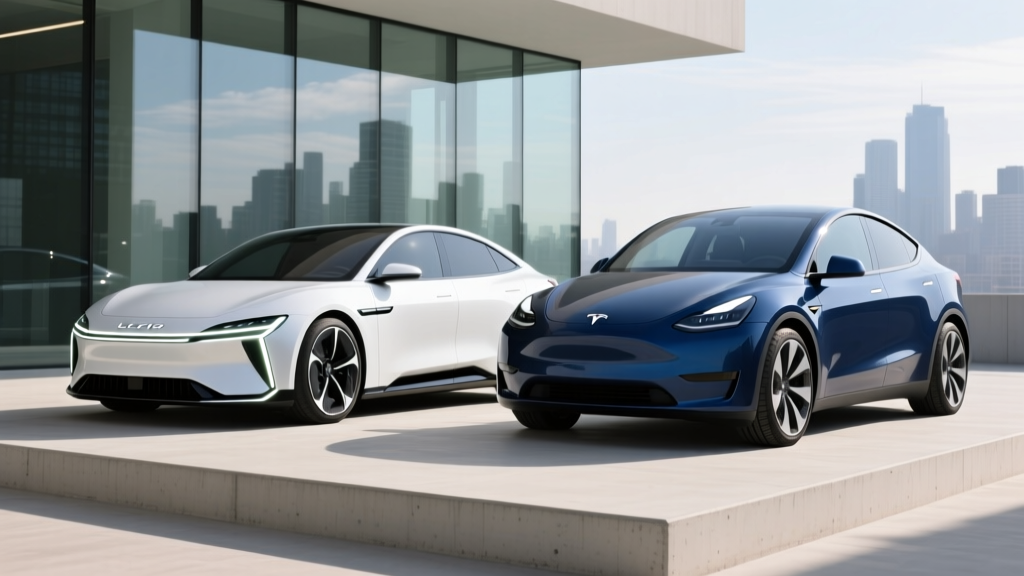
The Tesla Model Y has dominated the electric SUV segment for years, but the 2026 Lucid Gravity enters the ring with a compelling counterargument: more range, faster charging, and three-row seating in a premium package. For buyers cross-shopping these two, the decision isn't just about badges — it's about fundamentally different approaches to efficiency, space, and value. Here's the data-driven breakdown of how the Lucid Gravity stacks up against the Tesla Model Y across every metric that matters to real EV owners.
Spec Showdown: Lucid Gravity vs Tesla Model Y at a Glance
| Spec | Lucid Gravity (Grand Touring) | Tesla Model Y (Long Range AWD) |
|---|---|---|
| EPA Range | 440 miles | 320 miles |
| Battery (usable) | ~120 kWh (NMC) | ~75 kWh (NMC/LFP variant) |
| Efficiency | ~30 kWh/100 mi (est.) | 28 kWh/100 mi |
| Peak DC Charge Rate | 300+ kW | 250 kW |
| 10–80% DC Fast Charge | ~22 min | ~27 min |
| Level 2 Home Charging | 19.2 kW (~70 mi/hr) | 11.5 kW (~44 mi/hr) |
| 0–60 mph | 3.5 sec | 4.8 sec |
| Horsepower | 800+ hp (dual motor) | 384 hp (dual motor) |
| Drivetrain | AWD (dual motor) | AWD (dual motor) |
| Seating | Up to 7 (3 rows) | 5 (optional 7 in prior years) |
| Cargo (behind 2nd row) | ~60 cu ft | ~34 cu ft |
| Base MSRP | $79,900 | $44,990 |
| Battery/Powertrain Warranty | 8 yr / 100,000 mi | 8 yr / 120,000 mi |
Range and Efficiency: Lucid's Crown Jewel
Lucid Gravity Grand Touring: EPA 440 miles. Expect ~370–390 miles in mixed highway driving at 70 mph; approximately 300–330 miles in freezing temperatures with cabin heat running.
Tesla Model Y Long Range: EPA 320 miles. Expect ~270–290 miles highway; approximately 220–250 miles in sub-freezing conditions.
Lucid's efficiency engineering is the company's signature achievement. The Gravity's 900-volt architecture and miniaturized drive units deliver an SUV with sedan-rivaling energy consumption. According to fueleconomy.gov, Lucid's Air sedan platform already posts some of the highest MPGe figures in the industry, and the Gravity leverages the same powertrain philosophy with more mass to move.
The Model Y remains impressively efficient for its class — Tesla's thermal management system, including the octovalve heat pump, is among the best at minimizing cold-weather range loss. But physics favors Lucid here: a 120 kWh battery simply holds more energy, and even with the Gravity's heavier curb weight (~5,800 lbs vs ~4,400 lbs for the Model Y), the range gap is substantial.
For road-trippers who regularly cover 300+ miles between stops, the Gravity's extra 120 miles of EPA range translates to fewer charging stops and less route-planning anxiety. For daily commuters covering under 80 miles round-trip, both vehicles will go multiple days between charges, making the advantage less meaningful.
Charging Speed: 900V vs 400V Architecture
| Charging Level | Lucid Gravity | Tesla Model Y |
|---|---|---|
| Level 1 (120V / 12A) | ~3 mi/hr | ~3 mi/hr |
| Level 2 (240V / 48A–80A) | 19.2 kW / ~70 mi/hr | 11.5 kW / ~44 mi/hr |
| DC Fast Charge (peak) | 300+ kW | 250 kW |
| 10–80% DC Time | ~22 min | ~27 min |
| Charging Architecture | 900V nominal | ~400V nominal |
| Connector | NACS (native) | NACS (native) |
Lucid's 900-volt platform isn't just a marketing number — it fundamentally changes the charging curve. Higher voltage means lower current for the same power output, which reduces heat generation and lets the battery sustain peak charge rates longer. Where the Model Y begins tapering its charge rate noticeably above 50% state of charge (SoC), the Gravity holds closer to peak kW deeper into the session.
Both vehicles now use the North American Charging Standard (NACS) connector natively, meaning full access to Tesla's Supercharger network — currently over 6,000 stations and 30,000+ stalls in North America. This eliminates one of Tesla's historic advantages: proprietary infrastructure access. The Gravity also accesses Electrify America, EVgo, and other networks.
At home, the Gravity's 19.2 kW onboard charger is a standout. If your electrical panel supports a 100-amp dedicated circuit (a $500–$2,000 panel upgrade for many homes), you can add roughly 70 miles of range per hour of Level 2 charging. The Model Y's 11.5 kW max means ~44 miles per hour on a 60-amp circuit — perfectly adequate for overnight replenishment but slower for same-day turnaround scenarios.
Performance, Ride, and Drivetrain
The Gravity Grand Touring's dual-motor AWD system produces over 800 horsepower, rocketing this three-row SUV to 60 mph in approximately 3.5 seconds. That's sports-car territory in a vehicle with seating for seven. Lucid's torque vectoring and adaptive air suspension aim to deliver both track-capable dynamics and compliant highway cruising.
The Model Y Long Range AWD posts a respectable 4.8-second 0–60 time with 384 hp. It's quick by any measure, and Tesla's low center of gravity keeps body roll well-controlled. The ride quality has improved in recent refreshes with revised damping, but the Model Y still trades some compliance for sportiness — firm over broken pavement is a common owner observation.
Neither vehicle is rated for serious towing in the traditional truck sense, but the Gravity targets a 6,000-lb towing capacity (when properly equipped), while the Model Y is rated for approximately 3,500 lbs. For boat owners or those hauling small campers, the Gravity has a clear edge.
Pricing, Trims, and Federal Tax Credit Eligibility
| Item | Lucid Gravity | Tesla Model Y |
|---|---|---|
| Base Trim MSRP | $79,900 (Grand Touring) | $44,990 (Long Range AWD) |
| As-Tested / Loaded | $95,000+ (est.) | $52,000–$55,000 |
| §30D Federal Credit Eligible? | Unlikely — exceeds SUV MSRP cap | Potentially — within $80,000 SUV cap |
| Estimated Net Price (after credit) | $79,900+ | ~$37,490 (if full $7,500 applies) |
This is where the comparison gets complicated. Under current IRS §30D rules, the federal EV tax credit provides up to $7,500, but eligibility hinges on three simultaneous requirements:
- MSRP Cap: SUVs/vans/pickups must have an MSRP at or below $80,000. The Gravity Grand Touring at $79,900 sits right at the line — but options and destination charges can push it over.
- Buyer Income Cap: Modified adjusted gross income must not exceed $150,000 (single), $225,000 (head of household), or $300,000 (joint filers).
- Battery Sourcing: Critical minerals and battery components must meet phased-in domestic/free-trade-agreement sourcing thresholds that tighten each year. As of 2026, any battery components from a "foreign entity of concern" (FEOC — primarily Chinese suppliers) disqualify the vehicle entirely.
The Model Y, assembled in Fremont, California, with a U.S.-sourced battery supply chain, has historically qualified for the full or partial credit. The point-of-sale transfer option lets buyers apply the credit as an immediate discount at the dealership rather than waiting for a tax refund. Always verify current eligibility on the IRS clean vehicle credit page before purchasing, as sourcing rules and qualified-vehicle lists update frequently.
The Gravity's battery sourcing is less transparent publicly, and Lucid's lower production volumes mean its supply chain may not yet meet all FEOC-free thresholds. Buyers should confirm eligibility with Lucid directly and consult a tax professional before counting on the $7,500 offset.
Interior Space, Tech, and Daily Usability
The Gravity's three-row layout is its most obvious differentiator. With up to seven seats and approximately 60 cubic feet of cargo space behind the second row (expanding to over 100 cu ft with rows folded), it serves families that the Model Y simply cannot accommodate. The second row offers generous legroom — expect 38+ inches — and the third row is usable for adults on shorter trips, not just children.
The Model Y provides approximately 34 cubic feet behind the second row (roughly 76 cu ft total with seats folded). It's a comfortable five-seater with a minimalist interior centered on a 15.4-inch touchscreen. Previous model years offered a cramped optional third row, but it was best suited for small children.
On the technology front:
- Lucid Gravity: Features a 34-inch curved glass cockpit display spanning the dashboard, a lower touchscreen for climate and vehicle controls, wireless Apple CarPlay/Android Auto, and Lucid's DreamDrive Pro ADAS suite (adaptive cruise, lane centering, automated parking). DreamDrive is a Level 2 SAE driver-assistance system — the driver must remain engaged at all times.
- Tesla Model Y: Runs Tesla's proprietary infotainment on a single 15.4-inch center screen. No Apple CarPlay or Android Auto — Tesla's native navigation and media are the only options. Autopilot comes standard (Level 2); Full Self-Driving (Supervised) is available as a $8,000 add-on or subscription. FSD remains Level 2 — despite the name, it requires active driver supervision and does not make the vehicle autonomous.
Both Lucid DreamDrive and Tesla Autopilot/FSD are SAE Level 2 driver-assistance systems. The driver must continuously monitor the road, keep hands on or near the wheel, and be prepared to take over instantly. No consumer vehicle sold today is Level 3 or above. Only Waymo and Zoox robotaxi services operate at Level 4 in geofenced areas.
Pros and Cons: The Honest Summary
- Class-leading 440-mi EPA range
- 300+ kW DC fast charging with 900V architecture
- True 7-seat, 3-row SUV with usable adult third row
- 19.2 kW Level 2 onboard charger (fastest in class)
- 800+ hp with 3.5-sec 0–60 in a family hauler
- Air suspension for adjustable ride height
- 6,000-lb towing capacity
- $79,900+ starting price — nearly double the Model Y
- Federal tax credit eligibility uncertain (MSRP + sourcing)
- Limited service center network vs Tesla
- Brand-new model — long-term reliability unproven
- Smaller Supercharger-equivalent network (relies on EA/others)
- Higher insurance premiums expected (luxury segment)
- $44,990 base — accessible luxury pricing
- Full §30D tax credit potential (~$37,490 effective)
- Best-in-class Supercharger network access
- Proven reliability track record over multiple years
- OTA updates continuously add features
- Strong resale value and brand recognition
- 320-mi range trails Gravity by 120 miles
- Slower DC charging (250 kW peak, ~400V)
- No Apple CarPlay/Android Auto
- Firm ride quality on rough surfaces
- Only 5 seats in current configuration
- 3,500-lb towing limit
Who Should Buy Which?
- You need three rows for a family of 5+ or regularly carry adult passengers in the third row
- 400+ miles of range reduces your charging-stop anxiety on frequent road trips
- Your budget comfortably accommodates $80,000–$95,000 and you don't need the tax credit
- Fast Level 2 home charging matters (e.g., high daily mileage, limited overnight window)
- You want 6,000-lb towing for a boat or small trailer
Choose the Tesla Model Y if:
- Your budget is $45,000–$55,000 and you want to maximize the $7,500 federal tax credit
- Five seats are sufficient for your household
- Supercharger network reliability is a priority for road trips
- You value a proven platform with established service infrastructure
- You want strong resale value and lower insurance costs
Frequently Asked Questions
What is the real-world range of the Lucid Gravity?
The EPA rates the Gravity Grand Touring at 440 miles. In real-world highway driving at 70 mph in moderate temperatures, expect approximately 370–390 miles. In freezing weather with cabin heating, that drops to roughly 300–330 miles. Lucid's heat pump system helps mitigate cold-weather losses, but a ~25% reduction in extreme cold is typical for all EVs.
How fast does the Lucid Gravity charge compared to the Model Y?
The Gravity peaks above 300 kW on a compatible DC fast charger, reaching 10–80% in approximately 22 minutes. The Model Y peaks at 250 kW with a 10–80% time of roughly 27 minutes. At home on Level 2, the Gravity's 19.2 kW onboard charger adds ~70 miles per hour vs the Model Y's ~44 miles per hour at 11.5 kW.
Does the Lucid Gravity qualify for the $7,500 federal EV tax credit?
Possibly, but it's uncertain. The Gravity's $79,900 base MSRP sits at the IRS §30D SUV cap of $80,000, and options can push it over the limit. Additionally, battery sourcing must meet 2026 FEOC-free requirements. Confirm eligibility on IRS.gov and with Lucid directly before purchasing. The Model Y is more likely to qualify given its lower MSRP and established domestic supply chain.
Is the Lucid Gravity worth buying over the Tesla Model Y?
If you need three rows, maximum range, and the fastest charging available — and your budget allows it — the Gravity delivers capabilities the Model Y cannot match. If you're a five-person household prioritizing value, charging infrastructure access, and tax credit eligibility, the Model Y remains the pragmatic choice. They serve different buyer profiles more than they directly compete.
What are the biggest drawbacks of the Lucid Gravity?
Price is the primary barrier — at nearly double the Model Y's base MSRP, it's a luxury purchase. Lucid's service center network is still growing, meaning some owners may be far from a certified technician. As a first-year model, long-term reliability data doesn't yet exist. Insurance costs will likely run higher than the Model Y given the luxury segment classification and higher repair costs.
Can I use Tesla Superchargers with the Lucid Gravity?
Yes. The 2026 Gravity comes equipped with a native NACS (North American Charging Standard) port, which is the same connector used by Tesla Superchargers. You'll have full access to the Supercharger network plus Electrify America, EVgo, and other public networks.