The Lucid Gravity has arrived with a promise that few full-size electric SUVs can match: genuine three-row luxury paired with a tow rating that rivals body-on-frame trucks. With the latest 2026 software and hardware updates, Lucid has refined the Gravity's towing suite, added new trailering-assist features, and locked in EPA range figures that push past 440 miles. This review covers everything a prospective buyer needs — from real-world range expectations and charging speeds to whether the Gravity's $79,900 starting price clears the IRS §30D federal tax credit hurdles.
Lucid Gravity Towing Features Update: What Changed for 2026
Lucid's 2026 over-the-air and hardware refresh centers on making the Gravity a more capable tow vehicle without sacrificing the efficiency the brand is known for. Key updates include:
- Trailer Light Check Mode: A dedicated screen cycles through trailer running lights, brake lights, and turn signals so one person can verify the connection without a spotter.
- Tow/Haul Drive Mode with Adaptive Regen: Engaging Tow mode recalibrates regenerative braking to account for trailer mass, smoothing deceleration and reducing the "push" effect a heavy trailer exerts on a regen-heavy EV.
- Trailer Sway Mitigation: Uses the yaw-rate sensor and individual wheel braking to counteract trailer oscillation above 45 mph — a feature previously limited to the Ford F-150 Lightning and Rivian R1S.
- Integrated Brake Controller: Factory-installed 7-pin connector and proportional brake controller, eliminating the need for aftermarket wiring.
- Tow-Mirror Camera View: The 34-inch Glass Canopy display can split to show a trailer-hitch camera feed, simplifying hookups.
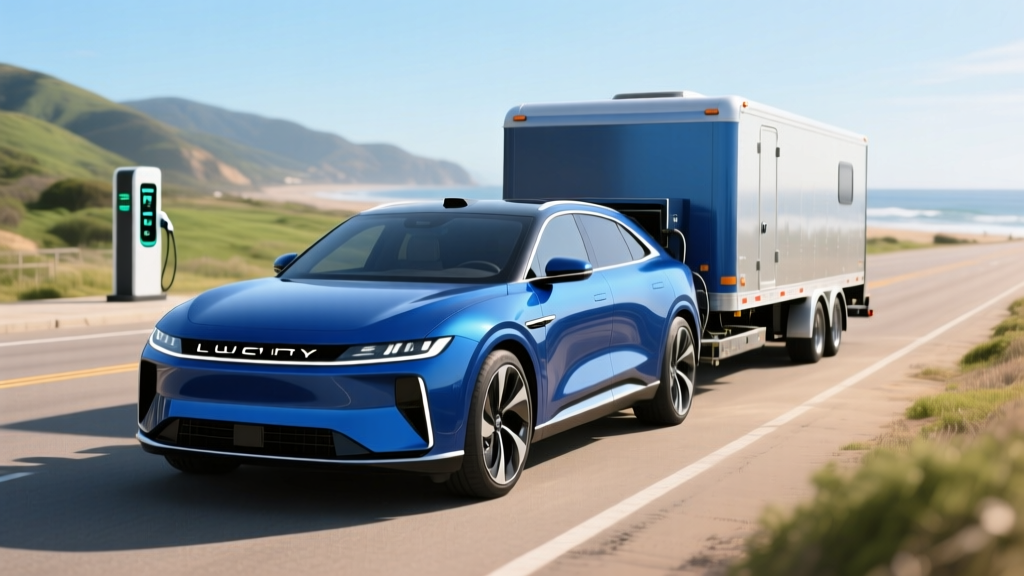
Lucid rates the Gravity at 6,000 pounds maximum tow capacity with the dual-motor AWD powertrain. That falls short of the Rivian R1S Tri-Motor's 7,700-lb rating and the F-150 Lightning's 10,000-lb peak, but it comfortably covers a two-horse trailer, a 20-foot boat, or a mid-size travel trailer.
EPA Range, Battery, and Real-World Efficiency
Real-World Expectation: Plan for ~360–380 miles on a highway-heavy road trip at 70–75 mph; towing a 5,000-lb trailer cuts range to roughly 200–230 miles depending on terrain and speed.
| Attribute | Pure (RWD) | Grand Touring (AWD) |
|---|---|---|
| EPA Range | 440 mi | 411 mi |
| Battery Capacity (usable) | 112 kWh | 112 kWh |
| Battery Chemistry | NMC (Nickel Manganese Cobalt) | NMC |
| Max DC Fast Charge | 300 kW | 300 kW |
| 10–80% DC Charge Time | ~22 min | ~22 min |
| Level 2 Home Charging | 19.2 kW (~73 mi/hr) | 19.2 kW (~73 mi/hr) |
| 0–60 mph | 5.9 sec | 3.5 sec |
| Horsepower | 480 hp | 800+ hp |
| Drivetrain | Rear-Wheel Drive | Dual-Motor AWD |
| MPGe (combined) | 116 MPGe | 107 MPGe |
| kWh/100 mi | 29 | 32 |
| Max Tow Rating | N/A (RWD not rated) | 6,000 lb |
| Base MSRP | $79,900 | $94,900 |
| Battery/Powertrain Warranty | 8 years / 100,000 miles | |
Lucid's 112-kWh NMC battery pack is among the largest in any production SUV. The NMC chemistry prioritizes energy density over the cycle-life advantage of LFP (lithium iron phosphate), which is a deliberate trade-off: you get more range per pound, but you should follow the 80% daily-charge best practice to maximize long-term health. The pack sits low in a skateboard-style architecture, contributing to the Gravity's surprisingly flat floor and car-like handling.
Efficiency is a Lucid hallmark. At 29 kWh/100 miles (Pure RWD), the Gravity outperforms the Rivian R1S (~37 kWh/100 mi) and the BMW iX xDrive50 (~35 kWh/100 mi) in energy consumption per mile. That efficiency advantage compounds on long road trips, where fewer charging stops save real time.
Charging Speed: DC Fast, Home Level 2, and the 900V Advantage
The Gravity uses Lucid's 900-volt electrical architecture — the same platform underpinning the Air sedan — which allows it to accept up to 300 kW at a compatible DC fast charger. Here's what that looks like across charging scenarios:
| Level | Power / Voltage | Speed (approx.) | Notes |
|---|---|---|---|
| Level 1 (120V) | ~1.4 kW | ~5 mi/hr | Emergency/trickle only |
| Level 2 (240V, 80A) | 19.2 kW | ~73 mi/hr | Requires hardwired 100A circuit |
| Level 2 (240V, 48A) | 11.5 kW | ~44 mi/hr | Standard NEMA 14-50 outlet |
| DC Fast (peak) | 300 kW (900V) | ~200 mi in 15 min | On 350 kW+ CCS/NACS stations |
A critical nuance for buyers: the Gravity's 19.2 kW Level 2 rate requires a hardwired wall connector on a dedicated 100-amp circuit. Most homes have 200-amp main panels, so a panel upgrade may be necessary — budget $1,500–$3,500 for that electrical work, confirmed by a licensed electrician per U.S. Department of Energy guidance.
On the DC fast-charging front, the 900V architecture delivers a tangible benefit. While many 400V SUVs (Rivian R1S, BMW iX) taper sharply above 60% State of Charge, the Gravity sustains above 200 kW deeper into the charge curve. Expect a 10–80% session in roughly 22 minutes at a 350 kW Electrify America or Tesla Supercharger (with NACS adapter) station. The taper above 80% still applies — physics demands it — but you'll spend less time lingering at the 90% top-off than you would in a 400V competitor.
Performance, Interior, and Cargo Space
The Grand Touring AWD's 800+ horsepower and 3.5-second 0–60 time put the Gravity in supercar-SUV territory, rivaling the Tesla Model X Plaid and far exceeding what any buyer needs for daily driving. The Pure RWD's 5.9-second sprint is more than adequate for highway merging and feels effortless thanks to instant electric torque.
Inside, the Gravity seats up to seven across three rows. Key dimensions:
- Cargo behind 3rd row: 27.4 cu ft
- Cargo behind 2nd row (3rd row folded): 62.8 cu ft
- Max cargo (all rear seats folded): 105.2 cu ft
- Front trunk (frunk): 11.5 cu ft
- 3rd-row legroom: 32.7 inches
- 2nd-row legroom: 39.6 inches
Third-row legroom is competitive with the Rivian R1S (34.2 in) but tighter than the Mercedes EQS SUV (34.6 in). The Gravity compensates with a flat floor and wide door openings that make ingress easier. The frunk adds meaningful grocery or charging-cable storage that most three-row competitors lack.
The 34-inch Glass Canopy curved display dominates the dashboard, running Lucid's proprietary infotainment OS. Wireless Apple CarPlay and Android Auto are standard. Driver assistance is handled by Lucid's DreamDrive Pro system, which includes adaptive cruise, lane-centering, automatic emergency braking, and a 360-degree camera suite. Important: DreamDrive Pro is a SAE Level 2 driver-assist system — the driver must remain engaged with hands on the wheel at all times. It is not autonomous or "self-driving."
Pricing, Trims, and Federal Tax Credit Eligibility
| Trim | Base MSRP | As-Tested (loaded) | §30D Credit Eligible? |
|---|---|---|---|
| Pure (RWD) | $79,900 | ~$86,000 | MSRP cap issue — SUV cap is $80,000* |
| Grand Touring (AWD) | $94,900 | ~$105,000 | No — exceeds $80,000 SUV MSRP cap |
*Under IRS §30D rules, new clean vehicles classified as SUVs must have an MSRP at or below $80,000 to qualify. The Pure trim's $79,900 base MSRP technically clears this threshold, but adding any factory options (paint, wheels, packages) pushes the MSRP above the cap. Income limits also apply: $300,000 joint / $225,000 head of household / $150,000 single filer. Battery critical-mineral and component sourcing requirements must also be met — confirm with your dealer and tax professional before assuming eligibility.
Practically speaking, most Gravity buyers will not qualify for the full $7,500 federal tax credit due to the MSRP cap and Lucid's evolving battery supply chain. State incentives vary — California's CVRP, for instance, has its own income and price caps that may also exclude the Gravity. Always check fueleconomy.gov and consult a tax professional before purchase.
Who the Lucid Gravity Suits Best
- You prioritize range above all else — 440 miles EPA is class-leading for a three-row SUV
- You want ultra-fast home charging (19.2 kW) to refill overnight from a large battery
- You need a premium interior with genuine third-row seating and a frunk
- Your towing needs stay under 6,000 lb (boat, small travel trailer, horse trailer)
- You need maximum towing — the F-150 Lightning (10,000 lb) or Rivian R1S Tri-Motor (7,700 lb) are better choices
- Tax credit eligibility is a dealbreaker — the Gravity's MSRP likely disqualifies it
- You want a proven service network — Lucid's service center footprint is still expanding compared to Tesla or BMW
Pros, Cons, and the Verdict
- Class-leading 440-mile EPA range (Pure RWD)
- 900V architecture enables 300 kW DC fast charging
- 19.2 kW Level 2 home charging fills the 112-kWh pack in ~6 hours
- Refined 2026 towing suite with integrated brake controller and sway mitigation
- Spacious three-row cabin with flat floor and 105 cu ft max cargo
- Outstanding efficiency (29 kWh/100 mi) for its size
- $79,900+ MSRP likely exceeds §30D tax credit cap for most configurations
- 6,000-lb tow rating trails Rivian R1S and F-150 Lightning
- Third-row legroom (32.7 in) is tighter than some rivals
- Lucid's service-center network is still growing — rural owners may face long tow distances
- 100A circuit required for max home charging speed — panel upgrade possible
The 2026 Lucid Gravity occupies a narrow but compelling niche: it is the longest-range three-row electric SUV on sale, and the towing-features update brings it closer to parity with the Rivian R1S for trailer-hitch duty. If your priority is maximizing miles between charges while carrying a family in genuine luxury, the Gravity Pure RWD at $79,900 is difficult to beat. If you need to tow heavy or want a vehicle that might qualify for the full federal tax credit, the Rivian R1S Dual-Motor ($75,900, eligible configurations available) or a well-equipped Ford F-150 Lightning remain the pragmatic alternatives.
Frequently Asked Questions
What is the real-world range of the 2026 Lucid Gravity?
The EPA rates the Gravity Pure RWD at 440 miles and the Grand Touring AWD at 411 miles. In real-world highway driving at 70–75 mph, expect roughly 360–380 miles. Cold weather (below 32°F) can reduce range by 15–25%, bringing the effective range to approximately 290–330 miles on a full charge. Towing a 5,000-lb trailer cuts range to roughly 200–230 miles.
How fast does the Lucid Gravity charge?
At a 350 kW DC fast charger, the Gravity peaks at 300 kW and charges from 10–80% in approximately 22 minutes, adding roughly 200 miles in 15 minutes. At home, the 19.2 kW Level 2 rate (requiring a 100A circuit) refills the 112-kWh battery in about 6 hours. On a standard 48A NEMA 14-50 outlet, expect about 44 miles of range per hour of charging.
Does the Lucid Gravity qualify for the federal EV tax credit?
The Pure RWD's $79,900 base MSRP technically falls under the $80,000 SUV cap for the IRS §30D credit, but adding any factory options pushes it above the limit. The Grand Touring at $94,900 is ineligible. Buyer income caps ($300K joint / $150K single), battery-sourcing requirements, and point-of-sale transfer rules also apply. Confirm with your dealer and a tax professional before relying on the credit.
Is the Lucid Gravity worth buying vs the Rivian R1S?
The Gravity wins on range (440 vs ~352 miles EPA) and charging speed (300 kW vs ~200 kW peak). The R1S wins on tow rating (7,700 vs 6,000 lb), off-road capability, and potentially better tax-credit eligibility at lower trims. If range and efficiency are your top priorities, the Gravity is the pick. If you tow heavy or want adventure-vehicle capability, the R1S is stronger.
What is the Lucid Gravity's warranty coverage?
Lucid covers the battery and powertrain for 8 years or 100,000 miles, whichever comes first. The battery warranty guarantees a minimum capacity retention (typically 70% State of Health) over that period. The limited vehicle warranty is 5 years / 60,000 miles. These terms are competitive with Tesla (8 yr/120,000 mi for Model X) and Rivian (8 yr/175,000 mi for R1S battery).
What are the biggest drawbacks of the Lucid Gravity?
The main limitations are price (tax credit unlikely), a 6,000-lb tow rating that trails body-on-frame competitors, a still-expanding Lucid service network, and the need for a costly 100-amp home circuit to unlock the full 19.2 kW Level 2 charging speed. Third-row legroom is also slightly tighter than the Mercedes EQS SUV.