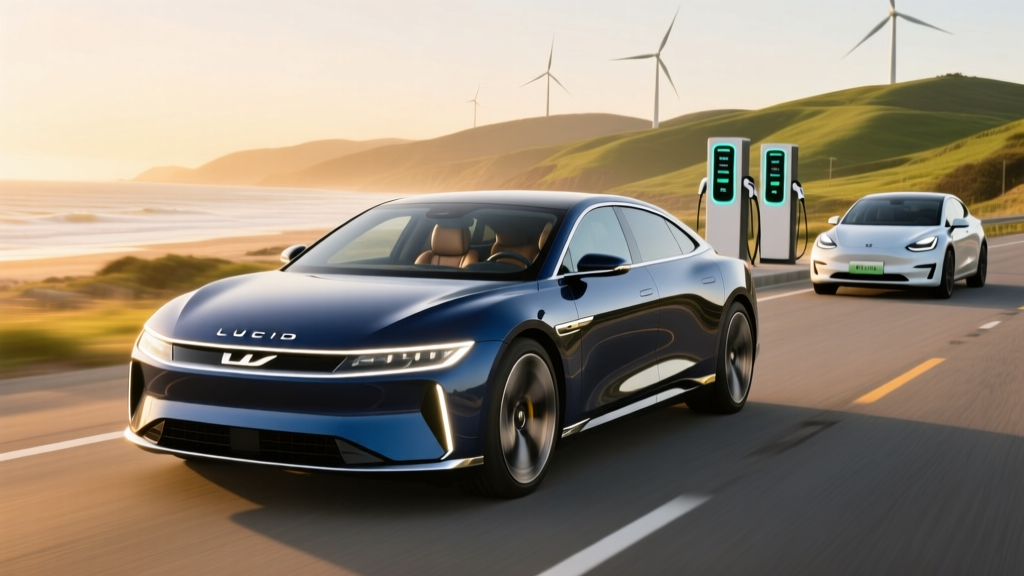
The 2026 Lucid Gravity Touring arrives as the more accessible variant of Lucid's flagship three-row electric SUV. Starting at $79,900 (including destination), the Touring trim ditches the 1,025-horsepower dual-motor setup of the Grand Touring for a single-motor rear-wheel-drive powertrain that still produces 420 horsepower. But the real story is efficiency: Lucid claims an EPA-estimated 440 miles of range from a ~112 kWh usable NMC battery pack — a figure that, if validated, would make it the longest-range three-row electric SUV on the market.
The keyword question in EV forums and buyer groups keeps circling back: how does the Lucid Gravity Touring compare to more affordable EVs like the Tesla Model X, Rivian R1S, or the Kia EV9? The answer depends entirely on what you value — maximum range and luxury, or practicality and price. This review breaks down every spec that matters.
| Spec | Value |
|---|---|
| EPA Est. Range | 440 miles (Touring RWD) |
| Battery (Usable) | ~112 kWh, NMC chemistry |
| Drivetrain | Rear-Wheel Drive (single motor) |
| Horsepower | 420 HP |
| 0-60 mph | 5.5 seconds (est.) |
| Max DC Fast Charge | 300 kW (peak) |
| 10-80% DC Charge | ~22 minutes |
| Level 2 Home Charge | 19.2 kW (~82 mi/hr) |
| Efficiency | ~118 MPGe / 28 kWh/100mi (est.) |
| Seating | Up to 7 passengers |
| Cargo (behind 3rd row) | ~28 cu ft |
| Cargo (max, seats folded) | ~112 cu ft |
| Base MSRP | $79,900 |
| Federal Tax Credit (§30D) | Up to $7,500 (eligibility varies) |
| Battery/Powertrain Warranty | 8 years / 100,000 miles |
Real-World Range: What 440 EPA Miles Actually Means on the Road
EPA Sticker: 440 miles (Touring RWD)
Real-World Expectation:
- City / mixed driving (65°F): ~400-430 miles achievable with moderate regen
- Highway at 75 mph (70°F): ~340-370 miles — aerodynamic drag cuts efficiency ~15-20%
- Cold weather (30°F, highway): ~280-320 miles — NMC packs lose 20-30% in freezing temps without consistent preconditioning
- Towing (5,000 lb trailer): ~200-230 miles — expect roughly half the EPA rating
Lucid's efficiency advantage comes from its proprietary powertrain architecture, which uses a miniaturized motor and inverter design first proven in the Air sedan. The Gravity Touring's single-motor RWD layout reduces parasitic drivetrain losses compared to the dual-motor Grand Touring, and the ~112 kWh NMC (nickel manganese cobalt) pack delivers high energy density without the weight penalty of competing 120+ kWh packs.
For context, the Tesla Model X Long Range achieves an EPA 335 miles from a ~100 kWh pack, while the Rivian R1S Dual-Motor Max lands around 390 miles on a 149 kWh pack — heavier and less efficient per kWh. The Gravity Touring's 440-mile figure, if it holds in EPA certification, represents a genuine efficiency milestone for a vehicle this size.
One caveat for buyers in northern climates: NMC chemistry is more susceptible to cold-weather range loss than LFP (lithium iron phosphate). The Gravity's thermal management system includes a heat pump and battery preconditioning, which mitigates the worst of winter degradation — but plan for 280-320 miles on a freezing highway run, not 440.
Charging Speed: 300 kW Peak, but Mind the Curve
| Level | Power / Rate | Miles Added per Hour | Notes |
|---|---|---|---|
| Level 1 (120V) | ~1.4 kW | ~5 mi/hr | Emergency / trickle only |
| Level 2 (240V, 48A) | 11.5 kW | ~41 mi/hr | Standard home charger |
| Level 2 (240V, 80A) | 19.2 kW | ~82 mi/hr | Requires hardwired 100A circuit |
| DC Fast (peak) | 300 kW | N/A | Sustained only below ~40% SoC |
| DC Fast (10-80%) | ~200 kW avg | N/A | ~22 minutes on 350 kW station |
The Gravity Touring supports a peak DC fast-charge rate of 300 kW on compatible 350 kW chargers (Electrify America, EVgo, Tesla Supercharger V4 with NACS adapter). In practice, that peak rate is available roughly between 10-40% state of charge. The charging curve tapers progressively: expect ~220 kW at 50% SoC, ~150 kW at 65%, and ~80 kW by 80%. This is standard behavior for NMC packs with active thermal management, and the Gravity's curve is competitive with the Hyundai Ioniq 9 and Kia EV9 GT-Line.
For a 10-80% session, budget roughly 22 minutes at a 350 kW station. On a 150 kW charger — still the most common DC fast-charger tier in the US — that stretches to ~35-40 minutes. Plan road-trip stops accordingly.
At home, the Gravity's onboard charger accepts up to 19.2 kW on a 240V / 80A hardwired Level 2 circuit. That's roughly 82 miles of range per hour of charging, meaning a full 10-100% replenishment takes about 6 hours. Most owners on a standard 48A Level 2 (11.5 kW) will see ~41 mi/hr — adequate for overnight top-ups. A 100-amp electrical panel may need upgrading to support 80A charging; budget $1,500-$3,000 for that work if needed.
Performance, Ride, and Drivetrain Character
The Touring's single rear-mounted motor delivers 420 horsepower and an estimated 0-60 mph time of 5.5 seconds. That's brisk for a three-row SUV weighing approximately 5,800 lbs, but it's a deliberate step down from the Grand Touring's 828 HP and 3.5-second sprint. Lucid's positioning is clear: Touring is for buyers who prioritize range and value over supercar acceleration.
Ride quality benefits from the standard air suspension, which adjusts ride height by up to 2.5 inches. In "Low" mode on the highway, the Gravity hunkers down for improved aerodynamics (contributing to that 440-mile EPA figure). In "High" mode, ground clearance reaches approximately 8.5 inches — enough for light off-pavement use, though this is not an off-road SUV. The air suspension also enables a self-leveling feature when towing, maintaining consistent ride height regardless of trailer tongue weight.
Regenerative braking is adjustable via the 34-inch curved glass cockpit display, with three levels plus a "one-pedal" mode that brings the vehicle to a full stop. The brake-by-wire system blends regen and friction braking smoothly — a common pain point in competing EVs that Lucid has largely solved.
Interior Space, Cargo, and Technology
The Gravity seats up to seven passengers in a 2-3-2 configuration (optional six-seat layout with second-row captains chairs). Third-row legroom measures approximately 30 inches — tight for adults on long trips but adequate for children or short errands. Second-row legroom is generous at ~40 inches. Front seats offer ~42 inches of legroom with ample bolstering.
Cargo volume behind the third row is approximately 28 cubic feet, expanding to ~62 cu ft with the third row folded and ~112 cu ft with both rear rows down. A front trunk (frunk) adds roughly 12 cu ft of lockable storage — a significant advantage over the Tesla Model X, which offers no frunk.
The infotainment system runs on Lucid's proprietary EV platform software displayed across a 34-inch curved glass cockpit (dubbed the "Clearview" display). Wireless Apple CarPlay and Android Auto are standard. The center stack features a retractable lower touchscreen for climate and media controls that slides up when needed and retracts to create a shelf — a clever space-saving design. A 21-speaker Surreal Sound Pro audio system (by Dolby Atmos) is available on higher trims.
Driver assistance comes via Lucid's DreamDrive Pro system, which uses a suite of cameras, radar, and lidar sensors. It offers adaptive cruise control, lane-centering, automatic lane changes, and a highway assist mode. Important: DreamDrive Pro is an SAE Level 2 driver-assist system — the driver must remain fully engaged with hands on or near the wheel at all times. This is not autonomous driving.
Pricing, Tax Credits, and Total Cost
| Trim | Base MSRP | Federal Credit (§30D) | Effective Price* |
|---|---|---|---|
| Pure (base, upcoming) | ~$69,900 (announced) | Up to $7,500 | ~$62,400 |
| Touring (RWD) | $79,900 | Up to $7,500 | ~$72,400 |
| Grand Touring (AWD) | $94,900 | Up to $7,500 | ~$87,400 |
*Effective price assumes full §30D credit eligibility. Actual credit depends on battery sourcing, buyer income, and MSRP caps. See IRS rules below.
The Gravity Touring at $79,900 sits well below the IRS §30D MSRP cap of $80,000 for SUVs and light trucks. However, qualifying for the full $7,500 federal tax credit requires meeting several conditions that change frequently:
- Buyer income caps: AGI must not exceed $150,000 (single), $225,000 (head of household), or $300,000 (joint filers) — per IRS §30D guidelines.
- Battery sourcing: A percentage of critical minerals and battery components must be sourced from the US or free-trade-agreement countries. These thresholds increase annually.
- Point-of-sale transfer: As of 2024, buyers can transfer the credit to the dealer at purchase, reducing the upfront cost rather than waiting for a tax refund.
- Assembly: The Gravity is assembled at Lucid's AMP-1 facility in Casa Grande, Arizona, meeting the North American final-assembly requirement.
The base Pure trim (announced at ~$69,900) is not yet available for delivery as of early 2026 — it remains a future model year offering. Buyers shopping today will encounter Touring and Grand Touring inventory. Consult a tax professional before assuming full credit eligibility; battery-sourcing rules have disqualified many EVs mid-year in prior cycles.
How the Gravity Touring Compares to Affordable Three-Row EVs
The "affordable EVs" conversation in the three-row SUV segment centers on three competitors:
| Spec | Lucid Gravity Touring | Tesla Model X LR | Kia EV9 GT-Line AWD | Rivian R1S Dual-Motor Max |
|---|---|---|---|---|
| Base MSRP | $79,900 | $79,990 | $73,900 | $84,900 |
| EPA Range | 440 mi | 335 mi | 280 mi | 390 mi |
| Battery (kWh) | ~112 NMC | ~100 NMC | 99.8 NMC | 149 NMC |
| Peak DC Charge | 300 kW | 250 kW | 238 kW | 220 kW |
| 10-80% Time | ~22 min | ~28 min | ~24 min | ~30 min |
| 0-60 mph | 5.5 sec | 3.8 sec | 5.0 sec | 4.5 sec |
| Seating | 7 | 6-7 | 6-7 | 7 |
| Towing Capacity | 6,000 lbs | 5,000 lbs | 5,000 lbs | 7,700 lbs |
The Gravity Touring wins on range and charging speed. The Kia EV9 undercuts it by $6,000 but sacrifices 160 miles of range. The Model X matches the price but trails by 105 miles and charges slower. The Rivian R1S excels at towing and off-road capability but costs $5,000 more with less range.
Choose the Lucid Gravity Touring if:
- Maximum range is your top priority (440 mi is best-in-class)
- You road-trip frequently and want the shortest DC fast-charge stops
- You value a premium interior with air suspension and a frunk
Choose a competitor if:
- You need serious towing (Rivian R1S at 7,700 lbs)
- Budget is tight (Kia EV9 starts at ~$73,900 with decent range)
- You want the fastest 0-60 time in the segment (Model X at 3.8 sec)
- You need proven Supercharger network access without an adapter (Tesla)
Warranty and Long-Term Ownership
Lucid covers the Gravity's battery and powertrain for 8 years or 100,000 miles, whichever comes first. The battery warranty guarantees a minimum of 70% capacity retention over that period — consistent with industry norms from Tesla, Rivian, and Hyundai. The vehicle limited warranty is 4 years / 50,000 miles.
For long-term ownership, NMC chemistry typically shows 10-15% degradation over 150,000 miles based on fleet data from comparable packs. The Gravity's oversized 112 kWh battery provides a buffer: even at 85% state of health after 150,000 miles, usable range would remain above 370 miles — more than most owners need.
Insurance premiums for the Gravity are expected to run 15-25% higher than a comparably priced gas SUV, reflecting repair-cost data for aluminum-intensive EV structures. Get quotes before purchase.
Pros, Cons, and Verdict
Pros
- Best-in-class 440-mile EPA range for a three-row SUV
- 300 kW peak DC charging — among the fastest in the segment
- Air suspension with self-leveling for towing
- Spacious frunk (12 cu ft) rare in this class
- US-assembled (Arizona) — meets §30D assembly requirement
- 19.2 kW Level 2 onboard charger enables fast home replenishment
Cons
- $79,900 starting price — not truly "affordable" despite Touring positioning
- Single-motor RWD only on Touring — no AWD option at this trim
- Lucid's service center network is still limited vs. Tesla or legacy OEMs
- NMC battery more vulnerable to cold-weather range loss than LFP alternatives
- DreamDrive Pro (Level 2) lags behind Tesla FSD and GM Super Cruise in highway coverage
- Pure trim ($69,900) not yet available — limits budget-conscious buyers
The 2026 Lucid Gravity Touring is the range king of three-row electric SUVs, and its charging speed backs up the efficiency claims. If the $79,900 price works within your budget and you can confirm §30D eligibility with your tax advisor, it's the most compelling long-distance family EV hauler currently on the market. Buyers who need AWD, off-road chops, or a sub-$70,000 price should look to the Rivian R1S, Kia EV9, or wait for the Gravity Pure.
Frequently Asked Questions
What is the real-world range of the Lucid Gravity Touring?
The EPA estimates 440 miles, but real-world results vary significantly. Expect ~400-430 miles in mild city/mixed driving, ~340-370 miles at sustained highway speeds, and ~280-320 miles in freezing temperatures. Towing a trailer cuts range roughly in half to ~200-230 miles.
How fast does the Gravity Touring charge at home and on the road?
On a 350 kW DC fast charger, it peaks at 300 kW and charges from 10-80% in approximately 22 minutes. At home on a 240V / 80A Level 2 circuit, it accepts 19.2 kW, adding about 82 miles of range per hour. A standard 48A Level 2 adds ~41 miles per hour.
Does the Lucid Gravity Touring qualify for the $7,500 federal EV tax credit?
It likely qualifies for at least partial credit, but full §30D eligibility depends on your income (AGI caps apply), the battery's critical-mineral and component sourcing (thresholds tighten annually), and the $80,000 MSRP cap for SUVs — which the $79,900 Touring barely meets. Always verify current-year rules at irs.gov and consult a tax professional before purchasing.
Is the Gravity Touring worth it versus the Tesla Model X or Kia EV9?
If range and charging speed are your priorities, the Gravity Touring's 440-mile EPA rating and 300 kW charging are unmatched in the segment. The Model X offers faster acceleration and Supercharger access but less range. The Kia EV9 costs $6,000 less but gives up 160 miles of range. For road-trippers, the Gravity is the strongest pick.
Can I get all-wheel drive on the Gravity Touring?
No. The Touring trim is rear-wheel drive only with a single motor. AWD is available on the Grand Touring ($94,900) with dual motors producing 828 HP. If you need AWD for snow or traction, you'll need to step up in price.
How does the Gravity's battery hold up over time?
The NMC pack is warranted for 8 years / 100,000 miles at a minimum 70% capacity retention. Based on fleet data from similar NMC packs, expect ~10-15% degradation over 150,000 miles. Because the Gravity starts with a massive 112 kWh pack, even degraded range remains well above 370 miles.