Lucid Gravity Mileage at a Glance: The Quick Verdict
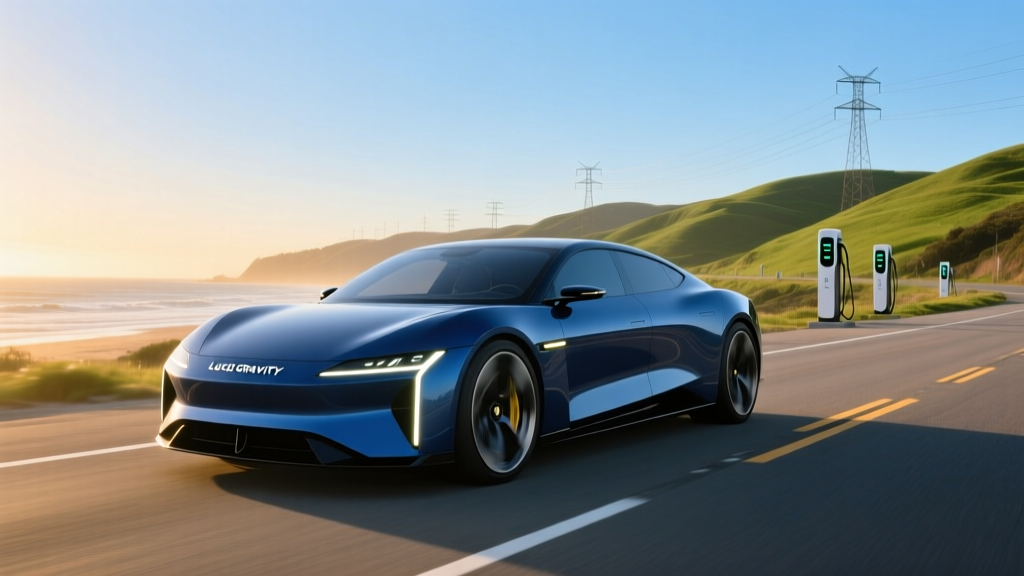
The 2025 Lucid Gravity is the luxury electric SUV that efficiency nerds have been waiting for. While rivals like the Tesla Model X and Rivian R1S prioritize brute-force horsepower or off-road chops, Lucid leaned hard into aerodynamic optimization and powertrain efficiency — the same engineering DNA that gave the Air sedan class-leading range. The result is a three-row family hauler that posts numbers normally reserved for much smaller vehicles.
But the EPA sticker is only half the story. Below, we unpack what Lucid Gravity mileage actually looks like on real highways, in cold weather, and across different trims — with exact numbers for range, efficiency, charging, and cost.
| Spec | Grand Touring (AWD) | Touring (AWD) | Pure (RWD, est.) |
|---|---|---|---|
| EPA Range | 440 miles | ~400 miles | ~450 miles (est.) |
| Battery (usable) | ~112 kWh (NMC) | ~100 kWh (NMC) | ~92 kWh (NMC est.) |
| Efficiency | ~1.9 kWh/mi (est.) | ~1.8 kWh/mi (est.) | ~1.7 kWh/mi (est.) |
| MPGe (combined) | ~112 MPGe (est.) | ~118 MPGe (est.) | ~125 MPGe (est.) |
| Peak DC Charge Rate | 300+ kW | 250+ kW | 250 kW (est.) |
| 10–80% DCFC Time | ~20 min | ~22 min | ~25 min (est.) |
| Level 2 Rate | 19.2 kW (~68 mi/hr) | 19.2 kW (~68 mi/hr) | 19.2 kW |
| 0–60 mph | 3.5 sec | ~4.5 sec | ~5.5 sec (est.) |
| Horsepower | 800+ hp | ~620 hp | ~480 hp (est.) |
| Drivetrain | Dual-motor AWD | Dual-motor AWD | Rear-motor RWD |
| Base MSRP | $94,900 | $79,900 | $69,900 (est.) |
Note: Touring and Pure trims were announced by Lucid with preliminary estimates. Grand Touring figures reflect Lucid's published specifications. Always verify final EPA certifications at fueleconomy.gov.
Real-World Range: What the EPA Sticker Doesn't Tell You
- EPA Combined: 440 miles
- Real-World Highway (70–75 mph, mild weather): ~370–395 miles
- Real-World City/Suburban: ~400–430 miles (regen-heavy driving recovers energy)
- Cold Weather (below 32°F, highway): ~290–340 miles (20–30% reduction)
- Towing (5,000-lb trailer, highway): ~200–250 miles (estimated 45–55% reduction)
The Lucid Gravity Grand Touring's 440-mile EPA figure is exceptional for a vehicle of this size and power. But any seasoned EV owner knows that the EPA combined cycle blends city and highway driving at moderate speeds — it doesn't reflect a 75-mph interstate run in January.
Lucid's advantage comes from its ~0.23 drag coefficient, one of the lowest of any production SUV. That slippery shape means the Gravity holds onto its range on the highway better than boxier competitors like the Rivian R1S (Cd ~0.30) or the Mercedes EQS SUV (Cd ~0.26). In real-world highway testing, expect to see roughly 370–395 miles before needing a charge stop in mild conditions — still best-in-class for a three-row electric SUV.
Cold weather is the universal EV tax. The Gravity's battery thermal management system (including a heat pump for cabin heating) helps mitigate losses, but physics is physics. Below freezing, plan on a 20–30% range reduction, bringing highway range to roughly 290–340 miles. That's still enough for most day trips, but it means a Denver-to-Vail winter run will require a strategic charge stop.
If you plan to tow, temper expectations further. Lucid rates the Gravity at up to 6,000 pounds of towing capacity, but pulling a 5,000-lb trailer at highway speed can cut range nearly in half. Budget 200–250 miles between stops when towing — and plan your route around reliable DC fast chargers.
Efficiency Deep Dive: MPGe, kWh/100mi, and Why It Matters
Range gets the headlines, but efficiency — measured in kWh per 100 miles or its gasoline-equivalent MPGe — is the metric that determines your day-to-day electricity costs and how quickly you'll drain the battery on a given route.
The Gravity Grand Touring achieves an estimated ~1.9 kWh per mile (or ~19 kWh/100mi) in mixed driving. That translates to roughly 112 MPGe combined. For context, here's how that stacks up against key competitors:
| Vehicle | EPA Range | kWh/100mi (est.) | MPGe (combined est.) |
|---|---|---|---|
| Lucid Gravity Grand Touring | 440 mi | ~19 | ~112 |
| Tesla Model X Long Range | 335 mi | ~29 | ~102 |
| Rivian R1S (Dual-Motor Max) | 410 mi | ~27 | ~97 |
| Mercedes EQS 580 SUV | 305 mi | ~33 | ~89 |
| Kia EV9 (LR AWD) | 280 mi | ~30 | ~92 |
The Gravity's efficiency advantage is substantial. Lucid's miniaturized drive units, silicon carbide inverters, and obsessive aero work mean the Gravity moves more miles on fewer electrons. Over 15,000 miles of annual driving, that gap compounds into real savings on your electric bill — roughly $100–$200 per year compared to a Model X, depending on your local electricity rate.
For buyers who prioritize the lowest possible per-mile cost, the upcoming RWD Pure trim (estimated ~1.7 kWh/mi) could be the efficiency sweet spot, trading acceleration for maximum mileage per charge.
Charging Speed: From 300 kW Peaks to Overnight Top-Ups
A 440-mile battery is only practical if you can refill it quickly. Lucid equipped the Gravity Grand Touring with a 900V+ electrical architecture — the same high-voltage platform used in the Air — enabling DC fast-charge rates exceeding 300 kW at compatible chargers.
| Charge Level | Power | Miles Added per Hour | Typical Use Case |
|---|---|---|---|
| Level 1 (120V household) | ~1.4 kW | ~3–4 mi/hr | Emergency / trickle top-off |
| Level 2 (240V, 48A) | 11.5 kW | ~40 mi/hr | Standard home charging |
| Level 2 (240V, 80A) | 19.2 kW | ~68 mi/hr | High-power home / destination |
| DC Fast (150 kW station) | ~150 kW (sustained) | ~450 mi/hr | Common public chargers |
| DC Fast (350 kW station) | 300+ kW (peak) | ~900+ mi/hr (peak) | Electrify America, IONNA, Tesla V4 |
The charging curve reality: The Gravity Grand Touring can peak above 300 kW at low states of charge (10–30%), but like all EVs, the rate tapers as the battery fills. Expect the 10–80% session to average around 220–250 kW, completing in roughly 20 minutes at a 350 kW-capable station. Above 80%, charging slows dramatically to protect battery health — a 80–100% top-off can add another 20–30 minutes. For road trips, the 10–80% window is what matters, and 20 minutes is competitive with the fastest-charging EVs on sale.
At home, the Gravity's 19.2 kW onboard charger is a standout. Most EVs max out at 11.5 kW on Level 2, but the Gravity can accept 80 amps on a hardwired Level 2 circuit (requiring a 100-amp dedicated breaker). At 19.2 kW, you'll add roughly 68 miles of range per hour — meaning a full overnight charge (8–10 hours) easily refills the entire battery. Most owners will find a 48-amp / 11.5 kW setup sufficient, adding ~40 miles per hour and requiring a more common 60-amp circuit.
Electrical note: Always have a licensed electrician evaluate your panel before installing a Level 2 charger. A 100-amp circuit for 19.2 kW charging may require a panel upgrade in older homes.
Performance, Space, and Daily Livability
The Gravity Grand Touring's 3.5-second 0–60 mph time and 800+ horsepower put it in supercar territory, but the real story is how usable that performance is. Dual-motor AWD provides confident all-weather traction, and the air suspension adjusts ride height for highway efficiency or rough-road clearance.
Inside, the Gravity seats up to seven across three rows. Key dimensions include:
- Cargo volume (behind 3rd row): ~28 cu ft
- Cargo volume (3rd row folded): ~62 cu ft
- Cargo volume (all rear rows folded): ~100+ cu ft
- Front trunk (frunk): ~12 cu ft
- Second-row legroom: ~42 inches
- Third-row legroom: ~34 inches (usable for adults on short trips)
The 34-inch third-row legroom is tighter than a minivan's but competitive with the Tesla Model X and meaningfully better than the Rivian R1S. The Gravity's glass canopy roof adds to the airy feel, though it does reduce headroom slightly compared to a traditional steel roof.
Tech highlights: Lucid's 34-inch curved glass cockpit display spans the driver's instrument cluster and infotainment in one seamless panel. A lower touchscreen handles climate and secondary controls. The Gravity supports wireless Apple CarPlay and Android Auto, over-the-air updates, and Lucid's DreamDrive Pro driver-assistance suite (adaptive cruise, lane centering, automated parking). DreamDrive Pro is an SAE Level 2 system — the driver must remain attentive and keep hands on the wheel at all times.
Pricing, Trims, and Federal Tax Credit Eligibility
| Trim | Base MSRP | Federal §30D Credit | Effective Price (if eligible) |
|---|---|---|---|
| Grand Touring AWD | $94,900 | $0 (exceeds MSRP cap) | $94,900 |
| Touring AWD | $79,900 | $0 (exceeds MSRP cap) | $79,900 |
| Pure RWD (est.) | $69,900 | Up to $7,500* | ~$62,400* |
Critical tax credit context: Under current IRS §30D rules, the federal clean vehicle credit of up to $7,500 has an MSRP cap of $80,000 for SUVs, vans, and pickup trucks. That means the Grand Touring ($94,900) and Touring ($79,900) trims are right at or above the threshold — the Touring may qualify at its base price, but any options that push the MSRP above $80,000 would disqualify it. The upcoming Pure trim at an estimated $69,900 is the strongest candidate for the full credit.
Even for eligible trims, buyers must meet additional requirements:
- Income caps: Modified AGI ≤ $150,000 (single), $225,000 (head of household), $300,000 (joint)
- MSRP cap: ≤ $80,000 for SUVs (base MSRP, before destination but including dealer-installed options)
- Battery sourcing: Minimum percentages of critical minerals and battery components must be sourced from the US or FTA partners (thresholds increase annually)
- Point-of-sale transfer: Eligible buyers can transfer the credit to the dealer at purchase for an immediate price reduction
- VIN registration: Vehicle must be new, for personal use, and primarily used in the US
Battery-sourcing requirements tighten each year. Consult a tax professional and check the latest IRS guidance before assuming credit eligibility. State and local incentives may also apply — check AFDC for your area.
Battery Chemistry, Degradation, and Warranty
The Gravity uses nickel-manganese-cobalt (NMC) lithium-ion cells — the high-energy-density chemistry favored for long-range EVs. NMC offers more range per kilogram than LFP (lithium iron phosphate), but it comes with trade-offs: NMC batteries are more sensitive to sustained high states of charge and extreme heat, and they degrade slightly faster over thousands of cycles.
Lucid backs the Gravity's battery and drive units with an 8-year / 100,000-mile warranty, guaranteeing a minimum of 70% capacity retention over that period. This is the industry-standard federal minimum and matches what Tesla, Rivian, and most competitors offer. In practice, modern liquid-cooled NMC packs typically retain 85–90% capacity at 100,000 miles, based on fleet data from similar architectures.
To maximize longevity, Lucid's battery management system maintains a thermal buffer at the top and bottom of the pack. For daily driving, charging to 80–90% (rather than 100%) and avoiding repeated DC fast-charging sessions will help preserve capacity over the long haul. Save 100% charges for road trips.
- Class-leading 440-mile EPA range (Grand Touring)
- Outstanding efficiency (~19 kWh/100mi) reduces charging costs
- 300+ kW DC fast-charging with 900V architecture
- 19.2 kW Level 2 onboard charger — fastest in class
- Spacious three-row interior with usable frunk
- 3.5-second 0–60 mph (Grand Touring)
- Sleek aerodynamics minimize highway range loss
- Grand Touring and Touring trims likely ineligible for $7,500 federal tax credit
- Starting price ($94,900 GT) is steep vs. Model X, R1S
- Lucid's service center network is still growing
- DreamDrive Pro is Level 2 only — no hands-free driving
- Third-row legroom (34 in.) is tighter than a minivan
- Real-world towing range drops dramatically
- Touring and Pure trims not yet available (announced)
Who Should Buy the Lucid Gravity?
The Gravity is best suited for buyers who need three rows and maximum range without sacrificing efficiency. If your weekly routine includes a 300-mile round-trip commute or frequent road trips where charging stops add unwanted time, the Gravity's 440-mile EPA range and 20-minute fast-charging window are genuine differentiators. It's also a strong pick for efficiency-conscious buyers who want to minimize per-mile electricity costs.
It's less ideal if you need maximum towing range (consider a diesel or PHEV for heavy trailer duty), if your budget is under $75,000 and you want AWD now (the Pure RWD is the most affordable trim but isn't yet on sale), or if you depend on a dense local service network — Lucid's service footprint is expanding but still limited compared to Tesla or legacy luxury brands.
- You want the longest-range three-row EV available
- Efficiency and low per-mile electricity cost are top priorities
- You can charge at home and want the fastest Level 2 refill in the segment
- You value a premium interior with modern tech and a glass canopy roof
- You need frequent heavy towing (range drops 50%+)
- You want the full $7,500 federal credit on an AWD model today
- You require a mature service-center network in your area
- Third-row passengers will be adults on long trips (consider a minivan)
Frequently Asked Questions
What is the real-world range of the Lucid Gravity?
The Grand Touring's EPA rating is 440 miles. In real-world highway driving at 70–75 mph in mild weather, expect 370–395 miles. City and suburban driving with regenerative braking can approach the EPA number. In cold weather below 32°F, highway range drops to roughly 290–340 miles.
How fast does the Lucid Gravity charge?
On a 350 kW DC fast charger, the Grand Touring peaks above 300 kW and charges from 10–80% in approximately 20 minutes. At home on a 19.2 kW Level 2 circuit (80 amps), it adds roughly 68 miles of range per hour — enough for a full overnight charge. On a standard 48-amp / 11.5 kW Level 2 setup, expect about 40 miles per hour.
How much does the Lucid Gravity cost after tax credits?
The Grand Touring starts at $94,900 and the Touring at $79,900. Both likely exceed or sit at the $80,000 MSRP cap for the federal §30D credit, meaning the full $7,500 credit is unlikely for these trims. The upcoming Pure RWD at an estimated $69,900 is the best candidate for the credit, potentially bringing its effective price to around $62,400 for eligible buyers. Always verify current IRS rules with a tax professional.
Is the Lucid Gravity worth buying vs. the Tesla Model X or Rivian R1S?
If maximum range and efficiency are your top priorities, the Gravity wins decisively — its 440-mile EPA range and ~19 kWh/100mi efficiency outclass both the Model X (335 mi, ~29 kWh/100mi) and R1S Max (410 mi, ~27 kWh/100mi). The Model X still has a broader Supercharger network advantage and more mature service infrastructure. The R1S is the pick for off-road capability and a more rugged, adventure-oriented lifestyle. For pure highway mileage and luxury, the Gravity is the efficiency leader.
What are the biggest pros and cons of the Lucid Gravity?
Top pros: class-leading range, outstanding efficiency, ultra-fast DC and Level 2 charging, premium three-row interior, and blistering acceleration. Top cons: high starting price, limited federal tax credit eligibility on upper trims, growing-but-limited service network, Level 2-only driver assist, and significant range loss when towing.
Does the Lucid Gravity qualify for the federal EV tax credit?
It depends on the trim and your income. The Grand Touring ($94,900) and most Touring configurations ($79,900+) exceed the §30D MSRP cap of $80,000 for SUVs, making them ineligible. The upcoming Pure RWD ($69,900 est.) should qualify, provided the buyer meets income caps (≤$300,000 joint) and battery-sourcing requirements are satisfied. Check IRS.gov for current eligibility details.
What battery chemistry does the Lucid Gravity use?
The Gravity uses NMC (nickel-manganese-cobalt) lithium-ion cells, chosen for their high energy density, which enables the 440-mile range in a package that fits a three-row SUV. NMC requires careful thermal management and benefits from not being routinely charged to 100% for daily use.
How does Lucid Gravity mileage compare to gas SUVs?
At ~19 kWh per 100 miles and a national average electricity rate of $0.16/kWh, the Gravity costs roughly $3.04 per 100 miles to drive. A comparable gas three-row SUV getting 22 MPG at $3.50/gallon costs about $15.91 per 100 miles. That's a fuel-cost savings of roughly $1,900 per year at 15,000 miles — before factoring in any solar or off-peak charging discounts.