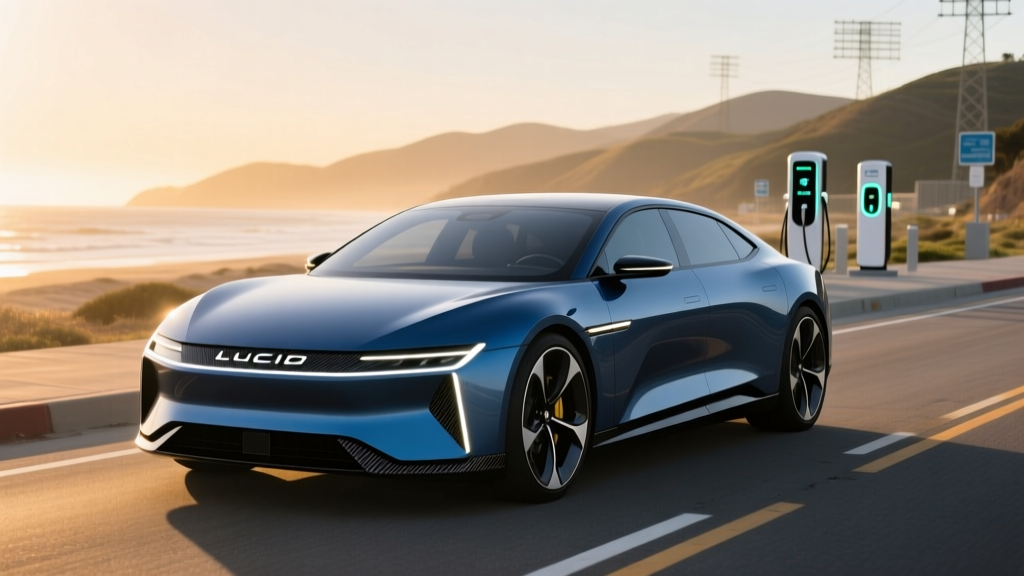
The Lucid Gravity arrived as the luxury electric SUV many enthusiasts have been waiting for — a three-row family hauler with the same efficiency-first engineering that made the Lucid Air a range king. But with a starting MSRP near $80,000, most buyers are looking hard at Lucid Gravity lease offers to get into one without the full purchase commitment. This review covers everything you need to know before signing: real-world range expectations, charging speed, total cost after incentives, and whether the Gravity delivers enough to justify its position against the Tesla Model X, Rivian R1S, and BMW iX.
Lucid Gravity at a Glance: 2026 Spec Sheet
| Spec | Gravity Pure | Gravity Touring |
|---|---|---|
| Base MSRP | $79,900 | $94,900 |
| EPA Range | ~390 mi (est.) | 440 mi (est.) |
| Battery (usable) | ~112 kWh (NMC) | ~112 kWh (NMC) |
| Drivetrain | RWD (single motor) | AWD (dual motor) |
| Horsepower | ~480 hp | ~800+ hp |
| 0–60 mph | ~5.0 sec | ~3.5 sec |
| Max DC Fast Charge | 300 kW | 300 kW |
| 10–80% DC Charge | ~20 min | ~20 min |
| Level 2 Home Charge | 19.2 kW (~70 mi/hr) | 19.2 kW (~70 mi/hr) |
| Efficiency | ~118 MPGe / 28 kWh/100mi | ~110 MPGe / 30 kWh/100mi |
| Seating | 7-passenger | 7-passenger |
| Cargo (behind 3rd row) | ~32 cu ft | ~32 cu ft |
| Cargo (max, seats folded) | ~110 cu ft | ~110 cu ft |
| Battery/Powertrain Warranty | 8 yr / 100,000 mi | 8 yr / 100,000 mi |
Note: Lucid's official EPA certification figures and final trim specs should be confirmed at Lucid's Gravity page and fueleconomy.gov before purchase. Figures above reflect manufacturer estimates and preliminary data for 2026 models.
Real-World Range: What the EPA Sticker Doesn't Tell You
EPA Estimate: Up to 440 miles (Gravity Touring AWD with available range package)
Real-World Expectation: 350–390 mi highway (70–80 mph); 310–350 mi in cold weather (below 32°F); 400+ mi achievable in mild city/suburban driving with regen
Lucid's engineering advantage has always been efficiency — the Air sedan routinely exceeds its EPA estimates in favorable conditions, and the Gravity benefits from the same compact, high-voltage powertrain architecture. However, physics still applies: a three-row SUV with a larger frontal area will lose more range at sustained highway speeds than a sedan.
In mixed real-world driving at moderate temperatures (55–75°F), expect the Gravity Touring to deliver roughly 370–400 miles on a full charge. Highway-only trips at 75+ mph will pull that down to the mid-340s. Cold weather is the bigger variable — battery chemistry (NMC in this case) is less efficient below freezing, and cabin heating in a large SUV cabin draws significant energy. Budget a 20–25% range reduction in deep winter conditions, which brings the Touring down to roughly 330–350 miles. That's still exceptional for the segment, but plan your road-trip charging accordingly.
One ownership advantage: Lucid's thermal management system includes battery preconditioning, which warms the pack when you navigate to a DC fast charger — critical for achieving advertised charge speeds in cooler weather.
Charging Speed: 300 kW Peak, but Mind the Curve
The Gravity supports a peak DC fast-charge rate of 300 kW on compatible chargers ( Electrify America, IONITY, and other 350 kW stations). Lucid claims a 10–80% charge time of approximately 20 minutes under ideal conditions.
Here's the nuance that spec sheets omit: peak kW is not sustained kW. Like all modern EVs, the Gravity follows a charge curve — it pulls maximum power in the 10–40% state-of-charge window, then progressively tapers to protect the battery. Expect sustained rates of 250–280 kW up to about 50% SoC, then a step-down to 150–180 kW through 70%, and a significant taper above 80%. This is normal and is why the 10–80% metric matters more than peak kW.
| Charging Level | Power (kW) | Speed (miles of range per hour) | Typical Use Case |
|---|---|---|---|
| Level 1 (120V household) | ~1.4 kW | ~4–5 mi/hr | Emergency / overnight trickle |
| Level 2 (240V home, 48A) | 11.5 kW | ~42 mi/hr | Standard home wall connector |
| Level 2 (240V home, 80A) | 19.2 kW | ~70 mi/hr | High-amperage home install (requires 100A circuit) |
| DC Fast Charge | Up to 300 kW | ~600+ mi/hr (peak) | Road trips, 10–80% in ~20 min |
Home charging note: To unlock the Gravity's full 19.2 kW Level 2 capability, you'll need a hardwired wall connector on a dedicated 100-amp circuit. Most homes require a panel upgrade for this — budget $1,500–$3,000 for electrical work beyond the charger itself. A more common 48-amp / 60-amp circuit setup delivers 11.5 kW, which still adds roughly 42 miles of range per hour — enough to fully recharge overnight for most commuters. Always consult a licensed electrician for your specific installation.
Performance and Drivetrain: From Efficient Cruiser to Sub-4-Second SUV
The Gravity lineup gives buyers a genuine choice between efficiency and performance:
- Gravity Pure (RWD): A single rear motor producing approximately 480 hp gets you to 60 mph in around 5.0 seconds. This is the range-maximizing variant, optimized for commuters and families who want maximum miles per charge.
- Gravity Touring (AWD): Dual motors deliver 800+ hp and a 0–60 time near 3.5 seconds — territory that embarrasses many sports cars, let alone three-row SUVs. The AWD system also provides confident all-weather traction.
Both variants benefit from Lucid's miniaturized motor technology, which allows more interior space by reducing the physical footprint of the powertrain. The Gravity's low center of gravity (battery pack under the floor) keeps body roll controlled through corners, though at roughly 5,800+ lbs, this is no canyon carver — it's a comfortable, composed highway cruiser that can summon serious acceleration on demand.
Interior, Cargo, and Tech: A True Three-Row EV
The Gravity's defining advantage over most luxury EV SUVs is genuine third-row usability. With approximately 32 cubic feet behind the third row and up to 110 cubic feet with both rear rows folded, it competes directly with full-size SUVs on practicality. Legroom in the third row accommodates adults on shorter trips — a rarity in the segment.
Tech highlights:
- Lucid's 34-inch curved glass cockpit display spanning the driver's instrument cluster and center infotainment
- Wireless Apple CarPlay and Android Auto
- Over-the-air software updates for continuous feature improvements
- Available DreamDrive Pro ADAS suite (SAE Level 2 — driver must remain engaged and supervising at all times)
- V2L (Vehicle-to-Load) capability for powering devices and appliances from the battery
DreamDrive Pro is an SAE Level 2 driver-assistance system. It combines adaptive cruise control, lane centering, and automated lane changes, but the driver must keep hands on or near the wheel and eyes on the road at all times. This is not autonomous or "self-driving" — it's a sophisticated assist system comparable to Tesla Autopilot, GM Super Cruise, or Ford BlueCruise. Only Level 4 services like Waymo operate without a human driver.
Notable drawbacks: Lucid's infotainment software, while visually impressive, has drawn criticism for responsiveness and occasional bugs in the Air — expect continued OTA refinement, but early adopters should tolerate some rough edges. The Gravity also lacks Apple CarPlay integration via a native widget-style interface (it uses standard wireless CarPlay projected to the screen). Service center availability remains limited outside major metro areas compared to Tesla's network.
Pricing, Lease Offers, and Federal Tax Credit Eligibility
The 2026 Lucid Gravity starts at $79,900 for the Pure trim and $94,900 for the Touring — before destination fees, options, or incentives. A fully optioned Touring with the available range package and premium interior can push past $105,000.
| Trim | Base MSRP | Est. As-Tested | Federal §30D Credit* | Est. Net Cost |
|---|---|---|---|---|
| Gravity Pure | $79,900 | $82,000 | Up to $7,500 | ~$74,500 |
| Gravity Touring | $94,900 | $102,000 | Up to $7,500 | ~$94,500 |
*Federal tax credit (IRS §30D) critical caveats:
- MSRP cap: SUVs/vans/pickups must have an MSRP at or below $80,000 to qualify. The Gravity Pure at $79,900 base barely clears this threshold — adding options or packages that push MSRP above $80,000 eliminates eligibility. The Touring at $94,900 does NOT qualify for the new-vehicle credit based on MSRP alone.
- Income cap: Buyer AGI must not exceed $300,000 (joint), $225,000 (head of household), or $150,000 (single).
- Battery sourcing: The full $7,500 requires meeting both critical-mineral and battery-component sourcing requirements under current IRS rules. Partial credit ($3,750) may apply if only one requirement is met. Verify current sourcing compliance on IRS.gov.
- Point-of-sale transfer: Eligible buyers can transfer the credit to the dealer at purchase, reducing the out-of-pocket price immediately rather than waiting for tax filing.
What This Means for Lucid Gravity Lease Offers
Leasing changes the tax-credit equation significantly. Under current IRS rules, the commercial clean vehicle credit (§45W) may apply to leased EVs even when the §30D new-vehicle credit does not — because the leasing company (lessor) is the legal purchaser. Many automakers pass this savings through as a "lease cash" incentive or reduced monthly payment. This means the Gravity Touring, which fails the §30D MSRP cap for purchase, may still benefit from a $7,500 lease incentive applied by Lucid or its financing arm.
Expected Lucid Gravity lease offers in 2026 will depend heavily on:
- Residual value projections (luxury EVs have faced steep depreciation — a lower residual means higher monthly payments)
- Money factor (lease interest rate equivalent — Lucid's captive financing rates vs. third-party banks)
- Whether Lucid passes through the §45W commercial credit as lease cash
- Term length (36 vs. 48 months) and annual mileage allowance (10K/12K/15K)
For a Gravity Pure with a $7,500 lease incentive, 36-month term, 12,000 miles/year, and a projected 52% residual, expect monthly payments in the $900–$1,100 range with modest drive-off fees. Touring leases will likely land in the $1,200–$1,500/month range depending on options and incentives. Always request a full lease disclosure (capitalized cost, residual, money factor, fees) before signing.
Gravity vs. the Competition: Where It Wins and Loses
| Metric | Lucid Gravity Touring | Tesla Model X LR | Rivian R1S (Dual) | BMW iX xDrive50 |
|---|---|---|---|---|
| Base MSRP | $94,900 | ~$81,000 | ~$80,000 | ~$87,000 |
| EPA Range | ~440 mi | ~335 mi | ~352 mi | ~324 mi |
| 3rd Row | Yes (adult-capable) | Yes (tight) | Yes (compact) | No (2-row only) |
| Max DC Charge | 300 kW | 250 kW | 220 kW | 200 kW |
| 0–60 mph | ~3.5 sec | ~3.8 sec | ~4.5 sec | ~4.4 sec |
| §30D Credit (Purchase) | No (MSRP cap) | Partial/No | Yes (if sourcing met) | No (MSRP cap) |
- Best-in-class EPA range (440 mi crushes all competitors)
- 300 kW DC fast charging — fastest in the luxury SUV segment
- Genuinely usable third row with adult-capable legroom
- Exceptional efficiency (kWh/100mi) for a vehicle this size
- Sub-4-second 0–60 with full family-SUV practicality
- Over-the-air updates and V2L capability
- Touring trim exceeds §30D MSRP cap for purchase credit
- Limited service center network vs. Tesla or legacy luxury brands
- Infotainment software still maturing (early-adopter bugs)
- No hands-free driving system comparable to Super Cruise/BlueCruise yet
- High starting price; lease residuals uncertain for luxury EVs
- 19.2 kW home charging requires expensive 100A circuit upgrade
Who Should Lease the Lucid Gravity?
- You need a genuine three-row electric SUV with adult-capable rear seating
- Range is your top priority — 440 miles eliminates most road-trip charging stops
- You have access to 350 kW DC fast chargers on your common routes
- You prefer to lease and avoid long-term depreciation risk on a luxury EV
- You value efficiency and cutting-edge powertrain tech over brand cachet
- You need an extensive service network in rural or smaller metro areas (consider Tesla Model X or Rivian's growing mobile service)
- You want a proven hands-free highway driving system (GM Super Cruise on the Cadillac Escalade IQ)
- Your budget caps at $70,000 (consider the Rivian R1S Standard or wait for Gravity price reductions)
- You only need two rows of seating (the BMW iX or Lucid Air offer similar tech in a more efficient package)
Frequently Asked Questions
What is the real-world range of the Lucid Gravity?
The EPA-estimated range for the Gravity Touring is approximately 440 miles. In real-world mixed driving at moderate temperatures, expect 370–400 miles. Highway-only driving at 75+ mph yields roughly 340–360 miles. In cold weather (below 32°F), budget for a 20–25% reduction, bringing range to approximately 330–350 miles. The RWD Pure trim trades some range for efficiency and is estimated around 390 miles EPA.
How fast does the Lucid Gravity charge at home and on the road?
On a 350 kW DC fast charger, the Gravity peaks at 300 kW and charges from 10–80% in approximately 20 minutes under ideal conditions. At home on a 240V Level 2 charger, the Gravity supports up to 19.2 kW (requiring a 100-amp circuit), adding about 70 miles of range per hour. A more common 48-amp home installation delivers 11.5 kW, or about 42 miles per hour — sufficient for a full overnight charge.
Does the Lucid Gravity qualify for the $7,500 federal EV tax credit?
It depends on the trim and how you acquire it. The Gravity Pure at $79,900 base MSRP is at the very edge of the §30D MSRP cap ($80,000 for SUVs) — adding options can push it over and eliminate eligibility. The Touring at $94,900 does not qualify for §30D on purchase. However, leasing may unlock the §45W commercial clean vehicle credit, which many lessors pass through as a lease incentive. Income limits ($300K joint / $150K single) and battery-sourcing requirements also apply. Verify current rules at IRS.gov and consult a tax professional.
Is leasing the Lucid Gravity better than buying?
Leasing offers two key advantages for the Gravity: (1) it may unlock a $7,500 incentive via the §45W commercial credit even on the Touring trim, which fails the §30D MSRP cap for purchase; and (2) it protects you from the steep depreciation that luxury EVs have experienced in recent years. The downside is you won't build equity and you're locked into mileage limits. For a $95,000+ vehicle with uncertain long-term residual values, leasing is a prudent choice for most buyers in 2026.
How does the Lucid Gravity compare to the Tesla Model X and Rivian R1S?
The Gravity's 440-mile range and 300 kW charging speed are unmatched in the segment — it outperforms the Model X (~335 mi, 250 kW) and R1S (~352 mi, 220 kW) on both metrics. It also offers a more spacious third row than either. However, Tesla's Supercharger network and service infrastructure remain more mature, and Rivian offers more off-road capability and a lower starting price. The Gravity wins on efficiency and range; choose Tesla or Rivian for proven infrastructure or adventure capability.
What is the Lucid Gravity's warranty coverage?
Lucid provides an 8-year / 100,000-mile warranty on the battery pack and powertrain, which is standard for the luxury EV segment. The basic vehicle limited warranty covers 4 years / 50,000 miles. The battery warranty guarantees a minimum capacity retention (typically 70% or above) over the coverage period. Given Lucid's efficiency-focused thermal management, long-term degradation should be moderate — but the brand's limited track record means less historical data than Tesla or legacy automakers.