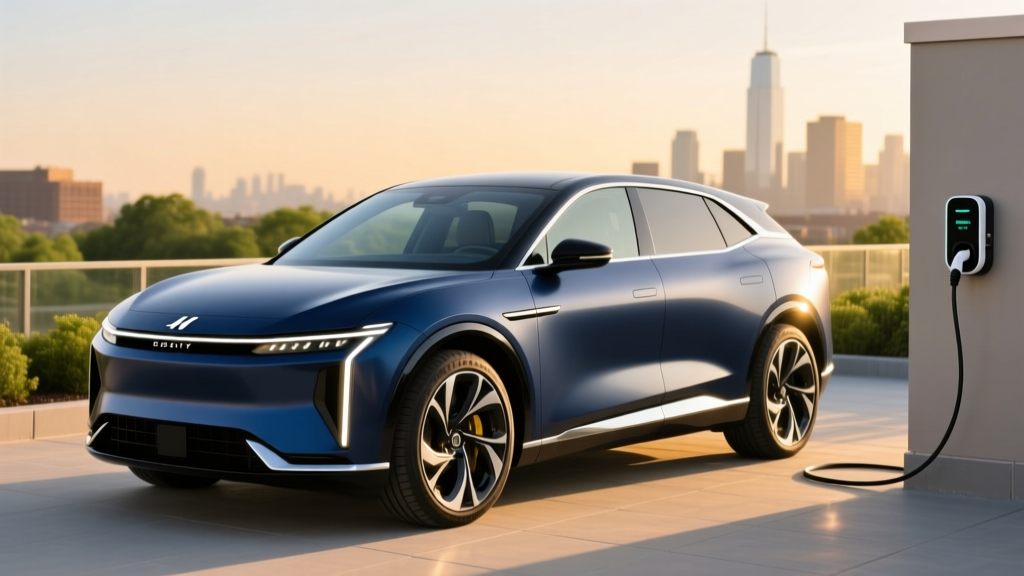
The Lucid Gravity arrives as the brand's second production vehicle and its first three-row SUV, aiming to prove that a full-size family hauler doesn't have to sacrifice the efficiency and range Lucid built its reputation on with the Air sedan. With up to 828 horsepower, a claimed 440-mile EPA range, and a 900-volt electrical architecture, the Gravity is positioned squarely against the Tesla Model X, Rivian R1S, and upcoming electric SUVs from legacy automakers. But specs on a press release don't tell you what it's like to live with one. Here's everything you need to know about the Lucid Gravity's horsepower, real-world range, charging behavior, and ownership economics before you put down a deposit.
Lucid Gravity HP, Drivetrain, and Performance Specs
The Gravity lineup offers two primary powertrain configurations for the 2026 model year. The entry-point Gravity Pure uses a dual-motor all-wheel-drive setup producing 480 horsepower, while the Gravity Grand Touring — the launch variant — pushes that figure to 828 hp with a dual-motor AWD system that uses Lucid's proprietary miniaturized drive units. These are the same compact motors that gave the Air its class-leading efficiency, now adapted for a vehicle with significantly more mass to move.
| Spec | Gravity Pure (AWD) | Gravity Grand Touring (AWD) |
|---|---|---|
| Horsepower | 480 hp | 828 hp |
| 0-60 mph | ~5.0 sec | 3.5 sec |
| Drivetrain | Dual-motor AWD | Dual-motor AWD |
| Battery (usable) | ~112 kWh (NMC) | ~112 kWh (NMC) |
| EPA Range | ~440 mi (est.) | ~440 mi |
| Max DC Fast Charge | 300+ kW | 300+ kW |
| 10-80% DC Time | ~20 min | ~20 min |
| Level 2 Home Charge | 19.2 kW (~70 mi/hr) | 19.2 kW (~70 mi/hr) |
| Towing Capacity | 6,000 lbs | 6,000 lbs |
| Base MSRP | ~$81,490 | ~$96,490 |
On paper, the Grand Touring's 3.5-second 0-60 mph time places it in supercar territory — remarkable for a three-row SUV that weighs well over 5,500 pounds. In practice, that acceleration is available in short bursts via a sprint mode; sustained highway passing power is where the 828 hp really shines, delivering effortless overtaking without the hesitation you'd feel in a turbocharged gas SUV. The dual-motor torque-vectoring system also provides confident traction in rain and light snow, though the Gravity's low center of gravity (courtesy of the floor-mounted battery pack) is what gives it its planted feel in corners.
Real-World Range vs. EPA Estimates
Real-World Expectation: ~340-380 miles highway (70-80 mph); ~280-320 miles in sub-freezing temperatures with cabin heat; ~400+ miles in mild city/suburban driving with regen.
Lucid's efficiency engineering is genuinely best-in-class. The Air sedan achieves over 4.5 miles per kWh, and the Gravity — despite its larger frontal area and greater weight — targets a similar efficiency bracket thanks to a drag coefficient under 0.25 Cd, a heat pump for cabin climate, and those compact, low-loss drive units. On fueleconomy.gov, the Grand Touring variant is expected to land near 115-120 MPGe combined, which translates to roughly 29-31 kWh per 100 miles.
However, real-world highway driving at sustained 75-80 mph speeds will reduce range by 10-15% compared to the EPA sticker. This is physics, not a Lucid flaw — every EV experiences higher aerodynamic drag at speed. In cold weather (below 32°F), expect an additional 15-25% range reduction due to battery conditioning overhead and cabin heating demands, even with the heat pump. Owners in northern climates should plan for an effective winter range of 280-320 miles on a full charge.
The good news: 440 miles of EPA range means that even with a 30% cold-weather penalty, you're still looking at 300+ miles of usable range — enough for most road-trip legs without excessive charging stops.
Charging Speed: DC Fast Charging and Home Level 2
The Gravity's 900-volt electrical architecture is the key enabler of its charging performance. Higher voltage means lower current for the same power, which reduces heat buildup and allows the battery to accept more energy faster for longer. Lucid claims peak DC fast-charging rates above 300 kW, with a 10-80% charge time of approximately 20 minutes at a compatible 350 kW charger.
| Charge Level | Power | Speed (Miles Added per Hour) | Notes |
|---|---|---|---|
| Level 1 (120V) | 1.4 kW | ~4 mi/hr | Emergency/trickle only |
| Level 2 (240V, 48A) | 11.5 kW | ~42 mi/hr | Standard home wall connector |
| Level 2 (240V, 80A) | 19.2 kW | ~70 mi/hr | Requires 100A circuit; full overnight charge |
| DC Fast (350 kW station) | 300+ kW peak | ~200+ mi in 10 min | 10-80% in ~20 min; tapers above 80% |
A critical nuance: that 300+ kW peak rate is not sustained across the entire 10-80% window. Like all EVs, the Gravity follows a charging curve that peaks at low state of charge and tapers as the battery fills. Expect the peak rate to hold from roughly 10-40% SoC, then step down progressively. The 20-minute 10-80% figure accounts for this taper, and it's still among the fastest in the SUV segment.
For home charging, the Gravity's onboard charger supports up to 19.2 kW on Level 2, which is significantly higher than most competitors (the Rivian R1S, for example, maxes at 11.5 kW). To unlock 19.2 kW, you'll need a hardwired wall connector on a dedicated 100-amp circuit — an installation that typically costs $1,200-$2,500 depending on your panel capacity and run distance. On a standard 48-amp Level 2 circuit (the more common residential setup), you'll see 11.5 kW, which still delivers a full charge in roughly 10 hours — fine for overnight replenishment.
The Gravity ships with a NACS (Tesla-style) charge port, granting native access to Tesla's Supercharger network — the most reliable and widespread DC fast-charging infrastructure in North America. For Electrify America and other CCS networks, an adapter is available.
Interior Space, Cargo, and Technology
The Gravity is a true three-row SUV with seating for up to seven passengers. Second-row captain's chairs are available in a six-passenger configuration. Cargo volume is generous: expect approximately 42 cubic feet behind the third row, expanding to over 80 cubic feet with the third row folded flat. A front trunk (frunk) adds roughly 8-10 cubic feet of additional sealed storage — useful for charging cables, groceries, or a carry-on bag.
Legroom is competitive with the BMW X7 and Mercedes GLS: approximately 41 inches in the first row, 38 inches in the second, and 33 inches in the third. The third row is viable for adults on shorter trips, which can't be said of every three-row EV.
The infotainment system centers on Lucid's 34-inch curved glass cockpit display, which spans the driver's instrument cluster and central touchscreen in a single floating unit. A lower secondary touchscreen handles climate and secondary controls. Wireless Apple CarPlay and Android Auto are standard, and the navigation system includes integrated route planning with automatic charging-stop suggestions based on real-time battery state and charger availability.
Driver assistance is branded as Lucid DreamDrive Pro, a Level 2 (SAE) system that combines adaptive cruise control, lane-centering, automatic lane changes, and a driver-monitoring camera. Per NHTSA and IIHS standards, this requires the driver to remain engaged at all times — it is not autonomous driving. Expect capabilities broadly comparable to Tesla Autopilot and Ford BlueCruise, with hands-on-wheel or eyes-on-road requirements depending on the mode.
Pricing, Trim Levels, and Federal Tax Credit
The 2026 Lucid Gravity lineup starts at approximately $81,490 for the Pure AWD trim and climbs to $96,490 for the Grand Touring. A fully loaded Grand Touring with premium packages (Surreal Stealth appearance, executive rear seating, premium audio) can reach $105,000-$110,000 before destination.
| Trim | Base MSRP | §30D Credit Eligible? | Effective Price (if eligible) |
|---|---|---|---|
| Pure AWD | ~$81,490 | Subject to sourcing/income rules | ~$73,990 (with $7,500) |
| Grand Touring AWD | ~$96,490 | Subject to sourcing/income rules | ~$88,990 (with $7,500) |
Federal tax credit reality check: Under IRS §30D rules, the Gravity is classified as an SUV, which carries an $80,000 MSRP cap for credit eligibility. The Pure trim at ~$81,490 sits right at the edge — option packages can push it over, disqualifying it. The Grand Touring at $96,490 exceeds the cap and does not qualify for the new-vehicle credit. However, buyers may be eligible if they structure a lease (where the $7,500 commercial credit under §45W passes through to the lessee), or if they purchase a qualifying used Gravity in future model years under the $4,000 used-EV credit. Income caps also apply: $300,000 joint / $225,000 head of household / $150,000 individual modified AGI. Battery component and critical-mineral sourcing requirements must also be met. Always verify current eligibility on IRS.gov or consult a tax professional before relying on the credit in your purchase decision.
Battery, Warranty, and Long-Term Ownership
The Gravity uses a ~112 kWh usable-capacity battery pack with NMC (nickel-manganese-cobalt) chemistry, chosen for its high energy density — necessary to achieve 440 miles in a heavy SUV without an impractically large pack. Lucid has not published an official LFP option for the Gravity; the energy-density requirements of this vehicle make NMC the practical choice.
Battery and powertrain warranty coverage is 8 years or 100,000 miles, whichever comes first, with a capacity retention guarantee of at least 70% over that period. This is consistent with industry norms (Tesla, Rivian, and Hyundai/Kia all offer similar 8-year terms, though Kia goes to 100,000 miles with a slightly higher retention threshold). Lucid's track record with the Air's battery degradation is still relatively young, but early Air owners report minimal degradation in the first 30,000 miles — a positive signal for the Gravity's long-term outlook.
Replacement cost for the full battery pack, should it be needed out of warranty, is estimated in the $18,000-$25,000 range based on current NMC cell pricing and Lucid's pack architecture. This is a worst-case scenario; most modern EV battery packs outlast the vehicle's useful life.
Lucid Gravity vs. Key Competitors
The Gravity doesn't exist in a vacuum. Here's how it stacks up against the three-row electric SUVs it directly competes with:
- Tesla Model X (Plaid): More horsepower (1,020 hp) and slightly quicker 0-60 (2.5 sec), but less range (~348 mi EPA), older interior architecture, and a higher starting price for the Plaid. The Gravity offers a fresher design and better efficiency per kWh.
- Rivian R1S (Dual-Motor Max Pack): Superior off-road capability, quad-motor option, and a more adventure-oriented design. Range is lower (~410 mi max pack), and DC charging peaks at ~200 kW. The R1S wins for trail use; the Gravity wins for highway efficiency and charging speed.
- Kia EV9 (GT-Line AWD): Significantly more affordable (~$75,000), but with 379 hp, ~270 miles of range, and slower charging. The EV9 is a value play; the Gravity is a premium performance-and-range play.
Who Should Buy the Lucid Gravity?
- You need three rows and 440 miles of range for long family road trips
- Charging speed matters — you want 10-80% in ~20 minutes on road trips
- You value efficiency (MPGe) as much as performance
- You want native NACS/Supercharger access without an adapter
- Off-road capability is a priority (Rivian R1S is better suited)
- Your budget is under $80,000 (consider the Kia EV9 or Hyundai Ioniq 9)
- You need the absolute quickest 0-60 time (Model X Plaid is faster)
- You require guaranteed federal tax credit eligibility on a new purchase
Pros and Cons
- Class-leading 440-mile EPA range in a three-row SUV
- 828 hp Grand Touring delivers supercar acceleration
- 300+ kW DC charging with NACS native port
- Excellent efficiency (~115-120 MPGe expected)
- Spacious third row usable for adults
- 900V architecture future-proofs charging compatibility
- Grand Touring exceeds §30D MSRP cap for new-vehicle credit
- Limited Lucid service center footprint vs. Tesla or legacy brands
- Pure trim pricing creeps close to the $80K credit threshold
- No air suspension standard on all trims (optional on some)
- Brand-new model — long-term reliability data not yet established
Frequently Asked Questions
What is the real-world range of the Lucid Gravity?
The EPA rates the Gravity Grand Touring at approximately 440 miles. In real-world highway driving at 75-80 mph, expect 340-380 miles. In freezing temperatures with cabin heat, plan for 280-320 miles. City and suburban driving with regenerative braking can exceed 400 miles in mild weather.
How fast does the Lucid Gravity charge at home and on the road?
On a 350 kW DC fast charger, the Gravity peaks above 300 kW and charges from 10-80% in approximately 20 minutes. At home on a 19.2 kW Level 2 circuit (80-amp), it adds roughly 70 miles of range per hour, achieving a full overnight charge in about 6-7 hours. On a standard 48-amp Level 2 circuit (11.5 kW), a full charge takes roughly 10 hours.
Does the Lucid Gravity qualify for the federal EV tax credit?
Under current IRS §30D rules, the SUV MSRP cap is $80,000. The Gravity Pure at ~$81,490 is borderline and may not qualify depending on options. The Grand Touring at ~$96,490 exceeds the cap. Income limits ($150K-$300K MAGI depending on filing status), battery sourcing requirements, and point-of-sale transfer rules also apply. A lease may unlock the commercial credit. Consult IRS.gov or a tax professional for your specific situation.
Is the Lucid Gravity worth buying over the Tesla Model X or Rivian R1S?
The Gravity wins on range, efficiency, and charging speed. The Model X Plaid wins on raw acceleration and Supercharger network maturity (though the Gravity now has native NACS access). The Rivian R1S wins on off-road capability and adventure versatility. Your priority — road-trip range, performance, or trail capability — should drive the decision.
What are the biggest drawbacks of the Lucid Gravity?
The primary concerns are Lucid's limited service center network (a real issue if you live far from a metro area with a Lucid facility), the tax-credit eligibility challenge at current pricing, and the fact that this is a first-year model with no long-term reliability track record. Early adopters accept some risk in exchange for class-leading specs.
How much Lucid Gravity horsepower do I actually need?
The 480 hp Pure AWD delivers a 5.0-second 0-60 mph time, which is brisk and more than adequate for daily driving, merging, and highway passing. The 828 hp Grand Touring is a performance statement — thrilling but not necessary for most buyers. If you don't regularly exploit full-throttle acceleration, the Pure's output will feel more than sufficient, and the money saved can go toward home charging infrastructure or accessories.