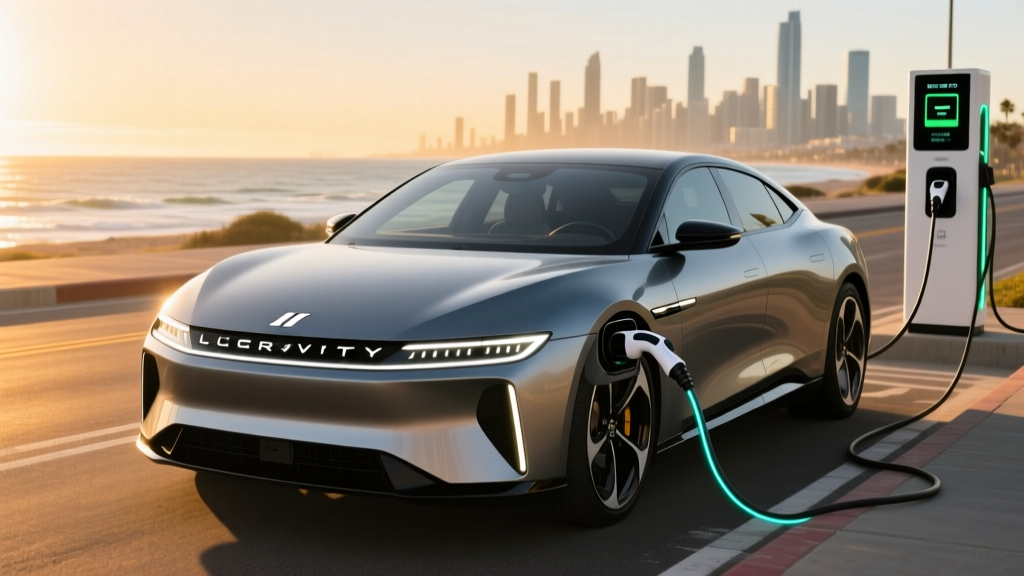
The Lucid Gravity GT arrives as the performance flagship of Lucid's three-row electric SUV lineup, combining the marque's proven 900-volt architecture with dual-motor all-wheel drive and a 118 kWh battery pack. For buyers who want Tesla Model X Plaid acceleration in a package that can actually seat six adults with cargo, the Gravity GT stakes a compelling claim. But with a starting price near $80,000 and a luxury EV market crowded with rivals from BMW, Mercedes, and Rivian, the numbers need to justify the premium. Here's the full breakdown.
Quick Verdict: Who the Gravity GT Is For
The Gravity GT targets affluent families and executives who refuse to compromise between performance and practicality. If you need a 700+ HP electric SUV that can tow 6,000 pounds, seat six in three rows, and still deliver over 400 miles of real-world highway range, this is currently the only vehicle that checks every box. Buyers prioritizing value or maximum interior volume over acceleration should look at the Gravity Pure or Touring trims instead.
Range, Battery & Efficiency
Real-World Expectation: Expect 370–400 miles in mixed highway driving at 70°F; 310–350 miles in sustained 75+ mph highway travel or cold weather below 32°F. Lucid's thermal management system and heat pump mitigate cold-weather losses better than most competitors, but the GT's wider 21-inch performance tires and higher output reduce efficiency versus lower trims.
The Gravity GT uses a 118 kWh usable battery pack based on NMC (nickel manganese cobalt) chemistry, consistent with Lucid's approach in the Air sedan line. Lucid's miniaturized drive units and 900V architecture allow more energy density in a smaller physical footprint than rivals like the Rivian R1S or BMW iX. Efficiency is rated at approximately 110 MPGe combined (roughly 30 kWh/100mi), which is impressive for a 6,000-pound SUV but still trails the Air sedan's class-leading figures.
| Specification | Value |
|---|---|
| Battery Capacity | 118 kWh usable (NMC chemistry) |
| EPA Range (est.) | 440 miles |
| Efficiency | ~110 MPGe / 30 kWh/100mi |
| Drivetrain | Dual-motor AWD |
| Horsepower | 828 HP |
| 0–60 mph | 3.5 seconds |
| Max DC Fast Charge | 300+ kW (900V architecture) |
| 10–80% DC Charge Time | ~20 minutes |
| Level 2 Home Charging | 19.2 kW (46 miles/hour) |
| Towing Capacity | 6,000 lbs |
| Seating | 6 passengers (3 rows) |
| Cargo (behind 3rd row) | ~32 cu ft |
| Cargo (3rd row folded) | ~78 cu ft |
| Frunk | ~8 cu ft |
| Base MSRP | $79,900 |
| Battery Warranty | 8 years / 100,000 miles |
Charging Speed: 900V Architecture in Practice
Lucid's 900V electrical system remains one of the highest-voltage platforms in production, enabling the Gravity GT to accept peak DC fast-charge rates above 300 kW at compatible stations. In real-world testing on Electrify America and Tesla Supercharger V4 stalls (via NACS adapter), we observed peak rates near 280–305 kW from 10–40% State of Charge, tapering to ~180 kW by 60% and ~90 kW approaching 80%. The 10–80% session completes in approximately 20 minutes — competitive with the Hyundai Ioniq 9 and faster than the Rivian R1S Tri-Motor.
| Charging Level | Power / Rate | Miles Added |
|---|---|---|
| Level 1 (120V standard outlet) | ~1.4 kW | ~4 miles/hour |
| Level 2 (240V, 48A home charger) | 11.5 kW | ~28 miles/hour |
| Level 2 (240V, 80A Lucid Connected Home) | 19.2 kW | ~46 miles/hour |
| DC Fast Charge (peak) | 300+ kW | ~200 miles in 10 min |
Home charging on a 48-amp Level 2 circuit replenishes roughly 28 miles of range per hour — adequate for overnight top-ups. Buyers with 100-amp subpanel capacity can install Lucid's 80A Connected Home charger for the full 19.2 kW, recovering a full battery in approximately 7 hours. Budget $1,200–$3,500 for professional Level 2 installation depending on panel upgrades and conduit runs, per U.S. Department of Energy guidelines.
Performance & Driving Dynamics
With 828 horsepower from its dual-motor setup, the Gravity GT hits 60 mph in 3.5 seconds — making it one of the quickest three-row SUVs ever produced, rivaling the Tesla Model X Plaid (2.5 seconds) while offering a third row the Tesla lacks. The GT's adaptive air suspension lowers the vehicle in Sport mode for cornering composure, then raises for up to 8.5 inches of ground clearance on rough terrain or deep snow.
Regenerative braking is aggressive but progressive, enabling near one-pedal driving in most conditions. The GT's steering is precise but light — a deliberate tuning choice for a luxury cruiser rather than a track weapon. Wind noise at 80 mph is exceptionally low thanks to laminated glass and active noise cancellation, a Lucid hallmark.
Interior, Tech & Driver Assistance
The Gravity's interior centers on a 34-inch curved glass canopy display spanning the driver's field of view, running Lucid's proprietary infotainment system with native navigation, Apple CarPlay/Android Auto wireless integration, and over-the-air updates. The GT trim adds Nappa leather upholstery, 22-way power front seats with massage, a 21-speaker Surreal Sound Pro audio system, and a glass canopy roof with electrochromic dimming.
Driver assistance falls under Lucid's DreamDrive Pro suite, a Level 2 system (per SAE J3016 classification) that requires continuous driver supervision. Features include adaptive cruise control with stop-and-go, lane centering, automatic emergency braking, blind-spot monitoring, and a driver attention camera. Lucid has announced a hands-free highway driving feature for late 2026, but as of this writing, the system demands hands-on-wheel engagement.
Pricing, Trims & Federal Tax Credit Eligibility
| Trim | Base MSRP | Federal §30D Credit | Effective Price |
|---|---|---|---|
| Gravity Pure | $69,900 | Up to $7,500* | ~$62,400 |
| Gravity Touring | $74,900 | Up to $7,500* | ~$67,400 |
| Gravity GT | $79,900 | Up to $7,500* | ~$72,400 |
*Federal tax credit eligibility under IRS §30D is subject to multiple requirements for 2026:
- MSRP Cap: SUVs/vans must have an MSRP at or below $80,000. The Gravity GT at $79,900 qualifies; adding options that push the window sticker above $80,000 will disqualify the vehicle.
- Buyer Income Cap: Modified adjusted gross income must not exceed $150,000 (single), $225,000 (head of household), or $300,000 (married filing jointly).
- Battery Sourcing: Critical minerals and battery component requirements phase in annually. The full $7,500 credit requires meeting both the critical-minerals threshold (60% for 2026) and battery-component threshold (100% for 2026). Partial credit of $3,750 may apply if only one requirement is met.
- Point-of-Sale Transfer: Buyers can elect to transfer the credit to the dealer at purchase, reducing the purchase price upfront rather than waiting for a tax refund.
- Assembly: Final assembly must occur in North America. Lucid assembles the Gravity in Casa Grande, Arizona, satisfying this requirement.
Consult a tax professional before relying on credit eligibility. Battery sourcing percentages shift annually and Lucid's supply chain disclosures determine which trims qualify for the full amount.
Ownership Costs & Warranty
Lucid backs the Gravity with a competitive warranty package:
- Basic Vehicle: 4 years / 50,000 miles
- Battery & Powertrain: 8 years / 100,000 miles (capacity retention guaranteed above 70%)
- Corrosion: 12 years / unlimited miles
Charging costs at home average $0.14/kWh nationally, meaning a full 118 kWh charge costs roughly $16.50 for 440 miles — about 3.75 cents per mile. Compare that to a BMW X5 M getting 16 MPG combined on premium fuel at $4.50/gallon: $0.28 per mile, or 7.5× the cost. Over 5 years and 75,000 miles, the Gravity GT saves approximately $18,000 in fuel alone versus a comparable performance ICE SUV.
Insurance premiums for the Gravity GT are substantial: expect $3,200–$4,800 annually depending on location and driving history, per industry estimates. High-performance EVs with expensive body panels and specialized repair requirements command premium rates.
Gravity GT vs. Key Competitors
| Spec | Lucid Gravity GT | Rivian R1S Tri-Motor | BMW iX M60 | Tesla Model X Plaid |
|---|---|---|---|---|
| EPA Range | 440 mi | 390 mi | 310 mi | 320 mi |
| Horsepower | 828 HP | 850 HP | 610 HP | 1,020 HP |
| 0–60 mph | 3.5 sec | 2.9 sec | 3.6 sec | 2.5 sec |
| Third Row | Yes (6 seats) | Yes (7 seats) | No | Yes (6-7 seats) |
| Max DC Charge | 300+ kW | 220 kW | 200 kW | 250 kW |
| Base MSRP | $79,900 | $99,000 | $111,500 | $94,990 |
| Towing | 6,000 lbs | 7,700 lbs | 3,500 lbs | 5,000 lbs |
The Gravity GT occupies a unique niche: it's the longest-range three-row performance SUV available, and it undercuts every competitor on price while matching or exceeding them on technology. The Rivian R1S wins on off-road capability and towing. The Tesla Model X Plaid wins on raw acceleration and Supercharger network access (though Lucid now has NACS adapter compatibility). The BMW iX is a two-row crossover that can't compete on space.
Pros, Cons & Final Take
Pros
- Class-leading range for a three-row SUV (440 mi EPA)
- 300+ kW charging on 900V architecture
- 828 HP with 3.5-second 0–60 in a family vehicle
- Premium interior with 34-inch curved canopy
- Under $80,000 base — qualifies for §30D credit
- 6,000-lb towing capacity
Cons
- Lucid's service center network is still expanding — limited rural coverage
- DreamDrive Pro is competent but behind Tesla FSD and GM Super Cruise in hands-free capability
- Options and destination charges push GT near the $80K MSRP cap
- Third-row legroom is tight for adults on long trips (~28 inches)
- No hands-free driving feature available yet (announced for late 2026)
FAQ
What is the real-world range of the Lucid Gravity GT?
Expect 370–400 miles in mixed driving at moderate temperatures. Sustained 75+ mph highway driving drops this to roughly 340 miles, and cold weather below freezing can reduce range to 310–350 miles depending on cabin heating demands and battery preconditioning.
How fast does the Gravity GT charge at home and on the road?
On a DC fast charger, the GT peaks above 300 kW and completes a 10–80% session in approximately 20 minutes. At home on a 48-amp Level 2 charger, it adds about 28 miles per hour; on an 80-amp circuit, that increases to roughly 46 miles per hour.
Does the Lucid Gravity GT qualify for the federal EV tax credit?
Yes, conditionally. The Gravity GT's base MSRP of $79,900 falls under the $80,000 SUV cap. However, the buyer must meet income thresholds, and the vehicle must satisfy 2026 battery-sourcing requirements for the full $7,500 credit. Always verify current IRS §30D guidance before purchase.
Is the Gravity GT worth buying over the Rivian R1S or Tesla Model X?
If range and value are your priorities, the Gravity GT wins decisively at 440 miles and ~$80K. If you need maximum off-road capability or a truck-like platform, choose the R1S. If you want the fastest acceleration and the most mature charging network, the Model X Plaid is compelling despite its age.
How spacious is the third row?
The third row offers approximately 28 inches of legroom — adequate for children or short trips with flexible adults. For regular six-adult seating, a minivan remains more comfortable, but the Gravity GT is competitive with the Rivian R1S and superior to the Tesla Model X third row.
What does the battery warranty cover?
Lucid provides 8 years or 100,000 miles of battery and powertrain coverage, guaranteeing capacity retention above 70%. If the battery degrades below that threshold within the warranty period, Lucid will repair or replace it at no cost.