The 2026 Lucid Gravity is the luxury electric SUV that promised to redefine three-row family hauling with sedan-rivaling efficiency and a trunk up front that does something no competitor has attempted: it folds into a seat. The Gravity's front trunk — or "frunk" — features a gullwing-opening hood and an available bench that faces rearward, creating a tailgate-style lounging spot that has become one of the most talked-about design choices in the EV space. But beyond the headline-grabbing Lucid Gravity frunk seat, does this $80,000+ electric SUV deliver where it counts — on range, charging speed, and daily usability?
After examining the Gravity's EPA data, battery specifications, and ownership economics, here's everything buyers need to know before putting down a deposit.
Lucid Gravity Specs at a Glance
| Specification | Gravity Pure (RWD) | Gravity Touring (AWD) | Gravity Grand Touring (AWD) |
|---|---|---|---|
| EPA Range | ~440 miles (est.) | ~400 miles (est.) | ~440 miles (est.) |
| Battery Capacity | ~112 kWh usable (NMC) | ~112 kWh usable (NMC) | ~118 kWh usable (NMC) |
| Horsepower | ~480 hp | ~620 hp | ~830 hp |
| 0-60 mph | ~5.0 sec | ~3.7 sec | ~3.5 sec |
| Drivetrain | Rear-Wheel Drive | Dual-Motor AWD | Dual-Motor AWD |
| Max DC Fast Charge | ~300+ kW | ~300+ kW | ~300+ kW |
| 10-80% DCFC Time | ~20 min | ~20 min | ~20 min |
| Level 2 Home Charge | 19.2 kW (~70 mi/hr) | 19.2 kW (~70 mi/hr) | 19.2 kW (~70 mi/hr) |
| Efficiency (MPGe) | ~120 MPGe (est.) | ~110 MPGe (est.) | ~112 MPGe (est.) |
| Starting MSRP | $79,900 | $94,900 | $109,900 |
Note: Some figures above reflect Lucid's published preliminary estimates for the 2026 model year. Final EPA certifications may vary. Always confirm with fueleconomy.gov before purchase.
Range and Efficiency: What to Expect Beyond the EPA Sticker
EPA Estimated: ~440 miles (Grand Touring)
Real-World Highway (70-75 mph): ~340-370 miles
Real-World Cold Weather (below 32°F): ~290-330 miles
Real-World Mixed Commuting: ~380-410 miles
The Lucid Gravity's headline range number — up to an estimated 440 miles on the Grand Touring trim — positions it as the longest-range three-row electric SUV on the market. Lucid achieved this through the same engineering philosophy used in the Air sedan: a highly efficient drivetrain with miniaturized motors, low rolling-resistance tires, and a drag coefficient that's remarkably low for a vehicle of this size.
But EPA estimates assume a mix of city and highway driving under moderate conditions. In sustained highway travel at 70-75 mph — where most road-trip range anxiety actually lives — expect the Gravity Grand Touring to deliver roughly 340 to 370 miles before needing a charge stop. Cold weather compounds this: lithium-ion batteries lose efficiency in freezing temperatures, and cabin heating draws significant power. Winter drivers in northern climates should plan for 290-330 miles of usable range.
The Gravity's efficiency is measured at an estimated 112 MPGe combined (Grand Touring), which translates to roughly 30-32 kWh per 100 miles. For context, the Rivian R1S (Dual-Motor) achieves around 86 MPGe combined, and the Tesla Model X lands near 102 MPGe. The Gravity's efficiency advantage is substantial and directly translates to fewer charging stops and lower electricity costs per mile.
Charging Speed: 900-Volt Architecture Delivers
Lucid's 900-volt electrical architecture — the same platform that makes the Air sedan one of the fastest-charging EVs available — carries over to the Gravity. Here's how charging breaks down across levels:
| Charging Level | Power / Rate | Miles Added per Hour | Notes |
|---|---|---|---|
| Level 1 (120V household) | ~1.4 kW | ~4-5 miles/hr | Emergency/top-up only |
| Level 2 (240V home) | Up to 19.2 kW | ~65-70 miles/hr | Requires 100A circuit; ~$800-$2,500 install |
| DC Fast Charge (peak) | 300+ kW | ~200+ miles in 15 min | 900V architecture; tapers above 80% |
The 10-80% DC fast-charge time of approximately 20 minutes is competitive with the Porsche Macan EV and faster than the Rivian R1S (which peaks around 220 kW on its latest pack). However, buyers should understand charge-curve taper: the Gravity will not sustain 300+ kW for the entire session. Peak speeds occur between roughly 10-50% state of charge, after which the rate gradually decreases to protect battery health. A full 10-90% session will take closer to 30-35 minutes.
For home charging, the Gravity's onboard charger supports up to 19.2 kW on Level 2, which is among the highest in the industry. This means a full overnight charge adds roughly 500+ miles of range — more than enough to replenish the battery from near-empty while you sleep. However, achieving 19.2 kW requires a dedicated 100-amp circuit and a hardwired Level 2 station. Most homes will need an electrical panel upgrade if they don't already have 200-amp service. Budget $1,500-$3,000 for a professional installation by a licensed electrician.
The Gravity ships with a NACS (Tesla-style) charge port, granting access to Tesla Supercharger stations — currently the most reliable DC fast-charging network in the US. This is a significant advantage over CCS-equipped competitors still reliant on Electrify America or EVgo for long-distance travel.
The Frunk Seat: Gimmick or Genuine Innovation?
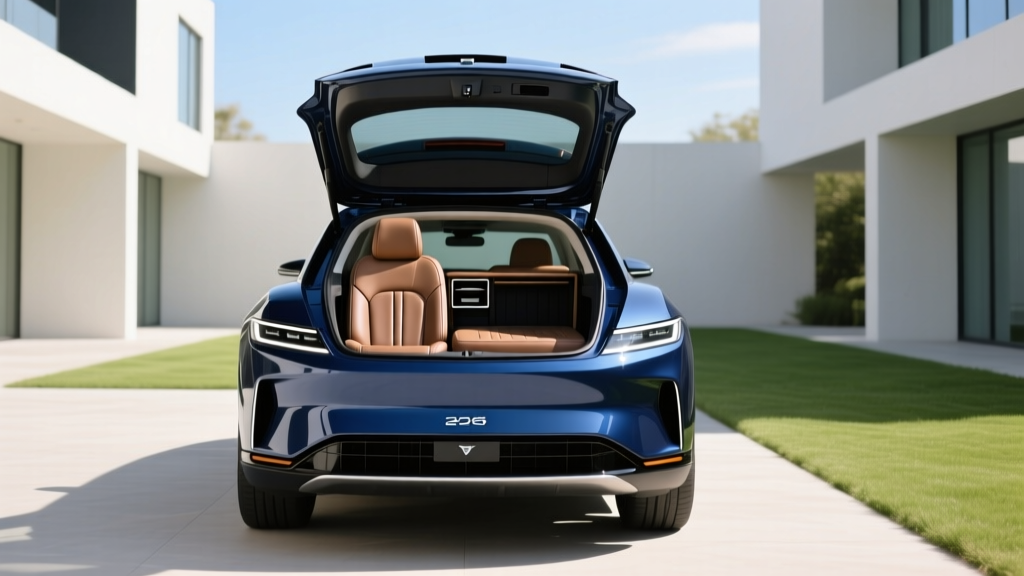
The Lucid Gravity frunk seat is the feature that dominates online discussion, and for good reason. The front trunk opens via a powered gullwing-style hood, revealing a cargo area of approximately 12 cubic feet. But Lucid went further: an available rearward-facing bench seat deploys from the frunk floor, creating a tailgate-style seating area for two adults.
In practice, the frunk seat works best as a social feature — think campsite lounging, tailgating at a kid's football game, or sitting with a coffee while watching a sunrise. The seat is padded, includes cupholders molded into the frunk surround, and benefits from the gullwing hood providing overhead shade and rain protection. It's rated for adults, though taller passengers (over 6'2") will find the legroom constrained by the frunk's depth.
The tradeoff is frunk cargo capacity. With the seat deployed, usable cargo space drops significantly. For buyers who prioritize front-trunk storage (charging cables, groceries, gym bags) over the seating feature, the frunk seat may feel like a solution in search of a problem. Lucid offers the Gravity without the frunk seat option for those who prefer maximum front cargo volume.
Worth noting: the gullwing hood requires overhead clearance to open. Low-ceiling garages (under 8 feet) may prevent full deployment, which also blocks frunk seat use in those environments.
Performance, Interior, and Daily Livability
The Gravity Grand Touring's 830 horsepower and 3.5-second 0-60 mph time make it one of the quickest three-row SUVs ever sold, electric or otherwise. Even the base Pure trim's ~480 hp and 5.0-second sprint is brisk for a vehicle weighing over 5,800 pounds. Dual-motor AWD trims provide confident all-weather traction, with torque vectoring that keeps the Gravity planted in corners despite its size.
Inside, the Gravity seats up to seven across three rows. Second-row captain's chairs are available in place of a bench, reducing capacity to six but dramatically improving third-row access. Cargo volume behind the third row is approximately 22 cubic feet, expanding to ~60 cubic feet with the third row folded and over 100 cubic feet with both rear rows down. Combined with the ~12 cu ft frunk, total cargo capacity rivals midsize SUVs a class above.
The infotainment system runs on a 34-inch curved glass cockpit display that spans the dashboard, replacing traditional gauge clusters. A lower 17-inch touchscreen handles climate, navigation, and media. Lucid's interface is responsive, though some users report a learning curve with the lack of physical buttons for common functions like fan speed and temperature. Wireless Apple CarPlay and Android Auto are standard.
Driver assistance comes via Lucid's DreamDrive Pro system, which uses a lidar sensor (mounted above the windshield) alongside cameras and radar. DreamDrive Pro operates at SAE Level 2 — meaning the driver must remain fully engaged with hands on the wheel and eyes on the road at all times. It is not a self-driving system. Features include adaptive cruise control, lane centering, automatic emergency braking, and blind-spot monitoring. Lucid has indicated a hands-free highway driving feature is in development but has not announced a release timeline.
Pricing, Tax Credits, and Total Cost of Ownership
| Trim | Base MSRP | Est. Federal Credit (§30D) | Effective Price |
|---|---|---|---|
| Gravity Pure (RWD) | $79,900 | Up to $7,500* | ~$72,400* |
| Gravity Touring (AWD) | $94,900 | Up to $7,500* | ~$87,400* |
| Gravity Grand Touring (AWD) | $109,900 | $0 (over MSRP cap) | $109,900 |
*Federal tax credit eligibility requires meeting all of the following (per IRS §30D rules):
- MSRP Cap: SUVs/vans must have an MSRP at or below $80,000. The Gravity Pure qualifies; the Touring and Grand Touring exceed this threshold and are ineligible.
- Buyer Income Cap: Modified AGI must not exceed $150,000 (single), $225,000 (head of household), or $300,000 (joint).
- Battery Sourcing: Critical minerals and battery components must meet phased-in domestic/free-trade-partner sourcing requirements. Lucid has not published full sourcing documentation — confirm with your dealer before relying on the credit.
- Point-of-Sale Transfer: Eligible buyers can transfer the credit to the dealer at purchase, reducing the purchase price directly rather than waiting for a tax refund.
The Gravity Pure's eligibility for the full $7,500 credit (assuming buyer income and battery sourcing requirements are met) makes it one of the most compelling luxury EV values at an effective ~$72,400. However, the Touring and Grand Touring trims fall outside the MSRP cap, meaning buyers pay full price. This is a critical consideration: if you want AWD and the full 440-mile range, you're looking at nearly $95,000-$110,000 with no federal offset.
On the ownership cost side, the Gravity's exceptional efficiency (~30 kWh/100 mi) means lower electricity costs than competitors. At a national average of $0.16/kWh, charging the Gravity costs roughly $4.80 per 100 miles — compared to about $14-$16 per 100 miles for a similarly sized gas SUV getting 20 MPG at $3.20/gallon. Over five years and 75,000 miles, fuel savings alone could reach $7,000-$9,000.
Lucid's battery and powertrain warranty covers 8 years or 100,000 miles (whichever comes first), with a capacity retention guarantee of at least 70% over that period. The vehicle limited warranty is 4 years/50,000 miles. These terms are competitive with Tesla and Rivian but fall short of Hyundai/Kia's 10-year/100,000-mile powertrain coverage.
Lucid Gravity vs. Rivian R1S vs. Tesla Model X
| Attribute | 2026 Lucid Gravity (GT) | 2026 Rivian R1S (Dual-Motor Max) | 2026 Tesla Model X (LR) |
|---|---|---|---|
| EPA Range | ~440 mi | ~410 mi | ~335 mi |
| Starting Price | $79,900 | $79,900 | $79,990 |
| Max DCFC Speed | 300+ kW | ~220 kW | ~250 kW |
| 0-60 mph | 3.5 sec | 4.5 sec | 3.8 sec |
| Third Row | Yes (adult-capable) | Yes (best-in-class space) | Yes (tight for adults) |
| Frunk Seat | Yes (unique) | No | No |
| Charge Port | NACS | NACS | NACS (native) |
| Towing Capacity | ~6,000 lbs | 7,700 lbs | 5,000 lbs |
The Gravity wins on range and charging speed. The Rivian R1S wins on off-road capability, towing, and third-row space. The Tesla Model X wins on Supercharger network maturity (though NACS adoption is closing this gap) and the Autopilot/FSD ecosystem for buyers who value driver-assist technology.
Pros and Cons
Pros
- Class-leading EPA range (~440 mi)
- 300+ kW DC fast charging with 900V architecture
- Unique frunk seat for outdoor social use
- Exceptional efficiency (~112 MPGe)
- NACS charge port for Supercharger access
- Adult-usable third row with strong cargo volume
- Stunning acceleration even on base trim
Cons
- Touring/GT trims exceed $80K MSRP cap — no federal tax credit
- Limited service center network vs. Tesla
- Gullwing frunk hood requires overhead clearance
- No hands-free driving feature yet (Level 2 only)
- Frunk seat reduces front cargo utility when deployed
- Luxury pricing with limited long-term reliability data
Who Should Buy the Lucid Gravity?
The Lucid Gravity is best suited for:
- Long-distance families who need three rows and want to minimize charging stops on road trips. The 440-mile range is transformative for 300-500 mile journeys.
- Efficiency-focused buyers who want maximum miles per kWh and the lowest per-mile electricity cost in the luxury SUV segment.
- Outdoor-oriented owners who will actually use the frunk seat for camping, sporting events, or scenic stops — it's a feature that rewards a specific lifestyle.
- Garage-charging households with the electrical capacity for a 19.2 kW Level 2 installation, maximizing the Gravity's fast home-charging capability.
Look elsewhere if you need maximum towing capacity (Rivian R1S), established service infrastructure (Tesla Model X), or off-road capability (Rivian or the upcoming Jeep Wagoneer S).
Frequently Asked Questions
What is the real-world range of the Lucid Gravity?
The EPA-estimated range is approximately 440 miles for the Grand Touring trim and around 400 miles for the Touring AWD. In real-world highway driving at 70-75 mph, expect 340-370 miles. In freezing weather, plan for 290-330 miles. These figures make the Gravity the longest-range three-row electric SUV available.
How fast does the Gravity charge at home and on the road?
On a DC fast charger, the Gravity peaks at over 300 kW and charges from 10-80% in approximately 20 minutes. At home on a 240V Level 2 charger (up to 19.2 kW), it adds roughly 65-70 miles of range per hour, meaning a full overnight charge is easily achievable. A 100-amp dedicated circuit is recommended.
Does the Lucid Gravity qualify for the $7,500 federal EV tax credit?
Only the base Gravity Pure trim (MSRP $79,900) is potentially eligible, as it sits at the $80,000 SUV MSRP cap set by IRS §30D. The Touring ($94,900) and Grand Touring ($109,900) exceed the cap and do not qualify. All trims are subject to buyer income limits ($150K single / $300K joint) and battery-sourcing requirements. Consult a tax professional before relying on credit eligibility.
Is the Lucid Gravity frunk seat practical?
The frunk seat is a genuinely useful feature for outdoor social scenarios — tailgating, camping, watching your kid's baseball game. It comfortably seats two adults of average height. However, deploying the seat eliminates most frunk cargo space, and the gullwing hood requires at least 8 feet of overhead clearance to open fully. If you rarely tailgate or camp, you may prefer the standard frunk configuration for maximum storage.
Is the Lucid Gravity worth buying over the Rivian R1S or Tesla Model X?
If your priorities are maximum range, charging speed, and efficiency, the Gravity is the strongest choice in the segment. If you need superior towing (7,700 lbs), off-road trails, or a more spacious third row, the Rivian R1S is better. If you value the most mature service network and driver-assist ecosystem, Tesla's Model X still has an edge. The Gravity occupies a unique lane as the luxury long-range cruiser with the most innovative front-end design.
What is the Lucid Gravity's battery warranty?
Lucid covers the battery and powertrain for 8 years or 100,000 miles, whichever comes first, guaranteeing at least 70% capacity retention over that period. The vehicle limited warranty is 4 years or 50,000 miles. These terms are in line with industry norms from Tesla and Rivian.