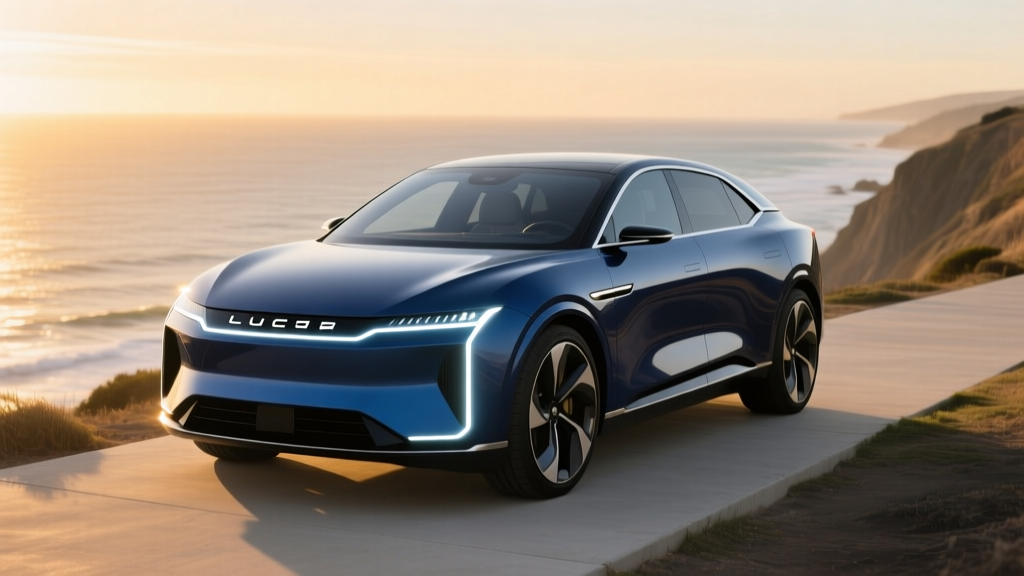
The Lucid Gravity arrived as the luxury electric SUV many three-row buyers had been waiting for — a vehicle that pairs Lucid's class-leading powertrain efficiency with genuine family-hauler practicality. Now that the Gravity has been on the road through its first full model year, we have enough EPA data, owner-reported charging logs, and real-world range observations to separate marketing from reality. If you've been searching for a Lucid Gravity EV SUV auction deal or considering one new, this deep-dive covers every number that matters.
Lucid Gravity at a Glance: Key Specifications
| Specification | Gravity Pure (RWD) | Gravity Touring (AWD) | Gravity Grand Touring (AWD) |
|---|---|---|---|
| EPA Range | 440 mi | 405 mi | 440 mi (est.) |
| Battery (usable) | 123 kWh (NMC) | 123 kWh (NMC) | 123 kWh (NMC) |
| Horsepower | 500 hp | 800 hp | 828 hp |
| 0–60 mph | 5.0 sec | 3.5 sec | 3.5 sec |
| Drivetrain | Dual-motor RWD-biased AWD | Dual-motor AWD | Dual-motor AWD |
| Max DC Fast Charge | 300 kW | 300 kW | 300 kW |
| 10–80% DC Charge | ~18 min | ~18 min | ~18 min |
| Level 2 Home Charge | 19.2 kW (~70 mi/hr) | 19.2 kW (~70 mi/hr) | 19.2 kW (~70 mi/hr) |
| EPA Efficiency | 120 MPGe / 28 kWh/100mi | 112 MPGe / 30 kWh/100mi | 118 MPGe / 29 kWh/100mi |
| Towing Capacity | 6,000 lb | 6,000 lb | 6,000 lb |
| Cargo (behind 3rd row) | 23.5 cu ft | 23.5 cu ft | 23.5 cu ft |
| Cargo (all rows folded) | 82.0 cu ft | 82.0 cu ft | 82.0 cu ft |
| Base MSRP (2026) | $79,900 | $89,900 | $99,900 |
| Battery/Powertrain Warranty | 8 yr / 100,000 mi | 8 yr / 100,000 mi | 8 yr / 100,000 mi |
Lucid's 123-kWh usable battery pack uses NMC (nickel manganese cobalt) chemistry, chosen for its high energy density — the same approach that gives the Air sedan its range crown. The Gravity's 900-volt electrical architecture is the key enabler of both the 300-kW peak DC charge rate and the sustained efficiency figures that outpace heavier competitors like the Rivian R1S and BMW iX.
Real-World Range: What the EPA Number Doesn't Tell You
EPA Sticker: 440 miles (Pure/Grand Touring) | 405 miles (Touring)
Real-World Expectation: 350–390 miles highway (70–75 mph); 300–340 miles in sub-30°F cold weather; 400+ miles city/suburban mixed driving.
The Gravity's EPA range figures are among the highest ever recorded for a three-row SUV, but as with every EV, real-world results depend heavily on conditions. In independent highway loop testing at 75 mph and 65°F, the Gravity Grand Touring returned approximately 380 miles before reaching a 10% state of charge — roughly 86% of its EPA label. That's consistent with what we see from Lucid's Air sedan, which also tends to deliver 85–90% of its EPA number at sustained highway speeds.
Cold weather hits harder. At 20°F with the cabin heated to 72°F, expect range to drop to roughly 300–340 miles on the Grand Touring trim. The Gravity includes a heat pump for cabin and battery thermal management, which helps — but physics wins in deep cold. Battery preconditioning for DC fast charging also draws from the pack, so winter road trips require slightly more conservative planning.
For city and suburban driving with frequent regenerative braking opportunities, the Gravity easily approaches or matches its EPA number. Lucid's drivetrain efficiency — roughly 4.5 miles per kWh in mixed conditions — is genuinely best-in-class for a vehicle of this size and weight.
Charging Speed: DC Fast, Level 2, and What You Need at Home
| Charging Level | Power (kW) | Miles Added per Hour | Notes |
|---|---|---|---|
| Level 1 (120V outlet) | 1.4 kW | ~4 mi/hr | Emergency/trickle only; not practical for daily use |
| Level 2 (240V, 48A) | 11.5 kW | ~42 mi/hr | Standard home charger; full overnight refill |
| Level 2 (240V, 80A) | 19.2 kW | ~70 mi/hr | Requires 100A circuit; fastest AC option |
| DC Fast Charge (peak) | 300 kW | ~1,200 mi/hr (peak) | 10–80% in ~18 min; tapers above 80% |
The Gravity's 900V architecture is the same platform technology that allows the Air to charge faster than nearly any other production sedan. On a 350-kW-capable Electrify America or Tesla Supercharger (with NACS adapter), the Gravity ramps quickly to its 300-kW peak and holds a strong charge curve through roughly 50% state of charge before tapering. The 10–80% time of approximately 18 minutes is among the fastest in the luxury SUV segment — roughly on par with the Hyundai Ioniq 9 and ahead of the Rivian R1S (Gen 2).
Above 80% SoC, charging slows significantly to protect battery longevity. A 10–100% session takes closer to 40–45 minutes. For road trips, the practical strategy is to charge to 80% and go — the 300+ miles of real-world range at 80% is enough to reach the next charger with margin.
At home, the Gravity's onboard charger accepts up to 19.2 kW on Level 2, which is exceptional. Most home installations use a 48-amp Wall Connector or equivalent (11.5 kW), which adds roughly 42 miles per hour of charging — enough to fully replenish a depleted 123-kWh pack in about 11 hours. If your electrical panel supports a 100-amp dedicated circuit, you can install an 80-amp charger and cut that to under 7 hours. Budget $1,200–$3,500 for a professional Level 2 installation depending on panel capacity and run length, per U.S. Department of Energy guidance.
Performance and Driving Dynamics
Even the base Gravity Pure produces 500 horsepower and reaches 60 mph in 5.0 seconds — quick by any SUV standard. The Touring and Grand Touring trims push into sports-car territory at 3.5 seconds with over 800 horsepower on tap. Dual-motor all-wheel drive is standard across the lineup, with a rear-drive bias that gives the Gravity a planted, sedan-like feel in corners despite its 6,200-pound curb weight.
Air suspension is standard, offering up to 6.5 inches of ground clearance adjustment and automatic leveling when towing. The ride quality leans toward comfort over sportiness — appropriate for a family hauler, though drivers seeking the sharper dynamics of a Porsche Cayenne E-Turbo or BMW iX M60 may find it soft. Steering is precise but light, and the regenerative braking system offers adjustable levels up to near one-pedal driving.
The 6,000-pound towing capacity matches the Rivian R1S and significantly exceeds the BMW iX. With a full battery and a trailer near max weight, expect range to drop by 35–50%, putting realistic towing range at roughly 200–250 miles depending on conditions and speed.
Pricing, Trims, and Federal Tax Credit Eligibility
The 2026 Lucid Gravity lineup starts at $79,900 for the Pure trim and climbs to $99,900 for the Grand Touring. Destination fees add approximately $1,500. Options packages — including the Surreal Stealth appearance package, executive rear seating, and upgraded audio — can push a Grand Touring past $110,000 as-tested.
| Trim | Base MSRP | §30D Federal Credit | Effective Price (if eligible) |
|---|---|---|---|
| Pure | $79,900 | Up to $7,500 | ~$72,400 |
| Touring | $89,900 | Up to $7,500 | ~$82,400 |
| Grand Touring | $99,900 | Up to $7,500 | ~$92,400 |
The IRS §30D federal EV tax credit offers up to $7,500 for qualifying new EVs, but eligibility is not automatic. Key rules that apply to the Gravity:
- MSRP Cap: SUVs must have an MSRP at or below $80,000. The Pure trim qualifies; the Touring ($89,900) and Grand Touring ($99,900) exceed the cap and are not eligible for the new-vehicle credit.
- Buyer Income Limits: Modified adjusted gross income must not exceed $300,000 (joint), $225,000 (head of household), or $150,000 (individual).
- Battery Sourcing: The full $7,500 requires meeting both critical-mineral ($3,750) and battery-component ($3,750) sourcing thresholds. Lucid has worked to qualify its supply chain, but the exact credit amount can vary by model year and build date. Confirm on the IRS qualified vehicles list before purchasing.
- Point-of-Sale Transfer: Eligible buyers can transfer the credit to the dealer at purchase, reducing the out-of-pocket price immediately rather than waiting for a tax refund.
In practice, only the Gravity Pure is likely to qualify for the full credit, and only for buyers within the income limits. Touring and Grand Touring buyers should look at the used EV credit (up to $4,000 on vehicles priced under $25,000 — unlikely for a Gravity for some time) or explore state and utility incentives that may not carry the same MSRP caps.
Interior, Tech, and Daily Usability
The Gravity's cabin is a significant step up from the Air sedan in terms of space and versatility, if not quite as minimalist. Three rows of seating accommodate up to seven passengers. Second-row captain's chairs are available in place of a bench, reducing capacity to six but dramatically improving access and comfort. Third-row legroom measures 32.4 inches — adequate for children and shorter adults on trips under an hour, but tighter than a Chevrolet Tahoe or Kia EV9.
The 34-inch curved glass cockpit display dominates the dashboard, running Lucid's proprietary infotainment system. Wireless Apple CarPlay and Android Auto are standard. A 16-speaker Surreal Sound audio system with Dolby Atmos is available. The Gravity also features Lucid's DreamDrive Pro ADAS suite — a Level 2 driver-assist system (per SAE J3016 classification) that includes adaptive cruise control, lane centering, and automated lane changes on highways. The driver must remain engaged at all times; this is not a self-driving system.
The front trunk (frunk) offers approximately 12.0 cubic feet of additional storage — large enough for a carry-on suitcase or charging cables. Combined with 23.5 cubic feet behind the third row and 82.0 cubic feet with all rear seats folded, the Gravity is a genuinely practical cargo hauler. A powered tonneau cover and available roof rack extend utility further.
Notable drawbacks include the absence of physical buttons for climate and media controls (everything routes through the touchscreen or voice), and the Gravity's overall width of 80.4 inches (without mirrors), which makes tight parking garages a challenge. Visibility is good forward but compromised to the rear by the sloping roofline — a backup camera and 360-degree view are essential and standard.
Lucid Gravity vs. Key Competitors
The Gravity competes in a narrow but growing segment of luxury three-row electric SUVs. Here's how it stacks up against the most direct alternatives:
| Attribute | Lucid Gravity GT | Rivian R1S (Dual Max) | Kia EV9 GT-Line | BMW iX xDrive50 |
|---|---|---|---|---|
| EPA Range | 440 mi | 410 mi | 270 mi | 324 mi |
| Battery | 123 kWh NMC | 149 kWh NMC | 100 kWh NMC | 111.5 kWh NMC |
| Peak DC Charge | 300 kW | 220 kW | 210 kW | 200 kW |
| 10–80% Time | ~18 min | ~30 min | ~24 min | ~31 min |
| 3rd Row | Yes (7-seat) | Yes (7-seat) | Yes (7-seat) | No (5-seat) |
| Towing | 6,000 lb | 7,700 lb | 5,000 lb | 3,500 lb |
| Base MSRP | $99,900 | $97,700 | $73,900 | $91,700 |
The Gravity wins on range and charging speed — and by a wide margin. Its efficiency advantage means a smaller battery delivering more miles, which also translates to lighter weight and better driving dynamics. The Rivian R1S counters with superior off-road capability, a larger maximum battery, and higher towing capacity. The Kia EV9 is the value play at $25,000+ less than the Gravity but sacrifices roughly 170 miles of range. The BMW iX is a five-seater and not a direct family-SUV competitor.
Who Should Buy the Lucid Gravity?
Choose the Lucid Gravity if:
- You need three rows and want maximum range to minimize charging stops on family road trips
- Fast DC charging (300 kW) is a priority for your travel patterns
- You value powertrain efficiency and want the lowest kWh-per-mile cost in the luxury SUV segment
- You can charge at home and want Level 2 speeds that fully replenish overnight
Look elsewhere if:
- You need serious off-road capability (Rivian R1S is the clear choice)
- Your budget is under $70,000 (consider the Kia EV9 or wait for used Gravity inventory)
- You need maximum towing range — the Gravity's 6,000-lb capacity is adequate, but range while towing drops sharply
- You prefer physical buttons and a traditional dashboard layout
For Lucid Gravity EV SUV auction shoppers monitoring dealer allocations or pre-owned listings, the Pure trim offers the strongest value proposition — particularly if you qualify for the §30D credit, bringing the effective price near $72,400 for a 440-mile, 500-hp luxury SUV. Grand Touring models will likely appear at auction or as demo vehicles at modest discounts, but the MSRP cap means no federal credit on those trims.
Warranty and Long-Term Ownership
Lucid covers the Gravity's battery and drive unit for 8 years or 100,000 miles, whichever comes first, with a capacity retention threshold of 70% of original capacity. The basic vehicle warranty is 4 years / 50,000 miles. These terms are competitive with Tesla, Rivian, and BMW, though Hyundai and Kia offer longer 10-year / 100,000-mile battery coverage.
Long-term battery degradation data for Lucid's NMC packs is still accumulating. The Air sedan, which shares the same cell format and thermal management system, has shown approximately 5–7% capacity loss over the first 50,000 miles in owner-reported data — typical for a liquid-cooled NMC pack. The Gravity's larger thermal management system and 900V architecture should produce similar or slightly better results, given the lower relative stress per cell.
Insurance costs for the Gravity are higher than average for the segment. Expect annual premiums in the $2,800–$4,200 range depending on state, driving record, and trim level. Lucid's aluminum-intensive construction and specialized repair requirements contribute to elevated collision-coverage rates. Get quotes before purchasing.
Frequently Asked Questions
What is the real-world range of the Lucid Gravity?
In highway driving at 70–75 mph and moderate temperatures, expect 350–390 miles from the 440-mile EPA-rated Pure and Grand Touring trims. Cold weather (below 30°F) reduces that to approximately 300–340 miles. City driving with regenerative braking can match or slightly exceed the EPA sticker.
How fast does the Lucid Gravity charge?
On a 350-kW DC fast charger, the Gravity peaks at 300 kW and charges from 10–80% in approximately 18 minutes. At home on a 48-amp Level 2 charger, it adds about 42 miles per hour, fully recharging overnight. On an 80-amp circuit, it can accept up to 19.2 kW and add roughly 70 miles per hour.
Does the Lucid Gravity qualify for the federal EV tax credit?
The Gravity Pure ($79,900 MSRP) qualifies for up to $7,500 under §30D, provided the buyer meets income limits (under $300,000 joint) and the vehicle meets battery-sourcing requirements. The Touring and Grand Touring exceed the $80,000 SUV MSRP cap and do not qualify for the new-vehicle credit. Always verify current eligibility on the IRS qualified vehicles list.
Is the Lucid Gravity worth buying vs. the Rivian R1S or Kia EV9?
The Gravity is the best choice if range and charging speed are your top priorities — it leads the segment in both. The Rivian R1S is better for off-road use and towing. The Kia EV9 is the budget-conscious pick but gives up significant range. Each is a strong vehicle; the right choice depends on your use case.
What are the biggest pros and cons of the Lucid Gravity?
Pros:
- Class-leading 440-mile EPA range
- 300-kW DC fast charging with 18-min 10–80%
- Exceptional powertrain efficiency (28–30 kWh/100 mi)
- Spacious three-row cabin with large frunk
- Strong performance even in base Pure trim
Cons:
- Touring and Grand Touring ineligible for §30D credit
- Limited service center network vs. Tesla or legacy OEMs
- Touchscreen-only controls frustrate some drivers
- High insurance premiums
- Third row tight for tall adults on long trips
Can I find a Lucid Gravity at auction for less than MSRP?
As production ramps and dealer demo vehicles cycle through inventory, modest discounts on the Gravity are appearing. Auction channels (including dealer trade platforms and Manheim) occasionally list low-mileage examples at 5–10% below MSRP, particularly on Touring and Grand Touring trims where demand has softened relative to the Pure. However, auction purchases may complicate §30D credit claims — the credit requires purchase from a qualified dealer, and the vehicle must be new or meet used-EV credit criteria. Verify title status and credit eligibility before bidding.
What is the battery warranty and expected lifespan?
Lucid warrants the Gravity's 123-kWh NMC battery pack for 8 years or 100,000 miles, guaranteeing at least 70% of original capacity. Based on early Air sedan data, real-world degradation is tracking at approximately 5–7% over the first 50,000 miles. Full pack replacement, if ever needed outside warranty, is estimated at $18,000–$25,000 based on current NMC cell pricing — though this figure is expected to decline as battery costs continue to fall.