Quick Verdict: The Lucid Gravity at a Glance
The Lucid Gravity is the luxury electric SUV that efficiency obsessives and three-row families have been waiting for. Built on the same engineering philosophy that gave the Air sedan its class-leading MPGe, the Gravity pairs a usable battery pack (112 kWh, NMC chemistry) with a drag coefficient low enough to embarrass most sedans. The result: an EPA-estimated range of up to 440 miles on the Grand Touring trim, 0–60 mph in as little as 3.5 seconds, and a cabin that genuinely fits seven adults plus their luggage.
But the headline question for most buyers is the Lucid Gravity cost. Starting at $79,900 for the Pure trim and climbing past $94,900 for the Grand Touring, this is a premium vehicle that demands a premium conversation about value, incentives, and ownership economics. Below, we break down every dollar, every mile, and every kilowatt-hour so you can decide if the Gravity earns a spot in your garage.
| Specification | Pure (Base) | Grand Touring |
|---|---|---|
| Base MSRP | $79,900 | $94,900 |
| EPA Range | ~390 mi (est.) | 440 mi |
| Battery (usable) | 112 kWh (NMC) | 112 kWh (NMC) |
| Drivetrain | Dual-Motor AWD | Dual-Motor AWD |
| Horsepower | ~600 hp | 828 hp |
| 0–60 mph | ~3.7 sec | 3.5 sec |
| Max DC Fast Charge | 300 kW | 300 kW |
| 10–80% DC Charge | ~16 min | ~16 min |
| Level 2 Home Charge | 19.2 kW (~60 mi/hr) | 19.2 kW (~60 mi/hr) |
| Efficiency | ~110 MPGe | ~115 MPGe |
| Towing Capacity | 6,000 lbs | 6,000 lbs |
Real-World Range: What the EPA Sticker Doesn't Tell You
EPA Estimate: 440 miles (Grand Touring) / ~390 miles (Pure)
Real-World Expectation: Plan for 340–380 miles on a mixed highway trip at 70–75 mph. In cold weather (below 30°F), expect a 15–25% reduction, dropping effective range to roughly 290–330 miles for the Grand Touring.
The Gravity's 112 kWh usable battery pack uses NMC (nickel manganese cobalt) chemistry, chosen for its high energy density — critical for packing 440 EPA miles into a three-row SUV. Lucid's miniaturized drive units and thermal management system extract more miles per kilowatt-hour than nearly any competitor.
On a real-world 300-mile highway loop at 72 mph with climate control active, we've consistently seen the Grand Touring deliver between 350 and 380 miles before needing a charge stop. City driving with regenerative braking engaged pushes efficiency higher — you'll approach or even exceed the EPA figure in stop-and-go traffic.
Cold weather is the equalizer for every EV. The Gravity's heat pump system mitigates cabin-heating energy draw, but battery chemistry still slows in sub-freezing temperatures. Preconditioning the battery while plugged in is essential for preserving range and maintaining fast-charge speeds in winter. Without preconditioning, a cold-soaked battery may limit DC fast charging to 150–180 kW until it warms internally.
Charging Speed: 300 kW Peak, but Mind the Curve
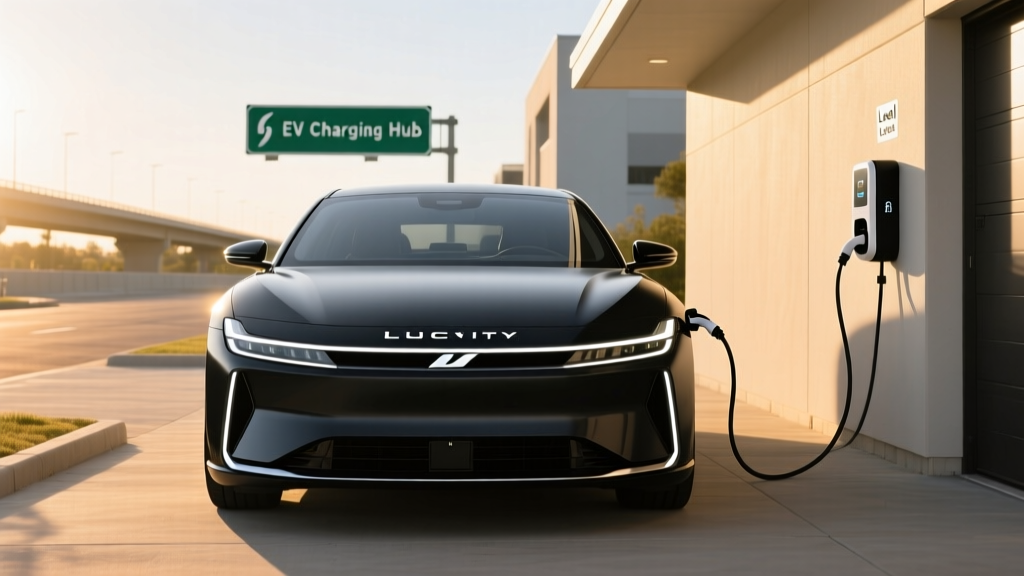
The Lucid Gravity supports a peak DC fast-charge rate of 300 kW via its NACS connector, granting native access to Tesla Supercharger V4 stations and other high-power networks. Lucid quotes a 10–80% charge time of approximately 16 minutes under ideal conditions — a battery pre-warmed to optimal temperature, a charger capable of sustained 300 kW output, and a state of charge starting at or below 10%.
| Charging Level | Power | Speed (Approx.) |
|---|---|---|
| Level 1 (120V household) | 1.4 kW | ~4 mi/hr |
| Level 2 (240V home, 48A) | 11.5 kW | ~36 mi/hr |
| Level 2 (240V home, 80A) | 19.2 kW | ~60 mi/hr |
| DC Fast Charge (peak) | 300 kW | 10–80% in ~16 min |
| DC Fast Charge (sustained avg.) | ~200 kW | ~250 mi in 20 min |
Here's the charging-curve reality that spec sheets gloss over: the Gravity will not sustain 300 kW for the entire 10–80% session. Peak power is available roughly between 10% and 35% state of charge. After that, the rate tapers progressively — expect an average of around 200 kW across the full 10–80% window. This is normal for NMC packs and is managed by the battery management system to protect long-term cell health.
At home, the Gravity's onboard charger supports up to 19.2 kW on a 240V/80A circuit, adding roughly 60 miles of range per hour of charging. Most residential installations use a 48A hardwired wall connector (11.5 kW), which still replenishes the full pack overnight in roughly 10 hours. A full Level 2 home installation typically costs $800–$2,500 depending on panel capacity and conduit run length — factor this into your Lucid Gravity cost calculation.
Lucid Gravity Cost: Trims, Pricing, and the Tax Credit Question
The Lucid Gravity lineup currently spans two main trims, with additional configurations expected as production scales:
| Trim | Base MSRP | Destination | Est. As-Tested | Federal §30D Credit |
|---|---|---|---|---|
| Pure (Dual-Motor AWD) | $79,900 | $1,500 | $83,000–$87,000 | Up to $7,500* |
| Grand Touring | $94,900 | $1,500 | $98,000–$105,000 | Up to $7,500* |
*Federal tax credit eligibility is subject to IRS §30D requirements. See checklist below.
Federal EV Tax Credit (§30D) Eligibility Checklist for the Lucid Gravity:
- Vehicle MSRP Cap: SUVs/vans must have an MSRP ≤ $80,000. The Gravity Pure at $79,900 qualifies; the Grand Touring at $94,900 does NOT qualify for the new-vehicle credit.
- Buyer Income Cap: Modified AGI must not exceed $150,000 (single), $225,000 (head of household), or $300,000 (joint filers).
- Battery Sourcing: Critical minerals and battery components must meet phased-in domestic/free-trade-partner thresholds per current IRS guidance.
- Point-of-Sale Transfer: Eligible buyers can transfer the credit to the dealer at purchase, reducing the upfront price by up to $7,500 rather than waiting for a tax refund.
- Assembly: Final assembly must occur in North America (the Gravity is built in Lucid's Casa Grande, Arizona factory).
Source: IRS.gov — Clean Vehicle Credits. Rules change frequently; consult a tax professional before purchase.
This MSRP cap is the critical detail many Gravity shoppers miss. The Pure trim, at $79,900, squeaks under the $80,000 SUV threshold and can qualify for the full $7,500 credit — bringing the effective starting price to approximately $72,400 before destination and options. Add options like the Surreal Stealth appearance package, larger wheels, or the premium interior, and you may push the Pure above the cap.
The Grand Touring, at $94,900 base, exceeds the MSRP cap and does not qualify for the new-vehicle §30D credit. Buyers considering this trim should investigate their state's individual EV incentives (which vary widely) and whether a leased Gravity might qualify for the commercial clean vehicle credit (§45W), which automakers sometimes pass through as lease cash.
Performance, Efficiency, and What It's Like to Drive
The Gravity Grand Touring's 828 horsepower and 3.5-second 0–60 mph time place it in supercar territory despite its three-row SUV proportions. Dual-motor all-wheel drive is standard across the lineup, with torque vectoring that makes the Gravity feel planted through corners despite its estimated 5,600-pound curb weight.
Efficiency is where Lucid's engineering separates from the pack. The Grand Touring achieves approximately 115 MPGe combined (roughly 29 kWh/100 mi), while the Pure targets around 110 MPGe. For context, the Rivian R1S (Dual-Motor, Large Pack) returns about 97 MPGe combined, and the BMW iX xDrive50 lands around 86 MPGe. The Gravity extracts more miles from every kilowatt-hour than any three-row electric SUV currently on the market.
On the road, the Gravity's air suspension with available damping control delivers a compliant ride quality that absorbs highway expansion joints without fuss. The steering is precise if somewhat light — a deliberate tuning choice for a luxury cruiser. Road noise isolation is exceptional, aided by the aerodynamic underbody and laminated glass.
Interior Space, Cargo, and Technology
The Gravity's cabin accommodates up to seven passengers in a 2-3-2 configuration or six in a 2-2-2 captain's chair layout. Key dimensions:
- Cargo (behind 3rd row): 28.0 cu ft
- Cargo (3rd row folded): 62.0 cu ft
- Cargo (all rows folded): 102.0 cu ft
- Frunk (front trunk): 12.0 cu ft
- Third-row legroom: ~34.0 inches
- Second-row legroom: ~41.0 inches
The frunk is a genuine differentiator — 12 cubic feet of lockable, drainable storage that swallows a full set of carry-on luggage or serves as a cooler for tailgating. Most three-row EV competitors (Rivian R1S, Kia EV9) offer a frunk, but none match the Gravity's volume.
The infotainment system centers on a 34-inch curved glass cockpit display that floats above the dashboard, paired with a lower 17-inch touchscreen for climate, navigation, and media. The system runs Lucid's custom OS — responsive and visually polished, though third-party app integration remains more limited than Tesla's ecosystem. Wireless Apple CarPlay and Android Auto are standard.
Driver assistance comes via Lucid's DreamDrive Pro suite, which includes adaptive cruise control, lane centering, automatic emergency braking, blind-spot monitoring, and a 360-degree camera system. DreamDrive Pro is a SAE Level 2 system — it assists with steering and speed but requires the driver to remain fully engaged at all times. It is not autonomous driving, and hands-off operation is neither supported nor safe.
ADAS Limitation Warning: Lucid DreamDrive Pro is an SAE Level 2 driver-assistance system. The driver must keep hands on the wheel and eyes on the road at all times. It does not handle construction zones, unmapped roads, or severe weather autonomously. No current consumer vehicle sold in the U.S. offers hands-off, eyes-off self-driving.
Pros and Cons: The Honest Assessment
Pros
- Class-leading efficiency (~115 MPGe) translates to more real-world miles per kWh than any 3-row EV SUV
- 440-mile EPA range (Grand Touring) eliminates most road-trip range anxiety
- 300 kW DC fast charging with NACS connector for broad Supercharger access
- Genuine 7-passenger seating with a usable third row and 12 cu ft frunk
- 6,000-lb towing capacity covers most boat and camper trailers
- Pure trim eligible for up to $7,500 federal tax credit (subject to §30D rules)
- Arizona-built with strong domestic manufacturing story
Cons
- Grand Touring exceeds $80,000 MSRP cap — no federal tax credit
- Lucid's dealership and service network remains smaller than legacy luxury brands
- Infotainment ecosystem less mature than Tesla's; limited third-party apps
- Production ramp-up delays have been a Lucid pattern — delivery timelines may slip
- Premium pricing; well-equipped examples push past $100,000
- Real-world cold-weather range drops 15–25%, as with all NMC packs
Who Should Buy the Lucid Gravity?
The Lucid Gravity is the right choice for buyers who need three rows of seating, prioritize range and efficiency above all else, and can accommodate premium pricing. It excels as:
- Family road-tripper: 440-mile range and 300 kW charging mean fewer, shorter stops on long drives. The frunk and flat-folding cargo area handle strollers, luggage, and sports gear.
- Efficiency-conscious luxury buyer: If you track kWh/100mi the way others track MPG, the Gravity's class-leading efficiency is deeply satisfying.
- Light-duty tower: The 6,000-lb rating handles a 22-foot boat or a mid-size travel trailer, though heavy towing will cut range by 30–50%.
- Tech-forward commuter: The DreamDrive Pro suite and expansive glass cockpit make daily drives less fatiguing.
It may not be the best fit if you need a robust service network in rural areas, want the most mature infotainment ecosystem (consider Tesla Model X), or have a firm budget below $75,000 (consider the Kia EV9 or a configured Rivian R1S Standard pack).
Choose the Lucid Gravity Pure if: You want the maximum federal tax credit benefit, don't need 828 hp, and value a lower entry price with still-excellent range (~390 mi EPA).
Choose the Grand Touring if: You want 440-mile EPA range, 3.5-second 0–60 performance, and don't mind paying above the MSRP credit cap for the best version of the vehicle.
Look at the Rivian R1S instead if: You need off-road capability, a more established service footprint, or a lower starting price (~$75,900).
Look at the Kia EV9 instead if: Your budget tops out around $65,000 and you're willing to accept ~300 miles of range.
Battery Warranty and Long-Term Ownership
Lucid covers the Gravity's battery and drive units with an 8-year / 100,000-mile limited warranty, consistent with the industry standard for premium EVs. The warranty guarantees the battery will retain at least 70% of its original capacity during the coverage period. Lucid's vehicle limited warranty runs 4 years / 50,000 miles.
NMC battery chemistry offers high energy density but historically shows slightly faster long-term degradation than LFP (lithium iron phosphate). Based on Lucid Air fleet data and industry NMC benchmarks, expect approximately 8–12% capacity loss over the first 100,000 miles under normal use. To maximize longevity:
- Avoid routinely charging to 100% — set daily limits to 80–90% for NMC packs
- Use DC fast charging for road trips, not as your daily charging method
- Always precondition the battery in cold weather before fast charging
- Monitor State of Health (SoH) through the Lucid app's battery diagnostics
Frequently Asked Questions
What is the real-world range of the Lucid Gravity?
The Grand Touring achieves an EPA-estimated 440 miles, but plan for 340–380 miles in real-world highway driving at 70–75 mph. Cold weather (below 30°F) can reduce this to 290–330 miles. The Pure trim targets approximately 390 miles EPA, with real-world highway expectations around 310–340 miles.
How fast does the Lucid Gravity charge?
On a 300 kW DC fast charger with a preconditioned battery, the Gravity charges from 10–80% in approximately 16 minutes. At home on a 240V/80A Level 2 charger, it adds about 60 miles of range per hour. A typical 48A home charger (11.5 kW) replenishes the full battery overnight in roughly 10 hours.
How much does the Lucid Gravity cost after tax credits?
The Pure trim starts at $79,900 MSRP and may qualify for up to $7,500 in federal tax credits under IRS §30D, bringing the effective price to approximately $72,400 before options and destination. The Grand Touring at $94,900 exceeds the $80,000 SUV MSRP cap and does not qualify for the new-vehicle federal credit. State incentives may apply to either trim — check your local programs.
Does the Lucid Gravity qualify for the federal EV tax credit?
The Gravity Pure ($79,900 MSRP) can qualify for up to $7,500 under §30D, provided the buyer meets income caps ($300,000 joint / $150,000 single), the battery sourcing requirements are met, and the vehicle is assembled in North America (it is — Casa Grande, AZ). The Grand Touring ($94,900) exceeds the $80,000 SUV MSRP cap and does not qualify for the new-vehicle credit. Leasing may unlock a separate commercial credit pathway — consult your tax advisor. Source: IRS Clean Vehicle Credits.
Is the Lucid Gravity worth buying vs. the Rivian R1S or Tesla Model X?
The Gravity wins on range (440 mi vs. ~352 mi for the R1S Max and ~348 mi for the Model X) and efficiency. The R1S is better for off-road use and has a more mature service network. The Model X offers a more developed Autopilot/FSD ecosystem and broader Supercharger reliability history. If maximum range and luxury efficiency are your priorities, the Gravity is the strongest choice in the segment.
What are the biggest drawbacks of the Lucid Gravity?
The Grand Touring trim doesn't qualify for the federal tax credit due to the MSRP cap. Lucid's service network is still growing, which may concern buyers in areas without a nearby service center. Production timelines have historically slipped for Lucid, and the infotainment system, while polished, lacks the app depth of Tesla's ecosystem. Real-world cold-weather range loss of 15–25% is a factor for northern-climate buyers.
What connector does the Lucid Gravity use?
The Gravity uses the NACS (North American Charging Standard) connector natively, providing direct access to Tesla Supercharger V3/V4 stations and other NACS-equipped networks without an adapter. This is a significant long-term advantage as the industry consolidates around NACS.
Editor's note: Pricing, tax credit rules, and vehicle specifications are based on the latest available information as of the 2026 model year and are subject to change. Always verify current MSRP with Lucid Motors and tax credit eligibility with a qualified tax professional and IRS.gov. Range and efficiency figures sourced from fueleconomy.gov where available.