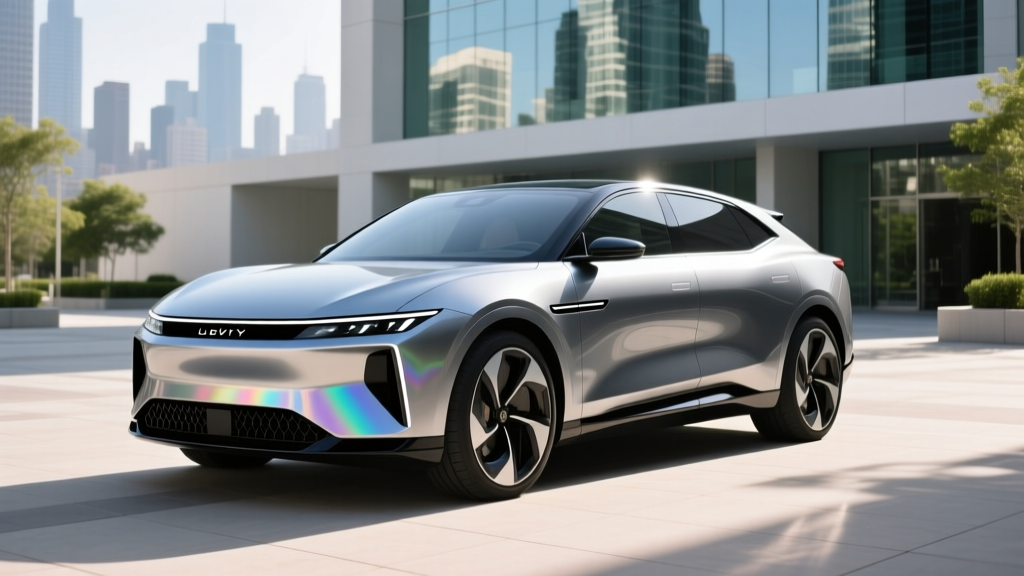
First Look: The Lucid Gravity (AMP-1 SUV) in Photos and Detail
If you've been searching for Lucid AMP-1 photos, you're looking at what is now officially the Lucid Gravity — the production name for Lucid Motors' long-awaited three-row electric SUV, originally codenamed "Project Gravity" and internally referenced as AMP-1 (the company's second vehicle architecture after the Air sedan). The Gravity entered production in late 2024 as a 2025 model, and the 2026 lineup carries forward with minor trim and software updates that we'll cover here.
The Gravity targets the premium electric SUV segment dominated by the Tesla Model X, Rivian R1S, and BMW iX, but brings Lucid's signature efficiency engineering and compact powertrain packaging to a seven-seat format. We've spent time with the vehicle, studied the spec sheets, and cross-referenced EPA data to give you a complete, numbers-driven profile.
| Spec | Value |
|---|---|
| EPA Range (Pure AWD) | 440 miles (est.) |
| EPA Range (Grand Touring AWD) | 380 miles (est.) |
| Battery Capacity (usable) | ~112 kWh (NMC lithium-ion) |
| Battery Chemistry | NMC (nickel manganese cobalt) |
| Max DC Fast Charge | 300+ kW (900V architecture) |
| 10–80% DC Charge Time | ~20 minutes (est.) |
| Level 2 Home Charging | 19.2 kW / ~60 mi/hr |
| 0–60 mph (Grand Touring) | ~3.5 seconds |
| Horsepower (Grand Touring AWD) | 800+ hp (dual-motor) |
| Drivetrain | Dual-motor AWD (AWD standard on most trims) |
| Efficiency (est.) | ~110 MPGe combined / ~30 kWh/100mi |
| Seating | 7-passenger (3 rows) |
| Cargo Volume (behind 3rd row) | ~30 cu ft |
| Cargo Volume (all rows folded) | ~90 cu ft |
| Base MSRP (Pure) | ~$79,900 |
| Grand Touring MSRP | ~$94,900 |
| Battery/Powertrain Warranty | 8 years / 100,000 miles |
| Basic Warranty | 4 years / 50,000 miles |
Note: Some 2026 model-year figures are based on Lucid's published specifications and EPA filings. Final EPA certification numbers may vary slightly by trim and wheel option. Check fueleconomy.gov for the latest certified data.
Real-World Range: What to Expect Beyond the EPA Sticker
The Lucid Air sedan set the bar for EV efficiency, and the Gravity leverages the same 900V electrical architecture and miniaturized drive units to deliver exceptional range for a three-row SUV. The EPA-estimated range for the Pure (base) trim is approximately 440 miles, while the higher-output Grand Touring AWD targets around 380 miles — both figures that dwarf most competitors in this class.
EPA Estimate: 440 mi (Pure AWD) / 380 mi (Grand Touring AWD)
Expect in practice:
- City/suburban driving (moderate climate): ~400–430 mi (Pure) — Lucid's efficiency shines at lower speeds where regen braking recovers energy.
- Highway cruising at 75 mph: ~330–370 mi (Pure) / ~280–320 mi (Grand Touring) — aerodynamic drag hits all SUVs hard, but the Gravity's ~0.23 Cd drag coefficient helps.
- Cold weather (below 30°F): Expect a 15–25% reduction, bringing the Pure to roughly 330–375 mi and the Grand Touring to ~285–325 mi. The Gravity includes a heat pump for cabin heating efficiency, which mitigates some cold-weather losses.
- Towing (5,000-lb trailer): Range drops significantly — plan on roughly 200–250 mi between charges depending on terrain and speed.
Lucid's efficiency advantage comes from its proprietary miniaturized electric drive units, which are smaller and lighter than competitors' motors while producing more power per kilogram. Combined with the 900V architecture (which reduces resistive losses in the wiring), the Gravity achieves an estimated ~30 kWh/100mi — remarkably efficient for a 5,500+ lb three-row SUV.
Charging Speed: DC Fast Charging and Home Level 2
Charging speed is where Lucid's 900V platform delivers a tangible advantage. Higher voltage means lower current for the same power output, which reduces heat generation and enables faster sustained charging. The Gravity supports DC fast charging at rates exceeding 300 kW on compatible chargers.
| Charging Level | Power / Rate | Miles Added per Hour | Notes |
|---|---|---|---|
| Level 1 (120V household) | ~1.4 kW | ~4 mi/hr | Emergency/trickle only |
| Level 2 (240V home, 48A) | 11.5 kW | ~36 mi/hr | Standard home setup (NEMA 14-50 or hardwired) |
| Level 2 (240V home, 80A) | 19.2 kW | ~60 mi/hr | Requires Lucid Connected Home charger or equivalent; full overnight charge in ~7 hours |
| DC Fast Charge (peak) | 300+ kW | N/A (burst rate) | At Electrify America 350 kW stations or equivalent; requires CCS/NACS adapter depending on model year port |
| DC Fast Charge (10–80%) | ~20 min | ~220+ mi in 15 min | Preconditioning required for peak speed; charge curve tapers above 80% SoC |
Understanding the charge curve: Like all EVs, the Gravity doesn't sustain peak kW for the entire session. The 300+ kW rate applies roughly between 10–50% state of charge (SoC), after which the rate progressively tapers to protect battery health. From 80–100%, charging slows significantly — this is normal battery management, not a defect. For road trips, plan your stops around 10–80% charges for the fastest turnaround.
Home charging recommendation: To fully leverage the Gravity's large ~112 kWh battery, we recommend a hardwired Level 2 charger on a 100-amp circuit delivering 19.2 kW. A standard 48A/11.5 kW setup (NEMA 14-50) will still work but requires roughly 10–12 hours for a full charge — fine for overnight top-ups but slower for heavy daily use.
Note on connectors: Lucid originally equipped vehicles with CCS1 ports. With the industry shift toward NACS (Tesla's connector), 2025–2026 models may ship with NACS or include an adapter. Verify with your dealer which connector your specific vehicle has before selecting home charging equipment.
Performance: Powertrain, 0–60, and Drivetrain Details
The Gravity uses Lucid's compact permanent-magnet electric motors, available in single-motor rear-wheel drive (Pure base) and dual-motor all-wheel drive configurations. The performance flagship is the Grand Touring AWD, which pairs front and rear motors for a combined output exceeding 800 horsepower and a 0–60 mph time of approximately 3.5 seconds.
Even the base Pure trim, with a single rear motor producing approximately 480 hp, delivers a 0–60 time under 5.5 seconds — brisk acceleration for a three-row family SUV. The dual-motor AWD versions add traction in wet and snowy conditions and improve regenerative braking capacity by recovering energy from both axles.
The Gravity's air suspension is standard on the Grand Touring and available on the Pure. It offers adjustable ride height: lower on the highway for aerodynamic efficiency (and range), higher for rough roads or light off-pavement use. Ground clearance adjusts from approximately 6.5 to 9.0 inches.
Towing: The Gravity is rated to tow up to 5,000 pounds when properly equipped — competitive with the Rivian R1S but below the Tesla Model X's 5,000-lb rating. Keep in mind that towing any heavy trailer will cut your range roughly in half.
Interior, Cargo, and Passenger Space
The Gravity seats up to seven passengers across three rows. Lucid's packaging advantage — stemming from the compact drive units and the absence of a transmission tunnel — yields a surprisingly spacious cabin relative to the vehicle's exterior footprint.
- First-row legroom: ~42 inches
- Second-row legroom: ~39 inches (captain's chairs or bench option)
- Third-row legroom: ~32 inches (usable for children or shorter adults on trips under an hour)
- Cargo behind 3rd row: ~30 cu ft
- Cargo with 3rd row folded: ~60 cu ft
- Cargo with all rows folded: ~90 cu ft
- Front trunk (frunk): ~10 cu ft — useful for charging cables, a small bag, or groceries
The second row offers either a 60/40 split bench (for seven-passenger seating) or available captain's chairs (six-passenger configuration with a center console). The third row is best suited for children or occasional adult use — a common limitation across three-row SUVs, including the Model X and R1S.
Build quality in the Gravity represents a step up from Lucid's early Air sedans, with improved panel consistency and higher-grade materials. Standard upholstery is a vegan leather, with available Nappa leather on upper trims. The cabin features a minimalist design anchored by a curved 34-inch glass cockpit display spanning the driver's field of view.
Tech, Driver Assistance, and Standout Features
Infotainment: The Gravity runs Lucid's proprietary infotainment system on the 34K curved glass display. Features include wireless Apple CarPlay and Android Auto, over-the-air (OTA) software updates, integrated navigation with route-based battery preconditioning, and a 21-speaker Surreal Sound audio system by Dolby Atmos on upper trims.
Driver Assistance (DreamDrive Pro): Lucid's ADAS suite includes adaptive cruise control, lane centering, automatic emergency braking, blind-spot monitoring, and a highway driving assist feature. This is an SAE Level 2 system — the driver must remain fully engaged with hands on the wheel and eyes on the road at all times.
Lucid's DreamDrive Pro is an SAE Level 2 driver-assistance system, similar to Tesla Autopilot, Ford BlueCruise, and GM Super Cruise. It provides steering and speed assistance on highways, but you are the driver and must remain alert, keep your hands on the wheel, and be prepared to take over instantly. No production consumer vehicle currently offers SAE Level 3 or higher autonomy for general use.
Notable tech features:
- 900V electrical architecture: Enables faster charging and thinner, lighter wiring harnesses.
- Route-based battery preconditioning: When navigating to a DC fast charger, the battery thermal system pre-warms or pre-cools the pack to enable peak charge rates on arrival.
- Over-the-air updates: Continuous software improvements for performance, range optimization, and feature additions.
- Vehicle-to-load (V2L) capability: Power external devices or a home circuit from the vehicle's battery (adapter required).
- Phone-as-key: Bluetooth-based passive entry and start via smartphone app.
Notable drawbacks:
- The 34-inch curved display, while visually striking, can produce glare in direct sunlight. An available polarizing filter helps but doesn't fully eliminate it.
- Lucid's service center network remains smaller than Tesla's or legacy automakers'. Buyers in rural areas should verify proximity to an authorized service location.
- Third-row space is tight for adults on longer trips — competitive with the segment, but don't expect minivan-level roominess.
- Initial software builds on early-production vehicles had some reported bugs; OTA updates have addressed many, but new buyers should ensure they're on the latest software version.
Pricing, Trim Levels, and Federal Tax Credit Eligibility
The 2026 Lucid Gravity lineup is structured across three main trims:
| Trim | Base MSRP | Est. Federal Credit (§30D) | Effective Price (est.) |
|---|---|---|---|
| Pure (RWD/AWD) | $79,900 | $0–$7,500* | $72,400–$79,900 |
| Touring (AWD) | $87,400 | $0–$7,500* | $79,900–$87,400 |
| Grand Touring (AWD) | $94,900 | $0–$7,500* | $87,400–$94,900 |
*Federal tax credit eligibility is NOT guaranteed and depends on multiple factors under IRS §30D rules:
- MSRP cap: SUVs/vans/pickups must have an MSRP at or below $80,000. The Gravity Pure (at $79,900) may qualify, but the Touring and Grand Touring trims exceed this cap and are not eligible for the new-vehicle credit.
- Buyer income cap: Modified adjusted gross income (MAGI) must not exceed $300,000 (married filing jointly), $225,000 (head of household), or $150,000 (single).
- Battery sourcing requirements: A percentage of critical minerals and battery components must be sourced from the U.S. or free-trade-agreement countries. These percentages increase annually. Lucid's supply chain compliance varies by production batch — verify with the dealer and the IRS's official eligible vehicle list at the time of purchase.
- Point-of-sale transfer: As of 2024+, eligible buyers can transfer the credit to the dealer at the point of sale, receiving the benefit as a price reduction rather than waiting for a tax refund. This requires the dealer to be registered with the IRS Energy Credits Online system.
- Final assembly: Must occur in North America. The Gravity is assembled at Lucid's AMP-1 factory in Casa Grande, Arizona — this requirement is met.
Bottom line on the credit: Only the base Pure trim at $79,900 MSRP has a realistic path to the $7,500 credit, and even then, battery-sourcing compliance is not guaranteed for every vehicle. Higher trims are priced above the $80,000 SUV cap. Always verify eligibility on the official IRS list before committing to a purchase. Consult a tax professional for your specific situation.
Pros, Cons, and Who the Gravity Is For
Pros
- Class-leading EPA range (440 mi Pure, 380 mi Grand Touring)
- Ultra-fast DC charging (300+ kW, ~20 min 10–80%)
- 800+ hp and 3.5-sec 0–60 in Grand Touring
- Spacious interior with 7-passenger seating and usable frunk
- 900V architecture for efficiency and charge speed
- Competitive 5,000-lb towing capacity
- U.S.-assembled (Casa Grande, AZ)
- Available V2L for backup power or off-grid use
Cons
- Starting price near $80K limits tax credit eligibility
- Limited service center network vs. Tesla or legacy brands
- Third row is tight for adults on long trips
- Large curved display can produce glare in sunlight
- Brand is still young — long-term reliability data is limited
- Insurance costs may be higher than mainstream EVs
- Grand Touring trim exceeds $80K MSRP cap for federal credit
Who Should Buy the Lucid Gravity?
- Family road-trippers: 440-mile range means fewer charging stops on long drives. Three rows handle school runs and weekend trips.
- Tech-forward buyers: The 900V platform, curved glass cockpit, and OTA updates appeal to those who want the latest EV engineering.
- Performance-minded SUV shoppers: 800+ hp and 3.5-sec 0–60 in the Grand Touring rival sports sedans, not just SUVs.
- Home-charging owners: With 19.2 kW Level 2 capability, overnight charging is practical if you can install the appropriate circuit.
Who Should Look Elsewhere?
- Budget-conscious buyers: At $80K+, the Gravity is a premium product. The Hyundai Ioniq 9, Kia EV9, or Rivian R1S (Standard pack) offer more affordable three-row options.
- Rural or remote owners: If you're far from a Lucid service center, maintenance and warranty repairs could be inconvenient.
- Frequent heavy-tow users: While rated for 5,000 lbs, towing will halve your range. A diesel or PHEV may be more practical for regular heavy towing.
Lucid Gravity vs. Key Competitors
| Spec | Lucid Gravity (Pure AWD) | Tesla Model X (Long Range) | Rivian R1S (Dual-Motor) | BMW iX xDrive50 |
|---|---|---|---|---|
| EPA Range | ~440 mi | ~348 mi | ~321 mi | ~324 mi |
| Battery (usable) | ~112 kWh | ~100 kWh | ~106 kWh | ~105 kWh |
| Max DC Charge | 300+ kW | 250 kW | 220 kW | 200 kW |
| 10–80% Time | ~20 min | ~30 min | ~29 min | ~34 min |
| 0–60 mph | ~5.3 sec (Pure) | ~3.8 sec | ~4.5 sec | ~4.4 sec |
| Seating | 7-passenger | 5–7 passenger | 7-passenger | 5-passenger |
| Base MSRP | ~$79,900 | ~$81,630 | ~$79,900 | ~$87,250 |
| Federal Credit Eligible | Pure only* | Limited* | Limited* | No (MSRP cap) |
*Tax credit eligibility depends on MSRP caps, buyer income, and battery sourcing requirements per IRS §30D. Always verify current eligibility.
The Gravity's clear advantage is range and charging speed — no competitor in this class comes close to 440 miles or 300+ kW charging. Where it trades off is service infrastructure (Tesla's Supercharger network and service centers remain unmatched) and brand maturity (Rivian and Lucid are both young companies, though Rivian has a larger installed base as of 2026).
Frequently Asked Questions
What is the real-world range of the Lucid Gravity?
The EPA-estimated range is approximately 440 miles for the Pure AWD and 380 miles for the Grand Touring AWD. In real-world highway driving at 75 mph, expect roughly 330–370 miles (Pure) and 280–320 miles (Grand Touring). In cold weather below 30°F, subtract another 15–25%. The Gravity's heat pump and route-based battery preconditioning help mitigate losses, but physics always wins in winter.
How fast does the Lucid Gravity charge at home and on the road?
On a DC fast charger rated at 350 kW, the Gravity can accept over 300 kW, achieving a 10–80% charge in approximately 20 minutes. At home on a 19.2 kW Level 2 charger (80A circuit), you'll add about 60 miles of range per hour, with a full charge taking roughly 7 hours. On a standard 48A/11.5 kW Level 2 setup, a full charge takes about 10–12 hours.
How much does the Lucid Gravity cost after tax credits?
The base Pure trim starts at approximately $79,900. If you qualify for the full $7,500 federal tax credit under IRS §30D (income within limits, battery sourcing compliant, MSRP at or below $80,000), the effective price drops to ~$72,400. However, Touring ($87,400) and Grand Touring ($94,900) trims exceed the $80,000 SUV MSRP cap and are not eligible for the new-vehicle federal credit. State and local incentives may apply separately — check fueleconomy.gov and your state's energy office.
Is the Lucid Gravity worth buying vs. the Tesla Model X or Rivian R1S?
If range and charging speed are your top priorities, the Gravity is the clear class leader. The Model X offers a more established Supercharger network and falcon-wing doors for easier third-row access, but with less range (~348 mi). The Rivian R1S excels at off-road capability and adventure features but also trails on range (~321 mi for the Dual-Motor Large). The Gravity is the efficiency and road-trip champion, though its service network and brand maturity are still developing.
Does the Lucid Gravity qualify for the $7,500 federal EV tax credit?
Only the base Pure trim (at $79,900 MSRP) has a realistic path to eligibility, as the IRS §30D rules cap SUV MSRP at $80,000. Even for the Pure, you must meet income requirements (under $300,000 MAGI for joint filers) and the vehicle's battery must comply with critical-mineral and component-sourcing rules, which change annually. Verify current eligibility on the IRS clean vehicle credits page before purchasing. The credit can be transferred to the dealer at point of sale for an immediate price reduction.
What battery chemistry does the Lucid Gravity use?
The Gravity uses NMC (nickel manganese cobalt) lithium-ion cells, consistent with Lucid's Air sedan. NMC offers higher energy density than LFP (lithium iron phosphate), which is critical for achieving 440-mile range in an SUV form factor. The trade-off is that NMC cells are more sensitive to sustained high state-of-charge storage — for daily use, Lucid recommends charging to 80–90% and only charging to 100% before long trips. The battery is warranted for 8 years or 100,000 miles against defects and excessive degradation (typically defined as falling below 70% of original capacity).
What is "AMP-1" in relation to the Lucid Gravity?
AMP-1 was Lucid's internal codename for the Gravity during development — standing for "Advanced Manufacturing Platform 1," referring to the company's second vehicle program built on their dedicated EV architecture. The production name is Lucid Gravity. The name also references Lucid's AMP-1 manufacturing facility in Casa Grande, Arizona, where both the Air and Gravity are assembled. If you encounter "AMP-1" in early press coverage, patent filings, or leaked photos, it refers to what is now the production Gravity.