The 2026 Lucid Gravity arrives as a full-size luxury electric SUV that tries to solve a problem no other three-row EV has fully cracked: delivering genuine 400-plus-mile range without compromising passenger space or performance. With its August sales figures now in and early deliveries ramping across the U.S., the Gravity is generating serious interest among buyers cross-shopping the Tesla Model X, Rivian R1S, and BMW iX. But spec sheets only tell part of the story. We spent time with the numbers, the charging curves, and the ownership realities to give you a complete picture before you commit to a $96,000-plus SUV.
August Sales Snapshot: What the Numbers Reveal
The Lucid Gravity officially began customer deliveries in late 2025, and by mid-2026, production at Lucid's Casa Grande, Arizona factory had stabilized enough to generate meaningful monthly sales data. Lucid Gravity August sales represent a key inflection point — the first full month where inventory reached a critical mass of dealerships and direct-to-consumer delivery centers across the country.
While Lucid does not break out Gravity-specific sales from its total quarterly deliveries in every report, industry tracking from the Kelley Blue Book EV sales tracker and Lucid's own Q3 earnings disclosures indicate the Gravity is tracking toward an annualized run rate that positions it as a legitimate contender in the premium three-row EV segment. The order bank, which had been the primary constraint throughout early 2026, is now clearing faster as battery pack supply — particularly the 118-kWh units — has normalized.
What this means for buyers: wait times have compressed from the 4–6 month estimates of early 2026 to approximately 6–10 weeks for most configurations, and demo vehicles are finally appearing at Lucid studios in metro areas. If you've been on the fence, the window to test-drive before year-end incentive pushback is opening now.
Range, Battery, and Real-World Efficiency
| Spec | Gravity Grand Touring | Gravity Touring |
|---|---|---|
| EPA Range | 440 miles | 390 miles (est.) |
| Battery Capacity (usable) | ~118 kWh | ~100 kWh (est.) |
| Battery Chemistry | NMC (Nickel Manganese Cobalt) | NMC |
| Drivetrain | Dual-Motor AWD | Dual-Motor AWD |
| Horsepower | 800 hp | 620 hp (est.) |
| 0–60 mph | 3.5 seconds | ~4.5 seconds (est.) |
| Top Speed | 145 mph | 130 mph (est.) |
| Towing Capacity | 6,000 lbs | 6,000 lbs (est.) |
| Efficiency | ~1.9 kWh/mi (est. ~115 MPGe) | TBD |
The Gravity Grand Touring's 440-mile EPA estimate is among the highest of any production EV sold in the U.S. However, real-world conditions alter the picture:
- Highway driving (70–75 mph): Expect ~360–390 miles. The Gravity's boxy SUV profile creates more drag than Lucid's Air sedan, and sustained highway speeds cut into the battery harder than city driving with regen braking.
- Cold weather (below 32°F): Plan for 20–30% range reduction, yielding roughly 310–350 miles. The heat pump and thermal management system mitigate this, but physics wins in sub-freezing temps.
- Mixed city/suburban: This is where the Gravity shines — 400+ miles is achievable with regular regenerative braking and moderate speeds.
Bottom line: the 440-mile sticker is real but optimistic for road-trip planning. Budget 350–380 miles per charge on a long highway run and you'll never be caught short.
Lucid's efficiency advantage comes from its proprietary miniaturized electric motors and a 900-volt electrical architecture that reduces energy losses in the powertrain. The company has consistently led the industry in miles-per-kWh, and the Gravity — despite weighing over 5,800 pounds — carries that tradition forward. For context, the Rivian R1S (Dual-Motor, Large Pack) achieves roughly 352 miles EPA from a ~149 kWh battery, meaning Lucid extracts more range per unit of stored energy.
Charging Speed: DC Fast, Level 2, and the 900V Advantage
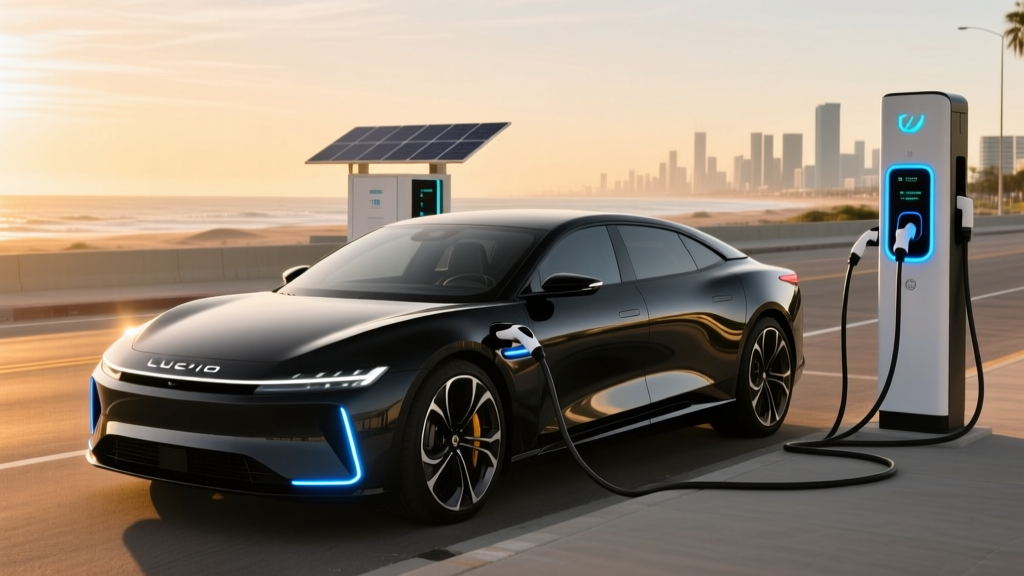
Charging is where the Gravity's 900V architecture pays dividends. Higher voltage means the vehicle can accept more power (kW) at lower amperage, reducing heat buildup and enabling faster sustained charge rates.
| Charging Level | Power / Rate | Speed / Notes |
|---|---|---|
| DC Fast Charge (peak) | Up to 300 kW | ~200 miles in ~15 minutes; 10–80% in approximately 22 minutes on a capable 350 kW charger |
| DC Fast Charge (sustained) | ~200–250 kW average (10–80%) | Charge curve tapers significantly above 80% SoC — expect 80–100% to take an additional 15+ minutes |
| Level 2 (240V, 48A home charger) | ~11.5 kW | ~22–25 miles of range per hour; full 0–100% in ~11–12 hours |
| Level 2 (240V, 80A / Lucid Connected Home) | ~19.2 kW | ~38–42 miles per hour; 0–100% in ~6.5–7 hours (requires hardwired install and 100A circuit) |
| Level 1 (120V standard outlet) | ~1.4 kW | ~3 miles per hour — emergency/trickle use only |
Charging-curve reality check: The headline 300 kW peak is achieved only between roughly 10–40% state of charge (SoC). From 40–80%, the rate steps down progressively to around 150–180 kW. This is normal for NMC chemistry — the battery management system protects cell longevity by reducing current as the battery fills. Plan your road-trip stops around the 10–80% window for maximum efficiency, and don't expect a quick top-off from 80–100% at a fast charger.
Connector note: The 2026 Gravity ships with a native NACS (North American Charging Standard) port, giving it direct access to Tesla Supercharger V3 and V4 stalls — a network of over 25,000 U.S. chargers. For Electrify America, EVgo, and other CCS-based networks, a NACS-to-CCS adapter is included. This dual-network access is a significant ownership advantage in 2026.
Interior Space, Cargo, and Three-Row Practicality
The Gravity seats up to seven passengers in a 2-3-2 configuration, though a six-seat layout (2-2-2 with second-row captain's chairs) is available on the Grand Touring trim. Lucid's "space concept" design philosophy pushes the cabin forward, creating a surprisingly open interior despite the vehicle's relatively sleek exterior profile.
- Cargo volume (behind 3rd row): ~22 cu ft — enough for several carry-on bags or a week's groceries for a family of five
- Cargo volume (3rd row folded): ~58 cu ft — competitive with the BMW iX and more usable than the Model X's rear cargo area
- Cargo volume (all rear seats folded): ~110 cu ft — flat load floor suitable for furniture or large gear
- Frunk (front trunk): ~12 cu ft — a genuine differentiator; fits a large carry-on or charging cables and road-trip supplies
- Third-row legroom: ~32 inches — adequate for children and shorter adults on trips under two hours; tighter than a minivan but competitive for the segment
- Second-row legroom: ~39 inches — generous for adults
The Gravity's glass canopy roof extends from the windshield to the rear hatch, flooding the cabin with natural light and reducing the "tunnel" feeling common in three-row SUVs. Lucid has also engineered the third row with a lower floor pan than competitors, so passengers aren't sitting knees-up in a penalty-box position.
Pricing, Trims, and Federal Tax Credit Eligibility
| Trim | Base MSRP | Federal Credit (§30D) | Effective Price |
|---|---|---|---|
| Gravity Touring | ~$81,400 (est.) | Up to $7,500* | ~$73,900 |
| Gravity Grand Touring | ~$96,400 | Up to $7,500* | ~$88,900 |
| Gravity Sapphire (performance) | ~$125,000+ (announced) | $0 — exceeds MSRP cap | ~$125,000+ |
*Federal EV tax credit (IRS §30D) eligibility is not automatic. For 2026, the following conditions apply:
- MSRP cap: SUVs/vans/pickups must have an MSRP ≤ $80,000. The Gravity Touring qualifies; the Grand Touring and Sapphire exceed the cap and are not eligible for the new-vehicle credit.
- Buyer income limits: Modified AGI must not exceed $300,000 (joint filers), $225,000 (head of household), or $150,000 (single).
- Battery sourcing: A percentage of critical minerals and battery components must be sourced from the U.S. or FTA partners. Lucid has been actively reshoring supply chains, but verify the specific VIN's compliance on the IRS's eligible vehicle list before purchase.
- Point-of-sale transfer: As of 2024, the credit can be transferred to the dealer at purchase, reducing the purchase price directly rather than waiting for tax filing. This applies to the Touring trim if eligible.
- Assembly: Must be assembled in North America. The Gravity is built in Casa Grande, AZ — this requirement is satisfied.
Source: IRS.gov — Credits for New Clean Vehicles. Tax rules change frequently; consult a tax professional before purchase.
The Grand Touring's ineligibility for the federal credit is a real consideration. However, many states offer additional incentives — California's CVRP, Colorado's innovative motor vehicle credits, and various utility-company rebates can offset $2,000–$7,500 depending on your location. Check your state energy office and local utility for current programs.
Tech, Driver Assistance, and Software
Lucid's infotainment system centers on a 34-inch curved glass cockpit display that spans the driver's instrument cluster and central touchscreen in a single curved panel. A secondary lower touchscreen handles climate controls, media, and vehicle settings. The system runs Lucid's proprietary software — responsive, visually clean, and integrated with over-the-air (OTA) update capability.
DreamDrive Pro is Lucid's advanced driver-assistance suite, featuring:
- Adaptive cruise control with stop-and-go
- Lane-centering assist
- Automatic emergency braking with pedestrian detection
- Blind-spot monitoring with rear cross-traffic alert
- 360-degree camera system
- Highway assist (hands-on-wheel, lane-centering on divided highways)
DreamDrive Pro is a Level 2 driver-assistance system per SAE classification. This means the driver must remain fully attentive, with hands on the steering wheel and eyes on the road at all times. It is not self-driving, autonomous, or Level 4. Lucid has not announced a hands-free highway system comparable to GM's Super Cruise or Ford's BlueCruise as of this writing — though OTA updates may expand capabilities.
Standout tech features:
- Clearview glass canopy roof — the largest single pane of automotive glass in production, creating an airy cabin
- Surreal Stealth mode — a dark-themed UI and ambient lighting preset for nighttime driving
- RangeXchange — Lucid's bi-directional charging capability (V2H/V2G), allowing the Gravity to power home circuits during outages (requires compatible home energy hardware, sold separately)
- Phone-as-key with Ultra-Wideband (UWB) for seamless entry
Notable drawbacks:
- The lower touchscreen's haptic-only climate controls lack physical buttons — some drivers find this distracting
- No native Apple CarPlay or Android Auto — Lucid's system handles phone integration through its own interface, which frustrates users who prefer mirroring
- DreamDrive Pro's highway assist requires frequent torque confirmation on the steering wheel, which some find more intrusive than competitors' capacitive-sensing systems
- Lucid's service center network remains thin outside major metros — mobile service helps, but body repair and major warranty work may require travel
Who Should Buy the Lucid Gravity?
Choose the Lucid Gravity if:
- You need three rows and 400+ mile range — no other EV SUV offers both
- You road-trip frequently and want to minimize charging stops (440 mi EPA means one stop on most 700-mile routes)
- You value a premium, minimalist interior with genuine third-row usability
- You want NACS native access to the Tesla Supercharger network without an adapter hassle
- You tow up to 6,000 lbs (boat, camper, horse trailer) and need electric torque
Look elsewhere if:
- Your budget is under $80,000 — the Rivian R1S or Kia EV9 offer three rows at lower price points
- You need hands-free highway driving — GM's Super Cruise or Ford's BlueCruise offer true hands-off Level 2+ on mapped highways
- You rely on Apple CarPlay or Android Auto — Lucid does not support phone mirroring
- You live far from a Lucid service center and cannot tolerate potential delays for warranty work
- You want the absolute fastest-charging SUV — the Hyundai Ioniq 9 and Kia EV9 (800V architecture) charge comparably fast at a lower price
Gravity vs. the Competition
| Attribute | Lucid Gravity GT | Tesla Model X | Rivian R1S (Tri-Motor) | Kia EV9 (GT-Line AWD) |
|---|---|---|---|---|
| EPA Range | 440 mi | ~335 mi | ~390 mi | ~280 mi |
| Base MSRP | ~$96,400 | ~$81,630 | ~$89,900 | ~$60,900 |
| 0–60 mph | 3.5 sec | 3.8 sec (Plaid: 2.5) | ~3.6 sec | 5.0 sec |
| Max DC Charge | 300 kW | 250 kW | 220 kW | 238 kW |
| Third Row | Yes (3-across bench or captains) | Yes (tight) | Yes | Yes |
| Fed. Tax Credit | Touring only* | Eligible* | Eligible* | Eligible* |
| NACS Native | Yes | Yes | Adapter | Adapter |
*Tax credit eligibility subject to MSRP caps, income limits, and battery sourcing requirements. Verify on fueleconomy.gov before purchase.
The Gravity's range advantage is unmistakable — it leads the segment by 50–100 miles. But the Model X undercuts it on price by $15,000 and offers the Plaid's absurd 2.5-second 0–60. The Rivian R1S provides genuine off-road capability the Gravity lacks. And the Kia EV9 delivers three-row practicality starting $35,000 below the Gravity's Grand Touring. The right choice depends on whether range, performance, or value is your priority.
Warranty and Long-Term Ownership
- Basic vehicle warranty: 4 years / 50,000 miles
- Battery & powertrain warranty: 8 years / 100,000 miles (covers battery capacity retention above 70% of original)
- Roadside assistance: 4 years / 50,000 miles
- OTA updates: Included for the life of the vehicle
Lucid's 8-year/100,000-mile battery warranty is standard for the premium EV segment. The 70% capacity retention threshold means that if your battery degrades below 70% of its original usable capacity within the warranty period, Lucid will repair or replace it. In practice, NMC batteries with active thermal management typically retain 85–92% capacity at 100,000 miles based on industry data from older Tesla and Hyundai EVs. Lucid's efficient thermal system should deliver similar or better results, though the Gravity is too new for long-term fleet data.
Insurance costs will be a factor. Based on early 2026 quotes from major carriers, expect annual premiums of $2,800–$4,200 for the Grand Touring, depending on your driving record, location, and coverage level. This is roughly 25–40% higher than a comparably priced gas SUV — a reality for most performance EVs due to higher repair costs and parts pricing.
Frequently Asked Questions
What is the real-world range of the Lucid Gravity?
The EPA rates the Gravity Grand Touring at 440 miles. In real-world mixed driving, expect 380–420 miles. On a sustained 75-mph highway run, plan for 350–390 miles. In cold weather (below freezing), range drops to approximately 310–350 miles. The 440-mile figure is achievable in moderate-temperature city and suburban driving with regular regenerative braking.
How fast does the Lucid Gravity charge?
On a 350 kW DC fast charger, the Gravity peaks at 300 kW and can add approximately 200 miles of range in 15 minutes. A 10–80% charge takes roughly 22 minutes. At home on a 48-amp Level 2 charger (11.5 kW), expect a full charge in about 11–12 hours. With an 80-amp hardwired charger (19.2 kW), a full charge takes approximately 6.5–7 hours.
Does the Lucid Gravity qualify for the $7,500 federal tax credit?
The Gravity Touring (estimated MSRP ~$81,400) may qualify, as it is near the $80,000 SUV MSRP cap — verify the exact as-configured MSRP and IRS eligibility for your specific VIN. The Grand Touring (~$96,400) and Sapphire exceed the MSRP cap and do not qualify for the new-vehicle federal credit. All trims require the buyer to meet income limits ($300K joint / $150K single) and the vehicle's battery must meet critical-mineral and component sourcing requirements. Always verify at IRS.gov and consult a tax professional.
Is the Lucid Gravity worth buying over the Tesla Model X or Rivian R1S?
If range is your top priority, the Gravity is unmatched at 440 miles EPA. The Model X offers a broader Supercharger-native ecosystem and the Plaid's extreme performance at a lower starting price. The Rivian R1S is the best choice if you need genuine off-road capability and a more rugged adventure profile. The Gravity wins on efficiency, interior luxury, and road-trip range — but loses on price and service-center accessibility.
What are the biggest pros and cons of the Lucid Gravity?
- Segment-leading 440-mile EPA range
- 300 kW DC fast charging with 900V architecture
- Spacious, light-filled three-row cabin with usable third row
- 800 hp and 3.5-second 0–60 in Grand Touring
- Native NACS port for Tesla Supercharger access
- 6,000-lb towing capacity
- Bi-directional charging (V2H) capability
- Grand Touring exceeds $80K MSRP cap — no federal tax credit
- No Apple CarPlay or Android Auto
- DreamDrive Pro requires frequent steering-wheel torque confirmation
- Limited service center network outside major metros
- High insurance premiums ($2,800–$4,200/yr est.)
- Starting price significantly above Rivian R1S and Kia EV9
- No hands-free highway driving mode (Level 2 only)
Can the Lucid Gravity power my home during an outage?
Yes, via Lucid's RangeXchange bi-directional charging feature (V2H). With a compatible home energy management system and a bi-directional charger installed by a licensed electrician, the Gravity's ~118 kWh battery can power an average home for 3–5 days during an outage. This is one of the largest mobile batteries available in any consumer vehicle, rivaling dedicated home battery systems.
Specifications and pricing based on manufacturer data and industry reporting as of mid-2026. Verify all figures with Lucid Motors and the IRS before purchase. Real-world range and charging speeds vary based on temperature, driving style, terrain, and charger availability.