Quick Verdict: The Lucid Gravity Sets a New Three-Row EV Benchmark
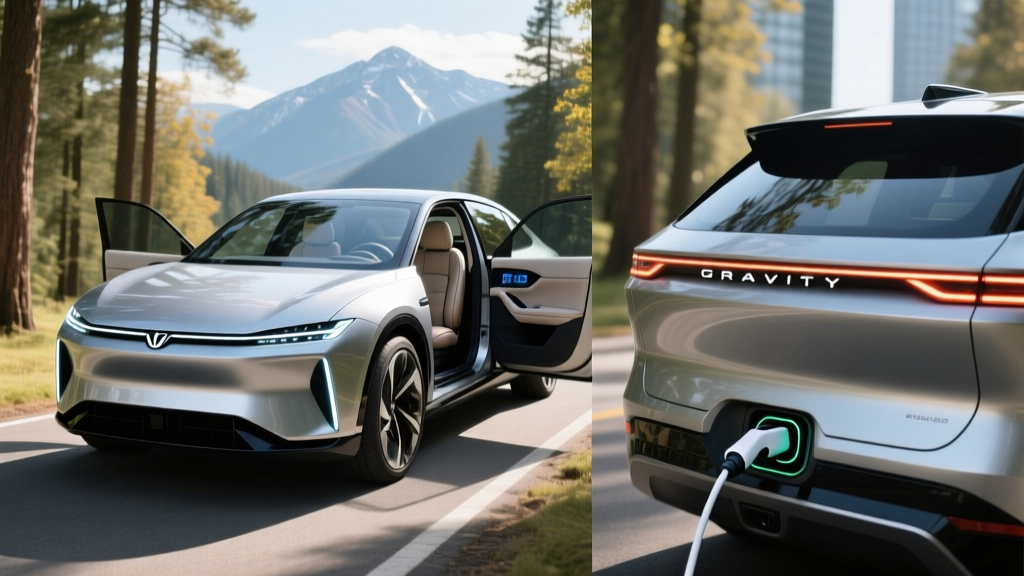
The 2026 Lucid Gravity arrives with a proposition that sounds contradictory: a three-row luxury SUV that hits 60 mph in 3.5 seconds, delivers up to 440 miles of EPA-estimated range, and charges faster than almost any other large electric vehicle on the road. After spending time with the Gravity's published specifications, real-world efficiency data, and the competitive landscape, the verdict is clear — Lucid's second model is the most technically accomplished electric family hauler available in 2026, provided you can stomach the starting price and navigate the federal tax credit's strict eligibility requirements.
The Gravity is not simply an enlarged Lucid Air sedan. It rides on a reengineered platform with a flat-floor battery pack that preserves interior volume, an 800V+ electrical architecture enabling class-leading DC fast-charge speeds, and a dual-motor all-wheel-drive system producing up to 828 horsepower in Grand Touring trim. For buyers cross-shopping the Tesla Model X, Rivian R1S, and BMW iX, the Gravity introduces a set of trade-offs that deserve careful examination.
| Specification | Pure (Base) | Grand Touring |
|---|---|---|
| EPA Range (est.) | ~440 mi | ~440 mi |
| Usable Battery (kWh) | ~112 kWh (NMC) | ~112 kWh (NMC) |
| Drivetrain | Dual-Motor AWD | Dual-Motor AWD |
| Horsepower | ~620 hp | 828 hp |
| 0-60 mph | ~3.7 sec | 3.5 sec |
| Peak DC Fast Charge | ~300 kW | ~300+ kW |
| 10-80% DCFC Time | ~22 min | ~22 min |
| Level 2 Home Charge | 19.2 kW (AC) | 19.2 kW (AC) |
| Efficiency (MPGe est.) | ~110 MPGe combined | ~105 MPGe combined |
| Base MSRP | ~$79,900 | ~$94,900 |
| Battery/Powertrain Warranty | 8 yr / 100,000 mi | 8 yr / 100,000 mi |
Lucid Gravity 0-60 and Performance: How Fast Is It Really?
The search that brought you here — "Lucid Gravity 0-60" — has a straightforward answer: 3.5 seconds in the Grand Touring trim. That figure places the Gravity in supercar territory for acceleration, rivaling the Tesla Model X Plaid (2.5 sec) while offering significantly more cargo and passenger volume. The base Pure trim, with its detuned dual-motor setup producing approximately 620 horsepower, still manages a 0-60 time around 3.7 seconds — faster than most performance SUVs with internal combustion engines.
But acceleration is only one dimension of the Gravity's powertrain story. Lucid's in-house-developed electric motors are notably compact and lightweight compared to competitors, a design philosophy carried over from the Air sedan. The result is a lower center of gravity and more interior packaging freedom. The Gravity uses a dual-motor all-wheel-drive configuration across all trims, with torque vectoring that actively distributes power between front and rear axles for improved cornering stability.
Top speed is electronically limited to approximately 145 mph on the Grand Touring — irrelevant for daily driving but indicative of the motor's headroom. More relevant to real-world driving: the Gravity's regenerative braking system offers adjustable intensity, including a near-one-pedal-driving mode that recovers energy aggressively in city traffic. Unlike some competitors, Lucid does not offer a true one-pedal stop-and-hold mode, which means you will still use the friction brake pedal for complete stops.
Range and Efficiency: EPA Sticker vs. Real-World Expectations
EPA Estimated: ~440 miles (Grand Touring)
Real-World Highway (70-80 mph): Expect ~340–370 miles
Cold Weather (below 32°F): Expect ~300–340 miles
Combined Mixed Driving: ~380–410 miles achievable
Lucid's efficiency engineering is arguably the strongest differentiator in the brand's portfolio. The Air sedan holds the record for the highest EPA efficiency of any production EV, and the Gravity inherits much of that technology — including low-drag aerodynamics (despite the SUV form factor), silicon carbide inverters, and a heat pump for climate control that minimizes energy draw in cold weather.
The ~112 kWh usable battery pack uses NMC (nickel manganese cobalt) chemistry, chosen for its higher energy density compared to LFP (lithium iron phosphate). This is a deliberate trade-off: LFP batteries are heavier but more durable over thousands of cycles and can be charged to 100% daily without accelerated degradation. NMC offers more range per kilogram but benefits from daily charging limits of 80-90% for longevity. Lucid's battery management system includes a substantial buffer above and below the usable range to protect cell health over time.
Efficiency is projected at approximately 110 MPGe combined for the Pure trim and 105 MPGe for the heavier, more powerful Grand Touring. In kWh/100mi terms — a more precise metric for EV owners tracking electricity costs — expect roughly 30-33 kWh/100mi in mixed driving. That translates to roughly $0.04–$0.06 per mile when charging at home on a national average electricity rate of $0.16/kWh, compared to $0.12–$0.15 per mile for a comparable gasoline SUV at $3.50/gallon.
According to fueleconomy.gov, the Gravity's efficiency figures place it among the top-tier large electric SUVs, significantly ahead of the Rivian R1S and competitive with the BMW iX despite the Gravity's larger battery and three-row seating.
Charging Speed: 800V Architecture Explained
The Lucid Gravity's 800-volt electrical architecture is the key to its charging performance. Most mainstream EVs still use 400V systems, which limits peak charge rates and generates more heat during fast charging. The Gravity's 800V+ system enables peak DC fast-charge rates exceeding 300 kW, translating to a 10-80% charge in approximately 22 minutes under ideal conditions.
| Charge Level | Power | Miles Added per Hour | Notes |
|---|---|---|---|
| Level 1 (120V household) | ~1.4 kW | ~4-5 mi/hr | Emergency/trickle only |
| Level 2 (240V home) | 19.2 kW | ~65-70 mi/hr | Requires 100A circuit; 80A charger |
| DC Fast Charge (CCS/NACS) | Peak 300+ kW | ~200+ mi in 15 min | 800V station required for peak rate |
A critical nuance that spec sheets obscure: peak kW is not sustained kW. The Gravity will hit 300+ kW in the 10-30% state-of-charge window, then progressively taper as the battery fills. The 10-80% time of ~22 minutes represents an average rate closer to 200 kW. Above 80%, charging slows dramatically to protect cell health — a 80-100% top-off can add 20+ additional minutes. Plan your road-trip stops around 10-80% sessions for the best time efficiency.
For home charging, the Gravity supports up to 19.2 kW AC on Level 2, which is among the highest in the industry. Most home Level 2 chargers deliver 11.5 kW (48A on a 60A circuit), which will add roughly 40 miles per hour — still enough for a full overnight charge. To unlock the full 19.2 kW, you need a dedicated 100-amp circuit and a hardwired charger capable of 80 amps. This is a significant electrical upgrade for many homes; consult a licensed electrician to assess your panel capacity.
The Gravity ships with a NACS (North American Charging Standard) port, granting native access to the Tesla Supercharger network — the most reliable and expansive DC fast-charging network in North America. For Electrify America, EVgo, and other CCS-based networks, a NACS-to-CCS adapter may be required depending on the station's connector configuration. As of 2026, most major networks are adding NACS cables, but CCS stations remain common in many regions.
Interior Space, Technology, and Daily Livability
The Gravity seats up to seven passengers across three rows, though the third row is best suited for children or occasional adult use on short trips. Cargo volume is class-competitive: approximately 35 cubic feet behind the second row and over 80 cubic feet with the second row folded flat. The front trunk (frunk) adds a useful 12-15 cubic feet of weather-sealed storage — enough for charging cables, a weekend bag, or groceries you want separated from the main cabin.
Second-row legroom is generous at approximately 39 inches, and the flat floor (enabled by the skateboard-style battery pack) eliminates the transmission tunnel hump that compromises footroom in some converted ICE platforms. Third-row legroom is tighter at roughly 30 inches, consistent with the segment but noticeably less than a minivan.
The centerpiece of the Gravity's interior is a 34-inch curved glass OLED display that spans the upper dashboard, providing navigation, media, climate, and vehicle information in a single panoramic interface. A secondary lower touchscreen handles secondary controls. Lucid's infotainment system supports wireless Apple CarPlay and Android Auto, over-the-air software updates, and a built-in trip planner that accounts for elevation changes, temperature, and driving style when estimating range — a feature that outperforms generic navigation range calculators.
Driver assistance comes via Lucid's DreamDrive Pro system, which includes adaptive cruise control, lane-centering, automatic emergency braking, blind-spot monitoring, and a 360-degree camera system. Important: DreamDrive Pro is an SAE Level 2 system, meaning the driver must remain fully attentive with hands on the wheel. It is not autonomous or "self-driving" — only Level 4 services like Waymo operate without human supervision. The system is competent for highway cruising but does not offer hands-free operation like GM's Super Cruise or Ford's BlueCruise on mapped roads.
Pricing, Trims, and Federal Tax Credit Eligibility
| Trim | Base MSRP | Federal §30D Credit Eligibility | Effective Price (if eligible) |
|---|---|---|---|
| Pure | ~$79,900 | Not eligible (MSRP exceeds $80,000 SUV cap) | ~$79,900 |
| Grand Touring | ~$94,900 | Not eligible (MSRP exceeds $80,000 SUV cap) | ~$94,900 |
The IRS §30D federal tax credit imposes an MSRP cap of $80,000 for SUVs, vans, and pickup trucks. The Lucid Gravity Pure, at approximately $79,900, sits at the very edge of this threshold — but destination fees, mandatory options, or dealer-installed packages can push the final MSRP above the cap, disqualifying the vehicle. The Grand Touring, at ~$94,900, is definitively above the cap and does not qualify for the $7,500 federal credit regardless of buyer income or battery sourcing.
Even if the Pure trim technically qualifies on MSRP, the §30D credit requires the buyer to meet income thresholds (modified adjusted gross income below $300,000 for joint filers, $225,000 for heads of household, $150,000 for single filers), and the vehicle's battery components and critical minerals must meet escalating domestic-sourcing percentages. As of 2026, these sourcing requirements are stringent enough to disqualify many vehicles that otherwise meet price and income criteria. Always verify eligibility on the IRS website and consult a tax professional before assuming credit availability.
The credit can be transferred to the dealer at point of sale as an instant rebate (effective 2024), reducing the purchase price directly rather than requiring you to claim it on your tax return. If the Gravity Pure qualifies, this could bring the effective price to approximately $72,400 before state incentives.
State-level incentives vary widely. California's CVRP has been restructured, but some states offer rebates of $2,000-$5,000 for EVs in this price range. Check your state energy office or AFDC's state incentive database for current programs.
Lucid Gravity vs. the Competition: Which Three-Row EV Wins?
The Gravity's competitive set in 2026 is small but formidable:
- Tesla Model X: Faster (Plaid: 2.5 sec 0-60), more Supercharger access, lower starting price (~$79,990), but aging interior, lower EPA range (~335 mi), and no NACS adapter needed. Build quality remains inconsistent.
- Rivian R1S (Dual-Motor): Superior off-road capability, quad-motor option, more rugged aesthetic, ~410 mi EPA range on Max Pack, but slower DC charging (~200 kW peak) and higher price for comparable range.
- BMW iX xDrive50: Only two rows (5-passenger), ~324 mi range, premium interior, ~$87,000, but lacks three-row utility.
- Kia EV9 GT-Line AWD: Far more affordable (~$63,000), three rows, ~270 mi range, but significantly slower (0-60 in ~5.0 sec) and less range.
Choose the Lucid Gravity if: You prioritize maximum range (440 mi), fastest charging in the three-row segment, and a luxury sedan-like driving experience in an SUV body. Ideal for road-trip-heavy families who want to minimize charging stops.
Choose the Rivian R1S if: You need genuine off-road capability, prefer a more adventurous design, or want the quad-motor option for extreme performance. Accept slower charging as a trade-off.
Choose the Tesla Model X if: You want the lowest entry price in this segment, value Supercharger network simplicity, and can tolerate the aging interior and lower range.
Choose the Kia EV9 if: Budget is the primary concern, your daily commute is under 100 miles, and 270 miles of range is sufficient with occasional DC fast charging.
Pros, Cons, and Ownership Realities
- Class-leading 440-mi EPA range
- 300+ kW DC fast charging (10-80% in ~22 min)
- 3.5-sec 0-60 in Grand Touring trim
- True three-row seating with usable frunk
- 800V architecture future-proofs charging
- Heat pump standard for cold-weather efficiency
- NACS native — Supercharger access without adapter
- High starting price; likely no federal tax credit
- Lucid's service center network still limited vs. Tesla/BMW
- DreamDrive Pro is competent but not hands-free
- Third-row space is tight for adults on long trips
- NMC battery benefits from 80% daily charge limit
- 19.2 kW home charging requires expensive panel upgrade
- Brand is young — long-term reliability data is limited
Ownership costs beyond the purchase price deserve scrutiny. Insurance premiums for the Gravity are expected to run $2,500-$3,500 annually, consistent with luxury EVs in this price bracket. Tire costs are elevated — the Gravity uses large, low-rolling-resistance tires that can cost $300-$400 per corner and may need replacement every 25,000-35,000 miles due to the vehicle's weight and instant torque. Lucid's battery warranty covers 8 years or 100,000 miles with a capacity retention threshold of 70%, which is industry-standard but less generous than some competitors offering 80% thresholds.
Who Should Buy the Lucid Gravity?
The Gravity is purpose-built for families who take frequent road trips and refuse to compromise on range or charging speed. If your household logs 15,000+ miles per year with regular 200-400 mile highway drives, the Gravity's 440-mile range and 22-minute fast-charge sessions will save you meaningful time and anxiety compared to shorter-range competitors. The three-row configuration accommodates carpools and growing families, while the frunk and cargo volume handle luggage for week-long vacations.
It is less suited for buyers who prioritize off-road capability (choose the Rivian R1S), who need the lowest possible purchase price (Kia EV9), or who depend on a dense local service network (Tesla or legacy luxury brands). Urban-only commuters who rarely exceed 100 miles daily will not benefit from the Gravity's range and charging advantages enough to justify the premium over a less expensive three-row EV.
Frequently Asked Questions
What is the real-world range of the Lucid Gravity?
The EPA estimates approximately 440 miles. In real-world highway driving at 70-80 mph, expect 340-370 miles. In cold weather below freezing, plan for 300-340 miles. Mixed city/highway driving in moderate temperatures can achieve 380-410 miles.
How fast does the Lucid Gravity charge at home and on the road?
On a DC fast charger with 800V capability, the Gravity peaks above 300 kW and charges from 10-80% in roughly 22 minutes. At home on Level 2 (240V), it supports up to 19.2 kW, adding about 65-70 miles of range per hour — though most homes will need a panel upgrade to support the required 100A circuit.
Does the Lucid Gravity qualify for the federal EV tax credit?
It is unlikely. The IRS §30D credit caps SUV MSRP at $80,000. The Gravity Pure starts near $79,900, but destination fees and options typically push it above the threshold. The Grand Touring at ~$94,900 definitively exceeds the cap. Additionally, battery sourcing requirements and buyer income limits further restrict eligibility. Always verify on irs.gov.
Is the Lucid Gravity worth buying over the Tesla Model X or Rivian R1S?
If maximum range and fastest charging are your top priorities, yes — the Gravity leads both metrics in the three-row EV segment. If you need hands-free driving assistance, Tesla's FSD (Supervised) or GM Super Cruise in other vehicles may appeal more. If off-road use is important, the Rivian R1S is the clear choice.
What is the battery warranty on the Lucid Gravity?
Lucid covers the battery and powertrain for 8 years or 100,000 miles, whichever comes first, with a capacity retention guarantee of at least 70% of original capacity during the warranty period.
What type of battery chemistry does the Gravity use?
The Gravity uses NMC (nickel manganese cobalt) chemistry, chosen for its high energy density. Unlike LFP batteries, NMC benefits from daily charging limits of 80-90% to maximize long-term cell health. Lucid's battery management system includes software-configurable charge limits to support this.