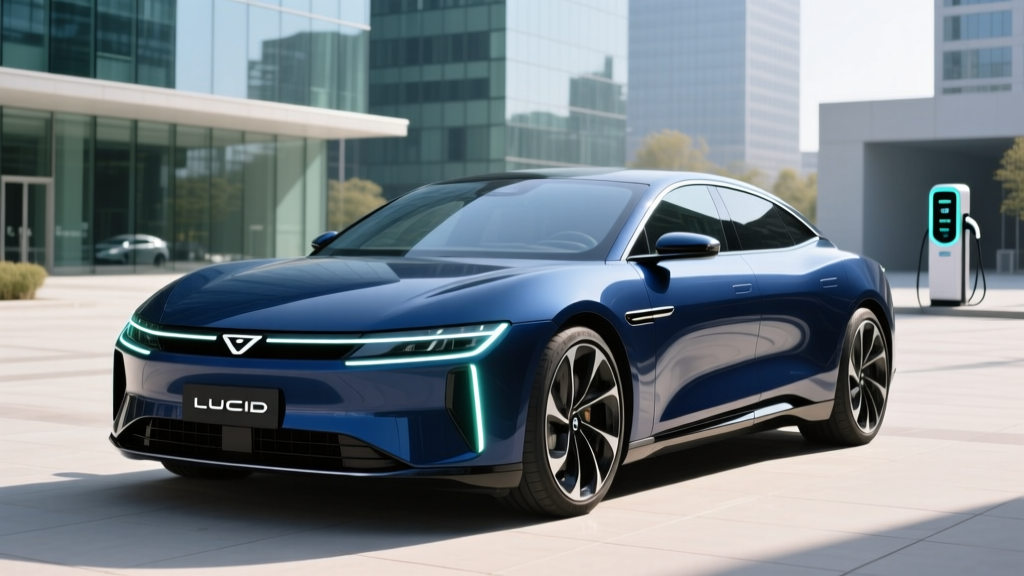
Rumors about Lucid Motors' financial stability have circulated in EV forums and financial press for months, prompting a blunt question from prospective buyers: is Lucid going out of business? The short answer as of mid-2026 is no — Lucid remains operational, continues to produce and deliver the Air sedan, and has secured significant backing from Saudi Arabia's Public Investment Fund (PIF). But the company's low production volumes, cash burn, and intense luxury-EV competition mean buyers should weigh real ownership risks against the Air's undeniable engineering achievements.
This review examines the 2026 Lucid Air across the metrics that matter — range, charging, performance, pricing, and tax-credit eligibility — while directly addressing the financial-health concerns shaping purchase decisions.
2026 Lucid Air: Core Specifications at a Glance
| Attribute | Pure | Touring | Grand Touring | Sapphire |
|---|---|---|---|---|
| EPA Range | 419 mi | 425 mi | 516 mi | 427 mi |
| Battery (usable) | 88 kWh (NMC) | 88 kWh (NMC) | 112 kWh (NMC) | 118 kWh (NMC) |
| Drivetrain | RWD | Dual-Motor AWD | Dual-Motor AWD | Tri-Motor AWD |
| Horsepower | 430 hp | 620 hp | 819 hp | 1,234 hp |
| 0–60 mph | 5.0 sec | 3.4 sec | 3.0 sec | 1.89 sec |
| MPGe (combined) | 146 MPGe | 131 MPGe | 131 MPGe | 109 MPGe |
| kWh/100 mi | 23 | 26 | 26 | 31 |
| Base MSRP | $69,900 | $78,900 | $110,900 | $249,000 |
All trims use nickel-manganese-cobalt (NMC) lithium-ion cells sourced primarily from LG Energy Solution and Samsung SDI. Lucid does not currently offer an LFP variant, which means the Air prioritizes energy density over the lower cost and longer cycle life associated with LFP chemistries. For a luxury sedan chasing 500+ miles, that tradeoff is intentional.
Real-World Range: What the EPA Number Doesn't Tell You
Lucid's efficiency advantage is real and measurable. According to fueleconomy.gov, the Grand Touring consumes 26 kWh per 100 miles — meaning it extracts more miles per kilowatt-hour than any competitor in its weight class. The Air's drag coefficient of 0.197 (the lowest of any production car) and its custom miniaturized drive units are the engineering reasons.
For context, the Tesla Model S Long Range (402 mi EPA) uses 30 kWh/100 mi. The Mercedes EQS 450+ (350 mi EPA) uses 31 kWh/100 mi. The Air Grand Touring simply does more with less energy, which is why range-anxiety concerns are largely moot for this vehicle.
Charging Speed: DC Fast, Level 2, and the Taper Reality
The Lucid Air supports a peak DC fast-charge rate of 300 kW on the Grand Touring and Sapphire trims (the Pure and Touring peak at approximately 200–220 kW). Lucid advertises 10–80% charging in roughly 15 minutes under optimal conditions — meaning a pre-conditioned battery at a 350 kW-capable CCS or NACS station.
| Charge Level | Power | Miles Added per Hour | Notes |
|---|---|---|---|
| Level 1 (120V) | ~1.4 kW | ~5–6 mi/hr | Emergency/trickle only |
| Level 2 (240V, 48A) | 11.5 kW | ~46 mi/hr | Full charge in ~10–12 hrs (GT) |
| Level 2 (240V, 80A) | 19.2 kW | ~77 mi/hr | Optional; requires 100A circuit |
| DC Fast (peak) | 300 kW (GT) | ~1,200 mi/hr (peak) | 10–80% in ~15 min |
| DC Fast (sustained) | ~180–220 kW avg | ~700–900 mi/hr avg | Real-world average to 80% |
Here's what the marketing doesn't emphasize: the 300 kW peak is sustained only between roughly 10–40% state of charge. Above 60%, the charge curve tapers significantly to protect the NMC cells, dropping to under 100 kW by 80%. This is standard behavior for NMC chemistry, and preconditioning via the car's navigation system is essential to achieving peak rates. If you arrive at a DC fast charger without preconditioning (for example, driving to a charger without routing through the nav), expect peak rates closer to 150–180 kW.
Lucid uses the NACS (Tesla-style) connector on 2026 models, granting direct access to Tesla Superchargers — a significant advantage over CCS-only vehicles. The Air can also use CCS stations via adapter.
Performance, Interior, and Technology
The Air's powertrain is its strongest competitive argument. Even the base Pure delivers 430 hp from a single rear motor, with smooth, immediate torque. The Grand Touring's 819 hp and dual-motor AWD produce a 3.0-second 0–60 time that embarrasses most supercars. The Sapphire's 1,234 hp and 1.89-second 0–60 exist in hypercar territory, though at $249,000, it competes with Rimac rather than BMW.
Interior dimensions are generous for a sedan:
- Front legroom: 41.1 inches
- Rear legroom: 38.0 inches
- Cargo (trunk + frunk): 32 cu ft total (26 cu ft trunk, 6 cu ft frunk)
- Wheelbase: 116.5 inches
The glass canopy roof creates an airy, open cabin, and the 34-inch curved Lucid UX infotainment display dominates the dash. Wireless Apple CarPlay and Android Auto are standard. The DreamDrive ADAS suite uses LiDAR (a differentiator over Tesla's camera-only approach) and provides SAE Level 2 driver assistance — meaning the driver must remain engaged at all times. This is not self-driving; it is an advanced cruise-and-lane-centering system comparable to GM's Super Cruise or Ford's BlueCruise.
Notable drawbacks: The Lucid UX infotainment system, while visually striking, has drawn criticism for slow response times and occasional software glitches. The absence of physical climate control knobs frustrates some drivers. Rear-seat headroom is slightly compromised by the sloping roofline for taller passengers. And the service center network remains thin outside major metro areas — a real concern if you live in a smaller market.
Pricing, Tax Credits, and What You'll Actually Pay
| Trim | Base MSRP | As-Tested (typical) | §30D Credit Eligible? | Effective Price |
|---|---|---|---|---|
| Pure | $69,900 | $72,000–$76,000 | Potentially (see rules) | From ~$62,400 |
| Touring | $78,900 | $82,000–$88,000 | No (MSRP cap) | $78,900+ |
| Grand Touring | $110,900 | $115,000–$125,000 | No (MSRP cap) | $110,900+ |
| Sapphire | $249,000 | $249,000+ | No (MSRP cap) | $249,000+ |
Under current IRS §30D rules, the federal EV tax credit provides up to $7,500, but eligibility depends on several factors:
- MSRP cap: Sedans must have an MSRP at or below $55,000. The Air Pure's base price of $69,900 exceeds this cap, meaning no Air trim currently qualifies for the new-vehicle §30D credit based on MSRP alone.
- Income limits: Modified AGI must not exceed $300,000 (joint), $225,000 (head of household), or $150,000 (single).
- Battery sourcing: Critical mineral and battery component sourcing requirements must be met — a moving target that shifts annually.
- Point-of-sale transfer: Eligible buyers can transfer the credit to the dealer for an instant price reduction, but only if the vehicle itself qualifies.
The bottom line: the Lucid Air does not qualify for the federal new-vehicle tax credit due to its MSRP. Buyers seeking credit-eligible luxury EVs should look at vehicles below the $55,000 sedan cap. State and local incentives may still apply — check your state's energy office for details.
Is Lucid Going Out of Business? The Financial Reality
Lucid's financial position warrants honest scrutiny. As of Q1 2026 filings, the company has burned through significant cash reserves since launching production in late 2021. Annual deliveries have remained well below Tesla, BMW, and Mercedes volumes — Lucid delivered approximately 8,000–10,000 vehicles in 2025, compared to Tesla's millions.
However, several factors argue against an imminent shutdown:
- PIF backing: Saudi Arabia's Public Investment Fund holds a roughly 60% stake in Lucid and has repeatedly injected capital. The PIF views Lucid as a strategic asset in Saudi Vision 2030's industrial diversification plans.
- Gravity SUV launch: The Lucid Gravity three-row SUV began deliveries in late 2024/2025, opening a much larger market segment.
- Technology licensing: Lucid's powertrain technology has attracted licensing interest, including a notable Aston Martin partnership.
- AMP manufacturing plant: The Casa Grande, Arizona factory has capacity to scale well beyond current output.
That said, buyers should be aware of real risks: thin service-center coverage, potential long wait times for parts, uncertain resale values given brand volatility, and the possibility of reduced software update cadence if the company tightens spending. Purchasing a Lucid Air in 2026 means accepting that you're buying from a low-volume startup, not a legacy automaker with 5,000 dealerships.
Lucid Air vs. Key Competitors
| Spec | Lucid Air GT | Tesla Model S LR | Mercedes EQS 450+ | BMW i7 xDrive60 |
|---|---|---|---|---|
| EPA Range | 516 mi | 402 mi | 350 mi | 318 mi |
| Battery | 112 kWh NMC | ~100 kWh | 107.8 kWh NMC | 101.7 kWh NMC |
| 0–60 mph | 3.0 sec | 3.1 sec | 5.9 sec | 4.5 sec |
| Peak DC Charge | 300 kW | 250 kW | 200 kW | 195 kW |
| Base MSRP | $110,900 | $79,990 | $105,550 | $120,295 |
| Efficiency (kWh/100mi) | 26 | 30 | 31 | 35 |
The Air Grand Touring wins on range and efficiency by a wide margin. The Model S wins on Supercharger network access (though the Air's NACS adoption narrows this gap), brand stability, and price. The EQS and i7 win on dealer support, service infrastructure, and brand cachet. Your priority list determines the winner.
Pros
- Industry-leading 516-mile EPA range (GT)
- Best-in-class efficiency at 26 kWh/100 mi
- 300 kW peak DC fast charging
- NACS connector for Supercharger access
- Spacious cabin with 38" rear legroom
- LiDAR-equipped DreamDrive ADAS
- Class-leading 0–60 performance across trims
Cons
- No federal tax credit eligibility (MSRP cap)
- Limited service center network
- Infotainment responsiveness complaints
- Company financial uncertainty
- Low production volume = potential parts delays
- Uncertain long-term resale values
- No physical climate controls
Who Should Buy the Lucid Air — And Who Shouldn't
Look elsewhere if: You need guaranteed long-term dealer support, you want a tax-credit-eligible vehicle, you live in a rural area far from Lucid service, or you prioritize resale-value predictability.
The Air is the right car for range-maximizing commuters, tech-forward professionals, and EV enthusiasts who value engineering over badge prestige. It is the wrong car for risk-averse buyers who want the security of a 100-year-old automaker behind their warranty.
Frequently Asked Questions
What is the real-world range of the Lucid Air?
The Grand Touring achieves 516 miles EPA. Real-world highway driving yields approximately 380–420 miles in moderate weather and 320–360 miles in freezing conditions. The Pure RWD delivers around 360–380 highway miles in practice.
How fast does the Lucid Air charge?
DC fast charging peaks at 300 kW on the Grand Touring, achieving 10–80% in approximately 15 minutes with preconditioning. Home Level 2 charging at 11.5 kW (48A) adds about 46 miles per hour, filling the Grand Touring's 112 kWh battery overnight.
Does the Lucid Air qualify for the federal EV tax credit?
No. Under IRS §30D, new sedans must have an MSRP of $55,000 or less. The least expensive Air Pure starts at $69,900, making all trims ineligible for the federal new-vehicle credit.
Is it worth buying a Lucid Air vs. a Tesla Model S?
If range and efficiency are your top metrics, the Air wins decisively (516 vs. 402 miles, 26 vs. 30 kWh/100 mi). If brand stability, service infrastructure, and lower pricing matter more, the Model S is the safer buy. Both now use NACS connectors.
What is Lucid's battery warranty?
Lucid provides an 8-year/100,000-mile battery and powertrain warranty, with coverage for capacity loss below 70% of original capacity. This is competitive with Tesla's 8-year/150,000-mile coverage, though Tesla offers a slightly longer mileage term.
Will Lucid honor warranties if the company struggles financially?
This is the core risk of buying from a low-volume startup. While PIF backing reduces the likelihood of sudden collapse, warranty enforcement depends on the company's continued operation. Consider purchasing from a source that offers supplemental warranty protection, and maintain records meticulously.