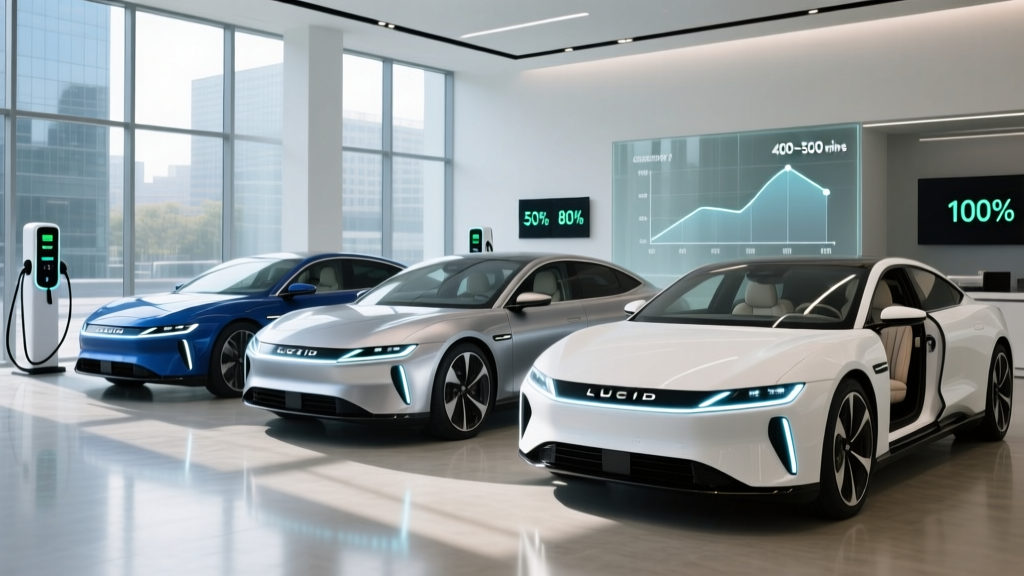
If you have been tracking Lucid EV deliveries 2025, you already know the company reached an inflection point this year. The Casa Grande, Arizona factory ramped output of the Air sedan while the Gravity three-row SUV finally entered customer hands after a delayed launch. But delivery volume only matters if the vehicles themselves deliver on their spec-sheet promises. Below is a data-driven profile of both models as they stand entering the 2026 model year, with real-world range reconciliation, charging-curve realities, and tax-credit math that Lucid's marketing materials tend to gloss over.
2026 Lucid Air: The Efficiency King Holds the Crown
The Lucid Air remains the most energy-efficient long-range sedan on the U.S. market. The Pure RWD trim starts at $69,900 and delivers an EPA-estimated 420 miles of range from a 92 kWh (usable) battery pack. The Touring AWD bumps that to 405 miles with dual motors, while the Grand Touring pushes the pack to 112 kWh usable and an EPA-estimated 516 miles — still the highest of any production EV sold in the United States, per fueleconomy.gov.
| Spec | Pure RWD | Touring AWD | Grand Touring AWD |
|---|---|---|---|
| EPA Range | 420 mi | 405 mi | 516 mi |
| Battery (usable) | 92 kWh (NMC) | 92 kWh (NMC) | 112 kWh (NMC) |
| Horsepower | 430 hp | 620 hp | 1,050 hp |
| 0–60 mph | 5.0 sec | 3.4 sec | 3.0 sec |
| Drivetrain | RWD (single motor) | AWD (dual motor) | AWD (dual motor) |
| Efficiency (MPGe) | 146 MPGe | 134 MPGe | 131 MPGe |
| kWh/100 mi | 23 | 25 | 26 |
| Base MSRP | $69,900 | $77,900 | $110,900 |
Real-World Range Reality Check
EPA sticker: 420–516 miles depending on trim.
Expect in practice: Sustained 75-mph highway driving nets roughly 350–380 miles (Pure) or 430–460 miles (Grand Touring). In freezing temperatures (below 32°F), add a 20–30% range penalty, dropping the Pure to roughly 290–340 miles on a full charge. Lucid's heat pump and thermal management system mitigate some of this, but physics is physics — cold electrolyte means higher internal resistance and cabin-heating load.
Charging Speed: 300 kW Peak, but Read the Curve
The Air uses a 900V+ electrical architecture that enables a peak DC fast-charge rate of up to 300 kW on compatible chargers. On an Electrify America or EVgo 350-kW stall, the Grand Touring can add roughly 200 miles of range in 12 minutes under ideal conditions. However, peak rate is not sustained rate.
| Charging Level | Power / Rate | Time / Range Added |
|---|---|---|
| DC Fast Charge (peak) | Up to 300 kW | 10–80% in ~20 min (ideal) |
| DC Fast Charge (sustained avg.) | ~170 kW avg. (10–80%) | ~25 min to 80% |
| Level 2 (home, 48A / 11.5 kW) | 11.5 kW | ~35 miles of range per hour |
| Level 2 (80A Wall Connector) | 19.2 kW | ~60 miles of range per hour |
| Level 1 (120V outlet) | ~1.4 kW | ~4 miles per hour |
The charge curve tapers noticeably above 60% state of charge and drops sharply past 80%. If you're road-tripping, the practical strategy is to charge from 10% to 80% and go — the last 20% can take nearly as long as the first 70%. For daily home charging, a 48-amp Level 2 wall unit on a 60-amp circuit adds roughly 35 miles per hour of plug-in time, which is more than sufficient for overnight replenishment.
2026 Lucid Gravity: The Three-Row Challenger
The Gravity is the vehicle Lucid needs to scale deliveries meaningfully. The luxury EV SUV market is crowded — Tesla Model X, Rivian R1S, BMW iX, Mercedes EQS SUV — and the Gravity's value proposition rests on range and interior volume rather than brute performance.
| Spec | Grand Touring | Touring | Pure (late availability) |
|---|---|---|---|
| EPA Range | 440 mi | 390 mi (est.) | TBA |
| Battery (usable) | 123 kWh (NMC) | ~100 kWh (NMC) | TBA |
| Horsepower | 823 hp | 600 hp (est.) | TBA |
| 0–60 mph | 3.5 sec | ~4.5 sec (est.) | TBA |
| Drivetrain | AWD (dual motor) | AWD (dual motor) | RWD (expected) |
| Towing Capacity | 6,000 lbs | 6,000 lbs | TBA |
| Base MSRP | $94,900 | $79,900 | ~$69,900 (announced) |
Cargo volume behind the third row is approximately 30 cubic feet, expanding to roughly 65 cu ft with the third row folded and over 100 cu ft with both rear rows down. Front legroom measures 41.7 inches; second-row legroom is 39.4 inches; the third row offers 34.5 inches — tight for adults on long trips but adequate for children. The Gravity also features a front trunk (frunk) with roughly 7 cu ft of additional storage.
For buyers tracking Lucid EV deliveries 2025, the Gravity Grand Touring began reaching customers in early-to-mid 2025. The Touring trim followed, and the Pure RWD variant is expected to enter production later — likely as a 2027 model-year vehicle. If you need the lowest-cost Gravity, patience is required.
Pricing, Tax Credits, and the §30D Reality Check
Lucid's pricing positions both vehicles firmly in the luxury segment. The Air Pure at $69,900 technically falls under the IRS §30D MSRP cap of $55,000 for sedans — wait, it does not. The $55,000 sedan cap means no Air trim qualifies for the full $7,500 new clean vehicle credit. The Gravity, classified as an SUV, benefits from the higher $80,000 MSRP cap, which means the Touring at $79,900 potentially qualifies, while the Grand Touring at $94,900 does not.
| Model / Trim | MSRP | §30D Eligible? | Effective Price (with credit) |
|---|---|---|---|
| Air Pure RWD | $69,900 | No (exceeds $55K sedan cap) | $69,900 |
| Air Touring AWD | $77,900 | No (exceeds $55K sedan cap) | $77,900 |
| Air Grand Touring | $110,900 | No | $110,900 |
| Gravity Touring | $79,900 | Potentially (under $80K SUV cap)* | ~$72,400* |
| Gravity Grand Touring | $94,900 | No (exceeds $80K SUV cap) | $94,900 |
*Critical caveats on the Gravity Touring credit: Even if MSRP qualifies, the buyer must meet IRS income caps ($150K single / $300K joint MAGI), and the vehicle must satisfy critical-mineral and battery-component sourcing requirements that shift annually. As of the 2026 tax year, the battery-component rule requires 100% of components to be manufactured or assembled in North America to qualify for the full $7,500 — a threshold that eliminates many vehicles. Always verify current sourcing compliance on the IRS eligible-vehicle list before counting on the credit. The credit can now be transferred to the dealer at point of sale, reducing your out-of-pocket at purchase rather than waiting for a tax refund.
Interior Tech, Driver Assists, and Standout Features
Lucid's Glass Canopy display stretches 34 inches across the dashboard — a curved, 6K-resolution panel that replaces a traditional instrument cluster and infotainment screen. The system runs Lucid's proprietary infotainment OS with native navigation, streaming apps, and over-the-air update capability. Wireless Apple CarPlay is supported; Android Auto is available wirelessly as well.
The DreamDrive Pro ADAS suite includes adaptive cruise control, lane-centering assist, automated parking, and a 32-sensor array (cameras, radar, lidar, ultrasonics). This is a SAE Level 2 driver-assistance system — meaning you must keep hands on the wheel and eyes on the road at all times. It is not autonomous driving, and Lucid does not currently offer a hands-free highway system comparable to GM's Super Cruise or Ford's BlueCruise. This is a notable gap in a vehicle at this price point.
Other standout features:
- ProPILOT-style cabin monitoring with driver attention camera
- Over-the-air updates that have added features post-delivery (range optimization, UI improvements)
- Space concept interior — the Air's "space" behind the rear seats accommodates full-size luggage more easily than most sedan competitors
- 10.5 cu ft frunk on the Air (among the largest front trunks in any sedan)
Notable drawbacks: The rear-seat headroom is compromised by the sloping roofline (37.8 inches). Service center density remains thin outside major metro areas. Lucid's mobile service program helps, but it is not a substitute for a dealer network when something goes wrong 200 miles from home. The Gravity's third row, as noted, is best suited for children.
Warranty, Reliability, and Battery Longevity
Lucid provides an 8-year / 100,000-mile battery and powertrain warranty, with a capacity-retention threshold of 70% — meaning if the battery degrades below 70% of original capacity within that period, Lucid will repair or replace it. The basic vehicle warranty is 4 years / 50,000 miles.
Both the Air and Gravity use NMC (nickel manganese cobalt) lithium-ion chemistry supplied primarily by LG Energy Solution and Samsung SDI. NMC offers higher energy density than LFP, which is why Lucid achieves its class-leading range figures, but the trade-off is slightly faster degradation over very high cycle counts and greater sensitivity to sustained 100% state-of-charge storage. Best practice for NMC longevity: charge to 80–90% for daily use, reserve 100% for road trips, and avoid leaving the car at very low SoC for extended periods.
Real-world degradation data from early 2022 Air owners (now with 40,000–70,000 miles) suggests roughly 4–7% capacity loss over the first three years — within the normal NMC curve and well above the 70% warranty threshold. No widespread battery-replacement issues have been reported per NHTSA complaint databases.
Who Should Buy a Lucid — and Who Should Look Elsewhere
Pros
- Best-in-class EPA range (516 mi Grand Touring)
- Outstanding efficiency — 23 kWh/100 mi (Pure) beats Tesla, Mercedes, BMW
- 300 kW peak DC fast charging with 900V architecture
- Spacious sedan interior with massive frunk
- Gravity offers 440 mi range in a three-row SUV — unmatched in segment
- Refined ride quality and low NVH (noise, vibration, harshness)
Cons
- Most trims do not qualify for $7,500 federal tax credit
- No hands-free highway driving (Level 2 only, no Super Cruise equivalent)
- Thin service-center network outside major cities
- Rear headroom limited in Air sedan
- Gravity third row is child-sized
- Brand is young — long-term resale value is uncertain
The Air is best for: Efficiency-minded commuters and road trippers who prioritize range above all else, have access to home Level 2 charging, and want a luxury sedan that sips electrons rather than guzzling them. If your daily drive is 50–80 miles and you take 300+ mile road trips monthly, the Air Pure or Touring is arguably the best vehicle in its class.
The Gravity is best for: Families who want three rows and real range — the 440-mile Grand Touring eliminates the range compromises of the Rivian R1S (est. 410 mi max) and demolishes the Mercedes EQS SUV (305 mi). If you need towing (6,000 lbs) and daily school runs without range stress, the Gravity occupies a unique niche.
Look elsewhere if: You need hands-free highway driving (GM Super Cruise or Ford BlueCruise), you want the lowest purchase price with maximum tax-credit eligibility (Tesla Model Y, Hyundai Ioniq 5), or you live far from a Lucid service center and cannot tolerate mobile-service-only support.
Lucid EV Deliveries 2025: Frequently Asked Questions
What is the real-world range of the 2026 Lucid Air?
The EPA rates the Air Pure at 420 miles and the Grand Touring at 516 miles. In real-world highway driving at 75 mph, expect roughly 350–380 miles (Pure) or 430–460 miles (Grand Touring). Cold weather below freezing can reduce range by 20–30%, bringing the Pure down to approximately 290–340 miles.
How fast does a Lucid charge at home and on DC fast chargers?
On a DC fast charger rated at 350 kW, the Air peaks at 300 kW and charges from 10–80% in roughly 20 minutes under ideal conditions. At home on a 48-amp Level 2 charger (11.5 kW), you will add about 35 miles of range per hour. An 80-amp home charger pushes that to approximately 60 miles per hour.
Does the Lucid Air or Gravity qualify for the federal EV tax credit?
The Air does not qualify because all trims exceed the IRS §30D MSRP cap of $55,000 for sedans. The Gravity Touring at $79,900 falls under the $80,000 SUV cap and may qualify, but eligibility also depends on buyer income limits ($150K single / $300K joint), battery-sourcing requirements, and point-of-sale transfer rules. Verify current eligibility on irs.gov before purchasing.
Is the Lucid Air worth buying over a Tesla Model S or Mercedes EQS?
The Air wins on range and efficiency — 420–516 miles versus the Model S at 402 miles and the EQS at 390 miles. The Model S counters with Supercharger network access (though Lucid is gaining NACS adapter compatibility) and more mature service infrastructure. The EQS offers a more traditional luxury interior and dealer network. If range-per-kWh is your top priority, the Air is the segment leader.
What battery chemistry does Lucid use, and how long will it last?
Lucid uses NMC (nickel manganese cobalt) lithium-ion cells. NMC provides higher energy density than LFP, enabling the Air's exceptional range, but requires more careful state-of-charge management for longevity. Early owner data suggests 4–7% degradation over three years / 50,000+ miles. The battery warranty covers capacity below 70% for 8 years or 100,000 miles.
How many Lucid vehicles were delivered in 2025?
Lucid has been scaling production at its Casa Grande factory throughout 2025, with combined Air and Gravity deliveries rising quarter over quarter. The Gravity ramp is the key growth driver. Exact quarterly delivery figures are reported in Lucid's investor relations releases and SEC filings.