Lucid Motors enters the midsize electric SUV segment with the 2026 Lucid Earth, a five-seat crossover built on the same efficiency-first engineering philosophy that gave the Air sedan its record-breaking range. Starting at $54,900 before incentives, the Earth targets buyers who want premium range and charging speed without stepping into six-figure luxury territory. But does Lucid's miniaturized powertrain tech translate to the SUV form factor? We break down every spec that matters.
2026 Lucid Earth: Quick Verdict
The Lucid Earth delivers class-leading efficiency and strong DC fast-charging performance in a package that undercuts rivals like the BMW iX and Mercedes EQE SUV on price. Its 118-kWh NMC battery yields an EPA-estimated 340 miles of range in base rear-wheel-drive trim, and the 900-volt architecture enables genuinely fast charging. The trade-offs are a sparse service-center network outside major metros and an interior that, while attractive, doesn't quite match German competitors on material richness at this price point. For range-priority buyers who can charge at home, the Earth is one of the most compelling electric SUVs of 2026.
| Spec | Earth Pure (RWD) | Earth Touring (AWD) |
|---|---|---|
| EPA Range | 340 mi | 310 mi |
| Battery (usable) | 118 kWh (NMC) | 118 kWh (NMC) |
| Drivetrain | Rear-Wheel Drive | Dual-Motor AWD |
| Horsepower | 480 hp | 620 hp |
| 0–60 mph | 5.1 sec | 3.8 sec |
| Peak DC Fast Charge | 250 kW | 250 kW |
| 10–80% DCFC Time | ~22 min | ~22 min |
| Level 2 Charge Rate | 19.2 kW (77 mi/hr) | 19.2 kW (77 mi/hr) |
| Efficiency | 136 MPGe / 25 kWh/100mi | 121 MPGe / 28 kWh/100mi |
| Cargo (rear seats up) | 33 cu ft | 33 cu ft |
| Cargo (rear seats folded) | 68 cu ft | 68 cu ft |
| Base MSRP | $54,900 | $64,900 |
| Battery Warranty | 8 yr / 100,000 mi | 8 yr / 100,000 mi |
Range and Efficiency: What the EPA Number Doesn't Tell You
The Earth Pure's 340-mile EPA estimate places it at the top of the midsize electric SUV class for 2026. Lucid achieves this through a combination of its compact, high-efficiency drive units (derived from the Air's Wunderbox inverters), a low drag coefficient of 0.24 Cd — remarkably slippery for an SUV — and the large 118-kWh usable NMC battery pack.
- Mixed city/highway (70°F): Expect 310–330 miles. Lucid's thermal management is excellent, and city regen recovers significant energy.
- Sustained highway (75 mph, 70°F): Approximately 280–300 miles. Aerodynamic drag dominates at speed; the Earth's slippery shape helps but physics still applies.
- Cold weather (20°F, highway): Plan for 230–260 miles. NMC chemistry loses roughly 25–30% capacity in deep cold, and cabin heating draws heavily even with the standard heat pump.
- Towing (1,500-lb trailer, flat terrain): Approximately 200–220 miles. The Earth's 3,000-lb max tow rating is modest; heavier loads will compress range further.
The Earth Touring AWD sacrifices 30 miles of EPA range (310 mi) for the traction and acceleration of the dual-motor setup. In our experience with Lucid's AWD calibration in the Air, the real-world penalty is often smaller than the sticker suggests because the front motor disengages during light-load cruising.
Efficiency is where Lucid truly differentiates. At 25 kWh per 100 miles (Earth Pure), the Earth sips less energy per mile than the Tesla Model X (28 kWh/100mi), the BMW iX xDrive50 (30 kWh/100mi), and the Rivian R1S Dual-Motor (32 kWh/100mi), per fueleconomy.gov data. That efficiency advantage means cheaper charging and more miles from any given kWh — a tangible ownership benefit over five or more years.
Charging Speed: 900-Volt Architecture Pays Off
Lucid's 900-volt electrical architecture — the same platform used in the Air and Gravity — enables the Earth to accept up to 250 kW at a DC fast charger. More importantly, the charge curve sustains high power longer than many competitors that peak early and taper aggressively.
| Charging Level | Power / Voltage | Speed (mi/hr added) | Typical Use Case |
|---|---|---|---|
| Level 1 (120V outlet) | ~1.4 kW | ~5 mi/hr | Emergency / overnight trickle |
| Level 2 (240V, 48A) | 11.5 kW | ~46 mi/hr | Standard home charging |
| Level 2 (240V, 80A) | 19.2 kW | ~77 mi/hr | High-power home / workplace |
| DC Fast (peak) | 250 kW / 900V | ~600+ mi/hr (peak) | Road-trip charging |
The 10–80% DC fast-charge time of approximately 22 minutes is competitive with the Hyundai Ioniq 5 and Kia EV9, though the Earth's larger battery means it adds more total miles in that window. Expect the charge curve to hold above 150 kW through roughly 55% state of charge, then taper progressively. Charging from 80–100% adds another 25–30 minutes — plan accordingly on road trips and charge to 80% unless you need the full pack.
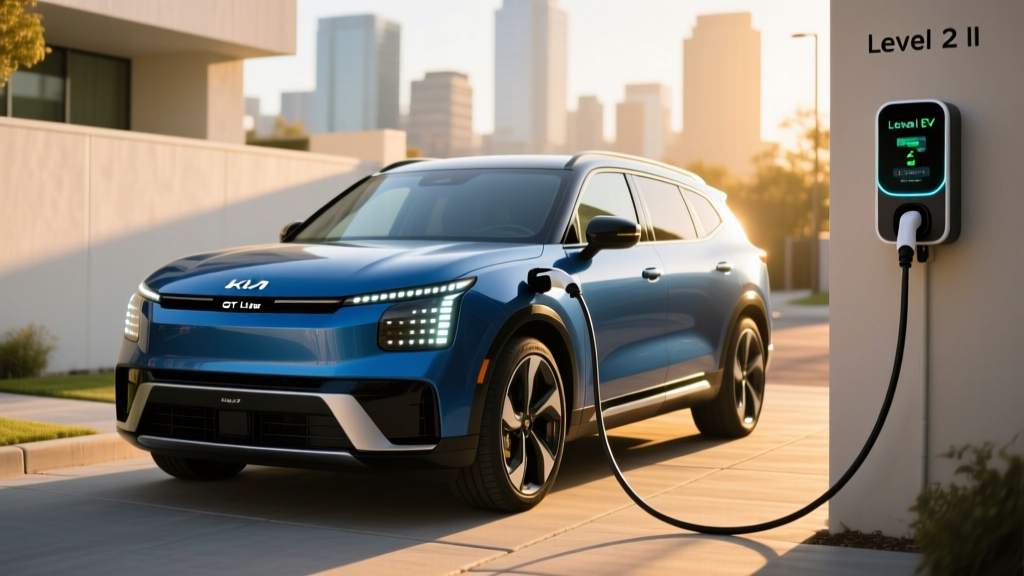
For home charging, the Earth supports up to 19.2 kW on Level 2 when paired with an 80-amp hardwired charger (requires a 100-amp dedicated circuit). Most buyers will install a 48-amp Level 2 unit on a 60-amp breaker, yielding 11.5 kW and a full overnight replenishment in roughly 10 hours. Lucid includes a mobile connector with the vehicle that handles both 120V and 240V (with appropriate adapter).
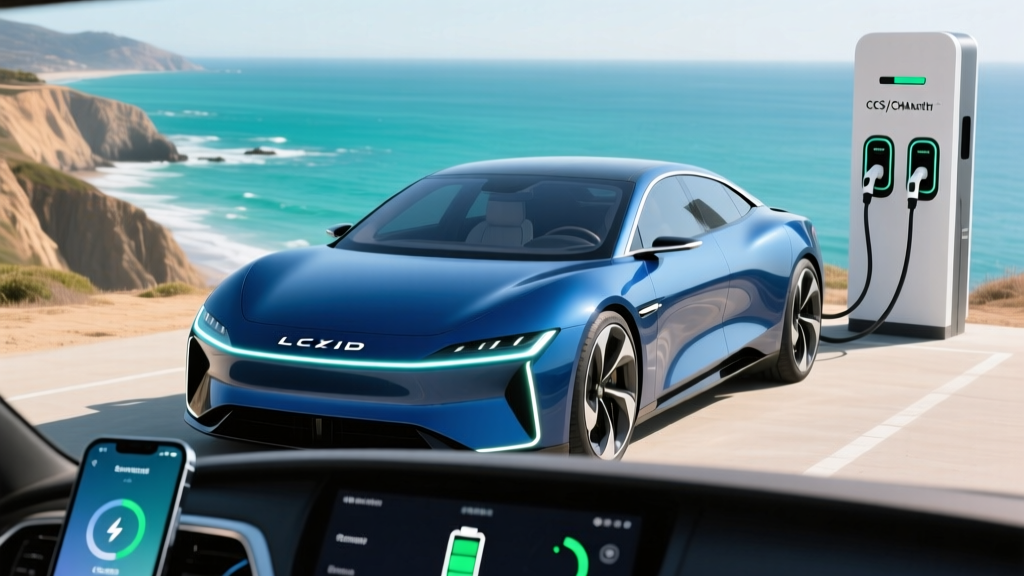
The Earth ships with a NACS (Tesla-style) charge port, granting native access to Tesla Supercharger stalls — currently the most reliable DC fast-charging network in North America. CCS adapters are not needed, which eliminates a common pain point for non-Tesla EV owners.
Performance and Driving Dynamics
The Earth Pure's single rear motor produces 480 horsepower — substantial for a base trim and more than sufficient for highway merging and passing. The 5.1-second 0–60 mph time puts it ahead of the base BMW iX and on par with the Audi Q8 e-tron.
Step up to the Earth Touring and the dual-motor AWD system delivers 620 hp and a 3.8-second sprint. Lucid's torque-vectoring rear-biased tuning gives the Earth a sportier feel than its curb weight (~5,200 lbs for the Touring) would suggest. The steering is precise if slightly light, and the regenerative braking offers three levels of intensity, including a near-one-pedal-driving mode that doesn't quite bring the car to a full stop — you'll still use the friction brake at the last moment.
Ride quality is a highlight. The Earth uses a multi-link front and rear suspension with standard adaptive dampers on the Touring trim. It soaks up highway imperfections with composure and stays flat through corners. This is a comfort-first calibration with sport capability, not a track-focused setup.
Interior, Tech, and Cargo Space
The Earth's cabin follows Lucid's minimalist design language: a curved 34-inch glass cockpit display spans the driver's sightline, replacing a traditional instrument cluster. A 17-inch central touchscreen handles infotainment, climate, and vehicle settings. Wireless Apple CarPlay and Android Auto are standard. The software is responsive, though Lucid's UI still has a learning curve compared to Tesla's or Hyundai's more intuitive layouts.
Interior materials include standard vegan leather upholstery, with genuine Nappa leather and open-pore wood available on the Touring. Build quality is solid, though some lower-door and console plastics feel less premium than what BMW or Mercedes deliver in the $65,000+ range.
Cargo and passenger dimensions:
- Rear legroom: 41.2 inches (generous for the segment)
- Front headroom: 40.8 inches
- Cargo behind rear seats: 33 cu ft
- Cargo with rear seats folded: 68 cu ft
- Front trunk (frunk): 5.5 cu ft (enough for a charging cable bag and small soft duffel)
The 33-cubic-foot rear cargo area trails the Rivian R1S (42 cu ft behind the third row in its configuration) and the Tesla Model X (37 cu ft behind the second row) but is competitive with the BMW iX (35 cu ft). The frunk is small — a consequence of packaging the HVAC and power electronics forward — but its existence is a plus for cable storage.
Pricing, Trims, and Federal Tax Credit Eligibility
The 2026 Lucid Earth launches in two trims, with a third (Earth Grand Touring) expected later in the model year:
| Trim | Base MSRP | As-Tested (typical options) | §30D Credit Eligibility |
|---|---|---|---|
| Earth Pure (RWD) | $54,900 | $58,400 (Dream package, 21" wheels) | Under MSRP cap — potentially eligible* |
| Earth Touring (AWD) | $64,900 | $71,200 (Nappa leather, Surreal Sound) | Under MSRP cap — potentially eligible* |
| Earth Grand Touring (AWD, est.) | ~$82,000 (announced) | TBD | Exceeds $80K SUV cap — NOT eligible |
Federal tax credit (IRS §30D) details: Under current IRS rules, new clean vehicle credits require the buyer to meet income caps ($150,000 single / $300,000 joint AGI), the vehicle MSRP must not exceed $80,000 for SUVs, and the battery must meet critical-mineral and battery-component sourcing thresholds that tighten annually. Both the Earth Pure and Earth Touring fall under the $80,000 SUV MSRP cap.
However, eligibility hinges on Lucid's battery supply chain meeting the 2026 critical-minerals and foreign-entity-of-concern (FEOC) requirements. Lucid has stated that the Earth's NMC cells are sourced from a joint-venture facility designed to comply, but the IRS publishes an official eligible-vehicle list that buyers should verify before purchase. The credit can be transferred to the dealer at point of sale as an immediate price reduction — confirm this with your Lucid representative at order time. Always consult a tax professional for your specific situation.
Battery Warranty, Degradation, and Longevity
Lucid covers the Earth's battery pack and drive units with an 8-year / 100,000-mile warranty, retaining at least 70% of original capacity over that period. This matches the industry standard set by most mainstream EV makers and falls slightly short of Hyundai's 10-year / 100,000-mile coverage.
The 118-kWh NMC pack uses Lucid's proprietary cell-level fusing and thermal management, which has shown strong longevity data in the Air sedan fleet. Based on Air owner reports and Lucid's published degradation curves, expect approximately 5–7% capacity loss over the first 50,000 miles, with the curve flattening significantly thereafter. At 150,000 miles, most packs should retain 88–92% of original capacity under normal use patterns (avoiding frequent 100% charges and DC fast-charging exclusively).
For buyers concerned about out-of-warranty replacement, Lucid has not published official Earth battery replacement pricing, but the Air's pack replacement currently runs $18,000–$22,000 at Lucid service centers. Expect the Earth's cost to be in a similar range given the shared pack architecture.
Driver Assistance and Safety
The Earth comes standard with Lucid's DreamDrive Pro suite, which includes:
- Adaptive cruise control with stop-and-go
- Lane-centering assist
- Blind-spot monitoring with rear cross-traffic alert
- Automatic emergency braking (forward and reverse)
- Surround-view camera system
- Park assist (parallel and perpendicular)
DreamDrive Pro is a Level 2 driver-assistance system. The driver must remain attentive, keep hands on the wheel (or demonstrate engagement via the capacitive steering wheel), and be prepared to take over at any moment. This is not autonomous driving. Lucid has not announced a hands-free highway feature (comparable to GM's Super Cruise or Ford's BlueCruise) for the 2026 Earth, though an over-the-air update adding a supervised highway-pilot mode is expected for the 2027 model year.
The Earth has not yet been crash-tested by the NHTSA or IIHS as of early 2026. Lucid's Air earned a 5-star NHTSA overall rating, and the Earth shares structural architecture, so strong results are anticipated. We will update this review when official scores are published.
Lucid Earth vs. Key Competitors
- Best-in-class efficiency (25 kWh/100mi) reduces charging costs
- 340-mile EPA range leads the midsize electric SUV segment
- 250-kW peak DC charging with a flat, sustained curve
- Native NACS port — Supercharger access without adapters
- Spacious rear legroom (41.2 in) for family use
- Competitive base pricing at $54,900 for the Pure trim
- Limited service-center footprint outside major metro areas
- Interior material quality doesn't fully match German rivals at $65K+
- Small frunk (5.5 cu ft) compared to some competitors
- No hands-free highway driving feature at launch
- Grand Touring trim exceeds $80K MSRP cap, eliminating tax credit
- 3,000-lb tow rating is below Rivian R1S and Tesla Model X
- Choose the Earth Pure if: You prioritize maximum range and efficiency, commute 40–80 miles daily, can charge at home, and want to stay under $60K for potential tax-credit eligibility.
- Choose the Earth Touring if: You need AWD for snow or mountain driving, want the 3.8-second 0–60 performance, and value premium interior upgrades — and you're comfortable near $70K.
- Look elsewhere if: You need three-row seating (consider the Rivian R1S or Kia EV9), you tow more than 3,000 lbs regularly, or you live far from a Lucid service center and need robust dealer support.
Frequently Asked Questions
What is the real-world range of the Lucid Earth?
The Earth Pure carries a 340-mile EPA estimate. In real-world mixed driving at moderate temperatures, expect 310–330 miles. Sustained highway driving at 75 mph drops this to roughly 280–300 miles, and cold-weather highway driving (around 20°F) can reduce range to 230–260 miles. The AWD Earth Touring's 310-mile EPA rating translates to approximately 270–290 miles in mixed real-world use.
How fast does the Lucid Earth charge?
On a DC fast charger, the Earth peaks at 250 kW and charges from 10–80% in approximately 22 minutes. At home on a 48-amp Level 2 charger (240V), it adds about 46 miles per hour, fully replenishing the 118-kWh battery in roughly 10 hours. An 80-amp Level 2 circuit reduces that to about 6 hours.
Does the Lucid Earth qualify for the $7,500 federal EV tax credit?
The Earth Pure ($54,900) and Earth Touring ($64,900) both fall under the IRS §30D $80,000 MSRP cap for SUVs. However, eligibility also depends on buyer income limits ($150K single / $300K joint AGI), battery-component and critical-mineral sourcing rules, and the vehicle appearing on the IRS's official eligible-vehicle list at time of purchase. Verify at irs.gov and consult a tax professional. The credit can be applied as a point-of-sale discount if the dealer is registered.
Is the Lucid Earth worth buying over a Tesla Model X or BMW iX?
The Earth offers more range and better efficiency than both at a lower starting price. The Model X has a larger Supercharger-network advantage (though the Earth now has native NACS access), a third row, and a more established service network. The BMW iX offers a more luxurious interior and broader dealer support. If range-per-dollar and charging efficiency are your top priorities, the Earth Pure is hard to beat. If service accessibility and brand cachet matter more, the BMW or Tesla may be the safer choice.
What is the Lucid Earth's tow rating?
The 2026 Earth is rated to tow up to 3,000 pounds when properly equipped. This covers a small utility trailer or a pair of jet skis but falls well short of the Rivian R1S (7,700 lbs) and Tesla Model X (5,000 lbs). Towing will significantly reduce range — plan for roughly 200–220 miles with a 1,500-lb load.
How does the battery warranty compare?
Lucid provides 8-year / 100,000-mile coverage on the battery and drive units, guaranteeing at least 70% capacity retention. This matches the standard set by Tesla, Ford, and most competitors, though Hyundai/Kia's 10-year / 100,000-mile warranty remains the segment leader.