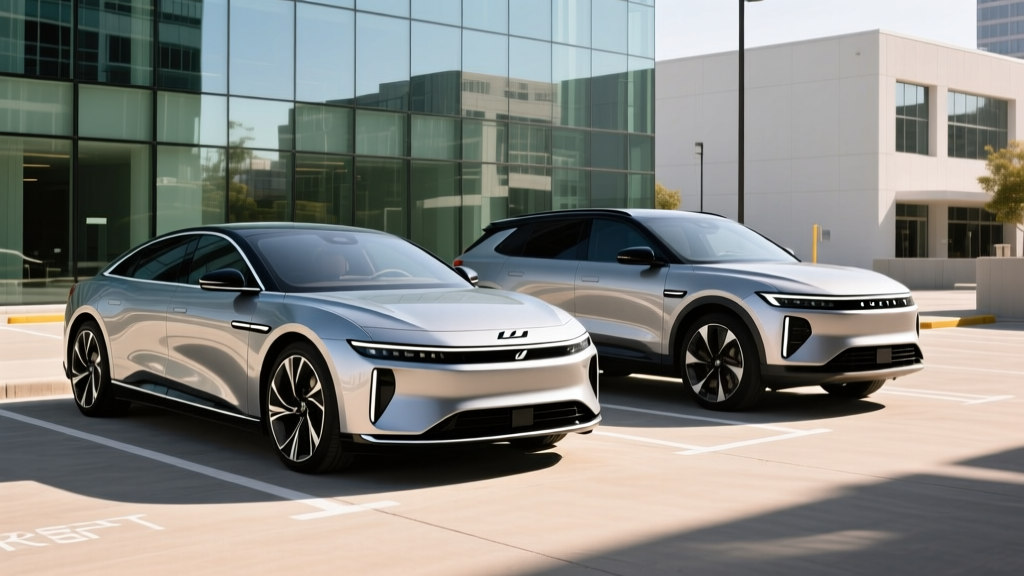
If you've been watching Lucid Motors headlines and searching for the latest Lucid earnings report, you're likely trying to answer one question: Is it safe to buy from this company? Financial stability matters when you're spending $70,000+ on an EV, especially when battery warranties and software updates stretch a decade into the future. This review unpacks what Lucid's 2026 financial trajectory means for the Air sedan and Gravity SUV lineup — and whether the numbers on the balance sheet match the numbers on the window sticker.
Lucid Air at a Glance: 2026 Spec Table
| Attribute | Air Pure | Air Touring | Air Grand Touring | Air Sapphire |
|---|---|---|---|---|
| EPA Range | 419 mi | 425 mi | 516 mi | 427 mi |
| Battery (usable) | 88 kWh (NMC) | 112 kWh (NMC) | 112 kWh (NMC) | 118 kWh (NMC) |
| Drivetrain | RWD | AWD Dual-Motor | AWD Dual-Motor | AWD Tri-Motor |
| Horsepower | 430 hp | 620 hp | 819 hp | 1,234 hp |
| 0-60 mph | 5.0 sec | 3.4 sec | 3.0 sec | 1.89 sec |
| Max DC Charge | 220 kW | 250 kW | 300 kW | 300 kW |
| 10-80% DC Time | ~28 min | ~22 min | ~20 min | ~20 min |
| Level 2 Rate | 19.2 kW (~77 mi/hr) | 19.2 kW (~77 mi/hr) | 19.2 kW (~77 mi/hr) | 19.2 kW (~77 mi/hr) |
| Efficiency | 146 MPGe / 23 kWh/100mi | 131 MPGe / 26 kWh/100mi | 131 MPGe / 26 kWh/100mi | 111 MPGe / 30 kWh/100mi |
| Cargo (trunk + frunk) | 32 cu ft + 10 cu ft | 32 cu ft + 10 cu ft | 32 cu ft + 10 cu ft | 32 cu ft + 10 cu ft |
| Base MSRP | $69,900 | $77,900 | $125,600 | $249,000 |
Source: fueleconomy.gov and Lucid Motors official specifications. Prices reflect 2026 model year MSRP before destination fees.
Why Lucid Earnings Matter to EV Buyers
Most car shoppers don't read quarterly 10-Q filings, but Lucid is not most automakers. As a relatively young, publicly traded EV manufacturer (NASDAQ: LCID), its financial health directly affects your ownership experience in three ways:
- Warranty fulfillment: Lucid's battery and powertrain warranty runs 8 years / 100,000 miles. That's a long tail — the company needs sufficient cash reserves and ongoing revenue to honor claims in 2032 and beyond.
- Software and feature updates: Lucid's infotainment and ADAS stack is developed in-house. Continued R&D spending (visible in earnings reports) determines whether your car gets better or stagnates after purchase.
- Service network expansion: Lucid has been growing its mobile service fleet and physical service centers. Earnings reports reveal capital expenditure trends — whether they're investing in support infrastructure or cutting costs.
For 2025 and into 2026, Lucid's earnings trajectory has been shaped by the Gravity SUV launch, Air production scaling, and its strategic supply relationship with Aston Martin (and broader interest from legacy OEMs in Lucid's powertrain technology). Delivery volumes have grown year-over-year, though the company still operates at a net loss — typical for a scaling EV automaker, but something buyers should weigh.
Real-World Range: What the EPA Number Doesn't Tell You
The Lucid Air Grand Touring's EPA-estimated 516 miles is the highest of any production EV sold in the US. But real-world results depend heavily on how you drive:
- Highway (70-80 mph): Expect 380–430 miles. Aerodynamic drag is the enemy at speed, and while the Air's 0.197 Cd is class-leading, sustained highway driving still cuts range by roughly 17–25% vs. the EPA combined cycle.
- City / mixed driving: 460–510 miles is achievable. Regenerative braking recaptures energy in stop-and-go traffic, and Lucid's powertrain efficiency (measured in kWh/100mi) is genuinely best-in-class.
- Cold weather (below 32°F): Budget 20–30% range loss. NMC chemistry loses efficiency in the cold, and cabin heating draws significant power. Preconditioning while plugged in mitigates this substantially.
Bottom line: If you're planning a 400-mile road trip in a Grand Touring, you'll likely make it in mild weather without stopping. In winter or at high speeds, plan one fast-charge stop.
Charging Speed: DC Fast and Home Level 2
| Charging Level | Power / Rate | Miles Added per Hour | Notes |
|---|---|---|---|
| Level 1 (120V household) | ~1.4 kW | ~5–6 mi/hr | Emergency/trickle only; impractical for daily use |
| Level 2 (240V, 48A circuit) | 11.5 kW | ~46 mi/hr | Standard home setup on a 60A breaker |
| Level 2 (240V, 80A circuit) | 19.2 kW | ~77 mi/hr | Requires 100A breaker; fastest AC option |
| DC Fast (Grand Touring peak) | 300 kW | ~300 mi in 20 min (10-80%) | Requires 350 kW CCS station; tapers above 80% |
| DC Fast (Pure peak) | 220 kW | ~200 mi in 20 min (10-80%) | Smaller battery limits sustained rate |
Lucid's 900-volt electrical architecture is the secret behind its charging performance. Higher voltage means lower current for the same power, reducing heat and allowing faster sustained charging. On a 350 kW Electrify America or similar CCS station, the Grand Touring can sustain over 250 kW through the 20–60% state-of-charge window before tapering. The 10–80% charge time of roughly 20 minutes for the Grand Touring is competitive with the Porsche Taycan and Hyundai Ioniq 5, though real-world speeds depend on station capability and battery temperature.
Home charging reality: Most buyers will install a Level 2 wall connector on a 60-amp circuit, delivering 11.5 kW and adding roughly 46 miles per hour of charging. An overnight charge (10 hours) adds ~460 miles — more than enough for even Grand Touring owners. If your electrical panel supports a 100-amp breaker, you can push to 19.2 kW for ~77 miles per hour, cutting full-charge time significantly. Budget $1,200–$3,500 for a professional Level 2 installation depending on panel proximity and local permit requirements.
Lucid Gravity: The SUV Earnings Are Counting On
The Lucid Gravity is the company's volume play — the three-row SUV that Lucid's earnings calls consistently highlight as the path to positive gross margins and higher production throughput. Here's how it stacks up:
| Attribute | Gravity Touring | Gravity Grand Touring |
|---|---|---|
| EPA Range | ~400 mi (est.) | ~440 mi (est.) |
| Battery | ~112 kWh (NMC) | ~118 kWh (NMC) |
| Seating | 7-passenger (3 rows) | 7-passenger (3 rows) |
| Horsepower | 620 hp | 820+ hp |
| 0-60 mph | ~3.5 sec | ~3.0 sec |
| Max DC Charge | 250+ kW | 300 kW |
| Base MSRP | $79,900 | $94,900 |
For buyers watching Lucid earnings, the Gravity is the make-or-break product. Its success determines whether Lucid reaches production volumes that justify long-term parts availability and service investment. Early deliveries began in late 2024, with 2025 and 2026 being the critical ramp years. If you're considering a Gravity, monitor quarterly delivery numbers — consistent month-over-month growth is the healthiest signal.
Pricing, Tax Credits, and Total Cost
| Model / Trim | Base MSRP | Federal §30D Credit | Effective Price | Income / MSRP Eligible? |
|---|---|---|---|---|
| Air Pure | $69,900 | Up to $7,500 | ~$62,400 | Under MSRP cap ($55k sedan cap — NOT eligible) |
| Air Touring | $77,900 | $0 | $77,900 | Exceeds $55k sedan MSRP cap |
| Air Grand Touring | $125,600 | $0 | $125,600 | Exceeds $55k sedan MSRP cap |
| Gravity Touring | $79,900 | Up to $7,500 | ~$72,400 | Under $80k SUV cap — income limits apply |
| Gravity Grand Touring | $94,900 | $0 | $94,900 | Exceeds $80k SUV MSRP cap |
Federal tax credit reality check: Under IRS §30D rules, the Lucid Air sedan lineup does not qualify for the federal clean vehicle credit because all trims exceed the $55,000 MSRP cap for sedans. The Gravity Touring, classified as an SUV, falls under the higher $80,000 cap and may qualify for up to $7,500 — provided the buyer meets income limits ($150k single / $300k joint modified AGI) and the vehicle meets critical-mineral and battery-component sourcing requirements, which are tightening annually through 2026.
Always consult a tax professional and verify current eligibility on irs.gov before counting the credit into your purchase budget. Point-of-sale transfer is available for eligible vehicles, letting you apply the credit as a down-payment reduction at the dealer.
Interior, Tech, and Driver Assistance
The Lucid Air cabin is genuinely spacious — rear legroom measures 41.3 inches, rivaling full-size luxury sedans. The glass canopy roof (standard on most trims) creates an airy feel, and the 34-inch curved glass cockpit display replaces traditional gauges. The infotainment system runs Lucid's proprietary software with native navigation, streaming apps, and over-the-air updates. Wireless Apple CarPlay and Android Auto are supported.
Driver assistance: Lucid's DreamDrive system uses 32 sensors including lidar (on higher trims), cameras, and radar. It offers adaptive cruise control, lane centering, automatic emergency braking, and blind-spot monitoring. This is an SAE Level 2 system — meaning the driver must remain fully engaged, hands on or near the wheel, and eyes on the road at all times. It is not autonomous driving.
ADAS Limitations
DreamDrive does not navigate on-ramps autonomously, does not handle construction zones without driver input, and does not function in all weather conditions. Lidar-equipped trims offer better object detection in low-light, but no Lucid system currently supports hands-free highway driving comparable to GM's Super Cruise or Ford's BlueCruise on mapped roads.
Pros, Cons, and Competitor Context
Pros
- Best-in-class EPA range (516 mi Grand Touring)
- Industry-leading efficiency (kWh/100mi)
- 900V architecture enables 300 kW DC charging
- Massive interior space relative to exterior footprint
- 19.2 kW Level 2 AC charging (fastest in class)
- Tri-motor Sapphire delivers hypercar performance
Cons
- Most Air trims exceed federal tax credit MSRP caps
- Service center network still limited vs. Tesla/BMW/Mercedes
- Company still operating at a net loss (watch earnings trajectory)
- ADAS lags behind Tesla Autopilot and GM Super Cruise in features
- No NACS port (CCS standard); Supercharger access requires adapter
- High starting price even for base Pure trim
Is it worth buying vs. key competitors? The Air Grand Touring competes with the Tesla Model S ($89,990, 402 mi), Mercedes EQS 450+ ($104,400, 390 mi), and Porsche Taycan ($99,400, 318 mi). On pure range and efficiency, the Air wins decisively. On charging infrastructure, Tesla still holds the advantage with the Supercharger network. On luxury brand cachet and service density, Mercedes and Porsche lead. The Air is the right pick if maximizing range and efficiency is your top priority and you have reliable home charging.
Warranty and Long-Term Ownership
Lucid's warranty package is competitive with luxury EV rivals:
- Basic vehicle: 4 years / 50,000 miles
- Battery and powertrain: 8 years / 100,000 miles (capacity retention threshold: 70% of original)
- Roadside assistance: 4 years / 50,000 miles
The 8-year battery warranty is standard for the industry, but Lucid's use of NMC chemistry with a sophisticated thermal management system should yield strong longevity. Independent long-term fleet data is still limited compared to Tesla's millions of vehicles on the road, so this is an area where monitoring Lucid earnings and production continuity matters — you want a company that will be around to honor claims in year seven.
Who Should Buy a Lucid Air or Gravity?
Decision Framework
- Choose Lucid Air if: You prioritize maximum range per charge, value powertrain efficiency, want a spacious luxury sedan without the SUV premium, and have home Level 2 charging.
- Choose Lucid Gravity if: You need three-row seating, want EV range above 400 miles in an SUV form factor, and your household income is under the §30D cap to capture the tax credit on the Touring trim.
- Look elsewhere if: You rely heavily on public DC fast charging (Tesla's network is more mature), you want the most advanced hands-free ADAS (GM Super Cruise), or you need a dense local service network for peace of mind.
Frequently Asked Questions
What is the real-world range of the Lucid Air Grand Touring?
The EPA rates it at 516 miles. In real-world highway driving at 75 mph, expect 380–430 miles. In city and mixed driving, 460–510 miles is realistic. In sub-freezing temperatures, plan for 360–410 miles unless you precondition the battery while plugged in.
How fast does the Lucid Air charge at home and on the road?
On a DC fast charger capable of 350 kW, the Grand Touring peaks at 300 kW and charges 10–80% in about 20 minutes. At home on a 240V/48A Level 2 circuit, it adds roughly 46 miles per hour. On an 80A circuit (requires a 100A breaker), it charges at 19.2 kW for ~77 miles per hour — among the fastest AC charging rates available in any EV.
Does the Lucid Air qualify for the federal EV tax credit?
No. All Air sedan trims exceed the $55,000 MSRP cap for sedans under IRS §30D rules. The Lucid Gravity Touring (SUV, $79,900 MSRP) may qualify for up to $7,500 if buyer income limits are met and battery-sourcing requirements are satisfied. Always verify current rules at irs.gov and consult a tax professional.
Is Lucid Motors financially stable enough to buy from?
Lucid is publicly traded and backed by significant investment from Saudi Arabia's Public Investment Fund (PIF), which holds a majority stake. The company continues to operate at a net loss while scaling production, which is typical for young EV automakers. Monitoring quarterly Lucid earnings reports — particularly delivery volumes, gross margin trends, and cash runway — is recommended for any buyer. The PIF backing provides a financial backstop that smaller EV startups lack.
How does the Lucid Air compare to the Tesla Model S?
The Air Grand Touring offers more EPA range (516 vs. 402 miles), better efficiency, and a more spacious rear seat. The Model S benefits from Tesla's Supercharger network (NACS), more mature Autopilot/FSD software, and a broader service footprint. The Air is the efficiency and comfort pick; the Model S is the infrastructure and software pick.
What battery chemistry does Lucid use?
Lucid uses NMC (nickel manganese cobalt) lithium-ion cells in a 900-volt pack architecture. NMC offers high energy density, which is essential for achieving 500+ mile range in a sedan form factor. The trade-off versus LFP (lithium iron phosphate) is that NMC degrades slightly faster over time and is more sensitive to sustained 100% state-of-charge storage. Lucid's battery management system includes a buffer to protect long-term health.
Can I charge a Lucid at Tesla Superchargers?
Lucid vehicles use the CCS1 connector as standard. Tesla has opened portions of its Supercharger network to CCS-equipped EVs via the Magic Dock adapter (built into select Supercharger stalls) or a third-party CCS-to-NACS adapter. Coverage is growing but not universal. Check Tesla's "Charge Your Non-Tesl EV" map for compatible stations in your area.