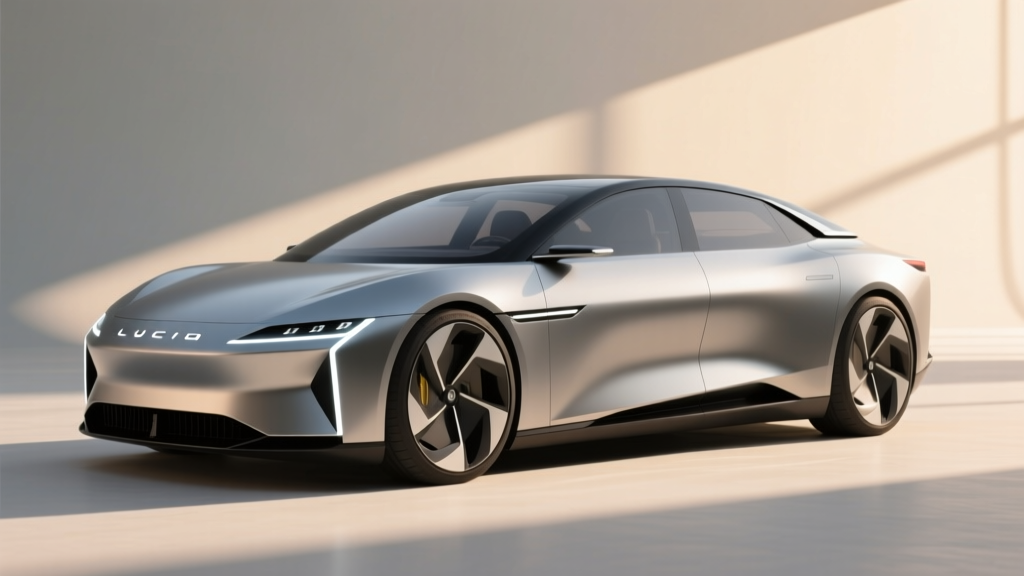
Lucid Motors built its reputation on the Air sedan's class-leading efficiency and the Gravity SUV's premium packaging. But the company's long-term viability hinges on a vehicle most buyers can actually afford. Enter the Lucid midsize platform — a family of cheaper EV prototypes that CEO Marc Winterhoff and the late Peter Rawlinson confirmed would underpin multiple vehicles starting around $50,000 before incentives.
As of early 2026, Lucid has shown prototype mules and confirmed the platform's engineering architecture, but no production vehicle has been released for sale. What follows is a comprehensive breakdown of every confirmed specification, a realistic assessment of what buyers should expect, and how these prototypes stack up against the competition they'll eventually face.
Platform Architecture: Why Lucid's Midsize EV Matters
Lucid's midsize platform isn't simply a shrunken Air or Gravity. The company engineered it from the ground up with a focus on manufacturability at scale — a critical distinction. The Air's hand-built luxury approach doesn't translate to a $50,000 price point, so Lucid has invested heavily in a new assembly strategy at its Casa Grande, Arizona factory (AMP-1), including expanded stamping and a new general assembly line.
Key architectural decisions Lucid has confirmed:
- 900V+ electrical architecture — carried over from the Air/Gravity, enabling faster DC charging and thinner, lighter wiring harnesses
- Miniaturized drive units — Lucid's proprietary permanent-magnet motors are among the smallest and most power-dense in the industry, freeing cabin and cargo space
- Structural battery pack — the battery serves as a stressed chassis member, reducing weight and increasing torsional rigidity
- LEAPS (Lucid Electric Advanced Platform Sharing) — the skateboard-style platform supports sedan, crossover, and potentially a smaller SUV body style
Estimated Range, Battery, and Efficiency Specs
Lucid has stated the midsize platform will target over 300 miles of EPA-estimated range in its highest-range configuration, with a base variant likely landing in the 250–280 mile range. Given Lucid's demonstrated efficiency leadership — the Air Grand Touring achieves an EPA-rated 4.0–4.5 miles per kWh, among the best of any production EV — these targets are credible.
| Attribute | Estimated Spec |
|---|---|
| Battery Capacity (Usable) | ~75–85 kWh (estimated) |
| Battery Chemistry | Likely NMC; LFP possible for base trim |
| EPA Range (Target) | 250–330 mi depending on trim |
| Efficiency Target | ~4.0 mi/kWh (~25 kWh/100 mi) |
| Drivetrain | RWD standard; AWD dual-motor available |
| Horsepower (AWD est.) | 400–500 hp |
| 0–60 mph (AWD est.) | ~3.5–4.5 seconds |
| Max DC Fast Charge | ~250 kW (900V architecture) |
| 10–80% DC Charge Time | ~20 minutes (estimated) |
| Level 2 Home Charge Rate | ~11.5 kW (~46 mi/hr) |
| Base MSRP (Target) | ~$50,000 |
| Battery/Powertrain Warranty | Expected 8 yr / 100,000 mi (industry standard) |
Charging: 900V Architecture Carried Forward
One of the most significant engineering advantages Lucid brings to the midsize segment is its 900V+ electrical system. Most competitors in the $40,000–$55,000 range — including the Tesla Model Y, Hyundai Ioniq 5, and Ford Mustang Mach-E — operate on 400V or 800V architectures. Higher voltage means faster charging at compatible DC fast chargers and thinner, lighter cabling throughout the vehicle.
| Charging Level | Power / Rate | Miles Added per Hour | Notes |
|---|---|---|---|
| Level 1 (120V) | ~1.4 kW | ~5–6 mi/hr | Emergency/trickle only |
| Level 2 (240V, 48A) | ~11.5 kW | ~46 mi/hr | Full overnight charge in ~7–8 hr |
| DC Fast Charge | Up to ~250 kW | ~800+ mi/hr (peak) | 10–80% in ~20 min; tapers above 80% |
Understanding the charge curve: Like all modern EVs, the midsize Lucid will not sustain its peak 250 kW rate for the entire session. Expect peak charge rates between 10–40% State of Charge (SoC), with a taper to ~150 kW by 60% and ~50 kW by 80%. This is why manufacturers quote 10–80% times rather than 0–100%. For road-trip planning, budget 20–25 minutes per DC fast-charge stop, not 15.
Lucid has equipped the Gravity and Air with the NACS (Tesla-style) connector, and the midsize platform is expected to follow. This grants access to Tesla's Supercharger network — currently the largest and most reliable DC fast-charging network in the U.S. — via native plug, no adapter required. This is a meaningful advantage over CCS-equipped competitors still relying on adapter compatibility at Superchargers.
Performance and Drivetrain
Lucid's miniaturized motor technology is arguably the company's most underappreciated engineering achievement. Each drive unit — motor, inverter, and gearbox in a single housing — fits in a carry-on suitcase yet produces well over 400 horsepower in the Air's dual-motor configurations.
For the midsize platform, expect:
- RWD base variant: Single rear motor, ~300–350 hp, 0–60 mph in approximately 5.0–5.5 seconds
- AWD variant: Dual-motor, ~400–500 hp, 0–60 mph in approximately 3.5–4.5 seconds
- Regenerative braking: Multiple modes including a strong one-pedal driving setting, consistent with Lucid's existing lineup
These figures would place the midsize Lucid firmly in the performance tier of its segment, competing with the Tesla Model Y Performance (3.5-sec 0–60) and the Hyundai Ioniq 5 N (3.4-sec 0–60), while likely offering superior efficiency.
Pricing, Trims, and Federal Tax Credit Eligibility
Lucid has targeted a starting MSRP of approximately $50,000 for the base midsize model, with higher trims (AWD, larger battery, premium interior) likely reaching $60,000–$65,000. This positions the vehicle squarely against the Tesla Model Y, Hyundai Ioniq 5, Kia EV6, and the forthcoming next-generation Tesla platform.
| Trim (Projected) | Est. MSRP | §30D Credit Potential | Est. Net Price |
|---|---|---|---|
| Base RWD | ~$50,000 | Up to $7,500* | ~$42,500 |
| Mid AWD | ~$55,000 | Up to $7,500* | ~$47,500 |
| Premium AWD (Long Range) | ~$62,000 | Up to $7,500* | ~$54,500 |
*IRS §30D Federal Tax Credit — 2026 Rules: Eligibility for the full $7,500 credit depends on multiple factors that the IRS outlines here. Key requirements include:
- MSRP cap: Sedans must be under $55,000; SUVs/pickups/vans under $80,000. If the midsize Lucid is classified as a sedan, only the base trim may qualify. If classified as a crossover/SUV, all trims likely fall under the cap.
- Buyer income cap: Modified AGI must not exceed $150,000 (single), $225,000 (head of household), or $300,000 (joint).
- Battery sourcing: Critical minerals and battery components must meet phased-in domestic/free-trade-partner sourcing thresholds. Lucid's supply chain decisions here will determine partial ($3,750) vs. full ($7,500) credit eligibility.
- Point-of-sale transfer: As of 2024+, buyers can transfer the credit to the dealer at purchase, effectively reducing the out-of-pocket price rather than waiting for a tax refund.
Interior Space, Tech, and Driver Assistance
Lucid's design philosophy emphasizes interior volume relative to exterior footprint — what the company calls "space efficiency." The Air sedan, despite being midsize externally, offers rear-seat legroom rivaling full-size luxury sedans. The midsize platform is expected to continue this tradition, targeting:
- Passenger space: ~100–105 cu ft total passenger volume; rear legroom expected around 38–40 inches
- Cargo: ~25–30 cu ft behind rear seats, plus a front trunk (frunk) of ~3–5 cu ft
- Infotainment: Lucid's glass canopy display (a curved 34-inch 6K screen in current models) is expected in a potentially simplified form for cost reduction
- Driver assistance: Lucid's DreamDrive Pro ADAS suite — currently an SAE Level 2 system requiring full driver engagement — will carry over with camera, lidar, and radar sensor fusion
Notable potential drawbacks based on Lucid's existing lineup:
- Lucid's software and infotainment UI, while improved, still trails Tesla and Hyundai/Kia in responsiveness and app ecosystem depth
- The Air's service center network remains limited compared to legacy automakers — a concern that will amplify with a higher-volume vehicle
- Lucid has not yet demonstrated the manufacturing throughput needed for a mass-market vehicle; production ramp risk is real
Competitive Positioning: Who Should Wait, Who Shouldn't
The midsize Lucid will enter the most competitive EV segment in the U.S. market. Here's how it projects against key rivals:
Choose the Midsize Lucid If:
- You prioritize efficiency and real-world range above all else
- You value a premium interior and ride quality at a mainstream price
- 900V fast-charging speed matters for your road-trip habits
- You want NACS Supercharger access without an adapter
- You can wait for production (likely 2027+)
Buy a Competitor Now If:
- You need a vehicle in the next 6 months
- You want a proven service network in your area
- Third-row seating is required (look at Model Y, Gravity, or Ioniq 9)
- You're budget-constrained below $40,000 (consider used EVs or Ioniq 5 base)
- You need a confirmed §30D tax credit vehicle today
Pros and Cons at a Glance
✅ Projected Pros
- Best-in-class efficiency (~4.0 mi/kWh target)
- 900V architecture for faster DC charging
- Native NACS / Supercharger compatibility
- Spacious interior relative to exterior footprint
- Premium materials and build at mainstream pricing
- Strong performance even in base RWD trim
❌ Projected Cons
- Not yet available — production timeline uncertain
- Limited service center network vs. legacy brands
- Tax credit eligibility unconfirmed (sourcing TBD)
- Software/infotainment may lag competitors
- Lucid's financial stability remains a question mark
- Manufacturing ramp-up risk for a mass-market vehicle
Frequently Asked Questions
What is the real-world range of the Lucid midsize EV?
Lucid targets 300+ miles EPA for the long-range variant. In real-world highway driving at 70–80 mph, expect roughly 250–270 miles. In cold weather (below freezing), plan for 200–230 miles. Lucid's efficiency leadership makes these projections credible, but real-world testing won't be possible until production vehicles are available.
How fast does it charge at home and on the road?
Estimated DC fast-charging peaks at ~250 kW, with 10–80% in approximately 20 minutes on a compatible 350 kW charger. Home Level 2 charging at 11.5 kW adds roughly 46 miles of range per hour, meaning a full overnight charge from empty takes 7–8 hours.
How much will it cost after tax credits?
The base RWD model is targeted at ~$50,000 MSRP. If it qualifies for the full $7,500 §30D federal credit (dependent on battery sourcing, buyer income, and MSRP classification), the effective price could drop to ~$42,500. This is not guaranteed — verify at purchase time via IRS guidelines.
Is it worth waiting for vs. buying a Tesla Model Y or Hyundai Ioniq 5 now?
If you need a vehicle within 6–12 months, buy now. The Model Y and Ioniq 5 are proven, well-built, and available with confirmed tax credits. If you can wait and value efficiency, premium feel, and 900V charging, the midsize Lucid could be compelling — but production timing and Lucid's financial health are legitimate risks.
Does the midsize Lucid qualify for the federal EV tax credit?
Not yet confirmed. Eligibility under IRS §30D requires meeting MSRP caps ($55,000 for sedans, $80,000 for SUVs), buyer income limits, and battery critical-mineral/component sourcing thresholds. Lucid must disclose its battery supply chain before we can confirm eligibility.
When will the Lucid midsize EV be available to buy?
Lucid has indicated a production target in the 2026–2027 timeframe, but automotive timelines frequently slip. The company must complete factory retooling at AMP-1 in Casa Grande, Arizona. We will update this article when a firm on-sale date and final specs are announced.
What warranty will it carry?
Lucid's current vehicles carry an 8-year/100,000-mile battery and powertrain warranty, and the midsize platform is expected to match or exceed this. This aligns with the industry standard set by Tesla, Hyundai, and Kia. Official warranty terms will be confirmed at launch.