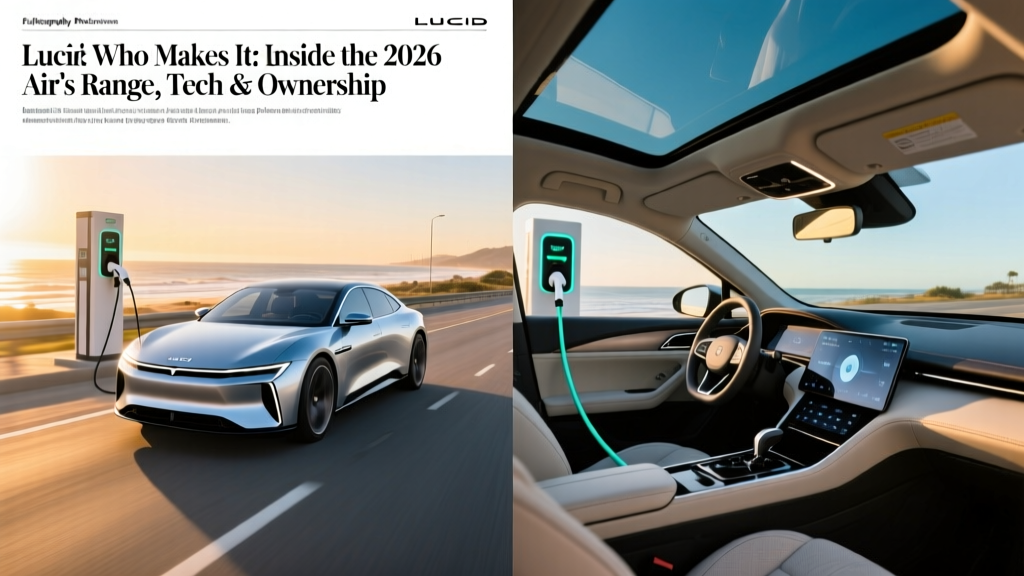
If you've searched "Lucid who makes it" you've landed on one of the most technically ambitious automakers in the EV space. Lucid Motors is an American electric-vehicle manufacturer headquartered in Newark, California, with its primary production facility — known as AMP-1 — in Casa Grande, Arizona. Founded in 2007 as Atieva (originally a battery-technology company), Lucid rebranded in 2016 and began delivering its first vehicle, the Lucid Air luxury sedan, in late 2021. The company is publicly traded on NASDAQ under the ticker LCID, with Saudi Arabia's Public Investment Fund (PIF) holding a majority stake as of 2025.
Unlike legacy automakers retrofitting platforms for electrification, Lucid engineered its vehicles around a proprietary 900-volt electrical architecture and in-house-developed miniature drive units. The result is a sedan that leads the industry in EPA-verified range and efficiency — numbers we'll break down with real-world context below.
2026 Lucid Air at a Glance: Specs That Matter
| Spec | Pure (RWD) | Touring (AWD) | Grand Touring (AWD) |
|---|---|---|---|
| EPA Range | 419 mi | 425 mi | 516 mi |
| Battery (usable) | 88 kWh (NMC) | 112 kWh (NMC) | 112 kWh (NMC) |
| Horsepower | 430 hp | 620 hp | 1,050 hp |
| 0–60 mph | 5.0 sec | 3.4 sec | 3.0 sec |
| Drivetrain | RWD (single motor) | AWD (dual motor) | AWD (dual motor) |
| MPGe (combined) | 136 MPGe | 130 MPGe | 131 MPGe |
| Efficiency | 24 kWh/100 mi | 26 kWh/100 mi | 25 kWh/100 mi |
| Max DC Charge Rate | 220 kW | 300 kW | 300 kW |
| 10–80% DC Time | ~25 min | ~20 min | ~20 min |
| Level 2 Rate | 19.2 kW (~70 mi/hr) | 19.2 kW (~70 mi/hr) | 19.2 kW (~70 mi/hr) |
| Base MSRP | $69,900 | $87,400 | $125,650 |
| Battery Warranty | 8 yr / 100,000 mi | 8 yr / 100,000 mi | 8 yr / 100,000 mi |
Sources: fueleconomy.gov, Lucid Motors official specs. Figures reflect 2025–2026 model-year data. The Sapphire performance variant (1,234 hp, $249,000) is excluded from this mainstream comparison.
Real-World Range: Beyond the EPA Sticker
The Grand Touring's EPA-rated 516 miles is the highest of any production EV sold in the U.S. as of 2026. But EPA tests include substantial city driving where regenerative braking recovers energy. Expect ~430–460 miles on a flat 70-mph highway run in mild weather, dropping to ~350–380 miles in freezing temperatures (below 30°F) due to battery-resistance increases and cabin-heating load. The Pure (RWD, 419 mi EPA) delivers roughly 350–380 real highway miles in similar conditions.
Lucid's efficiency advantage — roughly 25 kWh/100 mi for the Grand Touring — is genuine and measurable. That's approximately 15–20% less energy per mile than a Tesla Model S Long Range and nearly 30% better than heavier luxury EVs like the Mercedes EQS or BMW i7. The miniaturized drive units, 900V architecture (reducing current and resistive losses), and a drag coefficient of 0.197 all contribute.
Charging: 900V Architecture in Practice
Lucid's 900-volt electrical system is one of the highest in the industry (matched only by Porsche Taycan, Hyundai Ioniq 5/6, and Kia EV6/EV9 families at 800V). Higher voltage allows faster charging at lower current, reducing heat and cable weight.
| Level | Power | Miles Added Per Hour | Notes |
|---|---|---|---|
| Level 1 (120V household) | ~1.4 kW | ~3–4 mi/hr | Emergency/trickle only; full charge takes days |
| Level 2 (240V home, 48A) | 11.5 kW | ~42 mi/hr | Standard home setup; ~10–12 hr for full Grand Touring battery |
| Level 2 (240V, 80A circuit) | 19.2 kW | ~70 mi/hr | Requires 100A breaker; Lucid's onboard charger max |
| DC Fast (peak, Touring/GT) | 300 kW | ~550 mi/hr equivalent | Sustained only below ~40% SoC; tapers sharply above 80% |
| DC Fast (Pure) | 220 kW | ~400 mi/hr equivalent | Smaller battery charges quickly in absolute terms |
A critical nuance buyers often miss: peak kW is not sustained kW. The Grand Touring's 300-kW peak occurs in the 10–40% state-of-charge window on a capable 350-kW charger (such as Electrify America's latest stalls). Above 60% SoC, the charge curve tapers progressively, dropping below 100 kW past 80%. Lucid's stated 10–80% time of approximately 20 minutes is achievable in optimal conditions — battery preconditioned, moderate ambient temperature, and a non-congested 350-kW station. In real-world road-trip conditions, plan for 25–30 minutes per stop.
The Air uses the CCS1 connector natively. As of 2026, Lucid has confirmed NACS (Tesla-style) adapter compatibility for Supercharger access, though native NACS ports are expected in future model-year revisions.
Performance, Ride, and Daily Drivability
The dual-motor AWD variants (Touring and Grand Touring) deliver torque-vectoring all-wheel drive with sub-3.5-second 0–60 times — the Grand Touring hits 60 mph in 3.0 seconds with 1,050 hp. The Pure RWD, at 430 hp and 5.0 seconds, is more than adequate for real-world merging and passing.
Lucid's air-suspension system (standard on Touring and above, optional on Pure) provides a compliant highway ride with adjustable ride height. The cabin is genuinely quiet at speed — among the quietest in the luxury-EV segment — aided by acoustic glass and the inherent smoothness of the compact drive units.
Interior dimensions are generous for a sedan: 108.5 cu ft of passenger volume with 41.3 inches of front legroom and 37.6 inches of rear legroom. Trunk space is 22.1 cu ft (with an additional 8.5 cu ft frunk). That cargo total trails SUVs like the Tesla Model X or Rivian R1S but exceeds the Mercedes EQS sedan and BMW i7.
Pricing, Trims, and Federal Tax Credit Eligibility
| Trim | Base MSRP | Federal Credit Eligible? | Key Caveats |
|---|---|---|---|
| Pure | $69,900 | Yes (up to $7,500) | Under $55,000 sedan cap? No — sedan cap is $55,000 per §30D; Pure exceeds it |
| Touring | $87,400 | No | Exceeds $55,000 MSRP cap for sedans |
| Grand Touring | $125,650 | No | Exceeds $55,000 MSRP cap for sedans |
Tax-credit reality check: Under IRS §30D rules, new clean-vehicle credits are capped at $55,000 MSRP for sedans (and $80,000 for SUVs/pickups/vans). Since the Lucid Air is classified as a sedan, no current Air trim qualifies for the $7,500 federal tax credit as of the 2026 tax year. The Pure comes closest to Lucid's lineup but still starts well above the threshold.
Buyer income caps also apply: modified adjusted gross income (MAGI) cannot exceed $300,000 (joint), $225,000 (head of household), or $150,000 (individual). Battery-sourcing and critical-minerals requirements add further complexity — always confirm eligibility with a tax professional and reference IRS guidance before purchase.
For buyers who prioritize incentives, the Lucid Gravity SUV (starting around $79,900 in Pure trim) may have a clearer path to credit eligibility under the $80,000 SUV cap, though battery-sourcing rules still apply.
Tech, Driver Assistance, and Software
Lucid's infotainment centers on a 34-inch curved glass cockpit display spanning the driver's instrument cluster and center infotainment. The system runs Lucid's proprietary software (not Android Automotive) and supports wireless Apple CarPlay and Android Auto. A dedicated "DreamDrive" ADAS suite uses 32 sensors including lidar (on Grand Touring and above), cameras, and radar.
DreamDrive is a Level 2 driver-assistance system per SAE J3016 classification. It provides adaptive cruise control, lane-centering, and automatic emergency braking — but the driver must remain fully engaged with hands on the wheel and eyes on the road. This is not "self-driving." Lucid has discussed future Level 3+ capabilities via software updates, but no Level 3 or Level 4 functionality is commercially available as of 2026.
Notable tech strengths include over-the-air (OTA) software updates, route-based battery preconditioning for faster DC charging, and a heat pump for efficient cabin climate management. The Lucid app provides remote preconditioning, charge scheduling, and vehicle-location tracking.
Drawbacks: The infotainment system, while visually impressive, has drawn criticism for slower response times compared to Tesla's UI. The absence of native NACS (as of early 2026) means Supercharger access requires an adapter, adding a step at Tesla stations. And Lucid's service-center footprint remains far smaller than Tesla's — buyers in rural areas should verify proximity to authorized service.
Pros and Cons: Honest Assessment
Pros
- Class-leading EPA range (516 mi Grand Touring)
- Exceptional efficiency (24–26 kWh/100 mi)
- 300-kW DC fast-charging capability
- Refined, quiet ride with air suspension
- Spacious sedan interior with generous rear legroom
- 8-year/100,000-mile battery & powertrain warranty
Cons
- No federal §30D tax credit (sedan MSRP cap is $55k)
- CCS1 native port; NACS requires adapter
- Limited service-center network vs. Tesla or legacy luxury brands
- Infotainment UI lags behind competitors in responsiveness
- High starting price even for base Pure trim
- Depreciation steeper than Tesla Model S historically
Who Should Buy the Lucid Air?
Choose the Lucid Air if:
- You prioritize maximum range and efficiency above all else in a luxury sedan
- You regularly drive long highway corridors where 500+ miles of range reduces stop frequency
- You value a quiet, refined ride over sporty handling dynamics
- You can charge at home (Level 2) and want minimal public-charging dependency
Look elsewhere if:
- You need federal tax-credit eligibility (consider the Model S, which also exceeds the cap, or pivot to an SUV like the Gravity or Rivian R1S)
- You want the broadest Supercharger network access without adapters (Tesla Model S)
- You prioritize cargo space — an SUV like the Model X, Rivian R1S, or Lucid Gravity fits families better
- Service-center proximity is a concern in your region
Frequently Asked Questions
Who makes Lucid vehicles and where are they built?
Lucid Motors, Inc. — a publicly traded American company (NASDAQ: LCID) — designs, engineers, and manufactures its vehicles. The Lucid Air is assembled at AMP-1 in Casa Grande, Arizona. Saudi Arabia's Public Investment Fund (PIF) is the majority shareholder, providing significant capital backing.
What is the real-world range of the Lucid Air?
The Grand Touring achieves an EPA-rated 516 miles. In real-world highway driving at 70 mph in moderate temperatures, expect approximately 430–460 miles. In freezing conditions (below 30°F), plan for 350–380 miles. The Pure RWD (419 mi EPA) delivers roughly 350–380 highway miles in mild weather.
How fast does the Lucid Air charge at home and on the road?
On a 240V Level 2 home charger at 48 amps (11.5 kW), the Air adds roughly 42 miles of range per hour — a full overnight charge for most daily needs. At a 350-kW DC fast charger, the Touring and Grand Touring peak at 300 kW, achieving a 10–80% charge in approximately 20 minutes under optimal conditions (25–30 minutes in real-world road-trip scenarios).
Does the Lucid Air qualify for the $7,500 federal EV tax credit?
No, as of 2026. Under IRS §30D rules, new sedans must have an MSRP of $55,000 or less to qualify. The cheapest Lucid Air Pure starts at $69,900, exceeding the cap. Buyer income limits and battery-sourcing requirements add further restrictions. Always verify with a tax professional and consult IRS §30D guidance.
Is the Lucid Air worth buying vs. the Tesla Model S or Mercedes EQS?
If maximum range and efficiency are your top priorities, the Air Grand Touring has no equal — its 516 EPA miles and 25 kWh/100 mi efficiency lead the segment. The Tesla Model S offers broader Supercharger access, a more responsive UI, and a more established service network but trails in range (~405 mi). The Mercedes EQS provides a more traditionally luxurious interior and dealer network but is significantly less efficient and offers ~390 miles of range. Your choice depends on whether you value efficiency leadership (Lucid), charging infrastructure (Tesla), or dealer-based service (Mercedes).
What is the battery warranty on the Lucid Air?
Lucid provides an 8-year/100,000-mile warranty on the battery pack and powertrain, with a capacity-retention threshold of 70% of original capacity. This is competitive with Tesla (8 yr/120,000 mi on Model S) and BMW (8 yr/100,000 mi on i7).
Does the Lucid Air support Tesla Superchargers?
As of early 2026, the Air uses a native CCS1 port. Lucid has confirmed compatibility with NACS adapters for Supercharger access, but native NACS ports are not yet standard. Buyers who frequently use Superchargers should factor in the adapter requirement.
Always confirm final specs, pricing, and incentive eligibility with Lucid Motors and your tax professional before purchase. Specifications and credit rules are subject to change.