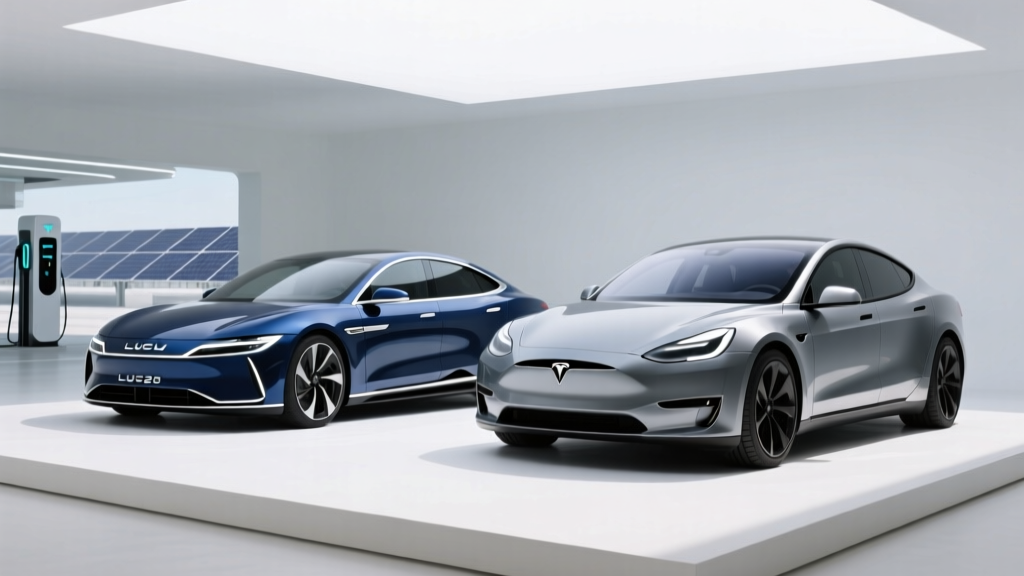
The phrase Lucid Model S is one of the most common misnomers in the EV world. Lucid Motors doesn't make a "Model S" — their flagship luxury sedan is the Lucid Air, a direct competitor to the Tesla Model S. If you've been searching for a "Lucid Model S," you're almost certainly looking for a head-to-head comparison of these two benchmark electric sedans. This review delivers exactly that, with 2026 model-year specs, real-world range data, charging benchmarks, and tax-credit realities that spec sheets rarely tell you.
Both cars target the same buyer: someone who wants 400+ miles of range, sub-4-second acceleration, and a premium cabin — without the compromises that plagued early EVs. But they take radically different paths to get there. Let's break down the numbers that actually matter.
Specs at a Glance: Lucid Air vs Tesla Model S
| Spec | Lucid Air Pure | Lucid Air Grand Touring | Tesla Model S Long Range | Tesla Model S Plaid |
|---|---|---|---|---|
| EPA Range | 419 mi | 516 mi | 402 mi | 396 mi |
| Battery (usable) | 88 kWh (NMC) | 112 kWh (NMC) | ~100 kWh (NMC) | ~100 kWh (NMC) |
| Drivetrain | RWD (single motor) | AWD (dual motor) | AWD (dual motor) | AWD (tri-motor) |
| Horsepower | 430 hp | 819 hp | 670 hp | 1,020 hp |
| 0–60 mph | 5.0 sec | 3.0 sec | 3.1 sec | 1.99 sec |
| Efficiency | 146 MPGe (23 kWh/100mi) | 131 MPGe (26 kWh/100mi) | 124 MPGe (27 kWh/100mi) | 116 MPGe (29 kWh/100mi) |
| Max DC Charge Rate | 200 kW | 300 kW | 250 kW | 250 kW |
| 10–80% DC Time | ~25 min | ~20 min | ~28 min | ~28 min |
| Base MSRP | $69,900 | $125,600 | $79,990 | $94,990 |
Sources: EPA fueleconomy.gov, Lucid Motors, Tesla. Specs reflect 2026 model year; verify with dealer for latest adjustments.
Real-World Range: What the EPA Sticker Doesn't Tell You
Lucid Air Grand Touring: EPA 516 mi → Expect ~400–440 mi at sustained 75 mph highway speeds; ~350–380 mi in sub-30°F winter conditions.
Tesla Model S Long Range: EPA 402 mi → Expect ~320–350 mi highway; ~280–310 mi in freezing weather.
The Lucid Air Grand Touring's 516-mile EPA figure is the highest of any production sedan on sale in 2026. But EPA range is tested on a mix of low-speed city driving and moderate highway cycles — it doesn't simulate a 75-mph interstate run in January. In independent highway range tests, the Air Grand Touring typically delivers 400–440 real-world miles before needing a charge, thanks to its class-leading aerodynamic efficiency (drag coefficient of 0.197) and 112 kWh usable NMC battery pack.
The Tesla Model S Long Range, while excellent at 402 mi EPA, sacrifices some efficiency to its wider, heavier platform and less optimized aero. Expect roughly 320–350 real-world highway miles. Both vehicles see a 15–25% range reduction in sustained cold-weather driving below freezing — a function of battery chemistry and cabin heating demands, not a defect. The Air's available heat pump helps mitigate this loss compared to resistive heating systems.
For the Lucid Air Pure (RWD, 88 kWh), the 419-mile EPA rating holds up well in mixed driving, yielding roughly 340–370 real-world miles on highway trips. It's the efficiency champion of the lineup at 146 MPGe combined.
Charging Speed and Infrastructure
Charging speed is where the Lucid Air's 900-volt electrical architecture earns its keep. The Grand Touring can accept up to 300 kW on compatible DC fast chargers, adding roughly 200 miles of range in 10 minutes under ideal conditions. The 10–80% charge takes approximately 20 minutes. However, charging curves taper significantly above 80% — a full 80–100% top-off can add another 25+ minutes. Plan your road-trip stops around 10–80% sessions for maximum efficiency.
The Tesla Model S peaks at 250 kW on V3 Superchargers, with a 10–80% session taking roughly 28 minutes. Tesla's advantage isn't peak speed — it's network reliability. The Supercharger network consistently delivers uptime above 95%, while third-party networks like Electrify America and EVgo still suffer intermittent connector failures and payment glitches.
Lucid Air owners now have access to Tesla Superchargers via the included NACS adapter (standard on 2025+ models, retrofittable on earlier builds). This dramatically expands the Air's road-trip charging map, though you'll be limited to 250 kW at V3 stalls rather than the Air's native 300 kW capability.
| Charging Level | Lucid Air Grand Touring | Tesla Model S LR |
|---|---|---|
| Level 1 (120V / 12A) | ~3 mi/hr (1.4 kW) | ~3 mi/hr (1.4 kW) |
| Level 2 (240V / 48A) | ~36 mi/hr (11.5 kW) | ~34 mi/hr (11.5 kW) |
| Level 2 (240V / 80A) | ~60 mi/hr (19.2 kW) | ~44 mi/hr (14 kW) |
| DC Fast Charge (peak) | 300 kW | 250 kW |
| 10–80% DC Time | ~20 min | ~28 min |
| Miles in 10 min (DC) | ~200 mi | ~150 mi |
At home on a 48-amp Level 2 circuit (the most common residential installation), both vehicles add enough range overnight for all but the longest commutes. The Air's onboard charger supports up to 19.2 kW on an 80-amp circuit — a worthwhile upgrade if your electrical panel supports it, cutting a full charge from ~13 hours to ~8 hours.
Performance and Driving Dynamics
The Tesla Model S Plaid's 1.99-second 0–60 time remains a physics-defying party trick, but the Lucid Air Grand Touring's 3.0-second sprint is hardly slow. Where the Air distinguishes itself is ride quality. Its available air suspension delivers a genuinely plush, Mercedes-S-Class-caliber ride that the Model S — even after its 2021 refresh — still can't match. The Model S leans sporty-firm, which thrills on canyon roads but fatigues on broken pavement.
The Air Pure (RWD, 430 hp, 5.0 seconds to 60) is the value play. It forgoes the dual-motor AWD grip but rewards with the best efficiency in the segment. For commuters in mild climates, RWD is a rational choice that saves $55,000+ over the Grand Touring.
Both vehicles feature regenerative braking with adjustable intensity. The Air's one-pedal driving mode is smooth and predictable, while Tesla's single aggressive regen setting (no longer adjustable on 2024+ Model S) takes some adaptation for drivers coming from ICE vehicles.
Interior, Tech, and Cargo
The Lucid Air's cabin feels like a Scandinavian lounge — open, airy, and minimalist in a way that emphasizes materials over screen real estate. The 34-inch curved glass cockpit display is crisp, but the center-stack infotainment still lags behind Tesla's responsiveness. Physical buttons for climate and volume are a welcome inclusion. Rear-seat legroom is generous at 41.3 inches — noticeably more than the Model S's 35.4 inches — thanks to the Air's "Space Concept" packaging that pushes the powertrain components outward.
Cargo volume tells a similar story:
- Lucid Air: 32 cu ft trunk + 10 cu ft frunk (42 cu ft total)
- Tesla Model S: 28 cu ft trunk + 5 cu ft frunk (33 cu ft total) — but offers a hatchback-style liftgate for easier loading of bulky items
Tesla's 17-inch center touchscreen remains the gold standard for EV infotainment: fast, intuitive, and packed with features (including an excellent trip planner and real-time Supercharger availability). The Air's system is improving with OTA updates but still feels a half-generation behind in UI fluidity. Both vehicles offer premium audio — the Air's 21-speaker Surreal Sound system (ProPILOT-equipped trims) rivals anything from Burmester or Bowers & Wilkins.
Pricing, Tax Credits, and Ownership Cost
| Model | Base MSRP | Federal §30D Credit | Effective Price |
|---|---|---|---|
| Lucid Air Pure | $69,900 | Up to $7,500* | ~$62,400 |
| Lucid Air Touring | $87,400 | Up to $7,500* | ~$79,900 |
| Lucid Air Grand Touring | $125,600 | Not eligible (MSRP cap) | $125,600 |
| Tesla Model S LR | $79,990 | Not eligible (MSRP cap) | $79,990 |
| Tesla Model S Plaid | $94,990 | Not eligible (MSRP cap) | $94,990 |
*Tax credit caveats: Under IRS §30D rules, the federal EV tax credit is subject to multiple eligibility gates. The MSRP cap for sedans is $55,000 — meaning the Air Pure at $69,900 base technically exceeds the cap. However, Lucid has structured certain configurations and lease arrangements that may qualify. The buyer must also meet income caps ($150,000 single / $300,000 joint AGI) and the vehicle's battery must satisfy critical-mineral and battery-component sourcing requirements that tighten annually. Credits can now be transferred to the dealer as a point-of-sale discount. Always verify current-year eligibility with your tax professional and the IRS before purchase.
For the Grand Touring and both Model S variants, the MSRP far exceeds the $55,000 sedan cap — no federal purchase credit applies. Lease structures may route through the commercial §45W credit, but this benefits the lessor, not you directly.
Driver Assistance and Safety
Both the Lucid Air's DreamDrive Pro and Tesla's Autopilot/FSD (Supervised) are SAE Level 2 driver-assistance systems. You must keep your hands on the wheel (or demonstrate attentiveness) and eyes on the road at all times. Neither system is autonomous. Only Level 4 services like Waymo operate without a human driver — and those are limited to geofenced urban zones.
Lucid's DreamDrive Pro uses 32 sensors including lidar — a hardware advantage over Tesla's vision-only approach. In practice, DreamDrive delivers smooth highway lane-keeping and adaptive cruise, but its feature set (automatic lane changes, intersection assist) trails Tesla's FSD (Supervised) in ambition and update frequency. Tesla's system handles complex urban scenarios more aggressively, though it occasionally makes head-scratching routing decisions that require immediate driver override.
Neither system is a reason to buy or avoid these cars in 2026 — both require full driver engagement and neither eliminates the tedium of long highway drives more than a good adaptive cruise system from any premium automaker.
Warranty and Long-Term Battery Outlook
- Lucid Air: 8 years / 100,000 miles battery & powertrain; 4 years / 50,000 miles bumper-to-bumper. Battery warranty guarantees 70%+ capacity retention over the coverage period.
- Tesla Model S: 8 years / 150,000 miles battery & drive unit; 4 years / 50,000 miles basic. Battery warranty guarantees 70%+ capacity retention.
Both use NMC (nickel-manganese-cobalt) battery chemistry, optimized for energy density over cycle life. Based on fleet data from Tesla's high-mileage Model S population and early Lucid Air returns, expect 8–12% degradation over the first 100,000 miles, with the curve flattening significantly thereafter. Neither manufacturer offers LFP chemistry in these flagship sedans — LFP's lower energy density would compromise the range targets that define these vehicles.
A full battery replacement out of warranty remains a significant expense: $15,000–$25,000 for the Model S, and estimated $20,000–$30,000 for the Air Grand Touring's larger pack. These are worst-case scenarios; most packs outlast the vehicles themselves.
Pros and Cons
- Class-leading EPA range (516 mi Grand Touring)
- Fastest DC charging in segment (300 kW)
- Spacious rear seat (41.3" legroom) and generous trunk
- Superb ride quality with available air suspension
- 900V architecture future-proofs charging
- Infotainment UI less polished than Tesla
- Limited service center network vs. Tesla
- Grand Touring price ($125K+) excludes most buyers
- No federal tax credit on most trims (MSRP cap)
- DreamDrive ADAS features lag FSD in scope
- Best-in-class infotainment and trip planner
- Unmatched Supercharger network reliability
- Plaid performance (1.99s 0–60) is unmatched
- Strong OTA update cadence adds features over time
- Higher service-center density nationwide
- Rear seat legroom is tight for the class (35.4")
- Ride quality still firm; lacks true luxury plushness
- No lidar; vision-only FSD has limitations in adverse weather
- No federal tax credit (MSRP exceeds sedan cap)
- Interior materials don't justify $80K+ price to all buyers
Who Should Buy Which?
Choose the Lucid Air if: You prioritize maximum range and charging speed for frequent road trips, need a genuinely comfortable rear seat for adults, value ride quality over outright performance, and budget allows the Grand Touring or can stretch for the Touring trim.
Choose the Tesla Model S if: You rely on the most dependable public charging network available, want the best infotainment and software experience, prioritize acceleration (Plaid), or prefer a brand with broader service infrastructure. The Long Range trim offers strong value at ~$80K for a 400-mile luxury sedan.
Consider alternatives if: Your budget is under $60K (explore the Lucid Air Pure's eventual price drops or the Tesla Model 3), you need SUV cargo space (Lucid Gravity or Model X), or you want federal tax-credit eligibility (sedans must be under $55,000 MSRP — a category neither car fits cleanly).
Frequently Asked Questions
What is the real-world range of the Lucid Air?
The Air Grand Touring's EPA rating is 516 miles. In real-world highway driving at 70–75 mph, expect 400–440 miles. In cold weather (below 30°F), plan for 350–380 miles. The Air Pure (419 mi EPA) delivers roughly 340–370 real-world miles.
How fast does the Lucid Air charge compared to the Model S?
The Air Grand Touring charges at up to 300 kW DC, completing a 10–80% session in ~20 minutes. The Model S peaks at 250 kW with a ~28-minute 10–80% session. At home on a standard 48A Level 2 charger, the Air adds ~36 mi/hr and the Model S adds ~34 mi/hr.
Does the Lucid Air or Tesla Model S qualify for the $7,500 federal EV tax credit?
Most trims of both vehicles exceed the $55,000 MSRP cap for sedans under IRS §30D, making them ineligible for the new-vehicle purchase credit. The Air Pure's base MSRP of $69,900 also exceeds the cap. Buyer income limits ($150K single / $300K joint) and battery-sourcing rules further restrict eligibility. Lease structures may access the commercial credit, but savings pass through at the lessor's discretion. Consult the IRS clean vehicle credit page and a tax professional before purchasing.
Is the Lucid Air worth buying over the Tesla Model S?
It depends on priorities. The Air wins on range (516 vs 402 mi), charging speed (300 vs 250 kW), rear-seat space, and ride comfort. The Model S wins on software polish, Supercharger network reliability, and performance (Plaid). For road-trip-heavy luxury sedan buyers, the Air Grand Touring is the stronger pick. For tech-forward buyers who value ecosystem integration, the Model S remains compelling.
Does the Lucid Air use Tesla's Supercharger network?
Yes. Starting with the 2025 model year, the Lucid Air ships with a NACS charge port and native Supercharger access. Earlier models can use the included NACS adapter. Charging at V3 Superchargers is limited to 250 kW (the stall's maximum), below the Air's 300 kW native capability on Electrify America and other CCS networks.
What is the battery warranty on both vehicles?
The Lucid Air covers the battery and powertrain for 8 years/100,000 miles with a 70% capacity retention guarantee. The Tesla Model S covers the battery and drive unit for 8 years/150,000 miles, also at 70% retention. Both use NMC chemistry; neither offers LFP in these trims.