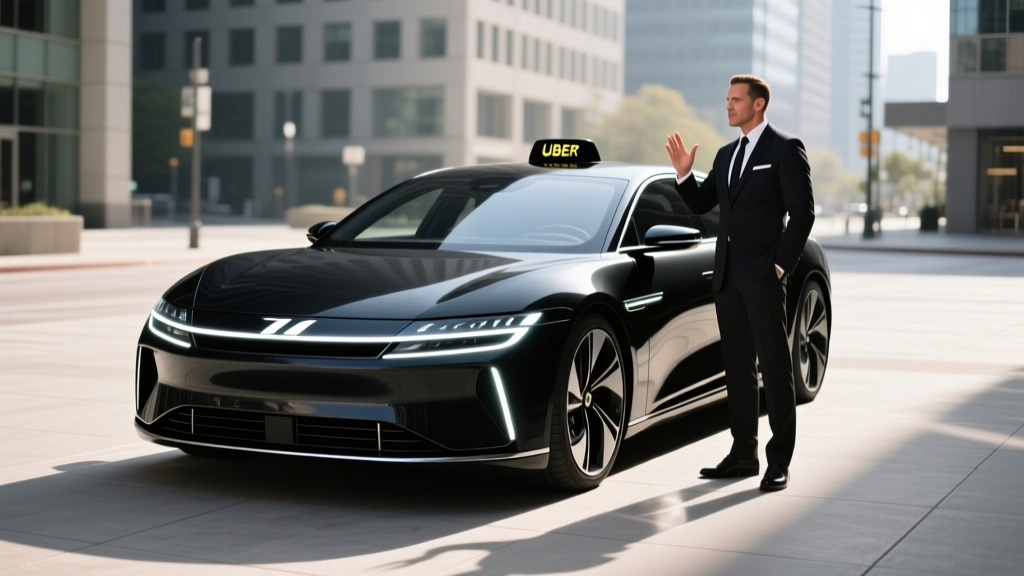
If you search forums and driver communities for "Lucid Uber," you will find a surprisingly active debate. Not about whether the Lucid Air is a good car — that's largely settled — but whether it makes financial sense as an Uber Black or Uber Lux sedan in 2026. The answer is more nuanced than a simple yes or no, and it depends heavily on your market, your weekly mileage, and how you charge.
The Lucid Air qualifies for Uber's premium tiers in most US markets, and its combination of class-leading range, whisper-quiet cabin, and limousine-grade rear legroom makes it a rider favorite. But with a starting price near $70,000 and limited federal tax credit eligibility, the ownership math requires careful modeling. This review breaks down the real numbers.
Quick Verdict: Is the Lucid Air Built for Rideshare?
For Uber Black/Lux drivers who can charge at home: The Lucid Air Pure RWD is one of the most capable premium EVs you can put into rideshare service. Its 419-mile EPA range means fewer charging interruptions during long shifts, and riders consistently rate the rear-seat experience highly.
For drivers without reliable home charging: Proceed with caution. Public DC fast charging at $0.35–$0.55/kWh erodes the Air's efficiency cost advantage, and the Air's large 88-kWh battery means longer stops at slower chargers.
Range, Battery, and Real-World Efficiency
The 2026 Lucid Air lineup uses two battery pack sizes across its trims, both employing NMC (nickel manganese cobalt) lithium-ion chemistry optimized for energy density — a deliberate choice by Lucid to maximize range over the cycle-life durability of LFP chemistry.
| Spec | Air Pure RWD | Air Touring AWD | Air Grand Touring AWD | Air Sapphire AWD |
|---|---|---|---|---|
| EPA Range | 419 mi | 406 mi | 516 mi | 427 mi |
| Battery (usable) | 88 kWh | 92 kWh | 112 kWh | 118 kWh |
| Chemistry | NMC | NMC | NMC | NMC |
| Efficiency (MPGe) | 140 MPGe | 131 MPGe | 131 MPGe | 110 MPGe |
| Energy consumption | 24 kWh/100mi | 26 kWh/100mi | 26 kWh/100mi | 30 kWh/100mi |
| Drivetrain | RWD single motor | AWD dual motor | AWD dual motor | AWD tri-motor |
| Horsepower | 430 hp | 620 hp | 819 hp | 1,234 hp |
| 0–60 mph | 5.0 sec | 3.4 sec | 3.0 sec | 1.89 sec |
Source: EPA / fueleconomy.gov and Lucid Motors official specifications.
Real-World Range: What to Actually Expect
EPA sticker: 419 mi (Pure RWD) to 516 mi (Grand Touring)
Real-world highway (70 mph, 72°F): Expect roughly 80–85% of EPA. The Pure RWD delivers approximately 335–355 miles on a full charge at sustained highway speeds. The Grand Touring achieves around 415–440 miles — still exceptional.
Cold weather (below 32°F): NMC chemistry loses 20–30% range in freezing temperatures without preconditioning. The Air Pure RWD drops to approximately 290–335 miles; the Grand Touring to roughly 360–415 miles. Lucid's heat pump and battery preconditioning mitigate some loss, but physics is physics.
City driving (rideshare-relevant): Regenerative braking in stop-and-go traffic pushes the Air close to or slightly above EPA estimates. Uber drivers in Los Angeles and Miami report 400+ effective miles on the Pure in warm-weather city loops.
For rideshare, the Air's efficiency is a genuine advantage. At 24 kWh per 100 miles (Pure RWD), it consumes roughly 15–20% less energy per mile than a Tesla Model S or Mercedes EQS, which translates directly into lower fuel costs whether charging at home or on public networks.
Charging Speed: DC Fast, Level 2, and Rideshare Turnaround
Charging speed is where the Lucid Air reveals a trade-off inherent in its design philosophy. Lucid prioritized range and efficiency over peak charging wattage, and the result is a charge curve that is respectable but not class-leading.
| Charging Level | Power / Rate | Air Pure RWD | Air Grand Touring | Notes |
|---|---|---|---|---|
| Level 1 (120V) | 1.4 kW | ~4 mi/hr | ~4 mi/hr | Emergency only; irrelevant for rideshare |
| Level 2 (240V, 48A) | 11.5 kW | ~38 mi/hr | ~38 mi/hr | Full charge in ~9–12 hours overnight |
| Level 2 (240V, 80A) | 19.2 kW | ~64 mi/hr | ~64 mi/hr | Requires hardwired charger + 100A circuit |
| DC Fast (peak) | ~200 kW (Pure) / ~250 kW (GT) | 10–80% in ~30 min | 10–80% in ~25 min | Peak rate sustained briefly; taper begins ~60% SoC |
| DC Fast (Tesla Supercharger) | ~150 kW (with adapter) | 10–80% in ~38 min | 10–80% in ~32 min | NACS adapter included; CCS-to-NACS network access |
A few things rideshare drivers should understand about these numbers:
The charge curve matters more than peak kW. The Air Grand Touring peaks near 250 kW but only sustains that rate between roughly 10–40% state of charge. From 60–80%, the rate tapers significantly — often below 80 kW. This is normal for NMC chemistry with large packs, but it means your 10–80% time is an average, not a constant rate. On a 350-kW Electrify America or EVgo stall, the Air won't pull the full rated power for long.
Level 2 at home is the rideshare play. If you install a 48-amp Level 2 charger (the most common home setup), you add roughly 38 miles per hour of charging. Plug in at 10 PM after your shift, and by 6 AM you have approximately 300 miles of range — enough for a full day of Uber Black in most markets. An 80-amp hardwired unit cuts this further, but requires a 100-amp dedicated circuit and a panel that can support it (more on installation costs below).
Supercharger adapter access is now standard. Lucid includes a NACS adapter, giving Air owners access to Tesla's Supercharger network (V3 stalls at 150 kW are the most common). This dramatically improves route flexibility for airport runs and longer trips, though charge speeds on V3 stalls are lower than on CCS-native 350-kW chargers.
Interior, Rear-Seat Comfort, and Cargo
For Uber Black and Uber Lux, the rear-seat experience is the product. This is where the Lucid Air earns its reputation among premium rideshare riders.
Rear legroom: 41.3 inches — more than the Mercedes S-Class and significantly more than the Tesla Model S (35.4 inches). This is the Air's single biggest advantage in rideshare service. Tall riders can cross their legs comfortably, and the flat floor (no transmission tunnel hump) makes the middle seat usable.
Rear headroom: 37.8 inches, aided by the Air's glass canopy roof that creates an airy, open feeling. Riders consistently comment on the sense of space.
Cargo: 26.3 cubic feet in the trunk, plus a 7.1-cubic-foot frunk. The trunk is deep and wide enough for four large suitcases — critical for airport runs. The frunk is useful for storing charging cables, a detail kit, or rider-requested amenities.
Infotainment: Lucid's 34-inch curved glass cockpit display spans the dash, with a lower 17-inch retractable touchscreen for media and climate. Apple CarPlay and Android Auto are wireless. The 21-speaker Surreal Sound Pro audio system (standard on Touring and above) is one of the best in any sedan at any price — riders notice it.
Climate: Standard heat pump with four-zone climate control. Rear passengers get dedicated vents and their own temperature zone, a must-have for premium rideshare.
Driver Assistance and Safety
SAE Automation Level: Level 2
The Lucid Air's DreamDrive Pro system is a Level 2 driver-assistance system. It provides adaptive cruise control, lane-centering, automatic lane changes, and intersection assistance. The driver must remain fully engaged, with hands on or near the wheel and eyes on the road at all times. This is not autonomous driving. DreamDrive uses 32 sensors including LiDAR, cameras, radar, and ultrasonics — a robust sensor suite, but the human driver is the final authority.
For rideshare, DreamDrive Pro reduces fatigue on highway segments and long airport runs. The LiDAR sensor (mounted above the windshield) gives the system strong object-detection performance in rain and low light compared to camera-only systems. However, it does not eliminate the need for driver attention, and Uber's terms of service require the driver to remain in control at all times.
Safety ratings: The Lucid Air earned a 5-star overall rating from NHTSA and a Top Safety Pick+ designation from IIHS. For rideshare drivers carrying passengers, these top-tier crash-test results provide meaningful peace of mind.
What DreamDrive Pro does NOT do: It does not navigate unmapped roads, handle construction zones autonomously, stop for all pedestrians in every scenario, or drive without supervision. Treat it as a co-pilot that reduces workload — not a replacement for attentive driving. Riders expect a professional driver, not a test pilot.
Pricing, Tax Credits, and Total Cost for Rideshare
| Trim | Base MSRP | Federal §30D Credit | Effective Price | Credit Eligibility Notes |
|---|---|---|---|---|
| Air Pure RWD | $69,900 | $0–$7,500 | $62,400–$69,900 | MSRP under $55K sedan cap? NO — exceeds cap. Credit depends on lease structure or commercial fleet rules. |
| Air Touring AWD | $82,400 | $0–$7,500 | $74,900–$82,400 | Same MSRP cap issue. Lease loophole may apply. |
| Air Grand Touring | $110,900 | $0–$7,500 | $103,400–$110,900 | Well above $55K sedan cap for purchase credit. |
| Air Sapphire | $250,500 | $0 | $250,500 | Not a rideshare candidate; included for completeness. |
Tax credit rules per IRS §30D. Eligibility depends on buyer income caps ($150K single / $300K joint), vehicle MSRP caps ($55K sedans, $80K SUVs/vans), battery sourcing requirements, and final assembly in North America. Always verify with a tax professional before purchase.
The MSRP cap problem: Under current §30D purchase rules, sedans must have an MSRP at or below $55,000 to qualify. The Lucid Air Pure at $69,900 exceeds this cap, meaning buyers who purchase outright likely will not receive the $7,500 federal credit. However, the commercial clean vehicle credit (§45W) and structured lease arrangements (where the leasing entity claims the credit and passes savings through as a capitalized-cost reduction) can partially or fully restore the incentive. Many Lucid buyers use the lease route. Consult a tax professional to model your specific situation.
Point-of-sale transfer: If you do qualify for any credit amount, the 2026 rules allow point-of-sale transfer to the dealer, reducing your out-of-pocket at delivery rather than waiting for a tax refund.
5-Year Ownership Cost Estimate (Uber Black, 40,000 mi/year)
| Cost Category | Lucid Air Pure RWD | Tesla Model S (baseline) |
|---|---|---|
| Purchase (after incentives) | ~$65,000 | ~$72,000 |
| Energy (5 yrs, home L2 at $0.13/kWh) | ~$15,600 | ~$18,200 |
| Maintenance (5 yrs) | ~$3,500 | ~$4,200 |
| Insurance (5 yrs) | ~$22,000 | ~$20,500 |
| Depreciation (est. 5-yr) | ~$32,000 | ~$35,000 |
| Total 5-year | ~$138,100 | ~$149,900 |
The Air Pure's lower energy consumption (24 vs ~28 kWh/100mi) saves roughly $2,600 over five years of high-mileage home charging. Insurance runs slightly higher due to Lucid's smaller repair network and higher parts costs. Depreciation remains a wildcard — Lucid's residual values are less proven than Tesla's, though the Air's range advantage may help long-term.
Warranty and Long-Term Durability
Lucid provides competitive warranty coverage for the premium EV segment:
- Basic vehicle: 4 years / 50,000 miles
- Battery & powertrain: 8 years / 100,000 miles (whichever comes first)
- Battery capacity retention: Guaranteed to retain at least 70% of original capacity during the warranty period
- Roadside assistance: 4 years / 50,000 miles
For rideshare drivers accumulating 40,000+ miles per year, the 100,000-mile powertrain cap is a consideration. You will reach it in approximately 2.5 years. Compare this to Tesla's Model S battery warranty of 8 years / 150,000 miles — a meaningful gap for high-mileage commercial use. Some rideshare drivers negotiate extended service agreements at purchase; availability varies by market.
The NMC battery chemistry in the Air offers excellent energy density but typically shows slightly faster degradation over thousands of cycles compared to LFP. Lucid's sophisticated thermal management system (liquid cooling with active heating and cooling) helps mitigate this. Real-world data from early 2022–2023 Air owners with 80,000+ miles shows approximately 5–8% capacity loss — within expectations for NMC.
Pros, Cons, and the Decision Framework
Pros for Rideshare
- Class-leading EPA range (up to 516 mi) reduces charging downtime
- Best-in-class rear legroom (41.3 in) — riders rate the experience highly
- Outstanding efficiency (24 kWh/100mi) lowers per-mile energy cost
- 5-star NHTSA safety; IIHS Top Safety Pick+
- Quiet cabin, premium audio, glass roof impress premium-tier riders
- NACS adapter included — Supercharger network access
- Large frunk + trunk handles airport luggage easily
Cons for Rideshare
- Base price ($69,900) exceeds §30D sedan MSRP cap for purchase credit
- Battery warranty only 100K miles — reached in ~2.5 yrs at rideshare pace
- DC fast charging peaks ~200–250 kW, slower than Hyundai/Kia 800V platforms
- Limited Lucid service center network vs Tesla — repairs can take longer
- Insurance premiums run 5–15% above comparable Tesla models
- DreamDrive Pro is good but not as polished as Tesla Autopilot in dense urban traffic
- Residual values less proven than established luxury brands
Should You Buy a Lucid Air for Uber?
Choose the Lucid Air Pure RWD if: You drive in a warm-climate metro (LA, Miami, Austin, Phoenix), have reliable home Level 2 charging, prioritize rider ratings and tips, and plan to keep the car 3–4 years. The range and rear-seat comfort are genuine competitive advantages that translate into better earnings per trip.
Choose the Tesla Model S or Mercedes EQS instead if: You drive in a cold-climate market, lack home charging, need the longest battery warranty possible, or want the widest service-center network. Tesla's 150,000-mile battery warranty and Supercharger-native experience reduce operational risk for high-mileage drivers.
Do not choose the Air Grand Touring or Sapphire for rideshare: The premium is not recoverable through Uber Black fares. The Pure RWD offers the best range-per-dollar and the lowest operating cost.
Frequently Asked Questions
Does the Lucid Air qualify for Uber Black and Uber Lux?
Yes. The Lucid Air is approved for Uber Black and Uber Lux in most US markets as of 2026. Verify your specific city's eligible vehicle list on the Uber driver portal, as requirements occasionally vary by region. The Air meets the typical criteria: premium sedan, leather interior, model year within the last 5–7 years, and a minimum vehicle value threshold.
What is the real-world range of the Lucid Air for rideshare driving?
In warm-weather city driving (the most common rideshare scenario), the Air Pure RWD can achieve 380–420 effective miles thanks to regenerative braking in stop-and-go traffic. On sustained highway runs at 70 mph, expect 335–355 miles. In freezing weather, plan for 290–335 miles. The Grand Touring extends all of these figures by roughly 15–20%.
How much does it cost to charge a Lucid Air per day for Uber?
At 24 kWh per 100 miles and a typical 200-mile rideshare day, the Air consumes approximately 48 kWh. At home Level 2 rates of $0.13/kWh, that's about $6.24 per day. On public DC fast chargers at $0.40/kWh, it's roughly $19.20 per day. Home charging is essential for rideshare economics — public-only charging erodes margins significantly.
Does the Lucid Air qualify for the $7,500 federal EV tax credit?
For outright purchase, likely not. The Air Pure's $69,900 MSRP exceeds the §30D sedan cap of $55,000. However, structured lease arrangements may allow the leasing company to claim the commercial credit and pass savings to you as a lower lease payment. The §45W commercial clean vehicle credit may also apply if the vehicle is titled to a business entity. Consult a tax professional — rules are complex and subject to change.
How does the Lucid Air compare to the Tesla Model S for Uber?
The Air wins on rear-seat space (41.3 vs 35.4 inches of legroom), efficiency (24 vs ~28 kWh/100mi), and EPA range (419 vs 402 miles). The Model S wins on battery warranty (150K vs 100K miles), Supercharger-native charging speed, service network breadth, and Autopilot polish. If rider comfort and tips are your priority, the Air has the edge. If operational simplicity and lower risk are paramount, the Model S remains the safer bet.
Is the Lucid Air's battery warranty sufficient for high-mileage rideshare?
The 8-year/100,000-mile battery warranty is the Air's weakest point for rideshare. At 40,000 miles per year, you exhaust the mileage cap in 2.5 years. After that, a battery replacement (estimated $18,000–$25,000 out of warranty) is your risk. Tesla's 150,000-mile battery warranty provides substantially more coverage for commercial mileage. Consider an extended service agreement or factor post-warranty battery risk into your financial model.
Can I install a home Level 2 charger for the Lucid Air?
Yes, and you should. A 48-amp Level 2 charger on a 60-amp circuit (the most common home installation) delivers 11.5 kW, adding roughly 38 miles of range per hour — enough to fully replenish a day's rideshare driving overnight. Expect $800–$2,500 for installation depending on your electrical panel capacity, distance from panel to garage, and local permit fees. If your panel is at capacity, a 200-amp service upgrade ($2,000–$4,000) may be required. Always hire a licensed electrician for the final installation.