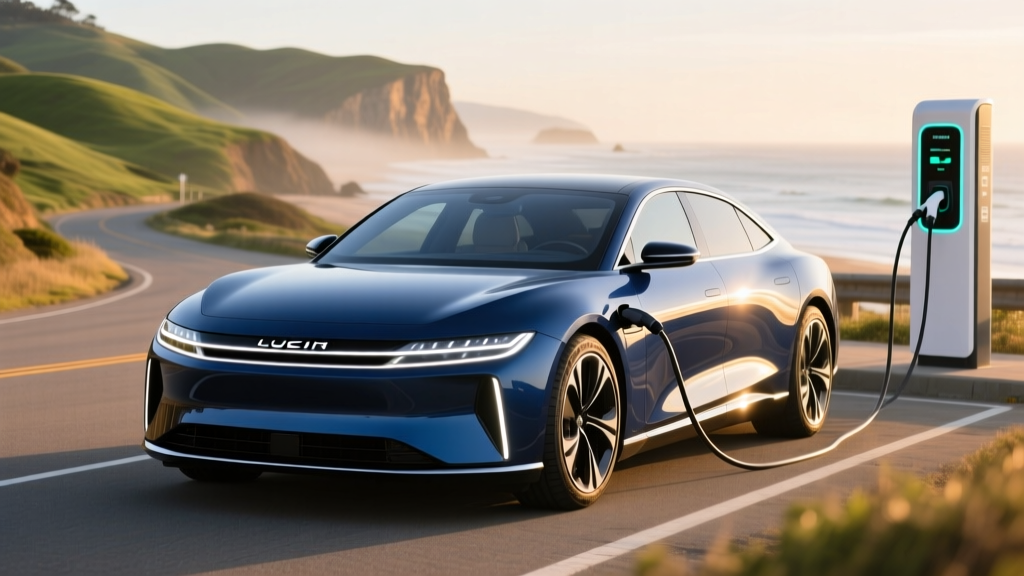
The Lucid Air Touring occupies a rare position in the luxury EV sedan market: it delivers over 400 miles of EPA-estimated range while undercutting the Tesla Model S and Mercedes EQS on price. But does the Touring trim — the volume play in Lucid's lineup — actually deliver when you factor in real-world highway driving, charging infrastructure, and the current federal tax credit landscape? I've spent time with the Air Touring's specs, charging curves, and ownership math to give you the unvarnished picture.
Quick Verdict: Who the Air Touring Is For
The 2026 Lucid Air Touring is a dual-motor, all-wheel-drive luxury sedan built for buyers who prioritize range efficiency and interior space over sub-3-second acceleration. It's ideal for long-distance commuters, frequent road trippers, and families who need a spacious rear seat without stepping into SUV territory. If you want a tech-forward sedan with legitimate 400+ mile legs and can charge at home, the Touring is compelling. If you need maximum cargo versatility, towing capability, or the cheapest possible luxury EV, look elsewhere.
Choose the Lucid Air Touring if: You want 400+ mile range, a refined ride, and sedan efficiency for long highway commutes and road trips.
Consider alternatives if: You need hatchback cargo space, want sub-$60K pricing, or prioritize the Supercharger network without an adapter.
Range and Efficiency: EPA vs. Real-World
| Metric | 2026 Lucid Air Touring |
|---|---|
| EPA Range | 406 miles |
| Usable Battery | 82 kWh (NMC lithium-ion) |
| EPA Efficiency | 140 MPGe combined / 24 kWh/100mi |
| Drivetrain | Dual-motor AWD |
| 0-60 mph | 3.4 seconds |
| Horsepower | 620 hp |
| Top Speed | 145 mph |
Real-World Range Reality: The 406-mile EPA figure assumes a mix of city and moderate-speed highway driving. Expect approximately 340–370 miles on sustained highway trips at 70–80 mph, where aerodynamic drag and higher speeds reduce efficiency. In cold weather (below 32°F / 0°C), plan for a 15–25% range reduction, bringing usable range down to roughly 300–345 miles depending on cabin heating demand and whether you precondition the battery. The Air Touring's heat pump helps mitigate winter losses compared to resistive heating systems, but physics still applies.
Lucid's efficiency advantage comes from its miniaturized drive units and 900V+ electrical architecture, which reduces energy losses in the powertrain. The result is an EV that extracts more miles per kWh than nearly any competitor — a critical advantage when DC fast charging, since you're paying per kWh at public stations.
Charging Speed: DC Fast, Level 2, and the Curve
| Charging Level | Power / Rate | Time / Miles Added |
|---|---|---|
| DC Fast Charge (peak) | 200 kW | 10–80% in ~34 minutes |
| DC Fast Charge (sustained avg.) | ~140–160 kW | ~200 miles in 20 min |
| Level 2 (home, 48A / 11.5 kW) | 11.5 kW | ~47 miles per hour of charging |
| Level 2 (standard 32A / 7.7 kW) | 7.7 kW | ~31 miles per hour of charging |
| Level 1 (120V / 1.4 kW) | 1.4 kW | ~5–6 miles per hour |
The Air Touring peaks at 200 kW on DC fast chargers — respectable, though it trails the Hyundai Ioniq 5's 240 kW peak and the Tesla Model S Plaid's ~250 kW capability. More important than peak rate is the charging curve: the Air Touring sustains strong power through the 10–60% state of charge (SoC) window before tapering significantly above 80%. This is standard for NMC battery chemistry, which Lucid uses to balance energy density and longevity.
On a 350 kW Electrify America or Tesla Supercharger (via the included NACS adapter), you'll realistically add about 200 miles of range in 20 minutes when starting from a low SoC. For road trips, this means two 20-minute stops on a 700-mile journey — competitive with most luxury EVs but not class-leading.
Home charging is where the Air Touring shines for daily use. With a 48-amp Level 2 wall connector on a 60-amp circuit, you'll recover roughly 47 miles of range per hour — enough to fully replenish the 82 kWh battery overnight from near-empty. Most owners will arrive home with 50–70% SoC and wake up fully charged. Installation costs for a 48A Level 2 setup typically run $800–$2,000 depending on panel proximity and local permitting, per Energy.gov guidance.
Performance and Driving Dynamics
The Air Touring's dual-motor AWD system produces 620 horsepower and achieves a 3.4-second 0–60 mph time. That's quick by any measure — quicker than a BMW 540i or Mercedes E450 — but Lucid reserves the extreme performance for the Grand Touring (819 hp) and Sapphire (1,234 hp) trims.
On the road, the Touring prioritizes composure over aggression. The ride is supple, cabin noise is exceptionally low (among the quietest EVs tested), and the regenerative braking offers adjustable levels including a near-one-pedal-driving mode. The steering is precise but light — tuned for grand-touring comfort rather than sports-sedan feedback.
The Air's low center of gravity (battery pack mounted under the floor) and near 50/50 weight distribution contribute to confident cornering, though at 4,800+ lbs, you feel the mass during aggressive direction changes. This is a luxury cruiser, not a track car, and that's the right calibration for its target buyer.
Interior, Cargo, and Technology
The Air Touring's cabin uses Lucid's "Space Concept" design philosophy, which pushes the windshield far forward and positions the battery to maximize interior volume. The result:
- Front legroom: 45.3 inches
- Rear legroom: 38.1 inches — genuinely comfortable for adults on long trips
- Cargo (trunk): 22.1 cu ft
- Frunk (front trunk): 10.0 cu ft
- Total cargo: 32.1 cu ft
The rear seat is a standout — more spacious than the Tesla Model S and competitive with full-size luxury sedans. The trunk opening is a traditional sedan notchback (not a hatchback or liftback), which limits loading of bulky items compared to the Porsche Taycan's hatch or an SUV.
Infotainment: Lucid's 34-inch curved glass cockpit display spans the driver's instrument cluster and center stack. The system supports wireless Apple CarPlay and Android Auto, over-the-air updates, and a "Surreal Sound" audio system with 21 speakers. The UI is clean but can require more taps than Tesla's minimalist approach for climate and navigation adjustments.
Driver Assistance: The Air Touring comes with Lucid's DreamDrive Pro suite, which includes adaptive cruise control, lane-keeping assist, automated emergency braking, and a 360-degree camera system. DreamDrive Pro is an SAE Level 2 system — it requires continuous driver supervision and is not autonomous. Lucid has announced future DreamDrive capabilities including hands-free highway driving, but as of the 2026 model year, the system operates similarly to Tesla Autopilot or GM Super Cruise in terms of driver engagement requirements.
ADAS Level Clarification: DreamDrive Pro is an SAE Level 2 driver-assistance system. The driver must remain alert, keep hands on or near the wheel (depending on mode), and be prepared to take over at any time. This is not self-driving — no consumer vehicle currently sold in the U.S. offers Level 3 or higher autonomy without geographic and conditional restrictions.
Pricing, Trims, and Federal Tax Credit
| Trim | Base MSRP | Est. After §30D Credit* |
|---|---|---|
| Air Pure (RWD) | $69,900 | ~$62,400 (if eligible) |
| Air Touring (AWD) | $79,900 | ~$72,400 (if eligible) |
| Air Grand Touring | $125,600 | Not eligible (MSRP cap) |
| Air Sapphire | $249,000 | Not eligible (MSRP cap) |
*Federal tax credit estimates based on 2026 IRS §30D rules. Eligibility depends on buyer income, battery component sourcing, and MSRP caps. See details below.
The 2026 Air Touring starts at $79,900 before destination and options. A well-equipped Touring with the Surreal Sound audio, upgraded interior materials, and 20-inch wheels can reach $88,000–$92,000 as-tested.
Federal EV Tax Credit Eligibility (§30D)
The Air Touring may qualify for up to $7,500 under IRS §30D, but only if ALL of the following are met:
- MSRP Cap: Vehicle MSRP must be ≤$55,000 for sedans. The Air Touring at $79,900 exceeds this cap and does NOT qualify for the new-vehicle §30D credit.
- Buyer Income Cap: Modified AGI ≤$150,000 (single), ≤$225,000 (head of household), ≤$300,000 (joint).
- Battery Sourcing: Critical minerals and battery components must meet escalating domestic/FATF-country thresholds.
- Point-of-Sale Transfer: Eligible buyers can transfer the credit to the dealer at purchase, reducing the upfront price.
Critical note: The Lucid Air Touring, as a sedan priced above $55,000 MSRP, does not qualify for the new-vehicle §30D federal tax credit under current IRS rules. The IRS §30D guidelines set a $55,000 MSRP cap for sedans (vans, SUVs, and trucks have an $80,000 cap). This is a significant cost consideration versus EV SUVs like the BMW iX or Rivian R1S, which fall under the higher cap.
Some buyers may offset costs through state-level incentives (California's CVRP, for example, has its own income and price thresholds), employer charging subsidies, or local utility rebates for home charger installation. Always consult a tax professional and verify current-year rules at irs.gov before purchasing.
Ownership Costs, Warranty, and Longevity
| Category | Details |
|---|---|
| Basic Warranty | 4 years / 50,000 miles |
| Battery & Powertrain | 8 years / 100,000 miles |
| Battery Capacity Retention | Warranted at ≥70% over 8 yr/100k mi |
| Estimated Insurance (annual) | $2,800–$3,600 (varies by state/profile) |
| Estimated Electricity Cost (annual, 12k mi) | $500–$750 (at $0.14/kWh avg.) |
| Maintenance (annual avg.) | $200–$400 (cabin filter, tires, fluid top-offs) |
Lucid's 8-year/100,000-mile battery and powertrain warranty is standard for the luxury EV segment — matching Tesla, BMW, and Mercedes. The 70% capacity retention threshold means Lucid will repair or replace the battery if it degrades below 70% of original capacity within the warranty period.
The 82 kWh NMC battery should prove durable for most owners. NMC chemistry typically sees 10–15% degradation over the first 100,000 miles based on industry data, with the curve flattening afterward. Best practices — avoiding frequent 100% charges, limiting DC fast charging to road trips, and using scheduled preconditioning — can help maintain long-term battery health.
Insurance premiums for the Air Touring run higher than average for its price class due to Lucid's limited repair network and higher parts costs. Expect quotes in the $2,800–$3,600/year range depending on your driving record and state. Get quotes before committing to the purchase.
Air Touring vs. Key Competitors
| Spec | Lucid Air Touring | Tesla Model S (LR) | Mercedes EQS 450 4M | BMW i5 M60 |
|---|---|---|---|---|
| EPA Range | 406 mi | 402 mi | 345 mi | 295 mi |
| Battery (usable) | 82 kWh | ~100 kWh | 107.8 kWh | 81.2 kWh |
| Efficiency (kWh/100mi) | 24 | 28 | 33 | 30 |
| Peak DC Charge | 200 kW | 250 kW | 200 kW | 205 kW |
| 10–80% Time | ~34 min | ~27 min | ~31 min | ~30 min |
| 0–60 mph | 3.4 sec | 3.1 sec | 5.3 sec | 3.7 sec |
| Base MSRP | $79,900 | $74,990 | $104,400 | $84,300 |
| §30D Credit | No (sedan cap) | No (sedan cap) | No (sedan cap) | No (sedan cap) |
The Air Touring's key advantage is efficiency: at 24 kWh/100mi, it uses less energy per mile than every competitor listed. That translates directly to lower charging costs and more range from a smaller battery. The Tesla Model S Long Range matches it on range but requires a larger, heavier battery to do so. The EQS and i5 trail significantly on range.
Where the Air Touring falls short: charging speed (200 kW peak vs. Tesla's 250 kW), Supercharger network access (Lucid includes a NACS adapter, but you're relying on adapter compatibility), and brand/service infrastructure (Lucid's service center network is still growing versus Tesla's or BMW's established presence).
Pros, Cons, and the Bottom Line
Pros
- Class-leading efficiency (24 kWh/100mi) reduces charging costs
- 406-mile EPA range — among the highest of any production EV
- Spacious rear seat with 38.1" legroom
- Quiet, refined ride quality
- Strong 620 hp / 3.4-sec 0–60 performance
- Over-the-air updates continue to add features
- NACS adapter included for Supercharger access
Cons
- $79,900 MSRP disqualifies from §30D federal credit (sedan cap)
- 200 kW peak DC charging trails some rivals
- Traditional trunk (not hatchback) limits cargo versatility
- Limited service center footprint vs. legacy brands
- Insurance premiums above class average
- Infotainment requires more menu diving than some competitors
The 2026 Lucid Air Touring is an engineering showcase — a sedan that proves range and efficiency don't require compromise. If the $79,900 price and lack of federal tax credit fit your budget, and you have reliable home charging, it's one of the most compelling long-distance luxury EVs available. If the tax credit is a dealbreaker or you need hatchback practicality, the Tesla Model S or an electric SUV may serve you better.
Frequently Asked Questions
What is the real-world range of the Lucid Air Touring?
The EPA estimates 406 miles. In real-world highway driving at 70–80 mph, expect approximately 340–370 miles. In cold weather (below freezing), plan for 300–345 miles depending on heating use and battery preconditioning.
How fast does the Air Touring charge at home and on the road?
On DC fast chargers, it peaks at 200 kW and reaches 10–80% in about 34 minutes. At home on a 48-amp Level 2 charger (11.5 kW), it adds roughly 47 miles of range per hour, fully recharging overnight.
Does the Lucid Air Touring qualify for the $7,500 federal EV tax credit?
No. Under current IRS §30D rules, sedans must have an MSRP of $55,000 or less to qualify. The Air Touring starts at $79,900, exceeding the cap. State incentives may still apply — check your local programs.
How does the Air Touring compare to the Tesla Model S?
The Air Touring is slightly more efficient (24 vs. 28 kWh/100mi) and offers a more spacious rear seat. The Model S charges faster (250 kW peak), has native Supercharger access, and a more established service network. Both exceed 400 miles of EPA range.
What battery chemistry does the Air Touring use, and how long will it last?
The Air Touring uses an NMC (nickel-manganese-cobalt) lithium-ion battery with 82 kWh usable capacity. NMC batteries typically degrade 10–15% over 100,000 miles. Lucid warranties the battery for 8 years/100,000 miles at 70% capacity retention.
Is the Air Touring a good family car?
Yes, if your family fits a sedan. The rear seat accommodates adults comfortably, and total cargo space (32.1 cu ft including the frunk) handles groceries and luggage for four. Families needing car seats, strollers, or frequent bulky-item hauling will find an SUV more practical.
Can the Air Touring use Tesla Superchargers?
Yes. Lucid includes a NACS adapter with the vehicle, enabling access to the Tesla Supercharger network. Ensure the adapter is properly connected and use the Lucid app or Tesla app to initiate sessions as needed.