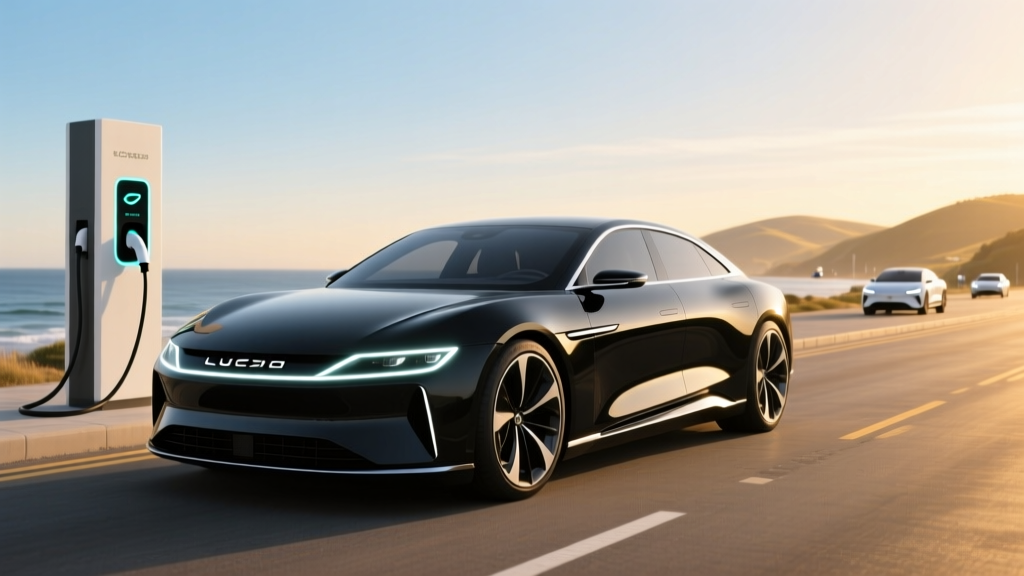
The Lucid Air Touring occupies a rare position in the luxury EV sedan market: it delivers over 400 miles of EPA-estimated range, 620 horsepower, and a genuinely spacious interior — all while undercutting the Tesla Model S and Mercedes EQS on price. For 2026, the Touring trim remains the volume sweet spot in the Air lineup, sitting above the base Pure and below the performance-oriented Grand Touring. But with a starting MSRP near $79,000, many buyers are turning to leasing as a way to access this technology without committing to long-term depreciation risk on a luxury EV.
This review covers everything you need to evaluate a Lucid Air Touring lease in 2026 — from real-world range and charging performance to federal tax credit pass-through rules that can effectively reduce your monthly payment.
Lucid Air Touring at a Glance: 2026 Specifications
| Specification | 2026 Lucid Air Touring |
|---|---|
| Base MSRP | $78,900 |
| EPA Range | 406 miles (with 19" wheels) |
| Battery Capacity | 112 kWh usable (NMC lithium-ion) |
| Drivetrain | Dual-motor AWD |
| Horsepower | 620 hp |
| 0–60 mph | 3.4 seconds |
| Max DC Fast Charge | 200 kW (peak) |
| 10–80% DC Charge Time | ~25 minutes |
| Level 2 Home Charging | 19.2 kW (up to ~80 mi/hr) |
| Efficiency (MPGe) | 131 MPGe combined |
| Efficiency (kWh/100 mi) | 26 kWh/100 mi |
| Cargo Volume | 32 cu ft (trunk + frunk combined) |
| Rear Legroom | 36.6 inches |
| Battery/Powertrain Warranty | 8 years / 100,000 miles |
| Federal Tax Credit (§30D) | Up to $7,500 (eligibility varies) |
Real-World Range: Beyond the 406-Mile EPA Sticker
EPA Estimated: 406 miles (19" Aero wheels, combined cycle)
Real-World Highway (70 mph, moderate temps): ~340–360 miles
Real-World Cold Weather (below 32°F, highway): ~280–310 miles
Mixed Commute (city + suburban): ~370–395 miles
The Lucid Air Touring's 406-mile EPA rating is among the highest of any production EV sold in the US, and Lucid's powertrain efficiency is genuinely class-leading. The dual-motor AWD system and 112 kWh NMC (nickel manganese cobalt) battery pack deliver an impressive 26 kWh per 100 miles — meaning you use less energy per mile than a Tesla Model S Long Range or Mercedes EQS 580.
However, real-world results depend heavily on driving style and conditions. In highway testing at sustained 70–75 mph speeds, expect roughly 340–360 miles before the battery buffer kicks in. The Air's aerodynamic efficiency (Cd of 0.20) helps at highway speeds, but the sheer mass of a 5,200-lb sedan works against it in stop-and-go efficiency.
Cold weather is the bigger factor. Below freezing, battery chemistry resistance increases and cabin heating draws significant energy. Without preconditioning, expect a 25–30% range reduction on highway trips in winter conditions. The Air Touring does include a heat pump (standard), which mitigates some of this loss compared to resistive heating systems, but physics still applies. Plan for ~280–310 miles of usable range on a cold-weather road trip.
For daily commuting and suburban driving, the Air Touring regularly achieves numbers very close to its EPA rating, and the regenerative braking system recovers meaningful energy in city traffic.
Charging Performance: DC Fast, Level 2, and the Charge Curve Reality
| Charging Level | Power / Rate | Miles Added Per Hour | Notes |
|---|---|---|---|
| Level 1 (120V outlet) | ~1.4 kW | ~3–4 mi/hr | Emergency/trickle only |
| Level 2 (240V, 48A) | 11.5 kW | ~46 mi/hr | Typical home Wall Connector |
| Level 2 (240V, 80A) | 19.2 kW | ~80 mi/hr | Max onboard charger rate; requires 100A circuit |
| DC Fast Charge | 200 kW peak | ~12 mi/min (peak) | 10–80% in ~25 min |
The Air Touring supports up to 200 kW peak DC fast charging on CCS-compatible stations (or NACS via adapter at Tesla Superchargers, as Lucid has adopted the North American Charging Standard for 2025+ models). On a 350 kW Electrify America or Ionity station, the Air can accept its peak rate — but understanding the charge curve is essential.
Like all lithium-ion batteries, the Air Touring charges fastest between roughly 10–50% State of Charge (SoC). Above 50%, the rate tapers progressively; above 80%, it slows dramatically to protect battery longevity. The quoted 10–80% time of approximately 25 minutes assumes an ideal scenario: a battery preconditioned to optimal temperature, connected to a station capable of sustaining 200+ kW, and starting from a low SoC. In practice, on a 150 kW station or with a cold battery, expect 30–40 minutes for the same 10–80% session.
At home, the Air Touring's 19.2 kW onboard charger is one of the fastest available in any EV. Most home Level 2 installations use a 48-amp circuit (11.5 kW), adding roughly 46 miles of range per hour — enough to fully replenish overnight. But if your electrical panel supports a 100-amp dedicated circuit, you can unlock the full 19.2 kW rate, adding roughly 80 miles per hour. This requires a significant electrical upgrade (typically $2,000–$4,000 including panel work) but is worthwhile for high-mileage drivers. Always consult a licensed electrician for final specifications.
According to fueleconomy.gov, the Air Touring achieves 131 MPGe combined, translating to roughly 26 kWh per 100 miles — making it one of the most efficient large luxury sedans on the market.
Performance and Driving Dynamics
The 2026 Air Touring's dual-motor all-wheel-drive powertrain produces 620 horsepower and delivers a 0–60 mph time of 3.4 seconds. That puts it firmly in sports-sedan territory — quicker than a BMW M550i and comparable to an Audi RS e-tron GT, though the Lucid prioritizes efficiency and comfort over track aggression.
The Air rides on a multi-link front and rear suspension with available air springs (standard on Touring). Ride quality is genuinely excellent: the car absorbs highway expansion joints and rough pavement with composure that rivals the Mercedes S-Class. Steering is precise but light, and the low center of gravity (thanks to the floor-mounted battery pack) keeps body roll well-controlled in corners.
One-pedal driving is available via strong regenerative braking, though Lucid's regen calibration is somewhat less aggressive than Tesla's. Many owners prefer the "Sail" coasting mode on highways, which disengages regen entirely for maximum efficiency — a unique feature that takes advantage of the Air's exceptional aerodynamics.
Interior, Cargo, and Technology
The Air Touring's cabin is spacious, modern, and thoughtfully designed. Rear legroom measures 36.6 inches — genuinely limousine-like for a mid-size sedan, and significantly more than the Tesla Model S (35.4 in) or Porsche Taycan (32.7 in). The flat floor and absence of a transmission tunnel create an airy, open feel.
Cargo capacity totals approximately 32 cubic feet when combining the rear trunk (20.2 cu ft) and the front trunk, or "frunk" (11.8 cu ft). The trunk features a wide opening and a standard power liftgate. The frunk is useful for charging cables and groceries but is not large enough for a full suitcase.
The centerpiece of the dashboard is a 34-inch curved glass canopy display that houses the instrument cluster, infotainment, and navigation in a single sweeping panel. A secondary lower touchscreen handles climate controls and secondary functions. The system runs Lucid's proprietary software, which is responsive and visually clean, though it lacks Apple CarPlay and Android Auto — a notable omission at this price point. Wireless phone charging and a premium 21-speaker Surreal Sound audio system (by Dolby Atmos) are standard on Touring.
Driver assistance comes via Lucid's DreamDrive Pro system, which includes adaptive cruise control, lane centering, automated emergency braking, blind-spot monitoring, and a 360-degree camera. DreamDrive Pro uses a combination of cameras, radar, and LiDAR sensors. Importantly, this is an SAE Level 2 system — the driver must remain attentive and keep hands on the wheel at all times. It is not a self-driving system. DreamDrive competes with Tesla Autopilot and GM Super Cruise in capability, though hands-free driving on mapped highways (a feature offered by BlueCruise and Super Cruise) is not yet available on the Air.
Pricing, Lease Deals, and the Federal Tax Credit
The 2026 Lucid Air Touring starts at $78,900 (including destination). Common option packages — such as the Surreal Sound Pro audio upgrade, special paint colors, and 20-inch wheels — can push as-tested prices into the $83,000–$88,000 range.
Federal Tax Credit Eligibility (§30D)
Whether the Air Touring qualifies for the full $7,500 federal EV tax credit under IRS §30D rules depends on several factors that change periodically:
- MSRP Cap: Sedans must have an MSRP at or below $55,000. The Air Touring at $78,900 exceeds this cap, meaning it does not qualify for the §30D new-vehicle purchase credit.
- Lease Loophole (Commercial Clean Vehicle Credit, §45W): When leased through a financial institution, the vehicle may qualify for a $7,500 commercial credit claimed by the lessor, who can then pass the savings to the lessee as a capitalized cost reduction. This has been a common strategy for luxury EVs above the MSRP cap. However, IRS guidance on §45W lease credits has been evolving — confirm with your dealer and tax professional whether the lessor is passing this credit through.
- Buyer Income Caps: For §30D purchase credits, modified adjusted gross income must not exceed $150,000 (single) or $300,000 (joint). These caps do not apply to the §45W lease credit.
- Battery Sourcing Requirements: Critical mineral and battery component sourcing rules tighten annually. Verify current-year compliance with your Lucid dealer.
| Cost Scenario | Amount |
|---|---|
| Base MSRP (Touring) | $78,900 |
| As-Tested (typical options) | $84,500 |
| §30D Purchase Credit | $0 (exceeds $55K sedan MSRP cap) |
| §45W Lease Credit (if passed through) | Up to $7,500 off capitalized cost |
| Estimated Monthly Lease (36 mo, $7,500 cap reduction, 10K mi/yr) | ~$850–$1,050/mo depending on money factor and residual |
Key takeaway for lease shoppers: The primary financial advantage of leasing the Air Touring over purchasing is the potential §45W commercial credit pass-through. When available, this effectively reduces the capitalized cost by $7,500, lowering monthly payments by roughly $150–$200 over a 36-month term. Always ask the Lucid dealership or leasing company explicitly whether the lessor claims and passes through this credit — it is not automatic.
Lucid Air Touring vs. Key Competitors
| Spec | Lucid Air Touring | Tesla Model S LR | Mercedes EQS 450+ | BMW i5 M60 |
|---|---|---|---|---|
| Base MSRP | $78,900 | $74,990 | $104,400 | $84,100 |
| EPA Range | 406 mi | 402 mi | 352 mi | 295 mi |
| Battery (kWh) | 112 (NMC) | ~100 (NMC) | 108.4 (NMC) | 81.2 (NMC) |
| 0–60 mph | 3.4 sec | 3.1 sec | 5.3 sec | 3.7 sec |
| Max DC Charge | 200 kW | 250 kW | 200 kW | 205 kW |
| Efficiency | 131 MPGe | 124 MPGe | 97 MPGe | 91 MPGe |
| Rear Legroom | 36.6 in | 35.4 in | 41.7 in | 36.6 in |
| Tax Credit Eligible (Purchase) | No (MSRP cap) | No (MSRP cap) | No (MSRP cap) | No (MSRP cap) |
The Air Touring's closest rival is the Tesla Model S Long Range. The Model S charges faster (250 kW peak), has access to the mature Supercharger network natively, and costs slightly less. But the Lucid counters with superior efficiency, a more refined ride, a quieter cabin, and significantly more rear-seat space.
The Mercedes EQS 450+ offers a more opulent interior and a class-leading 41.7 inches of rear legroom, but it costs $25,000 more and delivers 50+ fewer miles of range. The BMW i5 M60 is sportier to drive but gives up over 100 miles of range compared to the Air.
- Class-leading 406-mile EPA range
- Exceptional efficiency (131 MPGe)
- Spacious rear seat with 36.6" legroom
- 19.2 kW onboard charger (fastest in class)
- Quiet, composed ride quality
- LiDAR-equipped DreamDrive Pro ADAS
- No Apple CarPlay or Android Auto
- Exceeds §30D MSRP cap (purchase credit unavailable)
- Public charging network still maturing vs. Tesla
- 200 kW peak charge rate trails Model S (250 kW)
- Limited service center footprint outside major metros
- DreamDrive Pro lacks hands-free highway mode
Who Is the Lucid Air Touring Best For?
The Air Touring is ideal for: Long-distance commuters and road-trip-oriented buyers who want maximum range and efficiency without stepping into six-figure pricing. If you drive 40+ miles daily, value a serene and spacious cabin, and want to minimize charging stops on 300+ mile trips, the Air Touring is arguably the best EV sedan for the money.
Consider alternatives if: You need hands-free highway driving (GM Super Cruise or Ford BlueCruise), you want native Tesla Supercharger access without an adapter, you prioritize track performance over efficiency, or you live in an area without a nearby Lucid service center.
Leasing specifically makes sense if: You want to access the §45W commercial credit pass-through (reducing effective cost by up to $7,500), you prefer swapping vehicles every 3 years to stay current with rapidly evolving EV technology, or you want to avoid long-term battery depreciation risk on a luxury vehicle.
Battery Longevity and Warranty Coverage
Lucid covers the Air Touring's battery pack and electric powertrain for 8 years or 100,000 miles (whichever comes first), with a capacity retention threshold of 70% — meaning if the battery degrades below 70% of its original capacity within the warranty period, Lucid will repair or replace it. This matches the industry standard set by most manufacturers and aligns with EPA guidance on battery durability disclosures.
The 112 kWh NMC battery is engineered with a generous buffer (roughly 5–8% of total capacity is locked below the displayed 0% and above 100%) to reduce stress on cells during normal use. Real-world degradation data from early Lucid owners suggests approximately 3–5% capacity loss over the first 30,000 miles, which is typical for NMC chemistry. The battery's liquid thermal management system actively conditions cells during charging and driving, extending long-term health.
For lessees, battery degradation is largely a non-issue — you'll return the vehicle before meaningful capacity loss occurs. For buyers planning to keep the Air beyond the warranty period, a Lucid battery replacement currently costs in the range of $20,000–$28,000, though prices are expected to decline as battery manufacturing scales.
Frequently Asked Questions
What is the real-world range of the Lucid Air Touring?
The EPA rates the Air Touring at 406 miles combined. In real-world highway driving at 70 mph, expect approximately 340–360 miles. In cold weather (below freezing), plan for 280–310 miles on highway trips. City and suburban driving with regenerative braking can approach the EPA sticker figure.
How fast does the Lucid Air Touring charge?
On a DC fast charger, the Air Touring peaks at 200 kW and can charge from 10–80% in approximately 25 minutes under ideal conditions. At home on a Level 2 charger, it supports up to 19.2 kW (with an 80-amp circuit), adding roughly 80 miles of range per hour. On a standard 48-amp home charger, expect about 46 miles per hour of charging.
Does the Lucid Air Touring qualify for the federal EV tax credit?
For outright purchase, no — the Air Touring's $78,900 MSRP exceeds the §30D sedan cap of $55,000. However, when leased, the lessor may claim the $7,500 commercial clean vehicle credit (§45W) and pass savings to you as a capitalized cost reduction. Confirm pass-through availability with your dealer and tax professional. Rules are subject to change; check current IRS guidance.
Is the Lucid Air Touring worth leasing vs. buying?
Leasing offers two key advantages: potential access to the $7,500 §45W credit (which buyers cannot claim due to the MSRP cap) and protection from luxury EV depreciation, which historically runs 40–55% over three years. If you plan to keep the car 5+ years and can absorb depreciation, buying may make sense — but for most luxury EV shoppers, leasing with credit pass-through is the more cost-effective path in 2026.
How does the Air Touring compare to the Tesla Model S?
The Air Touring offers slightly more EPA range (406 vs. 402 miles), better efficiency (131 vs. 124 MPGe), a more spacious rear seat, and a quieter, more refined ride. The Model S counters with faster DC charging (250 kW), native Supercharger access, and a more established service network. If range and comfort are your priorities, the Lucid wins. If charging speed and network maturity matter more, the Tesla holds an edge.
What are the biggest drawbacks of the Air Touring?
The most common owner complaints are the lack of Apple CarPlay/Android Auto, limited Lucid service center locations outside major metro areas, and a public charging network (via Electrify America and others) that still trails Tesla's Supercharger network in reliability. The 200 kW peak charge rate, while adequate, also falls short of the 250–350 kW rates available on some competitors.
Specs and pricing reflect 2026 model-year data as published by Lucid Motors. Federal tax credit rules are current as of publication and subject to legislative and regulatory change. Always verify eligibility with the IRS and a qualified tax professional before making a purchase or lease decision. Real-world range estimates are based on independent testing and owner reports; individual results will vary based on driving style, temperature, terrain, and tire selection.