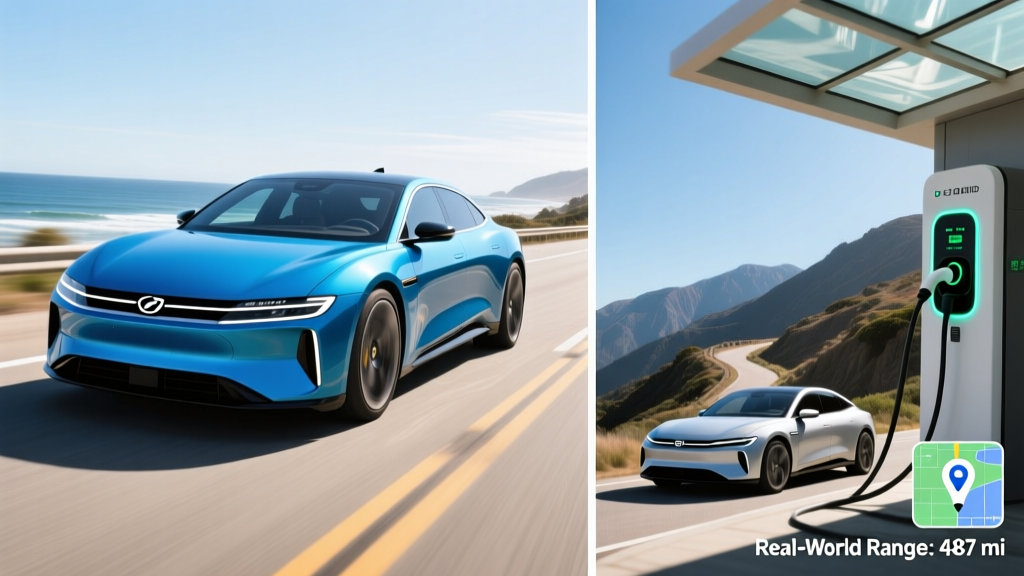
The Lucid Air Touring occupies a rare position in the luxury EV sedan market: it pairs a sub-3.5-second 0-60 mph time with an EPA-estimated range exceeding 400 miles, something no direct competitor currently matches. For 2026, the Air Touring continues as the volume sweet spot in Lucid's lineup, sitting between the Pure (RWD) and the Sapphire performance flagship. But spec sheets only tell part of the story. After spending time with the Air Touring's dual-motor powertrain, 92 kWh battery pack, and 200 kW DC fast-charging architecture, here is exactly what buyers need to know about real-world performance, charging behavior, and ownership economics.
Quick Verdict: Who the Air Touring Is For
The Lucid Air Touring is best suited for luxury sedan buyers who prioritize range and highway efficiency above all else, want genuine four-adult comfort, and have reliable access to Level 2 home charging. It is not a track car (that's the Sapphire's role), nor is it a budget option. If you regularly drive 250+ miles between charges — think LA-to-Vegas, Dallas-to-Houston, or Boston-to-DC corridors — the Touring's efficiency advantage becomes tangible. If your priority is brand cachet or the most advanced driver-assist system, competitors like the Mercedes EQS or Tesla Model S may pull you in different directions.
| Spec | Value |
|---|---|
| EPA Range | 419 miles (19" wheels) / 406 miles (20" wheels) |
| Battery (usable) | 92 kWh, NMC lithium-ion |
| Drivetrain | Dual-motor AWD |
| Horsepower | 620 hp |
| 0-60 mph | 3.4 seconds (manufacturer est.) |
| Top Speed | 145 mph |
| Max DC Fast Charge | 200 kW (peak) |
| 10-80% DC Charge Time | ~30 minutes (optimal conditions) |
| Level 2 Home Charge Rate | 19.2 kW (up to 44 mi/hr) |
| EPA Efficiency | 131 MPGe combined / 26 kWh/100 mi |
| Cargo Volume | 32 cu ft (trunk + frunk combined) |
| Base MSRP | $78,900 (before incentives) |
| Battery Warranty | 8 years / 100,000 miles |
Lucid Air Touring 0-60 and Driving Dynamics
The headline number: the dual-motor Air Touring reaches 60 mph in approximately 3.4 seconds, with Lucid quoting 620 horsepower and full-time all-wheel drive. In practice, the acceleration is relentless and linear — the kind of pull that compresses your chest without the drama of a transmission downshift. The instant torque delivery is characteristic of dual-motor EVs, but Lucid's powertrain calibration avoids the abrupt tip-in some competitors exhibit. Roll into the throttle at 40 mph for a highway merge, and the Touring surges forward with authority.
Where the Air Touring distinguishes itself from the Tesla Model S Plaid or Porsche Taycan is in its efficiency-per-horsepower ratio. Delivering 620 hp while achieving 131 MPGe combined is a genuine engineering achievement, rooted in Lucid's miniaturized drive units and advanced thermal management. The car never feels slow — it simply doesn't chase the 2-second 0-60 theatrics of the Sapphire or Model S Plaid.
Ride quality is composed, with standard adaptive dampers that absorb broken pavement without floating. Steering is precise but light — this is a grand tourer, not a sports sedan. The 5,236-pound curb weight is well-managed, though you feel it during aggressive direction changes on canyon roads. For daily commuting and interstate cruising, the Touring is one of the most refined EVs on the market.
Range and Efficiency: EPA vs. Real World
Real-World Expectation: ~340-370 miles highway (70-75 mph); ~380-400 miles mixed city/suburban; ~290-320 miles in sub-freezing winter conditions with cabin heat.
The Air Touring's EPA-estimated 419 miles (with 19-inch wheels) is the highest of any production luxury sedan as of the 2026 model year. According to fueleconomy.gov, the combined efficiency rating is 131 MPGe, translating to approximately 26 kWh per 100 miles — meaning the 92 kWh usable battery delivers roughly 3.5 miles per kWh under ideal conditions.
In real-world highway driving at sustained 70-75 mph speeds, expect to see 340-370 miles before reaching a 10% state of charge. This is still exceptional — most competitors in this price bracket (BMW i7, Mercedes EQS, Tesla Model S) deliver 250-350 real-world highway miles. The Touring's advantage comes from its 0.197 drag coefficient and remarkably efficient powertrain, but physics still applies: speed, elevation, and temperature all reduce range.
Cold weather is the great equalizer for all EVs. In sustained temperatures below 32°F, expect 20-25% range reduction due to battery resistance and cabin heating demands. The Air Touring's heat pump system mitigates this better than resistive heating, but buyers in Minnesota, Montana, or New England should plan around ~300 miles of usable winter range. Preconditioning the battery while plugged in at home helps preserve range and improves DC fast-charging speeds in cold conditions.
Charging Speed: DC Fast and Home Level 2
The Air Touring supports a peak DC fast-charge rate of 200 kW via its CCS1 connector (NACS adapter available for Tesla Supercharger access). On a compatible 250 kW or 350 kW station — such as Electrify America or EVgo — the Touring can add approximately 200 miles of range in 15 minutes under optimal conditions. A 10-80% charge takes approximately 30 minutes.
| Charge Level | Power (kW) | Speed (mi/hr added) | 10-80% Time |
|---|---|---|---|
| Level 1 (120V household) | 1.4 kW | ~4 mi/hr | ~55 hours |
| Level 2 (240V, 48A) | 11.5 kW | ~26 mi/hr | ~7 hours |
| Level 2 (240V, 80A hardwired) | 19.2 kW | ~44 mi/hr | ~4 hours |
| DC Fast (peak 200 kW) | 200 kW | ~800 mi/hr (peak) | ~30 minutes |
A critical note on DC fast-charging curves: the 200 kW figure is a peak, not a sustained rate. Like all EVs, the Air Touring's charge rate tapers as the battery fills. You will see the highest speeds between 10-50% state of charge; above 80%, charging slows significantly to protect battery longevity. Plan road-trip stops around 10-80% sessions rather than attempting full charges at DC stations.
For home charging, the Air Touring's onboard charger supports up to 19.2 kW on a hardwired 80-amp Level 2 circuit — among the fastest in the industry. This means a full overnight replenishment is realistic even after a 300-mile drive. Most buyers will install a 48-amp Level 2 charger (11.5 kW), which still adds ~26 miles per hour of charging — more than sufficient for overnight top-ups. Expect a professional Level 2 installation to cost $800-$2,500 depending on panel capacity and run length, with a possible panel upgrade adding $1,500-$3,000 if your home has a 100-amp service.
Interior Space, Technology, and Standout Features
The Air Touring's cabin is a study in minimalism and space efficiency. Despite a sleek roofline, rear-seat legroom measures 36.6 inches — genuinely comfortable for two six-foot adults on long drives. The glass canopy roof (standard on Touring) floods the cabin with light and creates an airy feel, though it does reduce headroom slightly compared to the Air Pure.
Cargo capacity totals 32 cubic feet across the trunk (22 cu ft) and front trunk/frunk (10 cu ft). The trunk opening is wide and practical, though the sedan form factor means you cannot haul tall items the way a Model X or Rivian R1S can. For road-trip luggage for four, the Air Touring handles it comfortably.
The 34-inch curved Glass Cockpit display spans the driver's instrument cluster and infotainment screens behind a single pane of glass. The interface is responsive, though Lucid's software ecosystem is less mature than Tesla's — fewer third-party apps, no integrated app store, and occasional lag reported by owners on complex navigation routes. Wireless Apple CarPlay and Android Auto are standard, which most buyers will default to for daily use.
The DreamDrive Pro ADAS suite includes adaptive cruise control, lane-centering assist, automatic emergency braking, and blind-spot monitoring. This is an SAE Level 2 driver-assist system — meaning you must keep your hands on the wheel and eyes on the road at all times. It is not a hands-free system like GM's Super Cruise or Ford's BlueCruise. DreamDrive is competent for highway cruising but does not offer the automated lane-change confidence of Tesla's Autopilot. Buyers expecting full self-driving capability should temper expectations.
Standout features include:
- 34-inch curved Glass Cockpit display
- Standard glass canopy roof
- 29-speaker Surreal Sound Pro audio (available upgrade)
- Over-the-air software updates
- NACS adapter for Tesla Supercharger network access
- Vehicle-to-load (V2L) capability for powering devices
Notable drawbacks:
- No hands-free highway driving mode (unlike Super Cruise/BlueCruise)
- Limited service center network vs. Tesla or legacy luxury brands
- Infotainment software polish trails competitors
- No third-row or hatchback utility
Pricing, Trims, and Federal Tax Credit Eligibility
The 2026 Lucid Air Touring starts at $78,900 (including destination), positioning it between the Air Pure ($69,900) and the Air Grand Touring ($119,900). The as-tested price with popular options — DreamDrive Pro package, Surreal Sound audio, 20-inch wheels — typically lands between $84,000 and $88,000.
| Item | Amount |
|---|---|
| Base MSRP (Touring AWD) | $78,900 |
| Typical As-Tested (with options) | $84,000 - $88,000 |
| Federal §30D Tax Credit (max) | Up to $7,500 (eligibility varies) |
| Effective Price After Max Credit | From ~$71,400 |
Federal tax credit eligibility requires careful attention. Under current IRS §30D rules, the Air Touring must satisfy several requirements:
- MSRP cap: Sedans must be under $55,000 MSRP — the Air Touring at $78,900 exceeds this cap and does NOT qualify for the new-vehicle §30D credit.
- Buyer income limits: AGI must not exceed $150,000 (single) / $300,000 (joint) — moot given the MSRP cap.
- Battery sourcing: Critical mineral and battery component requirements phase in annually.
- Point-of-sale transfer: Eligible credits can be applied at purchase rather than at tax filing.
Because the Air Touring's MSRP exceeds the $55,000 sedan cap, it is not eligible for the federal new-vehicle tax credit. Buyers should check for state-level incentives (California's CVRP, Colorado's innovative motor vehicle credit, and others may apply — consult your state's energy office or a tax professional for current availability). The IRS clean vehicle credits page maintains the definitive eligibility list.
Warranty and Long-Term Ownership
Lucid covers the Air Touring with an 8-year / 100,000-mile battery and powertrain warranty, with a capacity retention threshold of 70% — meaning if the battery degrades below 70% of original capacity within the warranty period, Lucid will repair or replace it. The basic vehicle warranty is 4 years / 50,000 miles.
The 92 kWh NMC (nickel manganese cobalt) battery pack uses proven chemistry with strong energy density, though NMC is more sensitive to sustained high-state-of-charge storage than LFP chemistry. Best practice: set daily charge limits to 80-90% and only charge to 100% before long road trips. Lucid's thermal management system actively conditions the battery, which helps mitigate degradation.
Long-term battery replacement costs for the Air Touring are not yet widely published (the platform is still relatively young), but industry estimates for premium NMC packs of this capacity range from $15,000-$25,000 out of warranty. Given Lucid's 70% retention guarantee over 8 years, most owners will never face this cost.
Air Touring vs. Key Competitors: Is It Worth It?
The Air Touring's closest competitors are the Tesla Model S (Dual Motor), BMW i7 eDrive50, Mercedes-Benz EQS 450 4Matic, and Porsche Taycan 4S. Here is how the Touring stacks up on the metrics that matter most:
- Range advantage: The Touring's 419-mile EPA rating beats the Model S (405 mi), i7 (318 mi), EQS 450 (390 mi), and Taycan 4S (246 mi EPA, though the Taycan often exceeds its sticker in real-world driving).
- Efficiency: At 131 MPGe combined, the Touring is the most efficient luxury sedan in this group, meaning lower electricity costs per mile.
- Performance: The 3.4-second 0-60 is quick but not class-leading — the Model S (3.1s) and Taycan 4S (3.8s but with launch control consistency) are in the same ballpark. The Sapphire exists for buyers wanting supercar acceleration.
- Charging: At 200 kW peak, the Touring charges slower than the Taycan's 270 kW (800V architecture) but faster than the Model S (~250 kW peak, though Tesla's curve is aggressive). The 19.2 kW Level 2 onboard charger is class-leading.
- Brand and service: Lucid's service center network is still growing. Tesla, BMW, and Mercedes have vastly more service locations nationwide. This matters for buyers outside major metro areas.
Pros
- Class-leading 419-mile EPA range
- 131 MPGe combined — lowest cost per mile in segment
- Genuine four-adult comfort with 36.6" rear legroom
- 620 hp / 3.4s 0-60 with refined delivery
- 19.2 kW Level 2 home charging (fastest in class)
- Glass canopy roof and premium interior materials
Cons
- No federal §30D tax credit (MSRP exceeds $55K sedan cap)
- Growing but limited service center network
- No hands-free highway driving mode
- Infotainment software less polished than Tesla/BMW
- 200 kW peak DC charge rate trails 800V competitors
- Sedan trunk limits cargo versatility vs. hatchbacks/SUVs
Frequently Asked Questions
What is the real-world range of the Lucid Air Touring?
Expect approximately 340-370 miles on the highway at 70-75 mph, and 380-400 miles in mixed city and suburban driving. In cold weather (below 32°F), plan for 290-320 miles. The EPA estimate of 419 miles assumes ideal conditions with moderate speeds and temperatures.
How fast does the Lucid Air Touring charge?
On a DC fast charger, the Touring peaks at 200 kW, adding up to 200 miles in 15 minutes and achieving a 10-80% charge in roughly 30 minutes. At home on a hardwired 80-amp Level 2 charger (19.2 kW), it adds approximately 44 miles per hour of charging, enabling a full overnight charge.
Does the Lucid Air Touring qualify for the federal EV tax credit?
No. Under current IRS §30D rules, sedans must have an MSRP under $55,000 to qualify for the new-vehicle credit. The Air Touring starts at $78,900 and exceeds this cap. State-level incentives may still apply — check your state's energy office for current programs.
How much does the Lucid Air Touring cost after incentives?
The base MSRP is $78,900, with typical as-tested prices of $84,000-$88,000 with popular options. Since the federal credit does not apply, the effective purchase price remains at or near MSRP, minus any applicable state or utility incentives.
Is the Lucid Air Touring worth buying over the Tesla Model S or BMW i7?
The Touring wins on range (419 mi) and efficiency (131 MPGe) and offers a more spacious rear seat than the Model S. The Model S offers a more mature software ecosystem, broader Supercharger access (though Lucid now has a NACS adapter), and more service locations. The BMW i7 provides a more traditional luxury experience with a stronger dealer network but significantly less range (318 mi). Your choice depends on whether range and efficiency (Touring), software and infrastructure (Model S), or traditional luxury service (i7) matter most.
What is the battery warranty on the Lucid Air Touring?
Lucid provides an 8-year / 100,000-mile battery warranty with a 70% capacity retention threshold. The basic vehicle warranty is 4 years / 50,000 miles.
Can the Lucid Air Touring use Tesla Superchargers?
Yes. Lucid offers a NACS adapter that enables Air Touring owners to charge at Tesla Supercharger stations, significantly expanding the available DC fast-charging network for road trips.