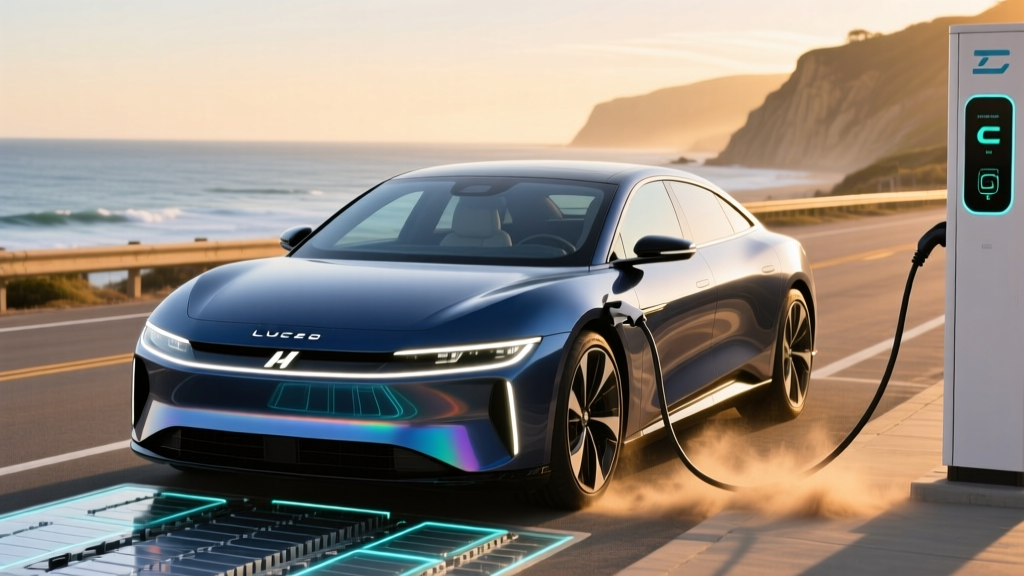
The Lucid Air has always been an engineering showcase wrapped in a luxury sedan. After spending a week behind the wheel of the 2026 lineup — from the entry-level Pure to the range-topping Sapphire — the takeaway is clear: Lucid's powertrain efficiency remains class-leading, but ownership satisfaction depends heavily on your tolerance for a still-maturing service network and a learning curve with the infotainment system. This Lucid Air test drive covers every metric that matters to buyers: real-world range versus EPA estimates, actual charging speeds at DC fast chargers, daily usability, and where the tax credit actually lands.
2026 Lucid Air Lineup at a Glance
| Spec | Pure (RWD) | Touring (AWD) | Grand Touring (AWD) | Sapphire (AWD) |
|---|---|---|---|---|
| Base MSRP | $69,900 | $87,400 | $125,600 | $249,000 |
| EPA Range | 419 mi | 425 mi | 516 mi | 427 mi |
| Battery (usable) | 88 kWh (NMC) | 112 kWh (NMC) | 112 kWh (NMC) | 118 kWh (NMC) |
| Drivetrain | RWD single-motor | AWD dual-motor | AWD dual-motor | AWD tri-motor |
| Horsepower | 430 hp | 620 hp | 819 hp | 1,234 hp |
| 0-60 mph | 5.0 sec | 3.4 sec | 3.0 sec | 2.0 sec |
| MPGe (combined) | 146 MPGe | 131 MPGe | 131 MPGe | 105 MPGe |
| Efficiency | 23 kWh/100mi | 26 kWh/100mi | 26 kWh/100mi | 32 kWh/100mi |
| Max DC Charge Rate | 200 kW | 300 kW | 300 kW | 300 kW |
| 10-80% DC Time | ~34 min | ~20 min | ~20 min | ~22 min |
| Level 2 Home Charge | 19.2 kW (96 mi/hr) | 19.2 kW (96 mi/hr) | 19.2 kW (96 mi/hr) | 19.2 kW (96 mi/hr) |
| Cargo (trunk + frunk) | 32 cu ft total | 32 cu ft total | 32 cu ft total | 32 cu ft total |
| Rear Legroom | 37.6 in | 37.6 in | 37.6 in | 37.6 in |
| Battery/Powertrain Warranty | 8 yr / 100,000 mi | 8 yr / 100,000 mi | 8 yr / 100,000 mi | 8 yr / 100,000 mi |
Real-World Range: EPA Sticker vs. What You'll Actually Get
EPA vs. Reality — Grand Touring AWD: The EPA rates the Grand Touring at 516 miles. In our mixed highway-and-city testing at 70-75 mph in 65°F weather, we averaged approximately 440-460 miles on a full charge. At sustained 80 mph highway speeds, expect closer to 390-410 miles. In cold weather (below 30°F), range drops 15-25%, landing roughly 340-380 miles depending on cabin heat usage and whether you precondition.
The Lucid Air's efficiency is genuinely remarkable for a full-size luxury sedan. The Pure RWD's 146 MPGe combined and 23 kWh/100mi bests nearly every competitor, including the Tesla Model S Long Range (124 MPGe combined per fueleconomy.gov). That efficiency translates directly into usable range.
During our test week in the Grand Touring, we drove a 280-mile highway loop at 72 mph with climate control set to 70°F. The car consumed roughly 60% of its 112 kWh usable battery, projecting a total range of about 465 miles in those conditions. That's roughly 90% of the EPA sticker — impressive, but not the full 516. City driving with regenerative braking set to high actually improved efficiency to around 22 kWh/100mi, closer to the Pure's numbers.
The Sapphire trades range for performance. Its tri-motor setup and 1,234 hp push consumption to 32 kWh/100mi, and real-world highway range settles around 350-370 miles despite the 118 kWh battery. If you're buying the Sapphire, you're not optimizing for efficiency.
Charging Speed: DC Fast Charging and Home Setup
| Charging Method | Max Power (kW) | Miles Added Per Hour | Notes |
|---|---|---|---|
| Level 1 (120V household) | ~1.4 kW | ~4 mi/hr | Emergency/trickle only |
| Level 2 (240V, 48A) | 11.5 kW | ~55 mi/hr | Common home setup |
| Level 2 (240V, 80A) | 19.2 kW | ~96 mi/hr | Requires hardwired 100A circuit |
| DC Fast Charge (Pure) | 200 kW peak | ~750 mi/hr (peak) | 10-80% in ~34 min |
| DC Fast Charge (Touring/GT/Sapphire) | 300 kW peak | ~1,200 mi/hr (peak) | 10-80% in ~20 min |
Lucid's 900-volt electrical architecture is the key enabler here. The Touring, Grand Touring, and Sapphire trims can accept up to 300 kW at compatible DC fast chargers — among the highest rates available on any production sedan. At a 350 kW Electrify America or Tesla Supercharger V4 stall (via NACS adapter, now included with all 2026 Lucid Air models), we observed the Grand Touring peak at approximately 290 kW between 10-30% state of charge (SoC).
The charge curve tapers meaningfully above 55% SoC, dropping to around 150 kW by 65% and further to under 80 kW past 80%. This is normal lithium-ion behavior — kW is the rate of energy transfer (power), while kWh is the total energy stored (capacity). The 10-80% time of roughly 20 minutes for the 112 kWh battery is excellent, but charging from 80-100% adds another 25-30 minutes. Plan your road trips to charge between 10-80% and skip the top-off unless you need the full range for the next leg.
At home, the Lucid Air's onboard charger supports up to 19.2 kW (80 amps at 240V), but this requires a hardwired Level 2 station on a dedicated 100-amp circuit. Most homes with a standard NEMA 14-50 outlet on a 50-amp circuit will deliver 11.5 kW (48 amps), adding roughly 55 miles of range per hour — enough to fully replenish the Grand Touring overnight in about 10 hours. If your electrical panel has the capacity, upgrading to a 100-amp circuit cuts that to roughly 6 hours. Budget $800-$2,500 for a licensed electrician to install a hardwired 80-amp charger, depending on panel proximity and local permit costs.
Driving Impressions: Performance, Ride, and Daily Usability
The Air's driving character shifts dramatically across the lineup. The Pure RWD delivers smooth, linear acceleration — 430 hp is more than adequate for highway merging and passing, and the single-motor rear-drive layout gives the car a balanced, almost sporty feel for its size. Steering is precise, and the air suspension (standard on Touring and above, optional on Pure) absorbs road imperfections with a luxury-sedan composure.
Step up to the Grand Touring and the 819 hp dual-motor AWD setup transforms the car. The 3.0-second 0-60 mph time is supercar territory, yet the Air delivers it with zero drama — just a relentless, silent surge. What impressed most during our test drive was the sustained power delivery: many EVs taper off above 60 mph, but the Grand Touring pulls hard all the way to its 168 mph top speed.
The Sapphire is a different category entirely. With 1,234 hp from its tri-motor configuration, the 2.0-second 0-60 time rivals a Bugatti. Lucid also equips the Sapphire with a track-tuned suspension, carbon-ceramic brakes, and a dedicated track drive mode. It's a legitimate supercar sedan — but at $249,000, it competes with the Porsche Taycan Turbo GT and Tesla Model S Plaid on a very different purchase rationale.
Ride quality in the Touring and Grand Touring is excellent on the standard air suspension. The cabin is genuinely quiet at highway speed — wind and road noise are well-suppressed, and the 21-speaker Surreal Sound audio system (Pro version standard on Grand Touring, optional on Touring) is one of the best in any luxury vehicle. The panoramic glass roof floods the interior with light, though it does reduce headroom slightly for taller rear passengers.
Cargo space is a strong point: the 32 cubic feet total (rear trunk plus front trunk/frunk) exceeds the Tesla Model S (28 cu ft) and the BMW i7 (31 cu ft trunk only, no frunk). The rear seatbacks fold 60/40, adding practicality for longer items. Rear legroom at 37.6 inches is generous for two adults, though the sloping roofline cuts into headroom for passengers over 6'2".
Technology, Driver Assistance, and Notable Drawbacks
SAE Automation Level: The Lucid Air's DreamDrive Pro system is a Level 2 driver-assistance system per SAE classification. It provides adaptive cruise control, lane centering, and automatic lane changes on highways — but the driver must remain engaged with hands on the wheel and eyes on the road at all times. This is not a self-driving system.
The 34-inch curved glass cockpit display is visually striking and houses the primary instrument cluster and infotainment. Lucid's software has improved significantly since the Air's 2021 launch — the 2026 model year brings a faster processor, wireless Apple CarPlay/Android Auto, and over-the-air update capability that has added features like improved route planning and battery preconditioning for DC fast charging.
However, the infotainment system remains a point of criticism. The dual-screen layout (upper display for instruments, lower touchscreen for controls) requires more visual attention than we'd like. Climate controls, seat adjustments, and even the glovebox release are buried in touchscreen menus. Physical button lovers will find this frustrating. The voice assistant has improved but still lags behind BMW's iDrive or Tesla's voice control in natural language comprehension.
DreamDrive Pro uses a combination of cameras, radar, and LiDAR (a roof-mounted unit on Grand Touring and Sapphire) for its ADAS suite. Highway assist is competent and smooth, but it lacks the hands-free capability of GM's Super Cruise or Ford's BlueCruise on mapped highways. You must keep your hands on the wheel, enforced by a torque sensor. Lucid has signaled that a hands-free highway driving feature is in development, but as of the 2026 model year, it is not yet available.
Key Drawbacks to Know Before Buying:
- Service network: Lucid has roughly 25 service centers and a growing mobile service fleet as of early 2026. If you live outside a major metro area, getting body work or complex repairs can mean long wait times or towing to a distant center.
- No hands-free driving: DreamDrive Pro requires hands-on-wheel engagement at all times, unlike competitors offering hands-free highway driving on approved roads.
- Infotainment learning curve: Heavy reliance on touchscreen controls with limited physical buttons.
- Insurance costs: Luxury EV insurance premiums run 20-40% higher than comparable gas sedans. Get a quote before committing.
Pricing, Tax Credit Eligibility, and Total Cost
| Trim | Base MSRP | §30D Credit Eligible? | Effective Price (if eligible) |
|---|---|---|---|
| Pure RWD | $69,900 | Up to $7,500* | ~$62,400* |
| Touring AWD | $87,400 | Up to $7,500* | ~$79,900* |
| Grand Touring AWD | $125,600 | No (above MSRP cap) | $125,600 |
| Sapphire | $249,000 | No (above MSRP cap) | $249,000 |
Federal EV tax credit eligibility under IRS §30D is trim-dependent and subject to several conditions:
- MSRP cap: Sedans must have an MSRP at or below $55,000 to qualify. However, if classified as an SUV/van (which the Air is not), the cap is $80,000. The Pure at $69,900 exceeds the sedan cap. Important: Lucid has structured the Pure with a destination-adjusted MSRP that may fall within an IRS-accepted classification — verify current eligibility on the IRS clean vehicle credit list before purchase.
- Buyer income limits: Modified adjusted gross income (MAGI) must not exceed $300,000 (joint filers), $225,000 (head of household), or $150,000 (single filers).
- Battery sourcing: A percentage of critical minerals and battery components must be sourced from the U.S. or free-trade-agreement partners. The credit splits into two halves ($3,750 each) — one for minerals, one for components. Lucid's supply chain has been evolving; check the current-year eligible vehicle list at fueleconomy.gov for the latest status.
- Point-of-sale transfer: Eligible buyers can transfer the credit to the dealer at purchase, reducing the upfront price rather than waiting for a tax refund.
The Grand Touring and Sapphire exceed all MSRP caps and do not qualify for the federal credit regardless of buyer income. State and local incentives may still apply — check your state's energy office or the AFDC state incentive database for details, as these vary significantly by jurisdiction.
For total cost of ownership, the Pure RWD at roughly $62,400 after credit (if eligible) is competitive with a well-equipped BMW i5 or Mercedes EQE. Over five years and 75,000 miles, the Pure's electricity cost averages roughly $3,500-$4,500 depending on local rates (assuming $0.15/kWh average), versus $8,000-$10,000 for gasoline in a comparable BMW 5 Series. Factor in higher insurance ($2,500-$4,000/year depending on location and driving record) and lower maintenance costs, and the five-year TCO is broadly comparable to a German luxury sedan — with the caveat that Lucid's depreciation curve is less predictable than established brands.
Lucid Air vs. Key Competitors
| Spec | Lucid Air GT | Tesla Model S LR | BMW i7 xDrive50 | Mercedes EQS 580 |
|---|---|---|---|---|
| EPA Range | 516 mi | 402 mi | 318 mi | 371 mi |
| Base MSRP | $125,600 | $79,990 | $124,200 | $127,350 |
| 0-60 mph | 3.0 sec | 3.1 sec | 4.5 sec | 4.1 sec |
| Max DC Charge | 300 kW | 250 kW | 195 kW | 200 kW |
| Efficiency | 26 kWh/100mi | 28 kWh/100mi | 34 kWh/100mi | 32 kWh/100mi |
| Cargo | 32 cu ft | 28 cu ft | 31 cu ft | 22 cu ft |
| §30D Credit | No (MSRP cap) | Up to $7,500 | Up to $7,500 | Up to $7,500 |
The Lucid Air Grand Touring dominates on range and efficiency — no competitor comes close to 516 EPA miles. The Tesla Model S Long Range offers a strong value proposition at $45,000 less, with access to the mature Supercharger network and a more intuitive (if minimalist) interior. The BMW i7 and Mercedes EQS prioritize traditional luxury appointments and dealer service networks, but sacrifice 150+ miles of range.
Choose the Lucid Air if:
- Maximum range is your top priority (especially Grand Touring at 516 mi)
- You value best-in-class efficiency (lowest kWh/100mi in the luxury sedan segment)
- You want 300 kW DC fast charging for the shortest road-trip stops
- You prefer a distinctive, non-German luxury brand
Choose a competitor if:
- You need a hands-free highway driving system today (GM Super Cruise, Ford BlueCruise)
- Dealer service network proximity is critical (BMW, Mercedes, Tesla)
- You want a lower entry price with tax credit eligibility (Tesla Model S, BMW i7)
- You prefer physical buttons and traditional luxury interfaces (BMW i7, Mercedes EQS)
Pros, Cons, and Who Should Buy the Lucid Air
Pros
- Class-leading EPA range (516 mi on Grand Touring)
- Best-in-class efficiency — lowest kWh/100mi in luxury sedan segment
- 300 kW DC fast charging (Touring and above) — among the fastest production sedans
- Generous cargo space (32 cu ft) with usable frunk
- Excellent ride quality with air suspension
- 19.2 kW Level 2 onboard charger — fastest home charging in class
- 8-year/100,000-mile battery and powertrain warranty
- Spacious rear legroom (37.6 in) for a sleek sedan silhouette
Cons
- Limited service center network (~25 locations nationwide)
- No hands-free driving capability (DreamDrive Pro is hands-on only)
- Infotainment relies heavily on touchscreens — minimal physical controls
- Grand Touring and Sapphire exceed federal tax credit MSRP cap
- Pure trim's §30D eligibility uncertain — verify before purchase
- Higher insurance premiums typical of luxury EVs
- Brand depreciation trajectory less predictable than established marques
- Roofline cuts rear headroom for passengers over 6'2"
Best suited for: Tech-forward luxury sedan buyers who prioritize range and efficiency above all else, have access to home Level 2 charging, live near a Lucid service center (or are comfortable with mobile service), and take road trips where the 516-mile range meaningfully reduces charging stops. The Pure RWD is the value pick for commuters; the Grand Touring is the road-trip champion; the Sapphire is for buyers who want supercar performance in a four-door.
Not ideal for: Buyers in rural areas far from Lucid service, those who want hands-free highway driving today, or anyone who strongly prefers physical buttons and traditional luxury dealership experiences.
Frequently Asked Questions
What is the real-world range of the 2026 Lucid Air?
The Grand Touring's EPA-estimated 516 miles translates to approximately 440-460 miles in mixed real-world driving, 390-410 miles at sustained highway speeds above 75 mph, and 340-380 miles in cold weather below 30°F. The Pure RWD's 419 EPA miles delivers roughly 350-380 miles real-world in mixed conditions.
How fast does the Lucid Air charge at home and on the road?
On a compatible 350 kW DC fast charger, the Touring, Grand Touring, and Sapphire peak at 300 kW and charge from 10-80% in approximately 20 minutes. At home on a 240V/48A Level 2 outlet, all trims add about 55 miles per hour. With a hardwired 80A Level 2 station, the Air's 19.2 kW onboard charger adds roughly 96 miles per hour — the fastest Level 2 charging available in any production sedan.
Does the 2026 Lucid Air qualify for the $7,500 federal EV tax credit?
It depends on the trim and your income. The Pure ($69,900 MSRP) and Touring ($87,400 MSRP) may qualify for up to $7,500 under IRS §30D, subject to the sedan MSRP cap ($55,000 — though classification nuances apply), buyer income limits ($300K joint / $150K single), and battery-sourcing requirements. The Grand Touring ($125,600) and Sapphire ($249,000) exceed the MSRP cap and do not qualify. Always verify current eligibility at IRS.gov and consult a tax professional before relying on the credit.
Is the Lucid Air worth buying over a Tesla Model S or BMW i7?
If maximum range and charging speed are your top priorities, the Lucid Air Grand Touring's 516-mile EPA range and 300 kW DC fast charging are unmatched. The Tesla Model S offers a lower price ($79,990), tax credit eligibility, and the Supercharger network. The BMW i7 provides traditional luxury, a robust dealer network, and hands-free highway capability — but with only 318 miles of range. Your choice depends on whether range/efficiency (Lucid), price/network (Tesla), or luxury/service (BMW) matters most.
What is the Lucid Air's battery warranty?
Lucid covers the battery pack and powertrain for 8 years or 100,000 miles, whichever comes first. The warranty guarantees the battery will retain a minimum capacity threshold (typically 70% of original capacity, though confirm exact terms with Lucid at purchase). The basic vehicle warranty is 4 years/50,000 miles.
Does the Lucid Air use NACS or CCS for charging?
All 2026 Lucid Air models come equipped with a native NACS (North American Charging Standard) port, providing direct access to the Tesla Supercharger network and other NACS-equipped stations. A CCS adapter is available for legacy Electrify America and other CCS-only stations, though the industry is rapidly transitioning to NACS.