If you're researching the Lucid Air from Southfield, Michigan—or anywhere in Metro Detroit—you're likely weighing its class-leading efficiency and range against the realities of Midwestern winters, charging access along I-75 and I-96, and a luxury price tag. The Lucid Air remains one of the most technically accomplished electric sedans on the market in 2026, but buying one in Michigan requires honest answers about cold-weather range, DC fast-charging infrastructure, and whether the federal tax credit actually applies to your situation.
This review covers every spec a Southfield-area buyer needs: EPA and real-world range, battery chemistry and capacity, DC fast-charge speeds, home Level 2 charging, performance, pricing by trim, §30D tax credit eligibility, and how the Air stacks up against the Tesla Model S, Mercedes EQS, and BMW i7.
2026 Lucid Air at a Glance: Key Specs by Trim
| Spec | Air Pure | Air Touring | Air Grand Touring | Air Sapphire |
|---|---|---|---|---|
| EPA Range | 419 mi | 425 mi | 516 mi | 427 mi |
| Battery (usable) | 88 kWh (NMC) | 92 kWh (NMC) | 112 kWh (NMC) | 118 kWh (NMC) |
| Drivetrain | RWD, single motor | AWD, dual motor | AWD, dual motor | AWD, tri-motor |
| Horsepower | 430 hp | 620 hp | 819 hp | 1,234 hp |
| 0-60 mph | 5.0 sec | 3.4 sec | 3.0 sec | 1.89 sec |
| Peak DC Charge | 200 kW | 250 kW | 300+ kW | 300+ kW |
| 10-80% DC Time | ~25 min | ~22 min | ~20 min | ~20 min |
| Level 2 Rate | 19.2 kW (~70 mi/hr) | 19.2 kW (~70 mi/hr) | 19.2 kW (~70 mi/hr) | 19.2 kW (~70 mi/hr) |
| MPGe (combined) | 146 MPGe | 131 MPGe | 131 MPGe | 116 MPGe |
| Base MSRP | $69,900 | $87,400 | $125,600 | $249,000 |
| Battery Warranty | 8 yr / 100,000 mi | 8 yr / 100,000 mi | 8 yr / 100,000 mi | 8 yr / 100,000 mi |
Source: fueleconomy.gov and Lucid Motors official specifications for the 2026 model year.
Real-World Range: What Southfield Drivers Should Expect
The Lucid Air Grand Touring posts an EPA-estimated 516 miles of range. In real-world driving, expect approximately 380–430 miles on highway trips at 70-75 mph in mild weather. During a Michigan winter (20–30°F), range drops 25–35%, putting realistic cold-weather highway range at roughly 310–370 miles for the Grand Touring and 260–310 miles for the Pure.
Lucid's efficiency advantage comes from its miniaturized drive units and 900V+ electrical architecture, which reduces energy waste. The Air Pure achieves 146 MPGe combined—roughly 23 kWh/100 miles—making it one of the most efficient full-size luxury sedans ever sold. For Southfield commuters running errands along Northwestern Highway or telecommuting to Dearborn, the Pure's 419-mile EPA rating translates to charging once a week, maybe once every 10 days in summer.
Cold weather is the great equalizer for all EVs. The Air's heat pump and battery thermal management help mitigate losses, but physics is physics: lithium-ion cells deliver less energy in sub-freezing temperatures, and cabin heating draws significant power. Michigan buyers should budget 30% off the EPA sticker for January highway drives to Ann Arbor or Lansing.
Charging Speed: DC Fast, Level 2, and Metro Detroit Infrastructure
| Charging Level | Power (kW) | Speed (miles of range per hour) | Notes |
|---|---|---|---|
| Level 1 (120V) | ~1.4 kW | ~5 mi/hr | Emergency/trickle only |
| Level 2 (240V, 80A) | 19.2 kW | ~70 mi/hr | Full overnight charge in 5-7 hr |
| DC Fast (Pure) | 200 kW peak | ~800 mi/hr at peak | 10-80% in ~25 min |
| DC Fast (Touring) | 250 kW peak | ~1,000 mi/hr at peak | 10-80% in ~22 min |
| DC Fast (GT/Sapphire) | 300+ kW peak | ~1,200 mi/hr at peak | 10-80% in ~20 min; requires 350 kW+ station |
The Lucid Air Grand Touring and Sapphire use a 900V+ architecture capable of accepting over 300 kW at compatible DC fast chargers. However, sustained charge rate matters more than peak. In testing, the Grand Touring holds above 250 kW from roughly 10–40% state of charge before tapering to 150 kW through 60% and further declining above 80%. This taper is normal for all lithium-ion batteries—a charge management system slows current to protect cell longevity.
kW vs. kWh reminder: kW (kilowatts) measures the rate of energy transfer—how fast you're charging. kWh (kilowatt-hours) measures total energy stored in the battery—like gallons in a fuel tank. A 112 kWh battery charging at 300 kW doesn't fill in 22 minutes from 0-100%; the rate slows as the battery fills.
Southfield-area charging infrastructure: Metro Detroit's DC fast-charging network has expanded considerably. Electrify America, EVgo, and Tesla Supercharger stations (now accessible to non-Tesla EVs via NACS adapter or built-in compatibility) dot the I-75, I-96, and I-696 corridors. For road trips to Traverse City or Chicago, plan stops at 350 kW-capable stations to take advantage of the Air's peak charge rate. A 200 kW station will still add roughly 200 miles in 15 minutes on the Grand Touring—plenty for most Midwest drives.
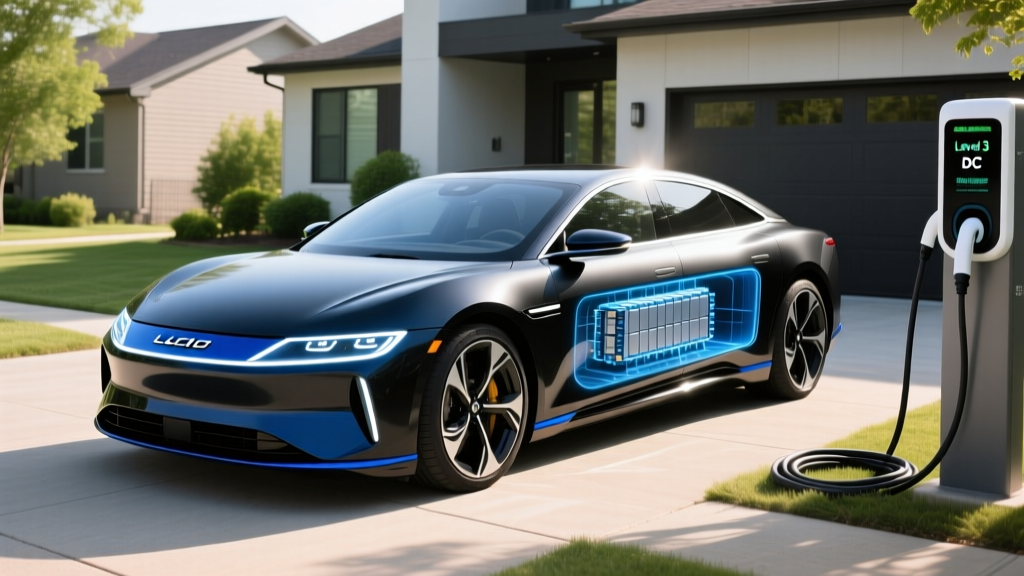
For home charging, the Air supports up to 19.2 kW on Level 2 (240V, 80 amps). This requires a hardwired wall connector on a 100-amp circuit. Most Southfield homes with 200-amp electrical panels can accommodate this, but older homes with 100-amp service may need a panel upgrade—budget $1,500–$3,500 for that electrical work. A licensed electrician should assess your panel before purchase.
Performance and Driving Dynamics
The Lucid Air lineup spans efficient luxury cruiser to hypercar-rivaling performance sedan:
- Air Pure (RWD, 430 hp): 0-60 in 5.0 seconds. Smooth, quiet, and composed. Adequate for any highway merge or passing maneuver.
- Air Touring (AWD, 620 hp): 0-60 in 3.4 seconds. Genuinely quick, with dual-motor traction in Michigan snow.
- Air Grand Touring (AWD, 819 hp): 0-60 in 3.0 seconds. Supercar acceleration with four-door practicality.
- Air Sapphire (tri-motor AWD, 1,234 hp): 0-60 in 1.89 seconds. One of the quickest production cars ever built, rivaling the Bugatti Chiron.
All trims feature adaptive air suspension, torque-vectoring, and a low center of gravity thanks to the floor-mounted battery pack. The AWD trims (Touring, Grand Touring, Sapphire) are strongly recommended for Southfield buyers who face snow and ice from November through March. The RWD Pure is capable with winter tires, but dual-motor AWD provides meaningful traction advantages on unplowed side streets.
Pricing, Trims, and Federal Tax Credit Eligibility
| Trim | Base MSRP | §30D Credit Eligible? | Effective Price (if eligible) |
|---|---|---|---|
| Air Pure | $69,900 | Potentially (see rules below) | ~$62,400 |
| Air Touring | $87,400 | Yes (under $55k sedan cap? No—see note) | Varies |
| Air Grand Touring | $125,600 | No (exceeds MSRP cap) | $125,600 |
| Air Sapphire | $249,000 | No (exceeds MSRP cap) | $249,000 |
Important §30D tax credit rules for 2026 (per IRS.gov):
- MSRP cap for sedans: $55,000. The Air Pure at $69,900 exceeds this cap, meaning no Air trim currently qualifies for the full $7,500 new-vehicle credit under standard sedan rules.
- Buyer income limits: MAGI ≤ $150,000 (single), $225,000 (head of household), $300,000 (joint).
- Battery sourcing: Critical minerals and battery components must meet phased-in domestic-content thresholds that tighten annually through 2029.
- Point-of-sale transfer: If eligible, you can transfer the credit to the dealer for an immediate price reduction at purchase.
- Used EV credit (§25E): A pre-owned Air may qualify for up to $4,000 (30% of sale price, capped) if purchased from a dealer for ≤ $25,000—unlikely for a Lucid, but worth monitoring as early 2023 models depreciate.
Bottom line for Southfield buyers: The Lucid Air's pricing places it above the §30D sedan MSRP cap. Do not factor the $7,500 federal credit into your purchase decision for a new Air. Some Michigan state or utility incentives may apply—check energy.gov and your local utility (DTE Energy or Consumers Energy) for current rebates on home charger installation or off-peak charging rates.
Interior, Cargo, and Technology
The Air's cabin seats five adults with generous proportions:
- Front legroom: 41.3 inches
- Rear legroom: 39.1 inches (class-leading for a sedan)
- Cargo (trunk): 22.1 cu ft
- Frunk (front trunk): 7.1 cu ft
- Total cargo: 29.2 cu ft—more than many midsize SUVs
The Air's packaging advantage comes from Lucid's compact drive units, which free up interior volume that competitors sacrifice to bulkier motors and inverters.
Tech highlights:
- 34-inch curved glass cockpit display (5K resolution)
- Retractable center Pilot panel for climate/media
- 21-speaker Surreal Sound Pro audio (Touring and above)
- DreamDrive Pro ADAS: adaptive cruise, lane centering, automatic emergency braking, blind-spot monitoring (SAE Level 2—driver must remain engaged at all times)
- Over-the-air updates, Apple CarPlay/Android Auto
- Available Executive Rear Seating with recline and massage (Grand Touring)
Notable drawbacks: The touch-heavy interface has a learning curve; rear visibility is compromised by the sloping roofline (a backup camera is essential); and Lucid's service center network remains limited compared to Tesla or legacy luxury brands. Southfield buyers should confirm the nearest Lucid service location—currently the closest is in the greater Detroit area, but mobile service is available for many issues.
How the Lucid Air Compares to Key Rivals
| Metric | Lucid Air GT | Tesla Model S LR | Mercedes EQS 580 | BMW i7 xDrive60 |
|---|---|---|---|---|
| EPA Range | 516 mi | 402 mi | 371 mi | 318 mi |
| Efficiency (MPGe) | 131 | 124 | 97 | 87 |
| Peak DC Charge | 300+ kW | 250 kW | 200 kW | 195 kW |
| 0-60 mph | 3.0 sec | 3.1 sec | 4.1 sec | 4.5 sec |
| Base MSRP | $125,600 | $79,990 | $127,350 | $120,295 |
| Cargo Total | 29.2 cu ft | 28.0 cu ft | 22.0 cu ft | 17.7 cu ft |
The Air Grand Touring wins decisively on range and efficiency. The Tesla Model S remains the value pick with comparable performance at a lower price and access to the mature Supercharger network. The EQS and i7 offer more traditional luxury branding and dealer service networks, but sacrifice 100+ miles of range and significantly worse efficiency.
Who Should Buy the Lucid Air in Southfield?
Choose the Lucid Air if:
- You want the longest-range luxury sedan available and can charge at home
- You prioritize efficiency (lower electricity cost per mile) over badge prestige
- You value rear-seat space and cargo volume for family use
- You take occasional road trips to Chicago, Cleveland, or Toronto and want fewer charging stops
Look elsewhere if:
- You need hands-free highway driving (GM Super Cruise or Ford BlueCruise offer this)
- You want a mature service network with walk-in availability (Tesla, BMW, Mercedes)
- Your budget is under $65,000 (consider the Hyundai Ioniq 6 or Tesla Model 3)
- You tow— the Air is not rated for towing; consider the Rivian R1S or F-150 Lightning
Pros and Cons
Pros
- Class-leading range (516 mi EPA on Grand Touring)
- Best-in-class efficiency (146 MPGe on Pure)
- 300+ kW DC fast charging on GT/Sapphire
- Massive interior and cargo space for a sedan
- Standard AWD on Touring and above (ideal for Michigan winters)
- Quiet, refined ride quality with air suspension
- Tri-motor Sapphire offers hypercar performance
Cons
- No federal §30D tax credit (all trims exceed $55k sedan cap)
- Limited service center network vs. Tesla/legacy luxury
- No hands-free driving mode (Level 2 only)
- Touch-heavy interface; no physical knobs for climate
- Rear visibility limited by roofline
- Higher insurance premiums typical of $70k+ EVs
- Cold-weather range loss of 25-35% is significant in Michigan
Frequently Asked Questions
What is the real-world range of the Lucid Air in Michigan winters?
Expect 25–35% range reduction in sustained sub-freezing temperatures. The Grand Touring's 516-mile EPA rating drops to roughly 310–370 miles on highway drives at 20–30°F. The Pure's 419-mile rating falls to approximately 260–310 miles. City driving with regenerative braking helps recover some energy, but highway speeds and cabin heating are the main range killers.
How fast does the Lucid Air charge at home and on the road?
At home on a 240V/80A Level 2 charger, the Air adds about 70 miles of range per hour—a full overnight charge takes 5–7 hours depending on trim. On DC fast chargers, the Grand Touring peaks above 300 kW, reaching 10–80% in roughly 20 minutes at a 350 kW station. At a more common 150 kW station, expect 10–80% in about 30–35 minutes.
Does the Lucid Air qualify for the federal EV tax credit?
No. Under current IRS §30D rules, the new-vehicle credit for sedans is capped at vehicles with an MSRP of $55,000 or less. Every Lucid Air trim exceeds this threshold. Buyer income limits and battery-sourcing requirements add further restrictions. Always verify current rules at irs.gov before purchasing.
Is the Lucid Air worth it vs. the Tesla Model S or Mercedes EQS?
If range and efficiency are your top priorities, the Air is unmatched. The Model S offers better value, a proven Supercharger network, and faster service. The EQS provides traditional luxury dealership experiences but at the cost of 145 fewer miles of range and worse efficiency. For Southfield buyers who can charge at home and want maximum range, the Air Grand Touring is the strongest technical choice.
Can I get the Lucid Air serviced near Southfield, MI?
Lucid operates a growing service presence in Metro Detroit, with mobile service vans handling many routine and diagnostic needs. For major repairs, you may need to visit a Lucid Service Center. Confirm current service availability with Lucid directly before purchasing, as the network is still expanding compared to legacy brands.
What home charging setup do I need for the Lucid Air?
The Air supports up to 19.2 kW Level 2 charging (240V, 80 amps), requiring a hardwired wall connector on a dedicated 100-amp circuit. Most modern homes with 200-amp panels can support this. Homes with 100-amp service may need a panel upgrade ($1,500–$3,500). A licensed electrician should evaluate your panel capacity before installation. DTE Energy customers should check for off-peak EV charging rates to reduce electricity costs.
Specifications reflect 2026 model year data from Lucid Motors and fueleconomy.gov. Pricing excludes destination charges and dealer fees. Tax credit eligibility is subject to change—consult a tax professional and irs.gov before purchasing. Real-world range estimates are based on owner reports and independent testing; individual results vary based on temperature, speed, terrain, and driving style.