Owning a luxury electric sedan in the Pacific Northwest comes with a unique set of advantages and challenges. Mild winters preserve battery range better than Midwest deep-freezes, and Washington's relatively clean grid means your charging footprint is lighter than in coal-heavy states. But when it comes to after-sales support, prospective Lucid Motors buyers in the region have one persistent question: what does service access actually look like? This 2026 Lucid Air review examines the vehicle's specs, real-world ownership costs, and the practical reality of relying on a Lucid service center in Seattle for maintenance and warranty work.
Lucid Air at a Glance: 2026 Specs and Trims
The 2026 Lucid Air lineup spans four trims, from the value-oriented Pure to the hypercar-rivaling Sapphire. All share Lucid's proprietary miniaturized electric drive units and a 900-volt+ electrical architecture that enables some of the fastest DC fast-charging speeds available in any production sedan.
| Spec | Pure RWD | Touring AWD | Grand Touring AWD | Sapphire |
|---|---|---|---|---|
| EPA Range | 419 mi | 406 mi | 512 mi | 427 mi |
| Battery (usable) | 88 kWh (NMC) | 88 kWh (NMC) | 112 kWh (NMC) | 118 kWh (NMC) |
| Horsepower | 430 hp | 620 hp | 819 hp | 1,234 hp |
| 0–60 mph | 5.0 sec | 3.4 sec | 3.0 sec | 1.89 sec |
| Drivetrain | RWD (single motor) | AWD (dual motor) | AWD (dual motor) | AWD (tri-motor) |
| MPGe (combined) | 140 MPGe | 131 MPGe | 131 MPGe | 116 MPGe |
| Base MSRP | $69,900 | $87,400 | $125,600 | $249,000 |
All trims use nickel-manganese-cobalt (NMC) lithium-ion cells. Lucid has not adopted LFP (lithium iron phosphate) chemistry, which trades energy density for lower cost and longer cycle life. The NMC choice prioritizes the Air's headline range and performance figures, though it means owners should follow best practices for long-term state-of-health — ideally keeping daily charge between 20% and 80% unless a full charge is needed for a long trip.
Real-World Range: What Seattle Drivers Actually Get
The Grand Touring's 512-mile EPA estimate is the highest of any production sedan sold in the U.S. In real-world mixed driving at highway speeds (70–75 mph), expect roughly 420–450 miles from the Grand Touring and 340–360 miles from the Pure RWD. Seattle's mild winters (rarely below 30°F) mean cold-weather range loss is modest — typically 8–12%, compared to 20–30% in sub-zero climates. Rain and the region's hilly terrain (think I-5 grades near Everett or the climb to Snoqualmie Pass) will reduce efficiency by roughly 5–8% on those specific routes.
The Air's efficiency is genuinely remarkable for its size. The Pure RWD achieves roughly 24 kWh/100 mi in mixed driving, which translates to about 4.2 miles per kWh. For context, that's roughly 15% more efficient than a Tesla Model S Long Range on a per-kWh basis, thanks to Lucid's low drag coefficient (Cd 0.20) and the compact, high-efficiency drive units derived from their Formula E powertrain work. On fueleconomy.gov, the Air Pure posts 140 MPGe combined — a class-leading figure.
Charging Speed: DC Fast and Home Level 2
The Air's 900V+ architecture is not just a marketing bullet — it enables sustained high-power charging that translates into meaningfully shorter road-trip stops. Here's what the numbers look like across charging levels:
| Charging Level | Power / Rate | Speed (miles added) | Notes |
|---|---|---|---|
| Level 1 (120V household) | ~1.4 kW | ~4 mi/hr | Emergency/trickle only |
| Level 2 (240V home, 48A) | 11.5 kW | ~36 mi/hr | Full charge overnight (~10–12 hrs for GT) |
| DC Fast Charge (peak) | Up to 300+ kW | ~200 mi in ~15 min | Grand Touring/Sapphire; Pure/Touring peak ~220 kW |
| 10–80% DC Fast (Grand Touring) | — | ~22 minutes | On a 350 kW-capable station (e.g., Electrify America) |
A critical nuance for buyers: the Air uses a CCS1 connector for DC fast charging (with a J1772 inlet for Level 2). As of 2026, Lucid has not adopted the NACS (Tesla) connector natively. While adapters exist for accessing Tesla Superchargers, peak charge rates through an adapter may be limited. In the Seattle area, Electrify America stations in Tukwila and Lynnwood, plus a growing ChargePoint and EVgo network, provide reliable CCS-compatible fast charging for road trips along the I-5 corridor or eastbound on I-90.
For home charging, a 48-amp Level 2 wall connector on a 60-amp circuit will fully replenish even the Grand Touring's 112 kWh battery overnight. Seattle-area electrical panel upgrades (common in older homes with 100-amp service) typically cost $1,500–$3,500 on top of the $500–$800 for the charger hardware itself. Budget $2,000–$4,500 total for a turnkey home install, depending on panel condition and conduit run length.
Performance and Driving Dynamics
The Air's performance envelope varies enormously by trim. The Pure RWD's 430 hp and 5.0-second 0–60 time are brisk by any sedan standard, but the dual-motor Touring and Grand Touring transform the car into genuine sports-sedan territory. The Grand Touring's 819 hp and 3.0-second sprint are accompanied by a composed, air-suspension-equipped ride that handles Pacific Northwest rain-slicked roads with confidence, aided by standard all-wheel drive on AWD trims.
The Sapphire, with its tri-motor 1,234 hp layout, is a low-volume halo — entertaining but largely irrelevant to the typical buyer. For most Seattle-area owners evaluating daily drivability, the Touring AWD offers the best blend of range (406 mi EPA), all-weather traction, and performance at a price that, while steep, doesn't cross into supercar territory.
Regenerative braking on the Air is adjustable but does not offer true one-pedal driving to a full stop in all conditions. Expect to use the friction brake pedal at very low speeds. This is a deliberate engineering choice by Lucid and differs from the aggressive one-pedal feel of a Nissan LEAF or Chevrolet Bolt.
Pricing, Tax Credits, and Ownership Cost
The Lucid Air's pricing places it firmly in the luxury EV segment. Here's how the numbers stack up, including federal tax credit considerations:
| Trim | Base MSRP | §30D Federal Credit | Effective Price | Credit Eligibility Notes |
|---|---|---|---|---|
| Pure RWD | $69,900 | Up to $7,500 | ~$62,400 | Must meet battery sourcing, buyer income caps ($150K single / $300K joint), and MSRP cap ($55K sedans — Air Pure exceeds cap; credit unlikely) |
| Touring AWD | $87,400 | $0 | $87,400 | Exceeds $55K sedan MSRP cap |
| Grand Touring AWD | $125,600 | $0 | $125,600 | Exceeds $55K sedan MSRP cap |
| Sapphire | $249,000 | $0 | $249,000 | Exceeds $55K sedan MSRP cap |
Under IRS §30D rules, new clean vehicle credits are capped at a $55,000 MSRP for sedans. Every 2026 Lucid Air trim exceeds this threshold, meaning no Air trim currently qualifies for the $7,500 federal new-vehicle credit. Buyer income limits ($150,000 single / $225,000 head of household / $300,000 joint MAGI) and critical-mineral/battery-component sourcing requirements would further restrict eligibility even if pricing qualified. Consult a tax professional for your specific situation. Washington State does not currently offer a supplementary EV purchase incentive beyond sales/use tax exemptions on a portion of the vehicle price — check the WA Dept. of Revenue for current thresholds.
Five-year total cost of ownership for the Air Touring, factoring in electricity at $0.12/kWh (Seattle City Light residential average), insurance (~$2,800–$3,500/year for luxury EVs), and minimal scheduled maintenance, lands in the $65,000–$75,000 range — competitive with a similarly priced BMW i5 or Mercedes EQS when depreciation is factored in, though Lucid's residual values are less proven than Tesla's or Porsche's.
Interior, Tech, and Cargo
The Air's cabin is genuinely spacious. Rear-seat legroom measures 41.7 inches — more than a Model S and close to limousine territory. The glass canopy roof floods the interior with light, a welcome feature during Seattle's gray months. Cargo volume is 32 cu ft total (22 cu ft trunk plus a 10 cu ft frunk), enough for a family road trip to the San Juans without a roof box.
The 34-inch curved glass cockpit display is visually striking, and the 2026 model year brings improved DreamDrive Pro ADAS with enhanced highway lane-centering and automatic lane-change capability. However, DreamDrive Pro remains a SAE Level 2 driver-assistance system — the driver must remain fully engaged with hands on or near the wheel and eyes on the road at all times. It is not autonomous driving. Some reviewers have noted that the Air's touchscreen-heavy interface lacks the physical button shortcuts that make climate and media adjustments easier while driving, a legitimate ergonomic drawback.
Seattle Service Access: What Owners Should Know
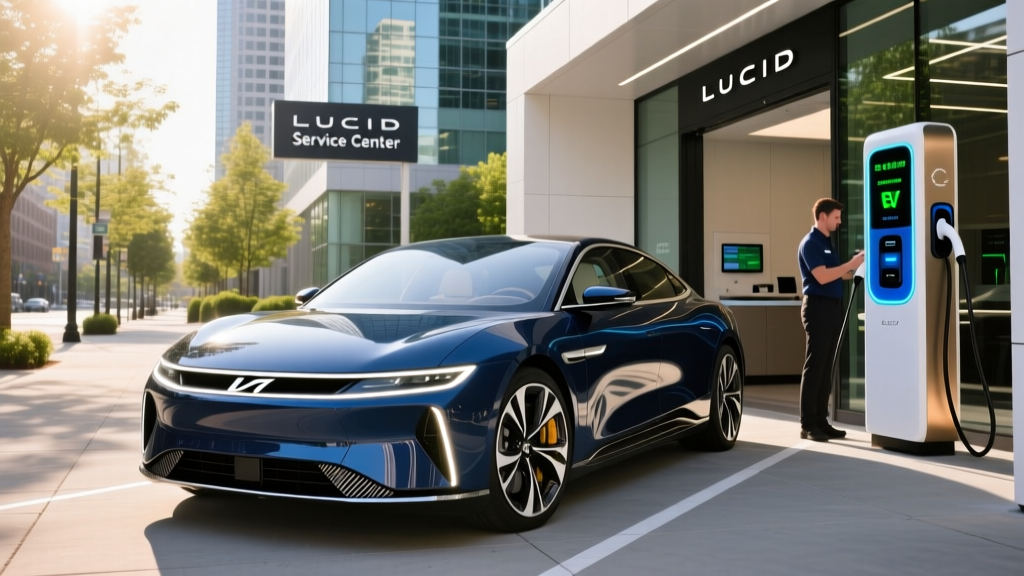
Lucid's service footprint in the greater Seattle area centers on a Lucid Service Center in the Seattle metro region, supplemented by mobile service technicians who can handle software updates, 12V battery replacements, minor trim repairs, and diagnostic work at your home or office. For major warranty work — high-voltage battery diagnostics, drive-unit replacement, structural repairs — the physical service center is required.
This is a practical consideration that buyers in less-served regions should weigh carefully. Unlike Tesla, which has multiple service locations across the Puget Sound area, or legacy luxury brands (BMW, Mercedes, Porsche) with extensive dealer networks, Lucid's service infrastructure is still scaling. If you live in central Seattle, Bellevue, or Kirkland, service access is reasonable. If you're in Olympia, Bellingham, or across the Cascades in Spokane, plan for longer drives or trailer transport for significant repairs.
Lucid's warranty provides:
- Basic vehicle: 4 years / 50,000 miles
- Battery and drive units: 8 years / 100,000 miles (covers capacity below 70% of original)
- Roadside assistance: 4 years / 50,000 miles
The 8-year/100,000-mile battery warranty is competitive with the segment standard (Tesla Model S matches this). The 70% capacity retention threshold is also typical, though some competitors like Hyundai offer a slightly higher 70% threshold over a longer 10-year/100,000-mile window on their EVs.
Pros and Cons
- Class-leading EPA range (512 mi Grand Touring; 419 mi Pure)
- Exceptional efficiency (140 MPGe Pure RWD)
- Ultra-fast DC charging (10–80% in ~22 min, Grand Touring)
- Spacious rear seat (41.7" legroom) and generous cargo (32 cu ft total)
- Composed ride quality with available air suspension
- 900V+ architecture future-proofs charging speed
- No trim qualifies for the $7,500 federal §30D credit (MSRP cap)
- Limited service center network — Seattle has one primary location
- No native NACS connector (CCS1 only; adapter needed for Superchargers)
- Touchscreen-heavy UI lacks physical shortcut buttons
- Residual values less established than Tesla/Porsche
- No true one-pedal driving to full stop
Who Should Buy the 2026 Lucid Air?
Choose the Air Pure RWD if you want maximum efficiency and range at the lowest entry price, primarily commute solo or with one passenger, and can charge at home. The 419-mile EPA range means most Seattle commuters could charge just once per week.
Choose the Air Touring AWD if you need all-wheel drive for Cascade pass trips or rainy mountain roads, want dual-motor performance (620 hp), and value the balance of 406-mile range with a sub-$90K starting price.
Choose the Grand Touring if road-trip range is paramount (512 mi EPA), you regularly drive long corridors (Seattle to Portland, Spokane, or Vancouver BC), and budget is flexible.
Look elsewhere (Model S, Taycan, i5) if you need a dense service network, want federal tax credit eligibility, or prefer NACS-native Supercharger access without adapters.
Frequently Asked Questions
What is the real-world range of the 2026 Lucid Air?
The Grand Touring's 512-mile EPA estimate translates to roughly 420–450 miles in real-world highway driving at 70–75 mph. The Pure RWD delivers about 340–360 miles in mixed real-world use. Seattle's mild climate preserves range better than colder regions; expect 8–12% loss in winter, not the 20–30% seen in sub-zero states.
How fast does the Lucid Air charge at home and on DC fast chargers?
On a 48-amp Level 2 home charger (11.5 kW), the Air adds roughly 36 miles of range per hour, fully charging overnight. On a 350 kW-capable DC fast charger, the Grand Touring can go from 10% to 80% in approximately 22 minutes, adding up to 200 miles in about 15 minutes at peak rate. Pure and Touring trims peak at a lower ~220 kW DC rate.
Does the Lucid Air qualify for the federal EV tax credit?
No. Under current IRS §30D rules, new sedans must have an MSRP at or below $55,000 to qualify. Every 2026 Air trim exceeds this cap, so none are eligible for the up-to-$7,500 federal credit regardless of buyer income or battery sourcing. Washington State's partial sales tax exemption on EVs may offset some cost — verify current thresholds with the WA DOR.
Is the Lucid Air worth buying vs. the Tesla Model S or Porsche Taycan?
The Air outperforms both on EPA range and interior space. The Model S offers a more established service network and Supercharger access; the Taycan delivers superior handling dynamics and 800V charging but far less range (~246 mi EPA for the base Taycan). If range, efficiency, and cabin room are your top priorities, the Air is the segment leader. If service infrastructure and resale confidence matter more, the Model S or Taycan may be safer choices.
What is Lucid service like in Seattle?
Lucid operates a service center in the Seattle metro area, supplemented by mobile service for minor repairs and software updates. For high-voltage or structural warranty work, the physical center is required. Service capacity is still scaling compared to Tesla or legacy luxury brands, so appointment lead times may be longer. Buyers outside the immediate metro area should factor in potential travel or towing for major service events.