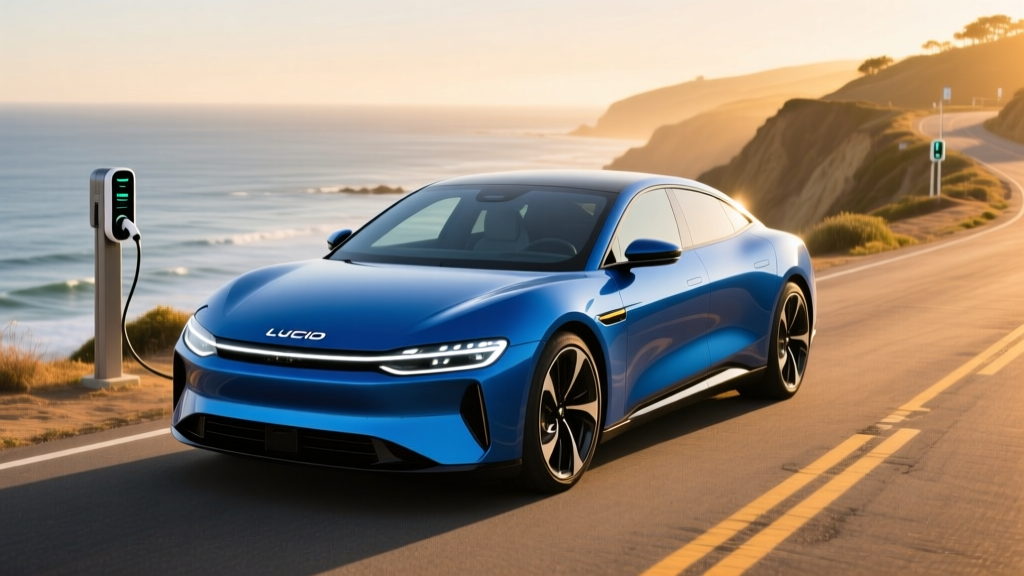
The Lucid Air Sapphire isn't just the fastest sedan Lucid Motors has ever built — it's one of the quickest production cars on the planet, full stop. But beyond the headline-grabbing 0-60 mph time, buyers researching Lucid Sapphire specs need to know the practical details: How far does it actually go on a charge? How fast does it recharge? And does a $249,000 hyper-sedan qualify for any federal EV incentives?
This profile breaks down every critical spec with real-world context, not just manufacturer press-release numbers. We've cross-referenced EPA data, Lucid's official specifications, and independent testing to give you the complete picture.
Lucid Air Sapphire: Core Specifications at a Glance
| Spec | Value |
|---|---|
| EPA Estimated Range | 427 miles |
| Usable Battery Capacity | 111 kWh (NMC lithium-ion) |
| Drivetrain | Tri-motor AWD (1 front, 2 rear) |
| Horsepower | 1,234 hp |
| 0–60 mph | 1.89 seconds (Lucid-verified) |
| Top Speed | 205 mph |
| EPA Efficiency | 128 MPGe combined (26 kWh/100 mi) |
| Max DC Fast Charge Rate | ~250 kW peak (900V architecture) |
| 10–80% DC Fast Charge | ~20 minutes (estimated, conditions-dependent) |
| Level 2 Home Charge Rate | 19.2 kW onboard charger (~75 mi/hr) |
| Base MSRP | $249,000 (excl. destination) |
| Battery/Powertrain Warranty | 8 years / 100,000 miles |
| Basic Vehicle Warranty | 4 years / 50,000 miles |
Range: EPA Sticker vs. Real-World Expectations
Real-World Expectation: ~340–370 miles highway at 75 mph; ~300–330 miles in cold weather (below 32°F). Mixed city/highway driving in moderate temps should yield ~380–400 miles.
The 427-mile EPA figure is remarkable for a 1,234-hp tri-motor performance sedan. For context, that's more range than most dual-motor, far-less-powerful competitors. Lucid achieves this through a combination of the 111 kWh NMC battery pack, an extraordinarily low drag coefficient (Cd 0.20), and the company's miniaturized motor technology that reduces parasitic losses.
But the EPA cycle includes generous city/regenerative-braking segments. On a sustained 75 mph highway run — the kind of road trip that matters most to grand-touring buyers — expect to lose roughly 13–20% from the sticker. In freezing temperatures, battery chemistry and cabin-heating demands can push that loss to 25–30%. The Sapphire's heat pump system mitigates some of this, but physics is physics: a 111 kWh pack pushing 1,234 hp through cold-thickened fluids and dense air won't match its 55°F city-loop number.
According to fueleconomy.gov, the Air Sapphire's combined efficiency rating of 128 MPGe (26 kWh per 100 miles) places it among the most efficient vehicles in its performance class — though it trails the standard Air Pure and Grand Touring trims, which benefit from dual-motor configurations and lower curb weights.
Charging Speed: DC Fast, Level 2, and Architecture
Lucid's proprietary 900V electrical architecture is one of the highest-voltage platforms in production, and it directly enables faster charging by reducing current (and therefore heat) for a given power level. Here's what that translates to in practice:
| Charge Level | Power | Miles of Range Added per Hour | Notes |
|---|---|---|---|
| Level 1 (120V household) | ~1.4 kW | ~3–4 mi/hr | Emergency/trickle only; 100+ hrs for full charge |
| Level 2 (240V home) | Up to 19.2 kW | ~75 mi/hr | Full charge in ~6 hrs; requires 100A circuit |
| DC Fast Charge | ~250 kW peak | ~200+ mi in 15 min | 10–80% in ~20 min; tapers significantly above 80% |
Critical nuance on DC fast charging: The ~250 kW peak rate is not sustained across the entire session. Like all EVs, the Sapphire follows a charge curve — peak power is available at lower states of charge (roughly 10–40% SoC) and tapers progressively as the battery fills. Above 80% SoC, charging slows dramatically to protect the NMC cells. Plan road-trip stops around 10–80% sessions of roughly 20 minutes, then get back on the road rather than waiting for a full top-up.
The 19.2 kW onboard AC charger is among the most powerful available in any production EV. Most home Level 2 chargers deliver 7.7–11.5 kW (32–48A on a 240V circuit), so you'll need a dedicated 100A circuit and a hardwired EVSE capable of 80A continuous to actually realize the full 19.2 kW rate. Most Sapphire owners will charge at 11.5 kW (~46 mi/hr) on a typical 48A home setup, which still replenishes the 111 kWh pack overnight in roughly 10 hours.
The Sapphire uses a CCS1 connector for DC fast charging in North America. Lucid has not adopted NACS (Tesla's connector) for the Air lineup as of the current model year, though adapters for Tesla Supercharger access are available. Check Lucid's official Air Sapphire page for the latest on charging network compatibility.
Performance: Tri-Motor Powertrain and Driving Dynamics
The Sapphire's tri-motor configuration places one motor on the front axle and two on the rear, enabling precise torque vectoring across all four wheels. The combined output of 1,234 hp and an estimated 1,400+ lb-ft of torque produces a Lucid-verified 0–60 mph time of 1.89 seconds — a figure that rivals the Rimac Nevera and demolishes the Tesla Model S Plaid's 1.99-second claim in independent testing.
But straight-line speed is only part of the Sapphire's engineering story. Lucid developed the Sapphire with a track-focused suspension, carbon-ceramic brakes (10-piston front calipers), and a bespoke torque-vectoring rear axle that can shift power between the two rear motors in milliseconds. The result is a sedan that handles road courses with a level of composure that belies its 5,200+ lb curb weight.
The Sapphire also includes a dedicated "Sapphire" drive mode that unlocks maximum power output and sharpens throttle response, steering weight, and suspension damping. In everyday "Smooth" mode, the car is remarkably docile — a genuine luxury grand tourer that happens to contain hypercar performance on tap.
Pricing, Trim, and Federal Tax Credit Eligibility
| Item | Amount |
|---|---|
| Base MSRP (Sapphire trim only) | $249,000 |
| Destination Fee | $1,500 (estimated) |
| As-Tested Price (typical) | $250,500+ (minimal options available) |
| Federal §30D Tax Credit | NOT eligible (MSRP cap exceeded) |
The Lucid Air Sapphire is a single, fully loaded trim — there are no sub-packages or option tiers to navigate. At $249,000, it includes the carbon-ceramic brake system, Alcantara and leather interior, Sapphire-specific suspension tuning, and the full Lucid DreamDrive Pro ADAS suite.
Federal tax credit status: The Sapphire does not qualify for the IRS §30D Clean Vehicle Credit. Under current rules (see IRS.gov §30D guidelines), new EVs must have an MSRP at or below $55,000 for sedans to be eligible. At $249,000, the Sapphire exceeds this cap by nearly 5x. Additionally, buyer income caps ($150K single / $300K joint MAGI) and critical-mineral/battery-component sourcing requirements further limit eligibility even for cheaper EVs. Consult a tax professional for your specific situation.
Interior Space, Cargo, and Daily Practicality
The Sapphire shares the Air's cabin dimensions, which means genuinely spacious accommodations for a performance sedan:
- Front legroom: 45.3 inches
- Rear legroom: 37.4 inches
- Trunk (rear): 22.1 cu ft
- Frunk (front trunk): 8.8 cu ft
- Total cargo: ~30.9 cu ft (combined)
The 30.9 cu ft of combined cargo space is competitive with midsize luxury sedans and significantly more than the Tesla Model S (26.3 cu ft combined). The frunk is useful for charging cables or a small bag, while the rear trunk easily swallows luggage for a four-person road trip.
The Sapphire distinguishes itself inside with Alcantara headliner, Sapphire-branded stitching, blue accent trim, and carbon fiber accents throughout. The 34-inch curved glass cockpit display (Lucid calls it the "Glass Canopy") remains one of the most striking dashboards in production, spanning the entire driver-side width with integrated navigation, media, and vehicle controls.
Driver Assistance, Tech, and Notable Drawbacks
DreamDrive Pro bundles adaptive cruise control, lane-centering assist, automated emergency braking, blind-spot monitoring, and a surround-view camera system. It uses a combination of cameras, radar, and LiDAR (a roof-mounted unit) for sensor fusion. In practice, it performs competently on highways but does not match the hands-off capability of GM's Super Cruise or Ford's BlueCruise on mapped roads.
Standout tech:
- 34-inch curved Glass Canopy display
- Over-the-air (OTA) software updates
- 21-speaker Surreal Sound audio system with Dolby Atmos
- Phone-as-key via Bluetooth LE
- Sapphire-specific telemetry and lap timer in the infotainment UI
Notable drawbacks:
- Infotainment responsiveness can lag behind Tesla and Porsche benchmarks
- No Apple CarPlay or Android Auto (Lucid uses a proprietary system)
- Service center network remains limited outside major metro areas
- CCS1 connector requires an adapter for Tesla Supercharger access
- Insurance premiums are substantial — expect $400–$700+/month depending on profile
- 1.89-sec 0–60 mph — among the fastest production cars ever made
- 427-mile EPA range despite 1,234 hp
- 900V architecture enables genuine fast charging
- Spacious interior with 30+ cu ft total cargo
- Carbon-ceramic brakes and track-capable chassis
- Unique — nothing else looks or drives like it
- $249,000 price — no tax credit, steep depreciation risk
- No Apple CarPlay / Android Auto
- Limited Lucid service center footprint
- CCS connector in a NACS-shifting industry
- Heavy curb weight affects tire wear and consumable costs
- DreamDrive Pro trails competitors in hands-free capability
Who the Lucid Air Sapphire Is Actually For
The Sapphire serves a narrow but passionate buyer: someone who wants hypercar acceleration wrapped in a daily-drivable, four-door luxury sedan with genuine 350+ mile real-world range. It's a grand tourer first and a track weapon second — comfortable enough for a 500-mile day, fast enough to embarrass a Lamborghini at a stoplight.
Best suited for:
- Performance enthusiasts who want EV instant torque without sacrificing luxury
- Buyers cross-shopping the Tesla Model S Plaid, Porsche Taycan Turbo GT, and BMW i7 M70
- Two-car (or three-car) households adding a flagship weekend/commuter vehicle
- Early adopters who value engineering distinction over brand cachet
Not ideal for:
- Buyers who prioritize total cost of ownership or resale value certainty
- Those in rural areas far from Lucid's service network
- Families needing third-row seating or SUV cargo height
Frequently Asked Questions
What is the real-world range of the Lucid Air Sapphire?
Expect roughly 340–370 miles on the highway at 75 mph in moderate temperatures, and 300–330 miles in freezing conditions. Mixed city/highway driving in spring or fall can approach the 427-mile EPA figure. The 111 kWh NMC pack and 0.20 Cd drag coefficient give it a significant efficiency advantage over most performance EVs.
How fast does the Sapphire charge at home and on the road?
On a DC fast charger, it peaks around 250 kW and can add roughly 200 miles in 15 minutes, with a 10–80% session taking approximately 20 minutes. At home on a 48A Level 2 charger (the most common installation), expect ~46 miles of range per hour and a full overnight charge in about 10 hours. The 19.2 kW onboard charger can charge faster if you install a dedicated 100A circuit.
Does the Lucid Air Sapphire qualify for the federal EV tax credit?
No. The IRS §30D credit caps sedan eligibility at $55,000 MSRP. At $249,000, the Sapphire is ineligible regardless of buyer income or battery sourcing. State-level incentives may still apply — check your local DMV or energy office for details.
Is the Sapphire worth buying over a Tesla Model S Plaid?
It depends on priorities. The Plaid ($89,990) offers comparable (slightly slower) acceleration, a mature Supercharger network, and a lower price. The Sapphire delivers superior range (427 vs. ~396 mi EPA), a more luxurious interior, carbon-ceramic brakes standard, and exclusivity — there are far fewer Sapphires on the road. If budget allows and you value differentiation and grand-touring comfort, the Sapphire makes a compelling case.
What is the battery warranty on the Lucid Air Sapphire?
Lucid covers the battery and drive unit for 8 years or 100,000 miles, whichever comes first. This is consistent with industry norms (Tesla, BMW, and Mercedes offer similar terms). Lucid's warranty covers defects and excessive capacity loss, though the specific degradation threshold for a warranty claim should be confirmed with your dealer at purchase.
How does the Sapphire compare to the Porsche Taycan Turbo GT?
The Taycan Turbo GT (1,019 hp, ~$230,000) matches the Sapphire on price and prestige but trails on range (~279 mi EPA) and straight-line acceleration (0–60 in ~2.1 sec). The Porsche wins on brand heritage, dealer/service network breadth, and driving-dynamics reputation among traditionalists. The Sapphire wins on range, power, and technology novelty.