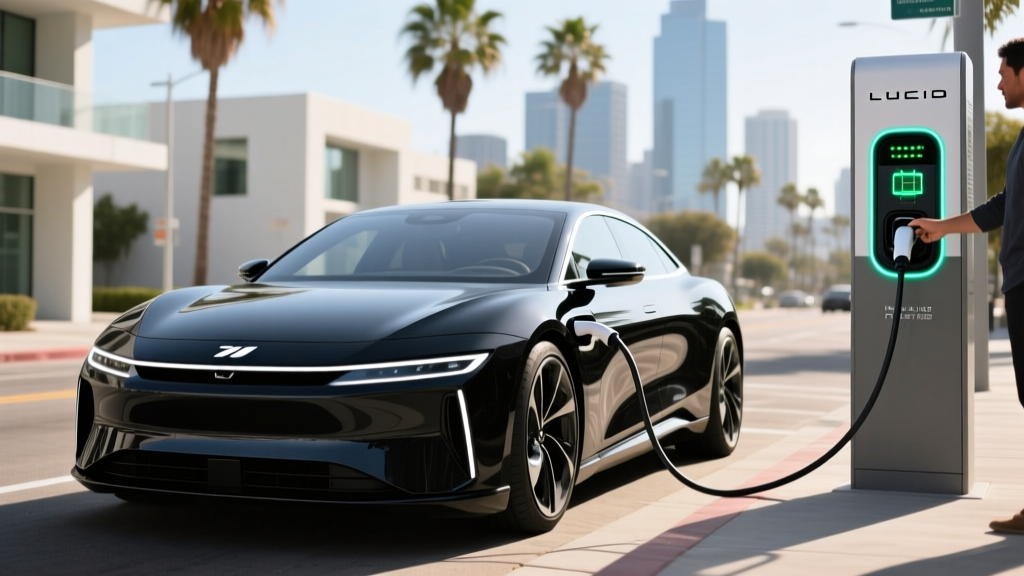
The Lucid Air remains one of the most efficient and longest-range electric sedans on the market, but buying one involves more than admiring its 500+ mile EPA sticker. For Southern California buyers specifically, ownership logistics — including proximity to a Lucid service center in San Diego — shape the real-world experience just as much as the powertrain specs. This review breaks down the 2026 Lucid Air lineup with exact numbers on range, charging, pricing, and what daily life with one actually looks like.
Quick Verdict: Who the Lucid Air Is For
The Lucid Air targets buyers who want maximum range and efficiency in a luxury sedan package. It outperforms the Tesla Model S, Mercedes EQS, and BMW i7 on miles-per-kWh efficiency, and its 900V+ architecture delivers some of the fastest DC charging in the segment. The trade-off: a limited service network (Lucid operates roughly 30+ service centers nationwide as of early 2026, with mobile service vans filling gaps), premium pricing on upper trims, and a brand still building its long-term reliability reputation.
Choose the Lucid Air if: You prioritize range and efficiency above all else, take frequent long road trips, and live within reasonable distance of a Lucid service hub or are comfortable with mobile/ranger service.
Look elsewhere if: You need a hatchback/SUV cargo layout, want the widest possible service network, or your budget caps below $70,000.
Range and Efficiency: EPA Numbers vs. Real-World Reality
EPA Estimated Range: Up to 516 miles (Air Grand Touring with 19" wheels) — the highest of any production EV sold in the U.S.
Real-World Expectation: Plan for 400–440 miles on mixed highway driving at 70–80 mph. In cold weather (below 40°F), expect a 15–25% reduction, dropping effective range to roughly 330–370 miles. City driving with regen braking can match or slightly exceed EPA figures thanks to the Air's exceptional efficiency.
The Air's efficiency is genuinely class-leading. The Pure RWD achieves 146 MPGe combined (roughly 23 kWh/100 mi), while the Grand Touring lands at 131 MPGe combined (~26 kWh/100 mi) per fueleconomy.gov. For comparison, the Tesla Model S Long Range sits at 120 MPGe combined, and the Mercedes EQS 580 at 97 MPGe.
| Trim | EPA Range (mi) | Battery Usable (kWh) | MPGe Combined | kWh/100 mi |
|---|---|---|---|---|
| Pure RWD | 419 | 88 | 146 | 23 |
| Touring | 425 | 112 | 140 | 24 |
| Grand Touring | 516 | 112 | 131 | 26 |
| Sapphire | 427 | 118 | 110 | 31 |
All trims use NMC (nickel manganese cobalt) lithium-ion cells in a structurally integrated battery pack. Lucid has not adopted LFP chemistry for the Air, prioritizing energy density over cycle-life longevity. The usable capacity is slightly less than gross to preserve a buffer for battery health.
Charging: 900V Architecture, Peak kW, and Home Setup
The Lucid Air's 900V+ electrical architecture is its charging secret weapon. Higher voltage means the car can accept more power at lower current, reducing heat and enabling sustained fast-charging performance.
| Charging Level | Max Rate | Speed / Notes |
|---|---|---|
| Level 1 (120V) | ~1.4 kW | ~3–4 mi/hr — emergency/trickle only |
| Level 2 (240V, 48A) | 11.5 kW | ~35–40 mi/hr; full charge in ~10–12 hrs (112 kWh pack) |
| DC Fast Charge (CCS) | Peak 300+ kW | 10–80% in ~20 min (Grand Touring); tapers significantly above 80% |
| DC Fast Charge (NACS adapter) | Up to 250 kW | Tesla Supercharger access via included adapter; speed limited vs. CCS |
A critical ownership note: peak 300+ kW charging requires a compatible CCS station (such as Electrify America's 350 kW dispensers) and optimal battery preconditioning. On a typical road trip, you'll see sustained rates of 150–220 kW through the 10–60% SoC window, tapering to 80–100 kW from 60–80%, and dropping sharply above 80%. Always precondition the battery via the navigation system before arriving at a charger — skipping this step can cut peak speeds in half in cool weather.
For home charging, a 48-amp Level 2 wall connector on a 60-amp circuit delivers the Air's max 11.5 kW AC rate. Expect installation costs of $800–$2,500 depending on panel capacity and run length (a 200-amp panel is typically required). San Diego homeowners should check SDG&E's EV rate plans for off-peak charging savings.
Performance: 0–60, Horsepower, and Drivetrain
| Trim | Drivetrain | Horsepower | 0–60 mph | Top Speed |
|---|---|---|---|---|
| Pure RWD | Rear-Wheel Drive | 430 hp | 5.0 sec | 145 mph |
| Touring | Dual-Motor AWD | 620 hp | 3.4 sec | 145 mph |
| Grand Touring | Dual-Motor AWD | 819 hp | 3.0 sec | 168 mph |
| Sapphire | Tri-Motor AWD | 1,234 hp | 1.89 sec | 205 mph |
Even the base Pure RWD delivers 430 hp — more than adequate for any real-world scenario. The Grand Touring's 819 hp and 3.0-second 0–60 put it in supercar territory while maintaining sedan practicality. The tri-motor Sapphire is a halo model that competes with the Tesla Model S Plaid and Porsche Taycan Turbo GT, but it sacrifices range and efficiency for that performance.
Pricing, Tax Credits, and Total Cost
| Trim | Base MSRP | §30D Credit Eligible? | Effective Price (if eligible) |
|---|---|---|---|
| Pure RWD | $69,900 | Potentially — see notes below | ~$62,400 |
| Touring | $87,400 | Potentially — see notes below | ~$79,900 |
| Grand Touring | $125,600 | No — exceeds MSRP cap | $125,600 |
| Sapphire | $249,000 | No — exceeds MSRP cap | $249,000 |
IRS §30D Federal Tax Credit Requirements (2026):
- MSRP Cap: Sedans must be under $55,000 — this disqualifies ALL Lucid Air trims from the new-vehicle credit. (Note: The Pure RWD at $69,900 exceeds this cap.)
- Buyer Income Cap: AGI must not exceed $150,000 (single), $225,000 (head of household), or $300,000 (joint).
- Battery Sourcing: Critical minerals and battery component requirements must be met; check IRS qualifying vehicle list for current eligibility.
- Point-of-Sale Transfer: Eligible credits can be transferred to the dealer at purchase for an immediate price reduction.
An important clarification: the Lucid Air's sedan pricing places it above the §30D MSRP cap of $55,000 for sedans. Buyers should not expect the $7,500 federal credit on any new Air trim. However, a used Lucid Air (model year 2022 or later, purchased from a dealer for $25,000 or more above a minimum threshold) may qualify for the up-to-$4,000 used EV credit under §25E, subject to buyer income caps. Consult a tax professional and the latest IRS guidance before relying on credit assumptions.
Interior, Cargo, and Technology
The Air's interior emphasizes a glass-canopy aesthetic with a 34-inch curved glass cockpit display spanning the driver cluster and infotainment. A retractable lower touchscreen handles climate and secondary controls. The cabin seats five adults comfortably, with 41.1 inches of front legroom and 36.6 inches rear — competitive with the BMW 7 Series and Mercedes S-Class.
Cargo volume is a weak point relative to hatchback competitors: 16.2 cu ft in the trunk (the Air is a traditional sedan, not a liftback). The front trunk (frunk) adds approximately 4.5 cu ft. For comparison, the Tesla Model S offers 28 cu ft behind the rear seats thanks to its hatchback design. If cargo flexibility matters, the Air's sedan trunk limits what you can haul.
Driver Assistance: The Air comes with Lucid's DreamDrive Pro ADAS suite — a Level 2 system per SAE classification. It includes adaptive cruise, lane centering, automatic emergency braking, and blind-spot monitoring. This is a driver-supervision-required system, not autonomous driving. Lucid has not yet deployed a hands-off or eyes-off system comparable to GM Super Cruise or Ford BlueCruise on highways.
Notable Tech Features:
- Over-the-air (OTA) software updates for powertrain, UI, and feature additions
- Wireless Apple CarPlay and Android Auto
- Surreal Sound by Dolby Atmos (21-speaker system on Grand Touring/Sapphire)
- Available Executive Rear Seat package with reclining, massaging rear seats
- Phone-as-key with NFC backup
Drawbacks: The dual-screen interface has drawn criticism for lag and menu depth in earlier model years, though OTA updates have improved responsiveness. There's no physical knob cluster for volume or climate, which some buyers find frustrating. Rear visibility is limited by the sloping roofline — a backup camera is essential.
Service, Warranty, and San Diego Ownership Logistics
This is where the Lucid service center in San Diego becomes a critical ownership factor. As of early 2026, Lucid operates a service presence in the San Diego metro area, supplemented by mobile service rangers who can perform many repairs at your home or office. However, the network remains far smaller than Tesla's 200+ U.S. service locations or legacy luxury brands.
For major warranty work — battery pack replacement, drive unit service, or structural repairs — you may need to visit a regional service center. Southern California buyers have options in the greater LA/Orange County area, but San Diego-specific access for heavy repairs may involve travel or vehicle pickup/drop-off logistics arranged by Lucid.
| Coverage Type | Duration / Mileage |
|---|---|
| Basic Vehicle | 4 years / 50,000 miles |
| Battery & Drive Units | 8 years / 100,000 miles |
| Battery Capacity Retention | Minimum 70% over 8 yr / 100,000 mi |
| Roadside Assistance | 4 years / 50,000 miles |
The 8-year/100,000-mile battery warranty with a 70% capacity retention floor is industry-standard, matching Tesla and most competitors. NMC chemistry in the Air typically shows 5–10% degradation in the first 50,000 miles based on owner-reported data, then stabilizes. Avoid routinely charging to 100% or leaving the car at low SoC for extended periods to maximize longevity.
For San Diego buyers specifically: weigh your comfort with a smaller service network against the Air's range and efficiency advantages. If you're a meticulous planner who can schedule service appointments and tolerate potential wait times for parts, the Air rewards you. If you want walk-in service availability and the densest support network, a Tesla Model S or BMW i7 may better match your risk tolerance.
Lucid Air vs. Key Competitors
| Spec | Lucid Air GT | Tesla Model S LR | Mercedes EQS 580 | BMW i7 xDrive60 |
|---|---|---|---|---|
| EPA Range | 516 mi | 402 mi | 371 mi | 318 mi |
| Battery (kWh usable) | 112 | ~95 | 107.8 | 101.7 |
| Peak DC Charge | 300+ kW | 250 kW | 200 kW | 195 kW |
| 0–60 mph | 3.0 sec | 3.1 sec | 4.1 sec | 4.5 sec |
| MPGe Combined | 131 | 120 | 97 | 86 |
| Base MSRP | $125,600 | $79,990 | $127,350 | $119,300 |
| Cargo (cu ft) | 16.2 + frunk | 28 (hatch) | 22 (hatch) | 17.7 |
The Air Grand Touring wins on range, efficiency, and peak charging speed. The Model S wins on cargo practicality, service network density, and price. The EQS and i7 offer more traditional luxury-brand dealership service experiences and interior material quality that some buyers prefer, at the cost of range and efficiency.
Pros
- Class-leading EPA range (516 mi) and efficiency
- Fastest DC charging in the luxury sedan segment
- Spacious, airy cabin with premium materials
- Smooth, quiet ride quality
- Strong OTA update cadence
Cons
- Limited service center network (San Diego coverage still developing)
- Sedan trunk limits cargo vs. hatchback rivals
- No federal new-vehicle tax credit (MSRP above $55K sedan cap)
- Infotainment learning curve; no physical knobs
- Brand-new company — long-term reliability track record still forming
Frequently Asked Questions
What is the real-world range of the Lucid Air?
The EPA rates the Grand Touring at 516 miles, but real-world highway driving at 70–80 mph typically yields 400–440 miles. Cold weather (below 40°F) reduces this further to roughly 330–370 miles. City driving with regenerative braking can approach or slightly exceed EPA estimates.
How fast does the Lucid Air charge at home and on the road?
At home on a 48-amp Level 2 charger, the Air charges at up to 11.5 kW, adding roughly 35–40 miles per hour. On DC fast chargers, it peaks above 300 kW (CCS), achieving a 10–80% charge in approximately 20 minutes under optimal conditions. Via the included NACS adapter, Tesla Supercharger speeds cap around 250 kW.
Does the Lucid Air qualify for the federal EV tax credit?
No. The IRS §30D credit caps sedan MSRP at $55,000, and every Lucid Air trim exceeds this threshold. Used Air models may qualify for the §25E used EV credit (up to $4,000) if purchased from a dealer and buyer income limits are met. Always verify current rules at irs.gov.
Is there a Lucid service center in San Diego?
Lucid has been expanding its service footprint in Southern California, including the San Diego area, supplemented by mobile ranger service for many common repairs. For major powertrain or battery work, you may need to coordinate with a regional center in greater Los Angeles or Orange County. Confirm current local service availability directly with Lucid before purchasing.
Is the Lucid Air worth buying over a Tesla Model S or BMW i7?
If maximum range and efficiency are your top priorities and you're comfortable with a smaller service network, the Air is the segment leader. If service accessibility, hatchback cargo space, or a lower entry price matter more, the Model S is a strong alternative. The i7 appeals to traditional luxury buyers who prioritize dealership service and interior opulence over range.
How long will the Lucid Air battery last?
Lucid warranties the battery for 8 years/100,000 miles with a minimum 70% capacity retention guarantee. NMC packs typically lose 5–10% capacity in the first 50,000 miles, then degradation slows. With proper care (avoiding routine 100% charges, minimizing DC fast-charging frequency), owners can expect the pack to remain functional well beyond the warranty period.