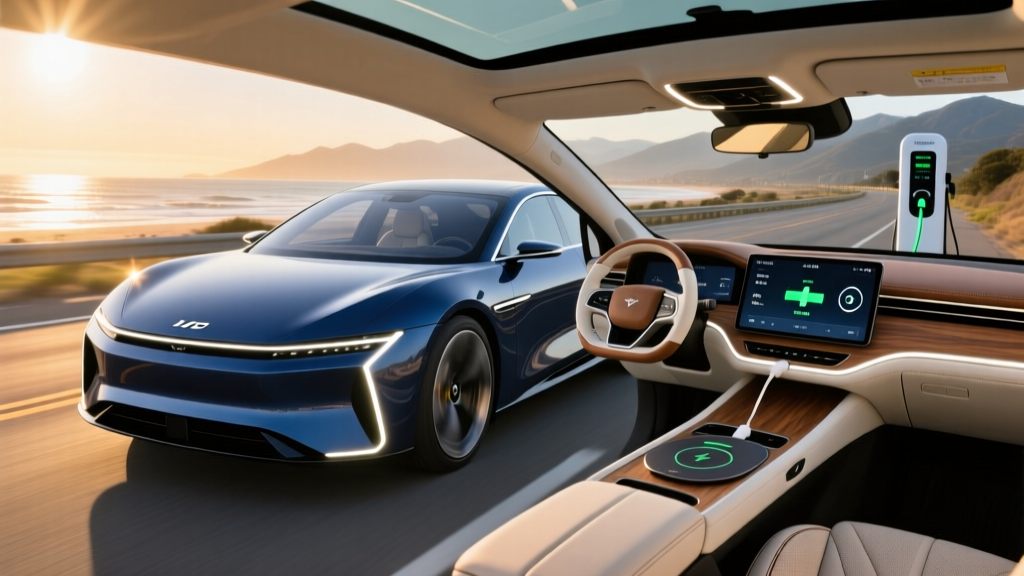
When actor Timothée Chalamet was photographed stepping out of a Lucid Air in Los Angeles, search interest in the brand spiked — and for good reason. The Lucid Air remains one of the most technically accomplished electric sedans on the road, pairing class-leading efficiency with a luxury cabin that rivals Mercedes and BMW. But celebrity endorsement doesn't tell you what it's like to live with one. This review breaks down the 2026 Lucid Air lineup with the exact numbers buyers need: real-world range, charging curves, tax-credit eligibility, and how it stacks up against the Tesla Model S, BMW i7, and Mercedes EQS.
2026 Lucid Air Lineup: Trim Overview and Pricing
Lucid offers the Air in four trims for 2026, spanning a $69,900 to $249,000 price range. The Pure RWD serves as the entry point, while the Sapphire sits at the apex as a 1,234-hp hyper-sedan. Here's how the lineup breaks down:
| Trim | Drivetrain | HP | Battery (kWh usable) | EPA Range | 0-60 mph | Base MSRP |
|---|---|---|---|---|---|---|
| Pure RWD | RWD (single motor) | 430 | 88 kWh (NMC) | 419 mi | 5.0 sec | $69,900 |
| Touring AWD | AWD (dual motor) | 620 | 112 kWh (NMC) | 425 mi | 3.4 sec | $87,400 |
| Grand Touring AWD | AWD (dual motor) | 819 | 112 kWh (NMC) | 516 mi | 3.0 sec | $125,600 |
| Sapphire | AWD (tri-motor) | 1,234 | 118 kWh (NMC) | 427 mi | 1.89 sec | $249,000 |
All trims carry a $1,395 destination charge. The Pure RWD is the value play — 419 miles of EPA range at under $70K is unmatched by any competing luxury sedan. The Grand Touring is the sweet spot for road-trippers who want 500+ miles without stepping to the Sapphire's supercar pricing.
Range & Efficiency: EPA vs. Real-World
Real-World Expectation: ~420–460 mi highway (70–75 mph); ~360–400 mi in freezing temps (below 32°F); ~480+ mi mixed city driving with regen
Efficiency: 146 MPGe combined / 24 kWh per 100 mi (Grand Touring AWD)
The Lucid Air Grand Touring's 516-mile EPA rating is the highest of any production EV sold in the United States, per fueleconomy.gov. But the EPA cycle is weighted toward city driving with frequent stops, where regenerative braking recovers energy. On a flat interstate at 75 mph in moderate temperatures, expect roughly 420–460 miles before needing a charger — still extraordinary, but a meaningful drop from the sticker figure.
Cold weather compounds the loss. Lithium-ion batteries lose efficiency below freezing, and cabin heating draws significant power. In sustained sub-32°F conditions, plan for 360–400 miles. Lucid's available heat pump (standard on Touring and above) mitigates this by pulling thermal energy from the drivetrain rather than relying solely on resistive heating, cutting winter range loss by roughly 10–15% compared to EVs without one.
The Pure RWD's 419-mile rating benefits from a lighter single-motor layout and the same aerodynamic drag coefficient (0.197 Cd) that makes the Air the most aero-efficient sedan in production. Its 26 kWh/100mi efficiency figure beats the Tesla Model S Long Range (28 kWh/100mi) and the Mercedes EQS 580 (31 kWh/100mi).
Charging Speed: DC Fast Charge and Home Level 2
The Lucid Air uses a 900V+ electrical architecture — one of the highest in the industry — enabling exceptionally fast DC charging. Here's what that translates to in practice:
| Charging Level | Power (kW) | Rate | Notes |
|---|---|---|---|
| Level 1 (120V household) | ~1.4 kW | ~4 mi/hr | Emergency/trickle only |
| Level 2 (240V, 48A) | 11.5 kW | ~38 mi/hr | Full charge in ~11 hrs (112 kWh battery) |
| DC Fast Charge (peak) | 300 kW | ~200 mi in 15 min | Requires 350 kW CCS station; NACS adapter available |
| DC Fast Charge (10–80%) | — | ~25 min (Touring/GT) | Curve tapers above 80% SoC |
The 300 kW peak rate is sustained between roughly 10% and 40% state of charge (SoC), then progressively tapers. By 60% SoC, you'll see approximately 200 kW; by 80%, it drops to around 120 kW. This is standard behavior for lithium-ion packs protecting cell longevity, but the 900V system keeps the curve flatter longer than most 400V competitors. A 10–80% session takes roughly 25 minutes on a 350 kW Electrify America or EVgo station.
For home charging, the Air's onboard charger accepts up to 11.5 kW on a Level 2 circuit (240V, 48 amps). That means a depleted 112 kWh pack fully replenishes overnight in about 11 hours. Most owners will arrive home with 40–60% battery remaining and wake up fully charged in 5–6 hours. Installation of a 48A hardwired Level 2 charger typically costs $800–$2,000 including electrician labor and permits, depending on panel capacity and run length.
Lucid provides a NACS adapter for Tesla Supercharger access, expanding the DC fast-charging network significantly. The Air's native port is CCS1, and the adapter supports up to 250 kW on V3 Superchargers — slightly below the Air's peak capability but adequate for road trips.
Performance and Driving Dynamics
The Air's performance envelope spans from serene luxury cruiser to hypercar-killer, depending on trim:
- Pure RWD: 430 hp, single rear motor, 5.0-second 0-60. Adequate for any real-world merge or passing maneuver, with the instant torque characteristic of EVs.
- Touring AWD: 620 hp, dual motor, 3.4-second 0-60. Genuinely quick, with all-weather traction from the front motor.
- Grand Touring AWD: 819 hp, dual motor, 3.0-second 0-60. Supercar acceleration in a four-door sedan.
- Sapphire: 1,234 hp, tri-motor (one front, two rear), 1.89-second 0-60. Competes directly with the Bugatti Chiron in straight-line acceleration, with torque-vectoring rear motors enabling sharp cornering.
Ride quality is air-suspension equipped on Touring and above, with automatic ride-height adjustment that lowers at highway speed for aerodynamic efficiency. The Pure uses a conventional steel-spring setup that's comfortable but slightly firmer over sharp impacts. Steering is precise if somewhat light — this is a grand tourer, not a sports sedan, though the Sapphire's track-focused tuning changes that equation entirely.
Interior, Cargo, and Technology
The Air's cabin uses a 34-inch curved glass canopy display spanning the driver's instrument cluster and central infotainment screen. A retractable lower touchscreen handles climate and secondary controls, sliding away to reveal a clean dashboard surface. Wireless Apple CarPlay and Android Auto are standard across all trims.
Passenger space is generous for a full-size sedan:
- Front legroom: 43.4 inches
- Rear legroom: 37.6 inches
- Trunk (rear): 22.1 cu ft
- Frunk (front): 7.1 cu ft
- Total cargo: 29.2 cu ft
The 22.1 cu ft trunk is larger than the BMW 5 Series (18.6 cu ft) and the Tesla Model S (28 cu ft combined, but with a liftback design). The frunk is modest — enough for a charging cable bag and a small soft cooler — but the trunk's depth and width handle four full-size suitcases easily.
Driver assistance: The Air ships with DreamDrive Pro, Lucid's Level 2 ADAS suite featuring adaptive cruise control, lane centering, blind-spot monitoring, and automatic emergency braking. A 32-sensor array includes lidar (on Touring and above), which is rare in the segment. However, DreamDrive Pro requires hands on the wheel at all times — this is SAE Level 2, not autonomous driving. Lucid has not announced a hands-free highway system comparable to GM's Super Cruise or Ford's BlueCruise as of early 2026.
Federal Tax Credit & Total Cost
Under IRS §30D rules, the federal EV tax credit provides up to $7,500, split into two halves: $3,750 for battery-component sourcing and $3,750 for critical-minerals sourcing. Eligibility depends on three factors that change annually:
- MSRP cap: Sedans must be priced at or below $55,000 to qualify. This eliminates every Lucid Air trim at base MSRP.
- Buyer income cap: Adjusted gross income must not exceed $150,000 (single), $225,000 (head of household), or $300,000 (joint filing).
- Battery sourcing: A percentage of critical minerals and battery components must be sourced from the U.S. or FTA partners. These thresholds increase each year.
Despite the federal credit ineligibility, the Air Pure RWD's $69,900 entry price undercuts the Mercedes EQS 580 ($105,550) and the BMW i7 xDrive60 ($120,295) by wide margins while delivering superior range and efficiency. Total cost of ownership over five years benefits from lower electricity costs versus premium gasoline, reduced maintenance (no oil changes, fewer brake replacements due to regen), and strong projected residual values.
Warranty and Long-Term Ownership
Lucid covers the Air with the following warranties:
- Basic vehicle: 4 years / 50,000 miles
- Battery & powertrain: 8 years / 100,000 miles (capacity retention guaranteed above 70% of original kWh)
- Roadside assistance: 4 years / 50,000 miles
The 8-year/100,000-mile battery warranty is standard for the luxury EV segment, matching BMW and Mercedes. The 70% capacity-retention threshold means Lucid will repair or replace the pack if it degrades below 77.8 kWh (on the 112 kWh pack) within the warranty period. Independent data from Recurrent Auto suggests that modern NMC packs with active liquid cooling — like the Air's — typically retain 88–92% capacity at 100,000 miles under normal use, making a warranty claim unlikely.
Lucid's service network is smaller than Tesla's or legacy luxury brands. As of 2026, Lucid operates roughly 30 service centers in the U.S., supplemented by mobile service vans in major metros. Rural owners may face longer wait times for bodywork or complex diagnostics — a legitimate consideration if you live outside a top-20 metro area.
Lucid Air vs. Key Competitors
| Spec | Lucid Air GT | Tesla Model S LR | Mercedes EQS 580 | BMW i7 xDrive60 |
|---|---|---|---|---|
| EPA Range | 516 mi | 402 mi | 371 mi | 318 mi |
| Battery (kWh) | 112 (NMC) | ~100 (NMC) | 108.4 (NMC) | 101.7 (NMC) |
| Peak DC Charge (kW) | 300 | 250 | 200 | 195 |
| 0-60 mph | 3.0 sec | 3.1 sec | 4.1 sec | 4.5 sec |
| Efficiency (kWh/100mi) | 24 | 28 | 31 | 33 |
| Base MSRP | $125,600 | $79,990 | $105,550 | $120,295 |
The Air Grand Touring leads on range, efficiency, and charging speed. The Model S Long Range is the closest competitor on performance and undercuts on price by $45,000, but its interior quality and ride refinement lag significantly behind Lucid's. The EQS and i7 prioritize cabin luxury and brand cachet over efficiency — both lose roughly 150 miles of range compared to the Air GT while costing nearly as much or more.
Choose the Tesla Model S if: You want Supercharger-native access, lower pricing, and stronger over-the-air update cadence — and can accept a plainer interior.
Choose the Mercedes EQS or BMW i7 if: Dealer service infrastructure, brand cachet, and traditional luxury appointment matter more than range or efficiency.
Pros and Cons
Pros
- Class-leading EPA range (516 mi on Grand Touring)
- Best-in-class efficiency at 24 kWh/100mi
- 300 kW peak DC charging — among the fastest sedans available
- Spacious rear seat and 29.2 cu ft total cargo
- 900V architecture future-proofs for next-gen chargers
- Pure RWD starts at $69,900 — accessible for the segment
Cons
- No federal §30D tax credit eligibility (all trims above $55K MSRP cap)
- Limited service-center footprint outside major metros
- DreamDrive Pro lacks hands-free highway capability (no Super Cruise competitor)
- Infotainment learning curve — no physical knobs for climate or volume
- Rear visibility hampered by sloping roofline and small rear window
- Sapphire pricing ($249K) enters exotic-car territory with limited practicality
Who Should Buy the Lucid Air?
Best for: Long-distance commuters and road-trippers who need 400+ real-world miles between charges. The Grand Touring is ideal for couples or small families who take 300+ mile highway trips regularly and want to minimize charging stops to one per day. The Pure RWD suits budget-conscious luxury buyers who want maximum range at the lowest entry price in the segment.
Not ideal for: Buyers in rural areas far from Lucid service centers, those who prioritize hands-free highway driving (look to GM's Super Cruise vehicles instead), or anyone needing third-row seating or SUV cargo flexibility. The Air is a sedan — if you need to haul lumber or tow over 3,000 lbs, look at the Rivian R1S or Tesla Model X.
The Timothée Chalamet effect brought attention to the Air, but the engineering speaks for itself. Lucid's powertrain efficiency, derived from its Formula E racing program, delivers measurable advantages in range and charging speed that competitors have yet to match in the luxury sedan segment. If the numbers align with your driving patterns, the Air earns its place at the top of the EV sedan hierarchy.
Frequently Asked Questions
What is the real-world range of the Lucid Air?
The EPA rates the Grand Touring at 516 miles and the Pure RWD at 419 miles. In real-world highway driving at 70–75 mph, expect roughly 420–460 miles from the GT and 340–370 miles from the Pure. Cold weather (below 32°F) reduces range by 15–25% depending on cabin-heating demand and whether the heat pump is active.
How fast does the Lucid Air charge?
On a 350 kW DC fast charger, the Air peaks at 300 kW and adds roughly 200 miles in 15 minutes. A 10–80% session takes about 25 minutes. At home on a 48A Level 2 charger (11.5 kW), a full charge takes approximately 11 hours for the 112 kWh battery.
Does the Lucid Air qualify for the federal EV tax credit?
No. Under IRS §30D rules, sedans must have an MSRP at or below $55,000 to qualify. Every 2026 Lucid Air trim exceeds this cap, starting at $69,900 for the Pure RWD. Check IRS.gov for current rules and consult a tax professional for personal eligibility.
Is the Lucid Air worth buying over a Tesla Model S?
If range, efficiency, and interior quality are your top priorities, yes — the Air delivers measurably better numbers in all three. If Supercharger-native access, lower pricing, and a more mature software ecosystem matter more, the Model S Long Range at $79,990 remains compelling. Test-drive both before deciding.
What is the battery warranty on the Lucid Air?
Lucid covers the battery and powertrain for 8 years or 100,000 miles, whichever comes first. The warranty guarantees capacity retention above 70% of the original usable kWh. Real-world degradation data suggests most owners will retain 88–92% capacity at 100,000 miles under normal charging habits.
Does the Lucid Air have self-driving capability?
No. DreamDrive Pro is an SAE Level 2 driver-assistance system that requires the driver to keep hands on the steering wheel and remain fully engaged at all times. It does not support hands-free or eyes-off driving. Lucid has not announced a Level 3 or Level 4 system for the Air as of 2026.