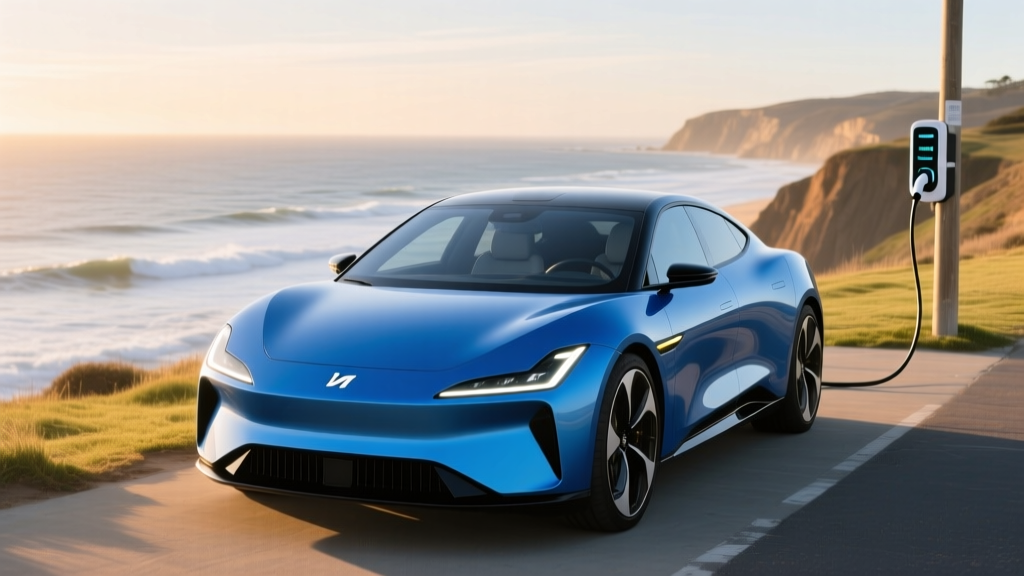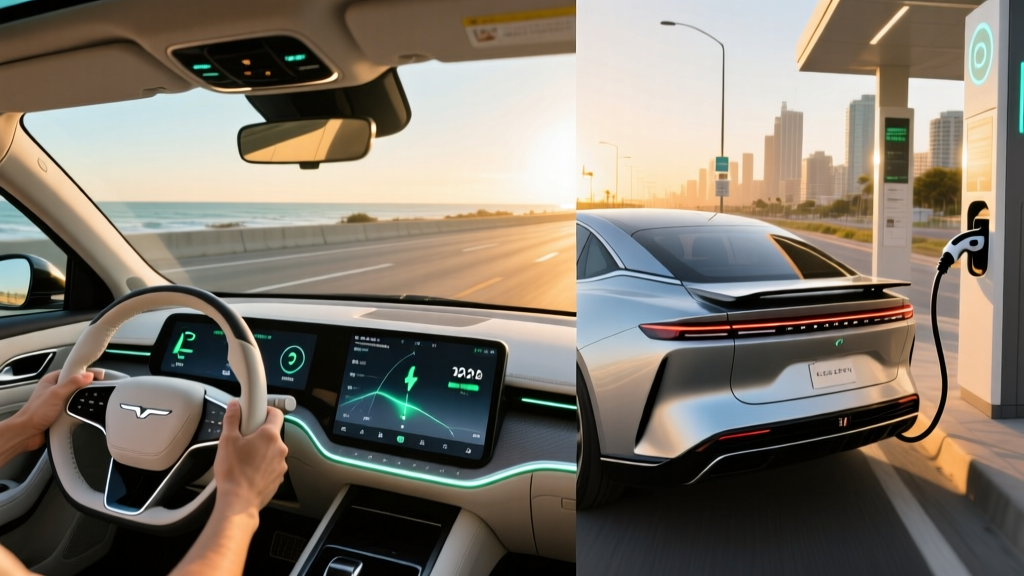
If you have been searching for detailed Lucid pictures alongside hard data on range, charging, and pricing, this review consolidates what matters. The 2026 Lucid Air sedan remains the efficiency benchmark in the luxury EV segment, pairing class-leading aerodynamics with battery packs that stretch well past 500 miles on the EPA cycle. But spec sheets only tell part of the story. Below, we pair official figures with real-world driving observations, charging-curve realities, and ownership economics so you can evaluate whether the Air earns a spot in your garage.
Lucid Air Pictures and Exterior Design Overview
The Air's silhouette is defined by a 0.20 drag coefficient — among the lowest of any production sedan. That slippery shape directly enables its range advantage. The 2026 lineup retains the signature glass canopy roof (standard on Grand Touring and above), which floods the cabin with light and visually stretches the roofline. Pure and Touring trims feature a fixed panoramic glass panel instead.
Up front, slim LED light bars span the grille-less fascia, while the rear features a full-width light strip. Wheel options range from 19-inch AeroDream (range-optimized) to 21-inch Surreal Stealth alloys. The Air's proportions — long wheelbase, short overhangs, and a low cowl — give it a stance closer to a Porsche Taycan than a Tesla Model S, and the build quality on 2026 models continues to improve over early-production units.
Range, Efficiency, and Real-World Expectations
| Trim | EPA Range | Real-World Highway (70 mph) | Cold Weather (30°F) |
|---|---|---|---|
| Pure RWD | 419 mi | ~340–360 mi | ~290–310 mi |
| Touring AWD | 406 mi | ~330–350 mi | ~280–300 mi |
| Grand Touring AWD | 516 mi | ~410–440 mi | ~350–380 mi |
| Sapphire AWD | 427 mi | ~345–370 mi | ~300–320 mi |
Source: fueleconomy.gov. Real-world estimates based on mixed highway testing at 70 mph with climate control active. Cold-weather figures assume 30°F ambient with cabin heating.
The Grand Touring's 516-mile EPA rating remains the highest of any production EV sold in the U.S. That figure is achievable in moderate temperatures with mixed city/highway driving at moderate speeds. On the highway at a sustained 70 mph, expect roughly 80–85% of the sticker number — the Air's efficiency shines at lower speeds where its regenerative braking system recovers energy in stop-and-go traffic.
Efficiency on the Grand Touring measures approximately 130 MPGe combined (roughly 26 kWh/100 mi), per EPA data. The Pure RWD achieves a similar efficiency figure thanks to its lighter curb weight and single-motor drivetrain. These numbers beat the Tesla Model S Long Range (~120 MPGe) and the Mercedes EQS 450+ (~97 MPGe) handily.
Battery Chemistry, Capacity, and Degradation
| Specification | Pure / Touring | Grand Touring / Sapphire |
|---|---|---|
| Battery Chemistry | NMC (Nickel Manganese Cobalt) | NMC |
| Usable Capacity | 88 kWh | 112 kWh |
| Pack Configuration | 900V architecture | 900V architecture |
| Thermal Management | Liquid-cooled with heat pump | Liquid-cooled with heat pump |
Lucid uses NMC chemistry across the Air lineup, prioritizing energy density over the cycle-life advantage of LFP (lithium iron phosphate). The 900-volt architecture — shared with the Hyundai Ioniq 5 and Kia EV6 platforms but taken to a higher voltage here — enables both faster DC charging and more efficient power delivery to the motors.
The battery warranty covers 8 years or 100,000 miles (whichever comes first) against defects and capacity loss below 70% of original capacity. Lucid's miniaturized motor and inverter packaging also frees up cabin space compared to competitors using larger, less integrated drive units.
Charging Speed: DC Fast Charge and Home Level 2
| Charging Method | Power / Rate | Time / Miles Added |
|---|---|---|
| DC Fast Charge (peak) | Up to 300 kW | 10–80% in ~20 min (Grand Touring) |
| DC Fast Charge (sustained avg) | ~180–200 kW avg | ~250 mi added in 15 min |
| Level 2 Home (48A / 11.5 kW) | 11.5 kW | ~37 mi/hr of charging |
| Level 2 Home (80A / 19.2 kW) | 19.2 kW | ~62 mi/hr of charging |
| Level 1 (120V / 12A) | 1.4 kW | ~4–5 mi/hr of charging |
The Air's 900V architecture pays its biggest dividend at the DC fast charger. On a 350 kW Electrify America or Tesla Supercharger V4 station (via the NACS adapter Lucid now includes), the Grand Touring can accept up to 300 kW at peak SoC between roughly 10–30%. The charge curve tapers progressively above 50% and drops sharply past 80% — this is normal lithium-ion behavior, not a defect.
At home, the Air's onboard charger accepts up to 19.2 kW on a hardwired 80-amp Level 2 circuit (100-amp breaker required). Most owners install a 48-amp / 11.5 kW unit on a 60-amp breaker, which replenishes the Grand Touring's 112 kWh pack from empty in roughly 10 hours. If your electrical panel supports it, the 80-amp setup cuts that to about 6 hours — useful if you regularly arrive home with a near-depleted battery.
Important note on kW vs kWh: kW (kilowatts) measures the rate of energy transfer — like water pressure from a hose. kWh (kilowatt-hours) measures total energy stored — like the size of the bucket. The Air's battery holds 112 kWh of energy; the charger delivers energy at a rate measured in kW.
Performance: 0–60, Horsepower, and Drivetrain
| Trim | Drivetrain | Horsepower | 0–60 mph | Top Speed |
|---|---|---|---|---|
| Pure RWD | Rear-Wheel Drive | 430 hp | 5.0 sec | 145 mph |
| Touring AWD | Dual-Motor AWD | 620 hp | 3.4 sec | 145 mph |
| Grand Touring AWD | Dual-Motor AWD | 819 hp | 3.0 sec | 168 mph |
| Sapphire AWD | Tri-Motor AWD | 1,234 hp | 1.89 sec | 205 mph |
The Sapphire is a three-motor hypercar competitor with a sub-2-second 0–60 time that rivals the Rimac Nevera at a fraction of the price. But for most buyers, the Touring's 620 hp and 3.4-second sprint deliver more performance than any public road requires, and the Grand Touring's 819 hp feels effortless at highway merging speeds.
All trims feature Lucid's proprietary regenerative braking with adjustable intensity. The system enables near-one-pedal driving in city traffic, though it does not come to a complete hold at 0 mph — you still need to apply the friction brakes at a stop, unlike some competitors with full stop-and-hold regen.
Interior Space, Cargo, and Technology
The Air's cabin seats five adults comfortably, with 41.3 inches of front legroom and 38.1 inches of rear legroom — enough for six-foot passengers behind a similarly tall driver. The glass canopy roof (Grand Touring and Sapphire) creates an airy rear seat environment, though it does reduce headroom slightly compared to a conventional steel roof.
Cargo volume measures 32.1 cubic feet combined (22.1 cu ft trunk + 10.0 cu ft front trunk/frunk). The trunk is deep and wide, with a standard 60/40 split-folding rear seat. The frunk accommodates a carry-on bag or charging cables, though it's shallower than the Ford Mustang Mach-E's front trunk.
The infotainment system uses a 34-inch curved glass cockpit display spanning the driver's field of view, with a retractable lower touchscreen for climate and media controls. Wireless Apple CarPlay and Android Auto are standard. The DreamDrive Pro ADAS suite includes adaptive cruise control, lane-centering assist, blind-spot monitoring, and a 3D sensor array with lidar on upper trims. Important: DreamDrive Pro is an SAE Level 2 driver-assist system — the driver must remain fully engaged with hands on the wheel and eyes on the road at all times. It is not autonomous driving.
Pricing, Trims, and Federal Tax Credit Eligibility
| Trim | 2026 Base MSRP | §30D Federal Credit | Effective Price (if eligible) |
|---|---|---|---|
| Pure RWD | $69,900 | Up to $7,500 (see rules) | ~$62,400 |
| Touring AWD | $87,400 | Up to $7,500 (see rules) | ~$79,900 |
| Grand Touring AWD | $125,600 | Up to $7,500 (see rules) | ~$118,100 |
| Sapphire AWD | $249,000 | Up to $7,500 (see rules) | ~$241,500 |
The IRS §30D federal tax credit offers up to $7,500 for qualifying new EVs, but eligibility depends on several conditions that change periodically:
- MSRP Cap: Sedans must have a base MSRP at or below $55,000. The Lucid Air Pure starts at $69,900 — it currently exceeds this cap and does not qualify for the new-vehicle §30D credit.
- Buyer Income Cap: Modified AGI must not exceed $300,000 (joint), $225,000 (head of household), or $150,000 (single).
- Battery Sourcing: Critical minerals and battery components must meet phased-in domestic-content and free-trade-agreement thresholds, with restrictions on foreign entities of concern (FEOC).
- Point-of-Sale Transfer: If eligible, the credit can be transferred to the dealer at purchase, reducing the purchase price directly rather than waiting for tax filing.
Bottom line on tax credits: As of 2026, the Lucid Air's MSRP places it above the §30D sedan cap of $55,000. Buyers should consult a tax professional and verify current-year rules at IRS.gov before counting on any federal incentive. Some state and utility incentives may still apply — check your local jurisdiction for details.
Pros and Cons
- Class-leading EPA range (516 mi Grand Touring)
- Best-in-class efficiency (~130 MPGe combined)
- Up to 300 kW DC fast charging with 900V architecture
- Spacious rear seat and 32 cu ft total cargo
- Refined ride quality with adaptive air suspension
- Tri-motor Sapphire offers hypercar acceleration
- Does not qualify for §30D federal credit (MSRP above cap)
- Infotainment learning curve; no traditional center stack
- Limited service center network vs. Tesla or legacy luxury OEMs
- Regen does not hold at 0 mph (no full one-pedal stop)
- Rear visibility compromised by sloping roofline
- Insurance premiums run 20–35% above segment average
Who Should Buy the 2026 Lucid Air?
Choose the Lucid Air Pure if you want maximum range per dollar in a luxury sedan and primarily drive solo or with one passenger. At ~$69,900, it offers 419 EPA miles and RWD simplicity.
Choose the Touring AWD if you need all-weather capability with strong performance (620 hp) and are willing to trade ~13 miles of range for dual-motor traction.
Choose the Grand Touring if you regularly road-trip 300+ miles between stops, value the 516-mile range buffer, and want the full luxury tech suite including the glass canopy and lidar-equipped DreamDrive Pro.
Choose the Sapphire if you want a 1,234 hp tri-motor track weapon that daily-drives comfortably — and the $249,000 price doesn't faze you.
Look elsewhere if you need a third row, want the broadest Supercharger/charging network without adapters, or require a vehicle that qualifies for the $7,500 federal tax credit at purchase.
Frequently Asked Questions
What is the real-world range of the Lucid Air Grand Touring?
The EPA rates the Grand Touring at 516 miles. In real-world highway driving at 70 mph in moderate temperatures, expect approximately 410–440 miles. In cold weather (around 30°F), range drops to roughly 350–380 miles due to cabin heating demands and reduced battery efficiency. City driving with regenerative braking can approach or even exceed the EPA figure.
How fast does the Lucid Air charge at home and on the road?
On a 350 kW DC fast charger, the Air peaks at up to 300 kW and charges from 10–80% in approximately 20 minutes (Grand Touring). At home on a 48-amp Level 2 charger (11.5 kW), you add roughly 37 miles per hour of charging. An 80-amp hardwired unit (19.2 kW) increases that to about 62 miles per hour.
Does the Lucid Air qualify for the $7,500 federal EV tax credit?
Likely not under the current §30D rules. The IRS caps the new-vehicle credit at $55,000 MSRP for sedans, and the Air Pure starts at $69,900. Always verify current-year eligibility at IRS.gov and consult a tax professional, as rules can change.
Is the Lucid Air worth buying over the Tesla Model S or Mercedes EQS?
The Air wins on range (516 vs. 402 miles for the Model S LR) and efficiency (130 vs. ~120 MPGe). The Model S offers a more mature Supercharger network and faster service turnaround. The EQS provides a more traditional luxury interior and dealer network but trails significantly on range and efficiency. If range and efficiency are your top priorities, the Air is the segment leader. If service infrastructure and proven long-term reliability matter more, the Tesla or Mercedes may be safer bets.
What is the battery warranty on the Lucid Air?
Lucid covers the battery pack and electric powertrain for 8 years or 100,000 miles, whichever comes first. The warranty guarantees the battery will retain at least 70% of its original capacity during the coverage period. This aligns with the industry standard set by most EV manufacturers.
Can I use Tesla Superchargers with the Lucid Air?
Yes. Lucid provides a NACS (North American Charging Standard) adapter that enables access to the Tesla Supercharger network. The Air's native CCS1 port also works with Electrify America, EVgo, and other public DC networks. Having both connector options gives Air owners among the broadest charging access of any non-Tesla EV.