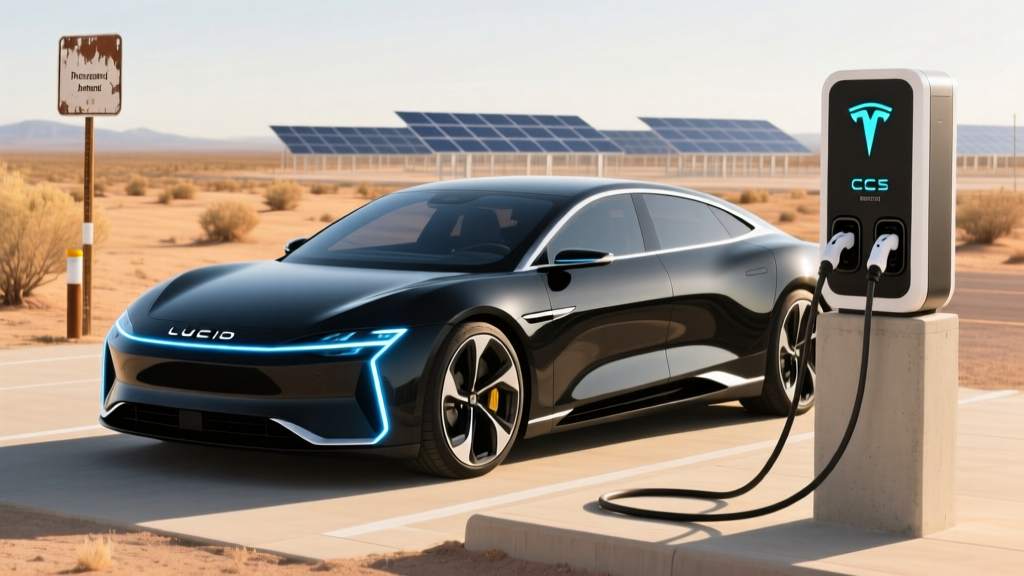
The Lucid Air remains one of the most range-rich electric sedans on the market heading into the 2026 model year, and its Arizona manufacturing roots are more relevant than ever as the city of Casa Grande in Pinal County navigates a significant lease land annexation that could reshape the economic landscape around Lucid's AMP-1 factory. For EV shoppers — particularly those in the Southwest weighing a luxury electric sedan — understanding both the vehicle's real-world capabilities and the local-policy environment around its production hub matters.
This review covers the 2026 Lucid Air lineup in full: EPA range versus real-world expectations, DC fast-charging speed and home charging, performance specs, pricing with federal tax credit context, and a closer look at what the Casa Grande Pinal County lease land annexation means for Lucid's operational footprint and potential buyer incentives in Arizona.
2026 Lucid Air at a Glance: Trim-by-Trim Specs
Lucid offers the Air across four primary trims for 2026. The Pure RWD anchors the lineup with a lower starting price, while the Grand Touring and Sapphire push into ultra-luxury and performance territory. Here is the full spec breakdown:
| Spec | Air Pure RWD | Air Touring AWD | Air Grand Touring AWD | Air Sapphire |
|---|---|---|---|---|
| EPA Range | 419 mi | 425 mi | 516 mi | 427 mi |
| Battery (usable kWh) | 88 kWh (NMC) | 112 kWh (NMC) | 112 kWh (NMC) | 118 kWh (NMC) |
| Horsepower | 430 hp | 620 hp | 819 hp | 1,234 hp |
| 0–60 mph | 5.0 sec | 3.4 sec | 3.0 sec | 1.89 sec |
| Drivetrain | RWD (single motor) | AWD (dual motor) | AWD (dual motor) | AWD (tri-motor) |
| Max DC Fast Charge | 220 kW | 300 kW | 300 kW | 300 kW |
| 10–80% DC Time | ~24 min | ~15 min | ~15 min | ~16 min |
| Level 2 Home Charge | 19.2 kW (92 mi/hr) | 19.2 kW (92 mi/hr) | 19.2 kW (92 mi/hr) | 19.2 kW (92 mi/hr) |
| MPGe (combined) | 146 MPGe | 131 MPGe | 131 MPGe | 110 MPGe |
| EPA Efficiency | 23 kWh/100mi | 26 kWh/100mi | 26 kWh/100mi | 31 kWh/100mi |
| Base MSRP | $71,490 | $87,490 | $127,490 | $250,500 |
| Battery Warranty | 8 yr / 100,000 mi | 8 yr / 100,000 mi | 8 yr / 100,000 mi | 8 yr / 100,000 mi |
Source: fueleconomy.gov and Lucid Motors official specifications. Real-world results may vary. All MSRP figures exclude $1,295 destination fee.
Real-World Range: What the EPA Sticker Doesn't Tell You
EPA sticker: 516 miles (Grand Touring AWD with 19" Aero wheels)
Real-world highway (70–75 mph, moderate temps): ~400–430 miles
Real-world cold weather (below 32°F, mixed driving): ~340–380 miles
City / stop-and-go (regen-friendly): ~460–500 miles
The Lucid Air Grand Touring's 516-mile EPA rating is the highest of any production EV sold in the U.S., and the sedan's efficiency — 26 kWh per 100 miles — is genuinely remarkable for a vehicle with over 800 horsepower. But EPA testing uses a specific drive-cycle blend that favors moderate-speed, warm-weather driving. On a sustained 75-mph highway run across I-10 from Phoenix to El Paso, expect roughly 400 to 430 miles before needing a charger, depending on wind, elevation changes, and HVAC load.
Cold weather is the Air's biggest range adversary. The NMC battery chemistry used across the lineup is energy-dense but more temperature-sensitive than LFP alternatives. In sub-freezing conditions, the battery management system draws energy to warm the pack, and cabin heating (even with the Air's standard heat pump) adds load. Plan for a 20–30% range reduction in sustained winter driving — consistent with industry-wide patterns for NMC packs.
The Pure RWD's 419-mile EPA figure is more conservative and, in my experience, easier to approach in mixed driving because the lighter single-motor configuration reduces rolling resistance and energy consumption. If you rarely drive in freezing weather and your commute is primarily highway, the Pure is arguably the more honest range-per-dollar pick.
Charging Speed: 300 kW Peak, but Mind the Curve
Charging is where the Lucid Air's 900-volt electrical architecture earns its keep. The Touring, Grand Touring, and Sapphire trims support up to 300 kW peak DC fast charging — among the highest rates available on any production EV in 2026. The Pure RWD peaks at 220 kW.
| Charging Level | Power / Rate | Miles of Range Added Per Hour | Notes |
|---|---|---|---|
| Level 1 (120V household) | ~1.4 kW | ~4–5 mi/hr | Emergency/trickle only; not practical for daily use |
| Level 2 (240V, 48A home charger) | 11.5 kW | ~55 mi/hr | Standard home install on a 60A circuit |
| Level 2 (240V, 80A / Lucid Connected Home) | 19.2 kW | ~92 mi/hr | Requires 100A circuit; overnight fill in ~6 hours (112 kWh pack) |
| DC Fast Charge (Touring/GT/Sapphire) | Up to 300 kW peak | ~300 mi in ~15 min (10–80%) | Requires 350 kW-class station; charge curve tapers sharply above 80% |
| DC Fast Charge (Pure RWD) | Up to 220 kW peak | ~200 mi in ~15 min (10–80%) | Slower peak but still competitive with CCS peers |
The headline number — 10% to 80% in approximately 15 minutes on the Grand Touring — assumes you're plugged into a 350 kW-capable DC fast charger like Electrify America's latest Hyperchargers or Tesla Supercharger V4 stalls equipped with a NACS adapter (Lucid provides a CCS-to-NACS adapter for Supercharger access). At a 150 kW station, expect 10–80% in roughly 25–30 minutes.
Charge-curve reality check: the Air's 300 kW peak is sustained from approximately 10% to 40% state of charge. From 40–60%, the rate tapers to around 200 kW, and above 80%, it drops below 50 kW as the battery management system protects the NMC cells. This is normal behavior — no lithium-ion pack sustains peak rate to full — but it means charging from 80–100% at a DC station is rarely worth the time. Plan your road-trip stops around the 10–80% sweet spot.
For home charging, the Air's onboard charger supports up to 19.2 kW on Level 2, which is best-in-class for a luxury sedan. A full overnight charge on a 19.2 kW home station adds roughly 92 miles of range per hour. Most owners will install a 48-amp (11.5 kW) wallbox on a standard 60-amp circuit, which still delivers 55 miles per hour — more than enough to replenish a day's driving overnight. Expect a home Level 2 installation to cost between $800 and $2,500 depending on panel capacity and run length, per the U.S. Department of Energy.
Performance and Driving Dynamics
The Lucid Air's performance credentials are well-documented, but the breadth across trims deserves emphasis. The base Pure RWD's 430 horsepower and 5.0-second 0–60 time already outpace most gas-powered luxury sedans in its price bracket. The Grand Touring's 819 hp and 3.0-second sprint put it in supercar territory while returning over 130 MPGe combined.
The Sapphire, with its tri-motor, 1,234-horsepower powertrain and 1.89-second 0–60, exists in a category of essentially one — it's the quickest production sedan ever produced. But at $250,500, it's a halo model, not a volume play.
Across all trims, the Air rides on a multi-link front and rear suspension with available air springs (standard on Grand Touring and Sapphire, optional on Touring). The ride quality is genuinely plush in Comfort mode, with well-damped body control that belies the car's 5,000+ pound curb weight. The steering is precise but light — this is a grand tourer, not a track car (Sapphire excepted).
Cargo, Passenger Space, and Interior Tech
The Air's interior dimensions reflect its full-size sedan positioning:
- Front legroom: 42.4 inches
- Rear legroom: 38.1 inches
- Trunk (rear): 22.1 cu ft
- Frunk (front trunk): 10.0 cu ft
- Total cargo: 32.1 cu ft
The 32.1 cubic feet of combined cargo space is generous for a sedan but falls short of crossover alternatives like the Tesla Model S (28 cu ft rear + hatch) or any mid-size electric SUV. If you regularly haul bulky items, the Air's traditional trunk opening is a limitation versus a hatchback or liftback design.
The interior centers on a 34-inch curved glass cockpit display that spans the driver's instrument cluster and infotainment in a single pane. A lower 17-inch retractable screen handles climate and secondary controls. The system runs Lucid's proprietary software — responsive, visually clean, and free of the subscription-gated features that plague some competitors. Wireless Apple CarPlay and Android Auto are standard. The available Surreal Sound Pro audio system (21 speakers) is among the best in any luxury vehicle.
Driver assistance comes via Lucid's DreamDrive Pro system, which uses a combination of cameras, radar, ultrasonic sensors, and LiDAR (on Grand Touring and Sapphire). DreamDrive Pro provides adaptive cruise control, lane centering, automated lane changes, and parking assist. This is an SAE Level 2 system — the driver must remain fully engaged and hands-on at all times. It is not self-driving, and Lucid does not market it as such.
DreamDrive Pro is an SAE Level 2 driver-assistance system. It requires continuous driver supervision. It will not navigate unmapped roads, handle all construction zones, or operate without driver input. Hands-off operation is not supported and is unsafe. Compare this to Lucid's planned future Level 3+ capabilities, which remain in development and are not available on any 2026 production vehicle.
Pricing, Tax Credits, and the Casa Grande Pinal County Lease Land Annexation Factor
| Trim | Base MSRP | Federal §30D Credit Eligibility | Est. Price After Credit (if eligible) |
|---|---|---|---|
| Air Pure RWD | $71,490 | Not eligible — exceeds $55,000 sedan MSRP cap | $71,490 |
| Air Touring AWD | $87,490 | Not eligible — exceeds $55,000 sedan MSRP cap | $87,490 |
| Air Grand Touring AWD | $127,490 | Not eligible — exceeds $55,000 sedan MSRP cap | $127,490 |
| Air Sapphire | $250,500 | Not eligible — exceeds $55,000 sedan MSRP cap | $250,500 |
Federal tax credit rules per IRS §30D: New clean vehicle credit requires a sedan MSRP at or below $55,000, buyer AGI within income caps ($150K single / $300K joint), and battery critical-mineral/sourcing thresholds. The Lucid Air, as a luxury sedan priced well above $55,000, does not qualify for the new-vehicle federal credit. A used Air may qualify for the up-to-$4,000 used EV credit (30% of sale price, max $4,000) if the used sale price is at or below $25,000 — unlikely for most model years currently on the secondary market. Always consult a tax professional for your specific situation.
What the Casa Grande Pinal County Lease Land Annexation Means for Lucid Buyers
If you've encountered search results or local news about the "Casa Grande Pinal County Lucid lease land annexation," here's the practical context. Lucid's AMP-1 manufacturing facility sits in Casa Grande, Arizona, within Pinal County. The factory, which began production in late 2021, was built on land with a complex mix of city, county, and state lease arrangements. In 2025–2026, Casa Grande initiated annexation proceedings to bring certain county-leased parcels — including land tied to Lucid's operations and surrounding infrastructure — into the city's formal jurisdiction.
Why this matters for EV buyers and the Lucid ecosystem:
- Municipal services and infrastructure: Annexation typically extends city water, sewer, road maintenance, and emergency services to previously unincorporated parcels. For Lucid's factory, this means more predictable utility infrastructure as the company scales production of both the Air and the upcoming Gravity SUV.
- Tax-incentive landscape: Arizona offers a state-level EV tax credit (up to $5,000 for new EV purchases, income-capped) and reduced vehicle license tax rates for alternative-fuel vehicles. Annexation into Casa Grande city limits may affect local property tax assessments on the facility but does not change the state EV incentives available to individual buyers.
- Production capacity signals: The annexation reflects Lucid's long-term commitment to the Casa Grande site. The factory has a stated capacity of up to 400,000 vehicles annually at full build-out. For buyers, this signals production stability — a concern given the company's early delivery challenges — and a growing local service/parts network in the Southwest.
- Arizona buyer proximity advantage: Arizona residents benefit from shorter delivery timelines (factory-direct logistics), a growing network of Lucid service centers in Phoenix and Tucson, and access to the state's robust solar-powered charging infrastructure.
The annexation itself is a municipal governance matter — it doesn't directly change the Air's price, specs, or availability. But it does underscore that Lucid is deepening its Arizona roots, which matters for long-term parts availability, service infrastructure, and the brand's staying power in the luxury EV segment.
Who Should Buy the Lucid Air — And Who Shouldn't
- Best-in-class EPA range (516 mi on Grand Touring)
- Outstanding efficiency: 23–26 kWh/100mi on most trims
- 300 kW peak DC charging with 900V architecture
- 19.2 kW Level 2 onboard charging (fastest in class)
- Spacious rear seat for a luxury sedan (38.1" legroom)
- LiDAR-equipped DreamDrive Pro (GT and Sapphire)
- Quiet, refined ride quality with available air suspension
- Arizona-built with growing Southwest service network
- No federal §30D tax credit (all trims exceed $55K MSRP cap)
- High starting price — Pure RWD at $71,490 before options
- Traditional trunk limits cargo versatility vs hatchback/SUV
- Limited service centers outside major metro areas
- DreamDrive Pro lags Tesla FSD and GM Super Cruise in hands-free miles
- Brand still young — long-term reliability data limited
- NMC battery more cold-sensitive than LFP alternatives
- Insurance premiums run 15–25% higher than comparable gas sedans
- Choose the Air Pure RWD if: You want maximum range-per-dollar in a luxury sedan, primarily drive in mild climates, and value efficiency over all-wheel-drive traction. At $71,490, it undercuts the Tesla Model S Long Range ($79,990) while delivering comparable range.
- Choose the Air Touring AWD if: You need dual-motor all-wheel drive for snow or rain, want the 300 kW charging capability, and can justify the $16,000 premium over the Pure for the extra 200 hp and larger battery.
- Choose the Air Grand Touring AWD if: You road-trip frequently and the 516-mile EPA range is a genuine quality-of-life benefit. This is the Air's sweet spot for long-distance luxury EV buyers who want to minimize charging stops.
- Look elsewhere if: You need cargo versatility (consider the Lucid Gravity SUV or Tesla Model X), require the federal $7,500 tax credit (look at the BMW i5, Tesla Model 3, or Hyundai Ioniq 6), or live far from a Lucid service center.
How the Air Stacks Up Against Key Competitors
The Lucid Air competes primarily with the Tesla Model S, BMW i5/i7, Mercedes-Benz EQS, and Porsche Taycan in the luxury electric sedan segment. Here's how the core metrics compare:
- Range leader: Lucid Air Grand Touring (516 mi) vs. Tesla Model S Long Range (402 mi) vs. BMW i5 eDrive40 (295 mi) vs. Mercedes EQS 450+ (390 mi)
- Charging speed leader: Lucid Air (300 kW peak) ties with Porsche Taycan (up to 320 kW on 2025+ models with updated pack) and exceeds the Model S (~250 kW)
- Price-to-range leader: Lucid Air Pure ($71,490 / 419 mi = ~$170 per EPA mile of range) — though the BMW i5 eDrive40 at $67,795 / 295 mi is cheaper overall if 295 miles is sufficient
- Service network leader: Tesla (by a wide margin) — Lucid's service footprint is growing but remains limited to roughly 20+ centers nationwide
The Air wins on range and efficiency. It loses on service accessibility and brand maturity. If you live in Phoenix, Los Angeles, or Miami — where Lucid has established service centers — the ownership experience is smooth. If you're in rural Montana or upstate New York, service logistics could be a friction point.
Frequently Asked Questions
What is the real-world range of the Lucid Air?
The EPA rates the Grand Touring at 516 miles, but real-world highway driving at 70–75 mph yields approximately 400–430 miles. In cold weather (below freezing), expect 340–380 miles. The Pure RWD's 419-mile EPA rating translates to roughly 350–380 miles on the highway and 300–340 miles in winter conditions. City driving with regenerative braking can approach or slightly exceed EPA figures.
How fast does the Lucid Air charge at home and on the road?
On a 350 kW DC fast charger, the Touring, Grand Touring, and Sapphire can add roughly 300 miles in about 15 minutes (10–80% SoC). The Pure peaks at 220 kW, taking roughly 24 minutes for 10–80%. At home on a 19.2 kW Level 2 station, all trims gain approximately 92 miles of range per hour, fully recharging overnight. On a standard 48-amp (11.5 kW) home charger, expect 55 miles per hour.
Does the Lucid Air qualify for the federal EV tax credit?
No. Under current IRS §30D rules, new sedans must have an MSRP at or below $55,000 to qualify. Every Lucid Air trim exceeds this cap. The buyer income caps ($150K single / $300K joint) and battery-sourcing requirements would also need to be met even if the MSRP threshold were satisfied. A used Air may qualify for the up-to-$4,000 used-vehicle credit if the sale price is at or below $25,000, but current resale values make this unlikely for most examples. Always verify with a tax professional.
What does the Casa Grande Pinal County Lucid lease land annexation mean for buyers?
The annexation brings Lucid's AMP-1 factory parcels and surrounding land into Casa Grande city jurisdiction, improving municipal services and signaling long-term production commitment. For buyers, the main impact is indirect: stronger service infrastructure in the Southwest, more stable production capacity, and continued access to Arizona's state-level EV incentives (up to $5,000 state tax credit, subject to income caps and annual limits). It does not change the Air's MSRP, specs, or federal tax credit eligibility.
Is the Lucid Air worth buying over a Tesla Model S?
If range, ride refinement, and interior luxury are your top priorities, the Air Grand Touring delivers a more comfortable, longer-range experience than the Model S. If you prioritize Supercharger network access (though Lucid now has NACS adapter access), over-the-air feature updates, and a broader service network, Tesla still has infrastructure advantages. The Air is the better luxury sedan; the Model S is the safer bet for service accessibility and brand longevity.
What is the Lucid Air's battery warranty?
Lucid covers the battery pack and electric powertrain for 8 years or 100,000 miles, whichever comes first. The warranty guarantees the battery will retain a minimum of 70% of its original capacity during the coverage period. This aligns with the industry standard set by most EV manufacturers and matches the NHTSA-recognized baseline for EV battery warranties. The basic vehicle warranty is 4 years / 50,000 miles.