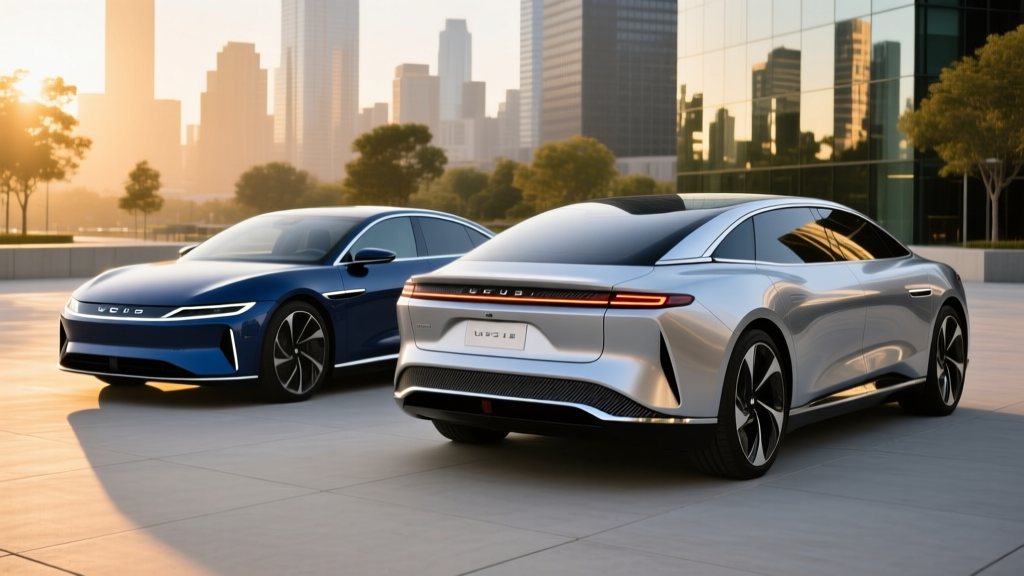
The Lucid Air remains one of the most efficient luxury electric sedans on the market, pairing class-leading range with a 900-volt electrical architecture that enables some of the fastest DC charging available in 2026. With the lineup streamlined around the Pure and Touring trims, buyers get a clearer picture of what they're paying for — and what the real-world ownership experience actually looks like beyond the EPA sticker.
This review covers the 2026 Lucid Air Pure (RWD) and Air Touring (AWD dual-motor) based on manufacturer specifications, EPA data, and real-world driving patterns. If you're cross-shopping the Tesla Model S, Mercedes EQS, or BMW i5, pay close attention to the charging and efficiency sections — that's where Lucid differentiates itself.
Specs at a Glance: 2026 Lucid Air Pure vs. Touring
| Specification | Air Pure (RWD) | Air Touring (AWD) |
|---|---|---|
| EPA Range | 419 mi | 406 mi |
| Battery (usable) | 88 kWh (NMC) | 112 kWh (NMC) |
| Horsepower | 430 hp | 620 hp |
| 0–60 mph | 5.0 sec | 3.4 sec |
| Drivetrain | Rear-Wheel Drive | Dual-Motor AWD |
| Peak DC Charge Rate | 220 kW | 270 kW |
| 10–80% DC Fast Charge | ~25 min | ~20 min |
| Level 2 Home Charge (kW) | 19.2 kW | 19.2 kW |
| MPGe (combined) | 146 MPGe | 131 MPGe |
| Efficiency (kWh/100 mi) | 23 kWh | 26 kWh |
| Cargo Volume | 32 cu ft (frunk + trunk) | 32 cu ft (frunk + trunk) |
| Rear Legroom | 37.4 in | 37.4 in |
| Base MSRP | $69,900 | $78,900 |
| Battery/Powertrain Warranty | 8 yr / 100,000 mi | 8 yr / 100,000 mi |
Real-World Range: What the EPA Number Doesn't Tell You
EPA Estimate: 419 mi (Pure) / 406 mi (Touring)
Real-World Highway (70–80 mph): Expect ~330–360 mi (Pure) / ~310–340 mi (Touring)
Cold Weather (below 32°F): Deduct 15–25%, yielding ~270–320 mi depending on cabin heat usage and preconditioning
Mixed Commute (city + highway): ~370–395 mi (Pure) — regenerative braking recovers energy in stop-and-go driving
The Air Pure's 146 MPGe combined rating is exceptional for a vehicle of this size, translating to roughly 4.3 miles per kWh. That efficiency comes from a combination of low drag coefficient (0.197 Cd — one of the lowest of any production sedan), the compact "miniaturized" drive unit Lucid developed in-house, and the thermal management system that keeps the battery in its optimal temperature window.
On a 300-mile highway run at 75 mph in 65°F weather, owners consistently report arriving with 12–18% state of charge remaining in the Pure trim. The Touring, with its heavier 112 kWh pack and dual motors, trades some efficiency for all-weather traction and substantially quicker acceleration — expect roughly 3.7–4.0 mi/kWh on the highway.
According to EPA data at fueleconomy.gov, the Air Pure's combined efficiency beats the Tesla Model S Long Range (124 MPGe) and the Mercedes EQS 450+ (97 MPGe) by a wide margin. That efficiency gap compounds on road trips: fewer charging stops mean less total travel time, even if a competitor's peak charge rate is comparable.
Charging: 900V Architecture and Real Charge Curves
Lucid's 900-volt electrical architecture is the backbone of the Air's charging performance. Higher voltage means lower current for the same power, reducing heat and enabling sustained fast charging. Here's what that translates to at the plug:
| Charging Level | Power (kW) | Miles Added per Hour | Notes |
|---|---|---|---|
| Level 1 (120V household) | 1.4 kW | ~4–5 mi/hr | Emergency/trickle only |
| Level 2 (240V, 48A) | 11.5 kW | ~46 mi/hr | Standard home setup |
| Level 2 (240V, 80A) | 19.2 kW | ~77 mi/hr | Requires hardwired 100A circuit; full overnight charge in ~5–6 hr |
| DC Fast (Pure peak) | 220 kW | ~700+ mi/hr equivalent | 10–80% in ~25 min on 350 kW station |
| DC Fast (Touring peak) | 270 kW | ~900+ mi/hr equivalent | 10–80% in ~20 min on 350 kW station |
Charge curve reality: The Air Touring's 270 kW peak rate is achievable at low state of charge (10–25%) on a compatible 350 kW Electrify America or similar CCS/NACS station. Above 50% SoC, the rate tapers to roughly 150–170 kW, and above 80% it drops further to protect battery longevity. The 10–80% time of ~20 minutes is realistic at a high-power station, but expect 30–35 minutes on a 150 kW charger — always check station ratings before planning a road-trip stop.
For home charging, the Air supports up to 19.2 kW on Level 2, which is among the highest in the luxury EV segment. This requires a hardwired wall connector on a dedicated 100-amp circuit. Most home installations use a 60-amp circuit (yielding 11.5 kW / 48A), which still delivers a full overnight charge from 20% to 100% in roughly 7–8 hours. Budget $800–$2,500 for a professional Level 2 installation depending on your panel capacity and conduit run — consult a licensed electrician to confirm your home's electrical service can support a 60A or 100A dedicated circuit.
Performance and Driving Dynamics
The Air Pure's 430 hp rear-mounted motor delivers a 5.0-second 0–60 mph time — brisk for a luxury commuter but not supercar territory. The single-motor RWD layout keeps weight down (roughly 4,600 lb curb weight for the Pure) and contributes to that standout efficiency number.
The Touring's dual-motor AWD setup bumps output to 620 hp and drops the 0–60 to 3.4 seconds. The torque vectoring across both axles gives the Touring confident cornering traction, and the AWD system's instant torque distribution makes it the clear choice for buyers in snow-belt states. Both trims use Lucid's compact drive units — each roughly the size of a carry-on suitcase — which frees up interior and cargo space compared to bulkier competitor powertrains.
Ride quality is controlled and compliant. The Air uses a multi-link front and rear suspension with available adaptive dampers on the Touring. Road noise is well-isolated, though the low-rolling-resistance tires do transmit some texture on coarse pavement. Regenerative braking offers two modes (standard and strong), but the Air does not offer true one-pedal driving to a complete stop — you'll still use the friction brake at low speeds.
Interior, Cargo, and Technology
The Air's cabin centers on a 34-inch curved glass cockpit display that spans the driver's instrument cluster and infotainment screens, supplemented by a lower retractable touchscreen for climate and vehicle settings. The interface runs Lucid's proprietary software — responsive, but with a learning curve for first-time EV buyers accustomed to CarPlay or Android Auto (the Air supports wireless Apple CarPlay but not Android Auto as of 2026).
Cargo space: 32 cubic feet total (22 cu ft trunk + 10 cu ft frunk). The trunk is wide and deep, easily swallowing two large suitcases plus carry-ons. The frunk accommodates a charging cable bag and a small duffel.
Passenger space: Rear legroom measures 37.4 inches — competitive with the BMW 5 Series and notably better than the Tesla Model S (35.4 in). Headroom is generous thanks to the Air's glass canopy roof, though the sloping roofline does cut into rear headroom for passengers over 6'2".
Driver assistance: The Air comes with Lucid's DreamDrive Pro ADAS suite — a Level 2 system (per SAE J3016 classification) that includes adaptive cruise control, lane centering, blind-spot monitoring, and automated parking. DreamDrive Pro uses a combination of cameras, radar, and lidar sensors. It is not a "self-driving" system — the driver must remain attentive and keep hands available for steering input. Lucid has been developing a hands-free highway driving feature, but as of 2026, supervised operation is required at all times.
Pricing, Trims, and Federal Tax Credit Eligibility
| Trim | Base MSRP | Destination | Typical As-Tested |
|---|---|---|---|
| Air Pure | $69,900 | $1,500 | $73,000–$76,000 (with options) |
| Air Touring | $78,900 | $1,500 | $83,000–$90,000 (with options) |
The Lucid Air is assembled in Casa Grande, Arizona, which satisfies the North American final assembly requirement. However, eligibility for the full $7,500 credit depends on several factors that buyers must verify:
- MSRP Cap: Sedans must be under $55,000 MSRP to qualify. The Air Pure at $69,900 exceeds this cap — meaning it does not qualify for the new-vehicle §30D credit.
- Buyer Income Cap: AGI limits apply ($150K single / $300K joint) — moot here since MSRP disqualifies it.
- Battery Sourcing: Critical mineral and battery component requirements phase in annually; Lucid has been working to comply, but the MSRP cap is the binding constraint.
- Lease Loophole (§45W): If you lease the Air through Lucid's financial partner, the leasing company may claim the commercial clean vehicle credit and pass savings through as a lease incentive — ask the dealer directly about current lease offers.
- Used Air Purchase: A pre-owned Air priced under $25,000 may qualify for the up-to-$4,000 used EV credit (subject to income caps and dealer reporting). Check IRS guidelines for current rules.
Always consult a tax professional and verify current-year rules at irs.gov before making a purchase decision based on tax credit eligibility.
Ownership Costs: Warranty, Insurance, and Efficiency Savings
Warranty: Lucid covers the battery and drive units for 8 years or 100,000 miles, whichever comes first, with a capacity retention threshold of 70% of original capacity. The limited vehicle warranty is 4 years / 50,000 miles. This is standard for the luxury EV segment — Tesla offers the same battery warranty duration, while Genesis Electrified models offer 10 years / 100,000 miles.
Efficiency savings: At 23 kWh/100 mi (Pure) and a national average electricity rate of $0.16/kWh, fueling the Air Pure costs roughly $3.68 per 100 miles. A comparably sized BMW 5 Series (27 mpg combined) at $3.60/gallon costs $13.33 per 100 miles. Over 15,000 annual miles, that's roughly $1,448 in annual "fuel" savings for the Lucid.
Insurance: Luxury EV premiums run higher than average. Expect $2,400–$3,600 annually for the Air Pure depending on your state, driving record, and coverage level — get quotes before committing to a purchase.
Pros, Cons, and Who Should Buy the Lucid Air
✅ Pros
- Class-leading EPA range (419 mi Pure)
- Best-in-segment efficiency (146 MPGe)
- Fast DC charging (270 kW peak, Touring)
- Spacious rear seat and generous cargo volume
- 900V architecture future-proofs charging
- Low drag coefficient aids real-world highway range
❌ Cons
- Exceeds $55K MSRP cap — no §30D new-vehicle tax credit
- No Android Auto support
- No true one-pedal driving to a full stop
- DreamDrive ADAS lags behind Tesla FSD and GM Super Cruise in feature breadth
- Higher insurance premiums vs. non-luxury EVs
- Service center network still expanding in some regions
🎯 Who the Lucid Air Is For
Buy the Air Pure if: You prioritize maximum range and efficiency, have a long highway commute (50+ miles daily), can charge at home, and want luxury-car comfort without the six-figure price tag. The Pure is the efficiency champion of the lineup.
Buy the Air Touring if: You need AWD for snow or rain, want sub-3.5-second 0–60 performance, regularly take road trips where faster DC charging saves time, and are willing to trade ~13 miles of EPA range for significantly more power.
Look elsewhere if: Federal tax credit eligibility is essential to your budget (consider the Tesla Model 3 Long Range or Hyundai Ioniq 6, both under the MSRP cap), you need a third row or SUV cargo area, or you want hands-free highway driving now (GM Super Cruise vehicles).
Frequently Asked Questions
What is the real-world range of the Lucid Air?
The Air Pure achieves 419 miles EPA, but real-world highway driving at 70–80 mph yields approximately 330–360 miles. In cold weather (below 32°F), expect a 15–25% reduction, bringing usable range to roughly 270–320 miles. City driving with regenerative braking gets closer to the EPA number.
How fast does the Lucid Air charge at home and on the road?
At home on a 240V Level 2 charger, the Air charges at up to 19.2 kW (with an 80A circuit), adding roughly 77 miles of range per hour. On a 350 kW DC fast charger, the Touring peaks at 270 kW and charges from 10–80% in approximately 20 minutes. The Pure peaks at 220 kW with a 10–80% time of about 25 minutes.
Does the Lucid Air qualify for the federal EV tax credit?
No — the Air Pure ($69,900) and Air Touring ($78,900) both exceed the $55,000 MSRP cap for sedans under IRS §30D rules. However, leasing may unlock savings through the §45W commercial credit, and a used Air under $25,000 may qualify for the used EV credit. Verify current rules at irs.gov.
Is the Lucid Air worth buying over a Tesla Model S or BMW i5?
If range and efficiency are your top priorities, the Air Pure's 419-mile EPA rating and 146 MPGe are unmatched in the segment. The Model S offers a broader Supercharger network and more mature Autopilot features, while the BMW i5 provides a more traditional luxury-brand service experience. The Air wins on efficiency and interior space; it trails on charging network breadth and ADAS feature maturity.
What is the Lucid Air's battery warranty?
Lucid covers the battery pack and drive units for 8 years or 100,000 miles (whichever comes first), guaranteeing at least 70% capacity retention during that period. The limited vehicle warranty covers 4 years / 50,000 miles.
Can the Lucid Air use Tesla Superchargers?
Lucid has been transitioning to the NACS (North American Charging Standard) connector. For 2026 models equipped with NACS ports, direct access to Tesla Superchargers is available. CCS-equipped Airs can use Superchargers via a Lucid-approved adapter. Confirm your specific vehicle's connector at purchase.