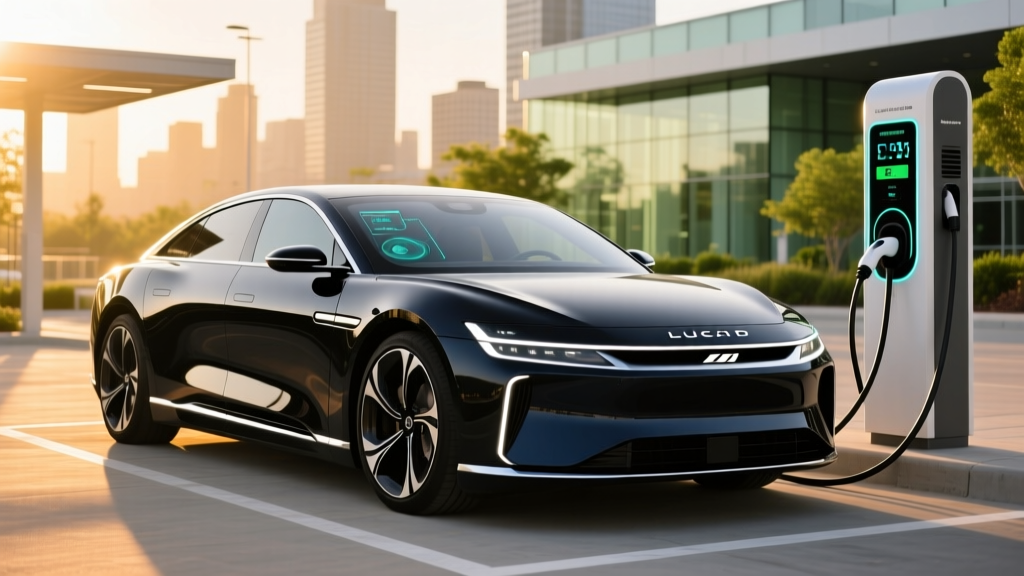
When luxury EV shoppers start researching the Lucid Air, the sticker shock is real. With MSRPs stretching well past six figures for top trims, many buyers pivot to a different strategy: Lucid leasing. Leasing a Lucid Air in 2026 can dramatically lower the monthly barrier to one of the most efficient, longest-range electric sedans on the market — but it also introduces complexity around tax credits, mileage limits, and residual values that most buyers don't anticipate.
This review breaks down the 2026 Lucid Air lineup with a specific lens on lease economics. We'll cover the real-world range you can actually expect, charging performance from DC fast chargers to your home Level 2 setup, the IRS §30D federal tax credit and how it works in a lease, and whether the Air's technology and ownership experience justify the commitment.
2026 Lucid Air Lineup: Trims, Pricing, and Lease Positioning
Lucid offers the Air in four primary trims for 2026. Pricing has shifted modestly as the company responds to competitive pressure from the Tesla Model S, Porsche Taycan, and Mercedes-Benz EQS. Here's where each trim lands before incentives or lease adjustments:
| Trim | Drivetrain | HP | EPA Range | Base MSRP |
|---|---|---|---|---|
| Air Pure | RWD (single motor) | 430 hp | 419 mi | $69,900 |
| Air Touring | AWD (dual motor) | 620 hp | 406 mi | $87,400 |
| Air Grand Touring | AWD (dual motor) | 1,050 hp | 516 mi | $125,600 |
| Air Sapphire | AWD (tri-motor) | 1,234 hp | 427 mi | $249,000 |
The Air Pure and Air Touring are the lease-volume trims. They're the models you'll most commonly see in Lucid's promotional lease offers, and they're the ones where the federal tax credit economics work most favorably. The Grand Touring and Sapphire push past the IRS MSRP cap for sedans, which affects how the §30D credit applies — more on that below.
Real-World Range: What the EPA Sticker Doesn't Tell You
The Lucid Air Grand Touring's EPA-estimated 516 miles remains the highest of any production EV sold in the U.S. But EPA range is tested under controlled conditions that don't fully replicate highway cruising at 75+ mph, cold-weather driving, or aggressive acceleration.
Air Pure (EPA 419 mi): Expect ~350–380 mi on highway road trips at 70–75 mph. In freezing temperatures (below 32°F), plan for 290–330 mi. City driving with regen braking gets you closest to the EPA number, sometimes exceeding 400 mi.
Air Grand Touring (EPA 516 mi): Highway driving at 75 mph yields roughly 400–440 mi in moderate temperatures. Cold weather (20°F and below) drops that to approximately 340–380 mi. The Air GT's heat pump helps, but physics still applies — battery chemistry slows in the cold.
Air Sapphire (EPA 427 mi): With tri-motor performance tuning and stickier tires, expect ~340–370 mi highway. This is a performance sedan first; range is secondary.
Lucid's efficiency advantage comes from its proprietary miniaturized drive units and a 900-volt electrical architecture that reduces energy loss. The Air Pure achieves roughly 146 MPGe combined (per fueleconomy.gov), translating to about 23 kWh per 100 miles — among the best of any luxury EV. The Grand Touring sits at around 131 MPGe combined, or roughly 26 kWh/100 mi, still exceptional for a 1,050-hp sedan.
Battery Chemistry, Capacity, and Long-Term Degradation
The Air Pure and Touring use an 88 kWh usable battery pack (NMC — nickel manganese cobalt chemistry). The Grand Touring and Sapphire step up to a 112 kWh usable pack, also NMC. Lucid does not currently offer an LFP (lithium iron phosphate) option in the Air lineup.
NMC packs deliver higher energy density — critical for hitting 500+ mile range targets in a sedan footprint — but they carry slightly different care requirements than LFP. Lucid recommends keeping daily charging to 80–90% State of Charge (SoC) and only charging to 100% before long road trips. The battery management system (BMS) includes a top and bottom buffer to protect against over-charge and deep-discharge degradation.
Warranty coverage: Lucid provides an 8-year/100,000-mile battery and powertrain warranty, with a capacity retention threshold of 70% over that period. This aligns with industry norms from Tesla, BMW, and Mercedes, though some competitors (Hyundai/Kia at 10yr/100k) offer longer coverage.
Charging Performance: DC Fast Charging and Home Level 2
Charging speed is where the Air's 900V architecture pays dividends. Most 400V EVs peak around 150–250 kW on DC fast chargers and taper quickly. The Air Grand Touring can sustain higher rates for longer, though real-world curves still taper significantly above 80% SoC.
| Charging Level | Power / Rate | Speed / Notes |
|---|---|---|
| Level 1 (120V household) | ~1.4 kW | ~3–4 mi/hr — emergency/trickle only |
| Level 2 (240V home, 48A) | 11.5 kW | ~35–40 mi/hr — full charge overnight (~10–12 hrs for GT) |
| Level 2 (240V home, 80A) | 19.2 kW | ~60–65 mi/hr — fastest home option (~7–8 hrs for GT) |
| DC Fast Charge (peak) | Up to 300 kW (GT) | 10–80% in ~20 min on a 350 kW charger; Pure/Touring peak ~220 kW, 10–80% in ~25 min |
Important context on charge curves: The Air GT's 300 kW peak rate is only sustained between roughly 10–40% SoC on a compatible 350 kW CCS or NACS station. Above 50%, the rate tapers to ~150 kW, and above 80% it drops below 50 kW. This is normal for all lithium-ion packs — charging the final 20% takes nearly as long as the first 60%. For road trips, plan your stops around 10–80% charges to minimize time at the plug.
The Air uses the NACS (Tesla-style) connector as of the 2025 model year refresh, giving it native access to Tesla Superchargers (V3 and V4) without an adapter. This is a significant practical advantage for road-trip charging infrastructure.
Federal Tax Credit, Lease Economics, and Total Cost
This is where Lucid leasing gets nuanced. Under the IRS §30D rules for 2026, the federal EV tax credit offers up to $7,500 — but eligibility depends on several factors that change based on whether you buy or lease:
- MSRP cap: Sedans must be priced at or below $55,000 — this eliminates every Air trim from qualifying on purchase.
- Buyer income cap: AGI ≤ $150,000 (single), $225,000 (head of household), $300,000 (joint).
- Battery sourcing: Critical minerals and battery components must meet phased-in domestic/free-trade sourcing thresholds.
- Point-of-sale transfer: Eligible buyers can apply the credit as a down-payment reduction at the dealer.
Because every 2026 Lucid Air trim exceeds the $55,000 sedan MSRP cap, no Air qualifies for the §30D purchase credit. However, leased vehicles fall under a different provision — IRC §45W (the commercial clean vehicle credit). In a lease, the leasing company (the legal owner) claims the credit and can pass it through as a lease cash incentive, reducing your monthly payment or capitalized cost. This "lease loophole" is how many luxury EV buyers access the $7,500 benefit.
| Trim | MSRP | Est. Lease Cash (if passed through) | Effective Cap Cost | Est. Monthly (36-mo, 10K mi/yr, $0 down)* |
|---|---|---|---|---|
| Air Pure | $69,900 | Up to $7,500 | ~$62,400 | ~$850–$950 |
| Air Touring | $87,400 | Up to $7,500 | ~$79,900 | ~$1,100–$1,250 |
| Air Grand Touring | $125,600 | Up to $7,500 | ~$118,100 | ~$1,600–$1,850 |
*Estimates based on typical money factors and residuals published by lease aggregators in early 2026. Actual payments depend on credit tier, state taxes, dealer fees, and negotiated cap cost. Always confirm lease cash availability with the dealer — Lucid is not obligated to pass the full credit through.
Performance, Tech, and Daily Ownership
The Air's performance credentials are serious. The Pure does 0–60 mph in 3.8 seconds, the Touring in 3.4 seconds, and the Grand Touring in an astonishing 3.0 seconds. The Sapphire hits 60 in 1.89 seconds — hypercar territory from a four-door sedan.
Inside, the cabin is minimalist in a way that divides opinion. The 34-inch curved glass cockpit display spans the dash, with a retractable lower touchscreen for climate and secondary controls. Wireless Apple CarPlay and Android Auto are standard. The available DreamDrive Pro ADAS suite includes adaptive cruise, lane-centering, and automatic emergency braking — this is SAE Level 2 driver assistance, meaning you must keep hands on the wheel and eyes on the road at all times. It is not autonomous driving.
Cargo space: The Air offers 32.0 cu ft of trunk volume (including the rear sub-trunk) plus a 7.1 cu ft frunk. Rear legroom measures 36.6 inches — adequate for adults but tighter than a Mercedes EQS. The glass canopy roof creates an airy cabin feel but reduces rear headroom for taller passengers.
Lucid Air vs. Key Competitors: Should You Lease the Air?
The Air competes against the Tesla Model S, Porsche Taycan, BMW i7, and Mercedes EQS in the luxury EV sedan segment. Here's how the lease decision breaks down:
- Maximum range is your top priority — nothing else touches 516 EPA miles.
- You value efficiency (kWh/100 mi) and want the lowest charging cost per mile in the segment.
- You prefer NACS native Supercharger access without carrying an adapter.
- You want a sedan, not a crossover, and appreciate the Air's driving dynamics.
- You need maximum rear-seat space and trunk volume (BMW i7, EQS are larger).
- You want a more established dealer/service network (Tesla, BMW, Mercedes).
- You prioritize sporty handling over efficiency (Porsche Taycan).
- You want an LFP battery option for daily 100% charging tolerance (Tesla Model S).
- Class-leading EPA range (516 mi GT) and real-world efficiency
- Limited service center network compared to legacy luxury brands
- No LFP battery option — requires 80–90% daily SoC management
- Rear headroom and trunk space trail BMW i7 and EQS
- DreamDrive Pro is competent but not class-leading vs. GM Super Cruise
- Lease residuals uncertain — long-term depreciation data still limited
Who Should Lease the Lucid Air in 2026?
The Lucid Air lease makes the most sense for tech-forward commuters and road-trippers who drive 8,000–12,000 miles per year and have access to home Level 2 charging. The Air's efficiency means your home electricity cost per mile is among the lowest in the luxury segment — roughly $0.04–$0.06 per mile depending on your utility rate, compared to $0.12–$0.18/mi for a comparable gas sedan.
If you drive more than 12,000 miles annually, watch the lease mileage cap carefully. Most Lucid leases default to 10,000 miles/year; bumping to 12K or 15K adds $50–$120/month. Excess mileage penalties at lease-end typically run $0.25–$0.30 per mile, which erases the monthly savings quickly.
For families needing maximum cargo space or easy car-seat access, a luxury EV SUV (Tesla Model X, BMW iX, Rivian R1S) may be more practical. The Air is a driver's sedan first — it excels at long-distance comfort, rapid charging on road trips, and daily efficiency, but it's not a people-hauler.
Frequently Asked Questions
Does the Lucid Air qualify for the $7,500 federal EV tax credit?
Not on a purchase — every Air trim exceeds the $55,000 sedan MSRP cap under IRS §30D. However, when leased, the leasing company can claim the commercial clean vehicle credit (§45W) and pass up to $7,500 through as lease cash, reducing your effective cost. Confirm with your Lucid dealer that lease cash is available and applied to your deal.
What is the real-world range of the Lucid Air Grand Touring?
The EPA rates the GT at 516 miles. In real-world highway driving at 70–75 mph in moderate temperatures, expect roughly 400–440 miles. In sub-freezing conditions, plan for 340–380 miles. City driving with regenerative braking can approach or occasionally exceed the EPA number.
How fast does the Lucid Air charge at home and on the road?
At home on a 48-amp Level 2 charger (240V), the Air adds roughly 35–40 miles of range per hour, or about 60–65 mi/hr on an 80-amp circuit. On a 350 kW DC fast charger, the Grand Touring peaks at 300 kW and can go from 10–80% in approximately 20 minutes. The Pure and Touring peak around 220 kW with 10–80% times of roughly 25 minutes.
Is it better to lease or buy a Lucid Air?
For most buyers, leasing is the stronger financial move in 2026. The lease loophole unlocks up to $7,500 in credit that purchase buyers can't access due to the MSRP cap. Leasing also shields you from uncertain long-term depreciation on a relatively new brand. If you plan to keep the car 7+ years and drive very low miles, buying could make sense — but the tax-credit disadvantage is significant.
What are the biggest drawbacks of the Lucid Air?
The primary concerns are Lucid's still-growing service network (fewer centers than Tesla or legacy luxury brands), the lack of an LFP battery option, and uncertain long-term resale values. The DreamDrive Pro driver-assist system works well but doesn't match the hands-free capability of GM's Super Cruise on supported highways. Rear-seat headroom is also modest for the class.
Can I charge a Lucid Air at Tesla Superchargers?
Yes. Since the 2025 model year, the Air uses the NACS connector natively, meaning you can plug directly into Tesla V3 and V4 Superchargers without an adapter. This provides access to the most reliable DC fast-charging network in North America.