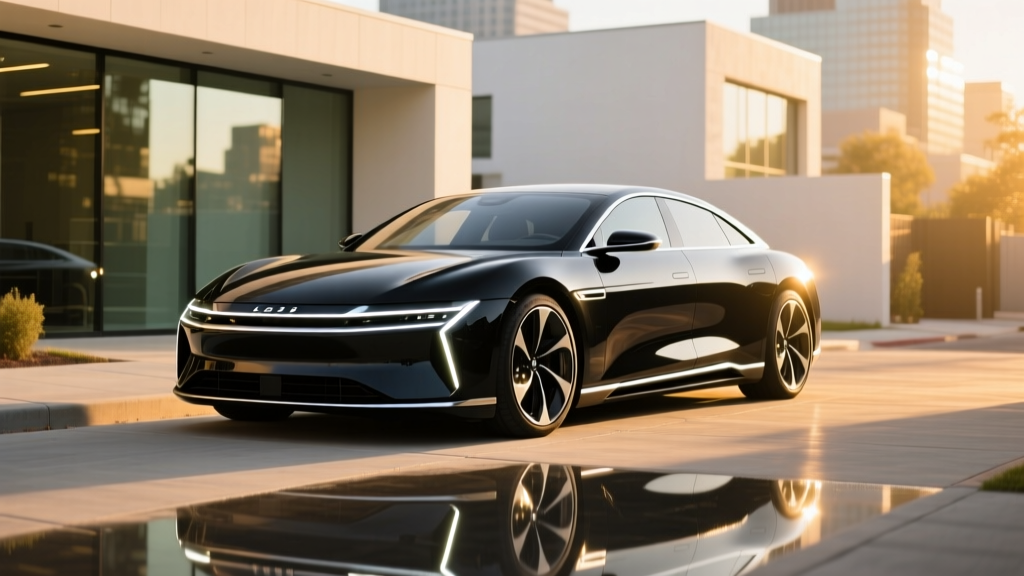
The Lucid Air occupies a rare position in the EV market: a luxury sedan that routinely outperforms its own EPA range estimates while offering some of the fastest charging speeds available on any production vehicle. For 2026, Lucid has streamlined the Air lineup and adjusted pricing to stay competitive against the Tesla Model S, Mercedes-Benz EQS, and Porsche Taycan. But with a base MSRP pushing into six figures, many shoppers are exploring Lucid Air lease offers as a way to access this technology without the long-term depreciation risk of a luxury EV.
This review breaks down the 2026 Lucid Air lineup — from the entry-level Pure to the performance-oriented Grand Touring — with exact specs, real-world range observations, charging data, and a hard look at whether leasing or buying makes more financial sense under current IRS §30D tax credit rules.
2026 Lucid Air Lineup at a Glance
Lucid offers the Air in three primary trims for 2026. Each uses variations of Lucid's proprietary miniaturized electric drive units and shares the same 900V+ electrical architecture that enables class-leading DC fast-charge speeds.
| Spec | Air Pure | Air Touring | Air Grand Touring |
|---|---|---|---|
| EPA Range | 419 mi | 425 mi | 516 mi |
| Battery (usable) | 88 kWh (NMC) | 112 kWh (NMC) | 112 kWh (NMC) |
| Drivetrain | RWD (single motor) | AWD (dual motor) | AWD (dual motor) |
| Horsepower | 430 hp | 620 hp | 819 hp |
| 0–60 mph | 5.0 sec | 3.4 sec | 3.0 sec |
| Max DC Charge Rate | 200+ kW | 300+ kW | 300+ kW |
| 10–80% DCFC Time | ~25 min | ~20 min | ~20 min |
| Level 2 Rate | 19.2 kW (~75 mi/hr) | 19.2 kW (~75 mi/hr) | 19.2 kW (~75 mi/hr) |
| Efficiency (MPGe) | 146 MPGe combined | 131 MPGe combined | 131 MPGe combined |
| Base MSRP | $69,900 | $87,400 | $125,600 |
All trims use nickel-manganese-cobalt (NMC) lithium-ion cells. Lucid has not adopted LFP (lithium iron phosphate) chemistry in the Air, prioritizing energy density over the cost and cycle-life advantages that LFP offers in lower-range vehicles. This matters for long-term degradation expectations — more on that below.
Real-World Range: What the EPA Sticker Doesn't Tell You
EPA estimated range: 516 miles (112 kWh battery, AWD). Real-world expectation: ~430–460 miles on mixed highway driving at 70–75 mph; ~370–400 miles in cold weather (below 32°F) with cabin heating active. The Air Pure's 419-mile EPA figure translates to roughly 350–380 miles in real-world highway conditions.
Lucid has earned a reputation for exceeding EPA estimates in ideal conditions — some independent testers have squeezed over 500 miles from the Grand Touring in moderate temperatures at city speeds. But highway driving at sustained 75+ mph, headwinds, elevation changes, and winter temperatures all erode range significantly. According to fueleconomy.gov, the Grand Touring achieves 131 MPGe combined, which equates to roughly 26 kWh per 100 miles — impressive for an 819-hp luxury sedan, but still meaning you'll consume about 30 kWh on a 115-mile highway stretch.
The Air's efficiency advantage comes from Lucid's miniaturized drive units, which weigh under 70 lbs each and achieve over 90% energy conversion efficiency. Combined with a drag coefficient of 0.197 — among the lowest of any production sedan — the Air converts battery capacity into miles more effectively than nearly any competitor.
Charging Speed: 900V Architecture in Practice
The Air's 900V+ electrical architecture is its most technically impressive feature. Where most EVs use 400V systems (limiting peak charge rates), the Air can accept over 300 kW at a compatible DC fast charger — provided the battery is preconditioned and the state of charge is low enough.
| Charging Level | Power (kW) | Miles Added per Hour | Notes |
|---|---|---|---|
| Level 1 (120V, 12A) | ~1.4 kW | ~4 mi/hr | Emergency/trickle only |
| Level 2 (240V, 80A) | 19.2 kW | ~75 mi/hr | Requires hardwired Wall Connector or equivalent; full overnight charge in ~6 hr |
| DC Fast Charge (peak) | 300+ kW | ~200 mi in 15 min | Requires 350 kW+ station; peak rate sustained to ~40% SoC, tapers significantly above 80% |
A critical point about the charge curve: the 300+ kW peak only holds from roughly 10% to 40% state of charge. Above 60%, the rate drops to under 150 kW, and above 80% it slows dramatically to protect the NMC cells. On a road trip, plan your stops to charge from 10% to 70–75% rather than waiting for a full charge — you'll spend less time at the charger and more time driving. Lucid's in-car navigation will precondition the battery when a DC fast charger is set as your destination, warming the pack to optimal temperature for maximum charge acceptance.
At home, the 19.2 kW Level 2 rate is among the highest in the industry, but it requires an 80-amp circuit (typically a 100-amp breaker) with hardwired installation. Most residential Level 2 setups run at 48 amps (11.5 kW), which still adds roughly 45 miles per hour — enough to fully recharge even the Grand Touring overnight.
Lease vs. Buy: Understanding Lucid Air Lease Offers in 2026
Lucid periodically offers lease deals through its financial partners, and the economics deserve close examination. A typical 2026 Air Pure lease might run $699–$849/month for 36 months with $5,000–$7,000 due at signing, depending on credit tier and region. The Touring often leases between $949–$1,149/month on similar terms.
Why lease a Lucid Air rather than buy? Three reasons stand out:
- Depreciation protection. Luxury EVs have historically depreciated faster than luxury ICE vehicles. The Air's resale values are still establishing themselves, and leasing transfers that residual-value risk to the lessor.
- Lease pass-through tax credit. Under current IRS rules, vehicles that don't qualify for the §30D purchase credit (due to MSRP caps, income limits, or battery-sourcing requirements) may still qualify for the commercial clean vehicle credit (§45W) when leased. The leasing company claims the credit and can pass the savings to the lessee as a capitalized-cost reduction — potentially $7,500 off the effective price. Confirm with your dealer whether the current lease program includes this pass-through.
- Technology refresh. EV battery and charging technology is advancing rapidly. A 36-month lease lets you upgrade to the next generation without the hassle of selling or trading in.
The downside of leasing: you don't build equity, mileage limits (typically 10,000–15,000 miles/year) can be restrictive for road-trip-heavy owners, and excess wear charges apply at turn-in. If you drive more than 15,000 miles annually or plan to keep the car 5+ years, buying may still be more economical.
Federal Tax Credit Eligibility: What Applies to the Air?
- MSRP cap: Sedans must have an MSRP at or below $55,000. The Air Pure ($69,900), Touring ($87,400), and Grand Touring ($125,600) all exceed this cap — meaning none qualify for the §30D purchase credit.
- Income cap: AGI limits of $150,000 (single), $225,000 (head of household), $300,000 (joint) — moot here since MSRP disqualifies first.
- Battery sourcing: Critical-mineral and battery-component requirements phase in annually through 2026. Again, irrelevant for purchase since MSRP is the primary disqualifier.
- Lease loophole: The §45W commercial credit may apply when leasing, potentially passing $7,500 in savings to the lessee. Verify with the leasing entity — this is not guaranteed.
This is the single biggest factor in the lease-vs-buy decision for the Air. If you purchase outright, expect zero federal tax credit. If you lease and the lessor passes through the §45W credit, you effectively save $7,500 — a meaningful offset on monthly payments. Always confirm current credit rules at irs.gov before signing, as regulations evolve.
Performance, Interior, and Daily Livability
The Air's performance credentials are well-documented: 819 hp in the Grand Touring, a 3.0-second 0–60 time, and a top speed of 168 mph. But what distinguishes the Air from a Tesla Model S Plaid or Porsche Taycan Turbo S is how it delivers that performance within a genuinely spacious, quiet cabin.
Interior dimensions are generous for the segment:
- Front legroom: 45.3 inches
- Rear legroom: 41.3 inches (significantly more than the Taycan's ~35 inches)
- Trunk: 22.0 cu ft (plus a 10.0 cu ft frunk)
- Total cargo: 32.0 cu ft with rear seats folded
The glass canopy roof floods the cabin with light and creates an airy feel unusual in a sedan. The 34-inch curved Glass Cockpit display floats above the dashboard, and a retractable lower touchscreen handles climate and secondary controls. The infotainment system runs Lucid's proprietary software — responsive and visually clean, though it lacks Apple CarPlay and Android Auto, which remains a sticking point for some buyers. Wireless phone mirroring is available as a workaround.
On the driver-assistance front, the Air includes Lucid's DreamDrive Pro system with a full sensor suite including LiDAR. This is a Level 2 SAE system — it offers adaptive cruise, lane centering, and highway assist, but requires active driver supervision at all times. It is not autonomous driving, and Lucid does not market it as such. The LiDAR sensor does, however, give DreamDrive a hardware advantage over camera-only systems for object detection in poor visibility.
Warranty, Battery Longevity, and Ownership Costs
Lucid backs the Air with a competitive warranty package:
- Basic vehicle: 4 years / 50,000 miles
- Battery and drive unit: 8 years / 100,000 miles (capacity retention threshold: 70% of original)
- Roadside assistance: 4 years / 50,000 miles
The 8-year/100,000-mile battery warranty is standard for the luxury EV segment. The 70% capacity-retention threshold means Lucid will repair or replace the battery if it degrades below 70% of its original capacity within the warranty period. For NMC chemistry, industry data suggests typical degradation of 8–12% over the first 100,000 miles under normal use — well within the warranty buffer. Lucid's sophisticated thermal management system (liquid cooling with active heating and cooling) is designed to minimize degradation from fast charging and extreme temperatures.
Insurance costs for the Air are higher than average for the segment. Expect annual premiums of $2,800–$4,200 depending on trim, driving record, and state. Always get a quote before committing — this is a significant ownership cost that lease payments don't include.
Lucid Air vs. Key Competitors
| Attribute | Lucid Air GT | Tesla Model S LR | Mercedes EQS 450+ | Porsche Taycan 4S |
|---|---|---|---|---|
| EPA Range | 516 mi | 402 mi | 390 mi | 316 mi |
| Battery | 112 kWh NMC | ~100 kWh | 107.8 kWh NMC | 93.4 kWh (800V) |
| Peak DC Charge | 300+ kW | 250 kW | 200 kW | 270 kW |
| 0–60 mph | 3.0 sec | 3.1 sec | 5.9 sec | 3.8 sec |
| Rear Legroom | 41.3 in | 35.4 in | 42.0 in | 34.8 in |
| Base MSRP | $125,600 | $79,990 | $104,400 | $103,800 |
| §30D Eligible? | No (MSRP) | No (MSRP) | No (MSRP) | No (MSRP) |
The Air Grand Touring leads on range and charging speed but commands a premium. The Model S undercuts significantly on price while offering the Supercharger network advantage. The EQS matches the Air's rear-seat space and offers a more traditional luxury experience. The Taycan wins on driving dynamics but trails badly on range.
- Class-leading EPA range (516 mi on Grand Touring)
- 300+ kW DC fast charging with 900V architecture
- Spacious rear seat and generous cargo for a sedan
- Outstanding efficiency (26 kWh/100 mi in GT)
- LiDAR-equipped DreamDrive Pro ADAS
- Lease pass-through may unlock $7,500 credit
- No §30D purchase credit (MSRP exceeds $55K cap)
- No native Apple CarPlay or Android Auto
- Limited service center network vs. Tesla or Mercedes
- High insurance premiums ($2,800–$4,200/yr)
- Resale values still unproven for long-term ownership
- Public charging requires CCS adapter or NACS transition
Who Should Lease the Lucid Air?
Lease the Air Pure if: You want maximum range-per-dollar in a luxury sedan, drive 12,000 miles or fewer per year, have reliable home Level 2 charging, and want to avoid long-term depreciation risk on a first-generation luxury EV brand.
Lease the Air Grand Touring if: You regularly take 300+ mile road trips, value the fastest DC charging speeds available, need genuine rear-seat space for adults, and the $7,500 lease credit pass-through meaningfully reduces your effective cost.
Buy instead if: You drive over 15,000 miles/year (lease overage charges add up fast), plan to keep the vehicle 5+ years, or live in a state with additional purchase-only EV rebates that don't apply to leases.
Look elsewhere if: You need CarPlay/Android Auto, want the most robust service and charging network (Tesla), or require a vehicle under $55,000 to qualify for the §30D purchase credit.
Frequently Asked Questions
What is the real-world range of the 2026 Lucid Air?
The EPA rates the Air Grand Touring at 516 miles, the Touring at 425 miles, and the Pure at 419 miles. In real-world highway driving at 70–75 mph, expect 10–15% less than EPA — roughly 430–460 miles for the GT, 360–380 for the Touring, and 350–370 for the Pure. Cold weather (below freezing) can reduce range an additional 15–25% depending on cabin heating use and whether you precondition the battery.
How fast does the Lucid Air charge at home and on the road?
At a 350 kW DC fast charger, the Air Touring and Grand Touring peak above 300 kW, adding roughly 200 miles in 15 minutes (10–70% in about 20 minutes). At home on a 19.2 kW Level 2 charger (80A circuit), you gain about 75 miles per hour — a full overnight charge. On a standard 48A Level 2 home charger (11.5 kW), expect roughly 45 miles per hour.
Does the Lucid Air qualify for the federal EV tax credit?
Not for purchase. All Air trims exceed the $55,000 MSRP cap for sedans under IRS §30D rules. However, leasing may unlock the §45W commercial clean vehicle credit — potentially $7,500 passed through as a cap-cost reduction. Confirm with your dealer and review current rules at irs.gov.
Is the Lucid Air worth it vs. a Tesla Model S or Mercedes EQS?
If range and charging speed are your top priorities, the Air Grand Touring is objectively the best in its class at 516 miles EPA and 300+ kW charging. The Model S wins on price, Supercharger access, and Autopilot maturity. The EQS offers a more traditional luxury interior and a wider dealer/service network. The Air's weaknesses are its limited service footprint and lack of native phone-mirroring integration.
What are the biggest drawbacks of the Lucid Air?
The most common complaints are the lack of Apple CarPlay/Android Auto (Lucid uses proprietary software), a still-growing service center network that can mean longer wait times for repairs in some regions, and the reality that no trim qualifies for the §30D purchase credit. Insurance costs also run $2,800–$4,200 annually — budget accordingly.
Should I lease or buy the 2026 Lucid Air?
For most buyers, leasing is the stronger financial move in 2026. You avoid the MSRP-cap disqualification on the tax credit (the lease pass-through may apply), you're protected from uncertain luxury-EV depreciation, and you can upgrade in 36 months as battery and charging technology continues to advance. Buying makes sense only if you drive high annual miles or plan to keep the car well beyond 5 years.