If you've been watching the luxury EV sedan market, the Lucid Air is hard to ignore. With EPA range figures that embarrass nearly every competitor and a 900-volt architecture that enables some of the fastest DC charging in production, it's a serious machine. But the sticker price — starting near $70,000 and climbing past $249,000 for the Sapphire — makes leasing an attractive path. Here's a comprehensive look at what the 2025 Lucid Air lineup delivers, how lease economics stack up, and whether this is the right luxury EV for your garage.
Quick Verdict: Who Should Lease the Lucid Air?
The Lucid Air targets buyers who prioritize range and efficiency above all else in the luxury EV sedan segment. It's the right lease if you want maximum miles per charge, appreciate minimalist interior design, and value a powertrain that punches well above its weight in efficiency. It's the wrong choice if you need SUV-level cargo space, want the most advanced hands-free driving assist available, or prefer a traditional luxury brand badge. For executive commuters and road-trip enthusiasts who can charge at home, the Air Pure and Air Touring represent the strongest value in the lineup.
2025 Lucid Air Lineup: Specs at a Glance
| Spec | Air Pure | Air Touring | Air Grand Touring | Air Sapphire |
|---|---|---|---|---|
| Base MSRP | $69,900 | $77,900 | $125,600 | $249,000 |
| EPA Range | 410 mi | 425 mi | 516 mi | 427 mi |
| Battery (usable) | 88 kWh (NMC) | 92 kWh (NMC) | 112 kWh (NMC) | 118 kWh (NMC) |
| Drivetrain | RWD (single motor) | AWD (dual motor) | AWD (dual motor) | AWD (tri-motor) |
| Horsepower | 430 hp | 620 hp | 1,050 hp | 1,234 hp |
| 0–60 mph | 5.0 sec | 3.4 sec | 3.0 sec | 1.89 sec |
| MPGe (combined) | 146 MPGe | 134 MPGe | 131 MPGe | 110 MPGe |
| Efficiency | 23 kWh/100mi | 25 kWh/100mi | 26 kWh/100mi | 31 kWh/100mi |
| Max DC Charge | 220 kW | 220 kW | 300 kW | 300 kW |
| 10–80% DCFC | ~25 min | ~25 min | ~22 min | ~22 min |
| Level 2 Rate | 19.2 kW (92 mi/hr) | 19.2 kW (92 mi/hr) | 19.2 kW (92 mi/hr) | 19.2 kW (92 mi/hr) |
| Cargo Volume | 32.0 cu ft (trunk + frunk combined) | |||
| Rear Legroom | 36.4 inches | |||
| Warranty | 4 yr/50,000 mi basic · 8 yr/100,000 mi battery & drive unit | |||
Source: fueleconomy.gov, Lucid Motors official specifications. Prices reflect 2025 model year MSRP before destination.
Real-World Range: What the EPA Sticker Doesn't Tell You
Air Pure: EPA 410 mi → Expect ~340–360 mi highway (70–80 mph), ~280–310 mi in sub-30°F cold.
Air Touring: EPA 425 mi → Expect ~350–380 mi highway, ~290–320 mi cold weather.
Air Grand Touring: EPA 516 mi → Expect ~410–440 mi highway, ~340–380 mi cold weather.
Air Sapphire: EPA 427 mi → Expect ~330–360 mi highway (performance tires and aggressive tuning reduce efficiency).
All EVs lose 15–30% range in freezing temperatures due to battery heating demands and cabin HVAC load. Highway driving at sustained speeds above 70 mph also reduces range versus the EPA's mixed-cycle test. The Air's class-leading efficiency means these losses still leave you with more usable miles than most competitors.
Lucid's efficiency advantage is real and rooted in engineering. The Air uses a miniaturized drive unit with proprietary motor and inverter design that reduces parasitic losses. The result: the Air Pure achieves 146 MPGe combined — a figure that outperforms the Tesla Model S Long Range (124 MPGe) and the Mercedes EQS 450+ (97 MPGe). On the EPA's fueleconomy.gov database, the Air Grand Touring's 516-mile rating remains the highest of any production EV as of the 2025 model year.
Charging Performance: Home and DC Fast Charging
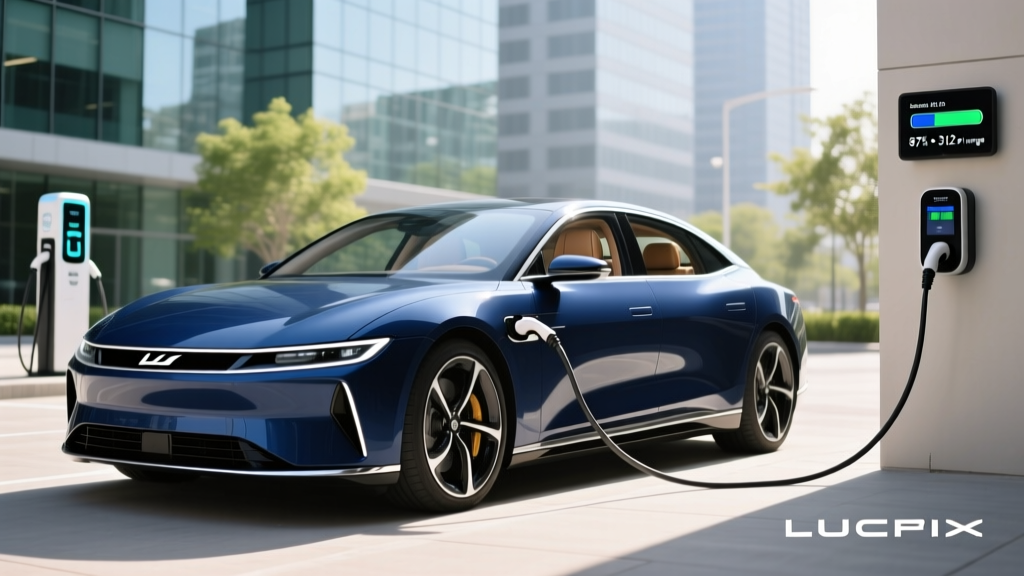
Lucid's 900-volt electrical architecture is one of the highest in any production EV (most competitors use 400V, while Hyundai/Kia use 800V). Higher voltage means the car can accept more power at a given current, translating to faster charging — provided the station can deliver it.
| Charging Level | Power | Miles Added per Hour | Notes |
|---|---|---|---|
| Level 1 (120V) | ~1.4 kW | ~3–4 mi/hr | Emergency/trickle only; impractical for daily use on 88–118 kWh batteries |
| Level 2 (240V, 80A) | 19.2 kW | ~92 mi/hr | Requires hardwired 100-amp circuit; full overnight replenishment |
| Level 2 (240V, 48A) | 11.5 kW | ~55 mi/hr | Standard NEMA 14-50 or 60-amp circuit; 8–10 hr full charge |
| DC Fast (peak) | 220–300 kW | — | 10–80% in ~22–25 min; requires 350 kW-class station for full speed |
Charging curve reality check: The Grand Touring's 300 kW peak rate is only sustained between roughly 10–40% state of charge. Above 50%, the rate tapers to approximately 150–180 kW, and above 80% it drops further to protect the battery. A 10–80% session at a capable Electrify America or Tesla Supercharger (with NACS adapter) takes roughly 22 minutes for the Grand Touring. If you arrive at a 150 kW station — still common on many networks — expect 10–80% in approximately 35–40 minutes regardless of trim.
For home charging, Lucid supports up to 19.2 kW on Level 2, which is among the highest in the industry. To unlock this rate, you'll need a 100-amp dedicated circuit and a hardwired Level 2 EVSE — budget $800–$1,500 for the charger and $1,500–$3,500 for professional installation depending on your electrical panel capacity. If your panel is maxed out at 100 or 150 amps, a panel upgrade to 200 amps can add $2,000–$4,000. A more common 48-amp setup on a 60-amp circuit still delivers a practical 55 miles of range per hour — enough to fully replenish even the Grand Touring overnight.
Pricing, Lease Economics & Federal Tax Credit Eligibility
The Lucid Air starts at $69,900 for the Pure RWD and scales dramatically upward. Here's where lease deals become relevant: Lucid has periodically offered aggressive lease incentives on the Air, particularly on the Pure and Touring trims, to move volume. Lease pricing fluctuates by region and dealer, but typical 2025 Air Pure lease structures have hovered around $699–$899/month for 36 months with $3,999–$5,999 due at signing, depending on money factor and residual.
- MSRP Cap: Sedans must have an MSRP at or below $55,000 to qualify. The Air Pure at $69,900 exceeds this cap — no Air trim currently qualifies for the $7,500 new EV credit under purchase rules.
- Lease Loophole (§25H Commercial Credit): When you lease, the leasing company (not you) claims the commercial clean vehicle credit. Some lessors pass this savings through as a capitalized-cost reduction (lowering your monthly payment), but this is not guaranteed. Ask your Lucid dealer or leasing partner whether the $7,500 commercial credit is being applied to your lease.
- Income Caps (purchase only): AGI limits of $150K single / $225K head of household / $300K joint filers apply to the §30D purchase credit.
- Battery Sourcing: Critical mineral and battery component sourcing requirements must be met. Lucid sources battery cells from multiple suppliers, and eligibility can shift.
Always verify current rules at IRS.gov and consult a tax professional before relying on credit eligibility.
Performance and Driving Impressions
Even the base Air Pure with 430 hp and a 5.0-second 0–60 time feels genuinely quick — the instant torque delivery of a single rear motor makes highway merging effortless. Step up to the Touring (620 hp, 3.4 sec) and you're in sports-sedan territory. The Grand Touring's 1,050 hp and 3.0-second sprint are supercar-adjacent, while the Sapphire's 1,234 hp and 1.89-second run exists in a category of its own — it's one of the quickest production sedans ever built.
Ride quality across the lineup is composed and comfortable, with an adaptive air suspension on Touring and above that smooths out highway imperfections. The steering is precise but light — tuned more for relaxed grand touring than canyon carving, unless you're in the Sapphire with its track-focused calibration. Regenerative braking is adjustable but notably, Lucid does not offer true one-pedal driving that brings the car to a complete stop — you'll still use the brake pedal for final stops, which some EV converts find disappointing.
Interior, Technology, and Driver Assistance
The Air's cabin is defined by a sweeping 34-inch curved glass cockpit display that stretches across the dashboard — it's visually striking and replaces a traditional center stack. The upper screen handles navigation, media, and vehicle settings, while a lower retractable screen provides secondary controls for climate and drive modes. The interface is responsive, though some reviewers and owners have noted that the software ecosystem feels less polished than Tesla's or BMW's iDrive. Wireless Apple CarPlay and Android Auto are standard.
Driver assistance: Lucid's DreamDrive system uses a suite of cameras, radar, and LiDAR (on higher trims) to provide SAE Level 2 driver assistance — meaning adaptive cruise control, lane-centering, and automatic emergency braking. However, this is not a hands-free system. Unlike GM's Super Cruise or Ford's BlueCruise, DreamDrive requires you to keep your hands on the wheel. Lucid has signaled future over-the-air updates for more advanced capabilities, but as of the 2025 model year, you should expect a conventional Level 2 experience with good execution but no hands-free highway driving.
Notable drawbacks: Rear visibility is compromised by the sloping roofline and thick C-pillars — the digital rearview mirror helps but takes getting used to. The rear seat, while offering 36.4 inches of legroom, has a relatively low cushion height that may leave taller passengers wishing for more thigh support. And while the 32.0 cu ft of combined cargo space (trunk plus frunk) is generous for a sedan, it can't match a crossover's utility.
How the Lucid Air Compares to Key Rivals
| Attribute | Lucid Air Pure | Tesla Model S LR | Mercedes EQS 450+ | BMW i7 eDrive50 |
|---|---|---|---|---|
| Base MSRP | $69,900 | $74,990 | $104,400 | $119,300 |
| EPA Range | 410 mi | 402 mi | 390 mi | 318 mi |
| Efficiency | 146 MPGe | 124 MPGe | 97 MPGe | 87 MPGe |
| Max DC Charge | 220 kW | 250 kW | 200 kW | 195 kW |
| 0–60 mph | 5.0 sec | 3.1 sec | 5.9 sec | 5.5 sec |
| Hands-Free ADAS | No | No | No (Level 3 in limited areas) | No |
| Supercharger Access | Yes (NACS adapter) | Native | No (CCS) | No (CCS) |
The Air's efficiency advantage is dramatic — 146 MPGe versus the EQS's 97 means the Lucid uses roughly 34% less electricity per mile. Over 15,000 miles annually, that translates to meaningful savings at public chargers and less strain on your home electrical system. The Tesla Model S remains the closest competitor in range and performance, with the advantage of native Supercharger access and a more mature software stack, but its interior quality and ride refinement don't match the Lucid.
Pros, Cons, and Final Recommendation
- Best-in-class EPA range (up to 516 mi)
- Industry-leading efficiency (146 MPGe)
- 900V architecture enables fast DC charging
- Spacious, minimalist luxury interior
- Strong performance even in base trim
- Generous 32 cu ft cargo (sedan)
- Tesla Supercharger access via NACS adapter
- No federal purchase credit (MSRP exceeds $55K cap)
- DreamDrive is competent but not hands-free
- Software UX trails Tesla and BMW
- Limited service center network vs. legacy luxury brands
- Rear seat cushion height could be better
- No true one-pedal driving to a stop
- Brand is young — long-term depreciation uncertain
Who should lease the Air: Executive commuters covering 40–80 miles daily who want to charge once or twice a week. Road-trip enthusiasts who value maximum range to minimize charging stops. Tech-forward buyers who want the most efficient EV on the market and can accept a younger brand's growing pains. If you lease, press the dealer on whether the $7,500 commercial clean vehicle credit is being passed through to your lease terms — this can meaningfully reduce your monthly payment.
Frequently Asked Questions
What is the real-world range of the Lucid Air?
EPA estimates range from 410 miles (Pure) to 516 miles (Grand Touring). In real-world highway driving at 70–80 mph, expect roughly 80–85% of the EPA figure. In freezing weather with cabin heat, plan for 65–75% of the sticker range. The Air's exceptional efficiency means these adjusted numbers still exceed what most rival EVs deliver at their EPA peak.
How fast does the Lucid Air charge?
On DC fast charging, the Air Pure and Touring peak at 220 kW, while the Grand Touring and Sapphire reach 300 kW at compatible stations. A 10–80% session takes roughly 22–25 minutes. At home on a 48-amp Level 2 charger, you'll add about 55 miles per hour; on a full 80-amp circuit, that jumps to 92 miles per hour.
Does the Lucid Air qualify for the federal EV tax credit?
For a direct purchase, no — the §30D credit caps sedan MSRP at $55,000, and every Air trim exceeds that. However, when you lease, the leasing entity may claim the §25H commercial clean vehicle credit ($7,500) and pass savings to you as a cap-cost reduction. This is not automatic — confirm with your dealer. Check current rules at IRS.gov.
Is the Lucid Air worth it over a Tesla Model S?
If efficiency and range-per-kWh are your top priorities, the Air wins decisively (146 vs. 124 MPGe). The Lucid also offers a more refined ride and more luxurious interior materials. The Model S counters with native Supercharger integration, faster acceleration in base form, Autopilot's wider feature set, and a more established service network. Both are excellent — your choice depends on whether you prioritize efficiency luxury (Lucid) or tech-ecosystem maturity (Tesla).
What's the biggest risk of leasing a Lucid?
Lucid is a relatively young automaker, and long-term residual values are uncertain. Leasing mitigates depreciation risk — you return the car at term end regardless of market value. The bigger practical risk is service access: Lucid's service center and mobile-service footprint is growing but still thin compared to BMW, Mercedes, or Tesla. Check whether you have a Lucid service option within a reasonable distance before committing.
What battery warranty does Lucid offer?
Lucid covers the battery pack and drive unit for 8 years or 100,000 miles, whichever comes first. This is competitive with the industry standard (Tesla offers 8 yr/150,000 mi on Model S; most others are 8 yr/100,000 mi). Lucid uses NMC (nickel manganese cobalt) chemistry across the Air lineup, which offers higher energy density than LFP but benefits from staying between 20–80% state of charge for daily use to maximize long-term health.