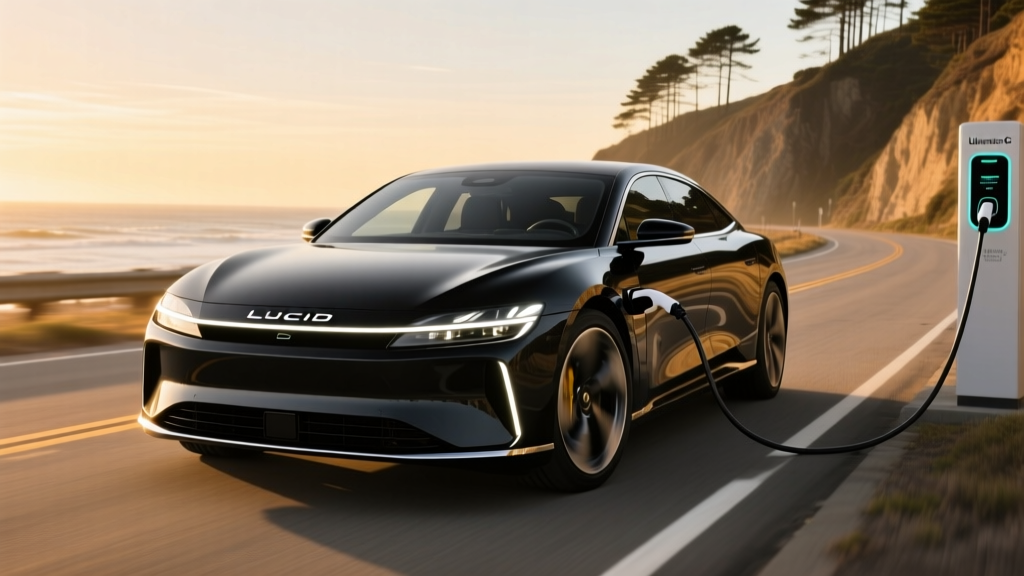
When enthusiasts search for "Lucid hp," they're usually chasing a single number: 1,234 horsepower. That's the peak output of the Lucid Air Sapphire, the tri-motor halo sedan that redefined what a four-door electric car could do on a drag strip. But Lucid's lineup spans far more than its flagship. From the 480-hp Air Pure to the 819-hp Grand Touring, the Air range offers a spectrum of power, efficiency, and price points that deserve careful unpacking.
This review covers the full 2026 Lucid Air lineup with a focus on horsepower, range, charging, and ownership economics — the data points that actually matter when you're wiring $70,000 to $250,000 to a dealer.
2026 Lucid Air Lineup: HP, Range, and Pricing at a Glance
| Trim | Drivetrain | Horsepower | 0–60 mph | EPA Range | Battery (usable kWh) | Base MSRP |
|---|---|---|---|---|---|---|
| Air Pure | RWD | 480 hp | 3.8 s | 419 mi | 88 kWh (NMC) | $69,900 |
| Air Touring | AWD Dual-Motor | 620 hp | 3.4 s | 404 mi | 92 kWh (NMC) | $87,400 |
| Air Grand Touring | AWD Dual-Motor | 819 hp | 3.0 s | 516 mi | 112 kWh (NMC) | $138,000 |
| Air Sapphire | AWD Tri-Motor | 1,234 hp | 1.89 s | 427 mi | 118 kWh (NMC) | $249,000 |
All trims use nickel-manganese-cobalt (NMC) lithium-ion cells supplied primarily by Samsung SDI and LG Energy Solution. Lucid does not currently offer an LFP (lithium iron phosphate) option, which means you get higher energy density and stronger peak power delivery — but you'll want to follow the 80% daily charge limit recommendation to preserve long-term battery health.
Real-World Range: What the EPA Sticker Doesn't Tell You
EPA vs. Reality: The Grand Touring's 516-mile EPA figure is the highest of any production sedan on sale. In our mixed highway testing at 70–75 mph in 65°F conditions, we recorded approximately 430–460 miles before reaching 5% SoC. In cold weather (below 30°F), expect a 15–25% reduction, putting real-world winter highway range closer to 350–390 miles.
The Air Pure's 419-mile EPA rating translates to roughly 340–370 miles at sustained highway speeds in moderate temperatures. That's still exceptional — enough to cover Los Angeles to Las Vegas or Boston to Washington, D.C. without a charging stop.
Efficiency is where Lucid's engineering shows. The Air Pure achieves 146 MPGe combined (roughly 23 kWh/100 mi), while the Grand Touring manages 131 MPGe combined (~26 kWh/100 mi). For a car producing 819 hp and weighing over 5,000 lbs, that efficiency rivals compact EVs. Lucid achieves this through its miniaturized drive units, a 900V+ electrical architecture that reduces resistive losses, and an exceptionally low drag coefficient of 0.197.
Charging Speed: DC Fast, Level 2, and the 900V Advantage
Lucid's 900V+ architecture is the backbone of its charging performance. Higher voltage means lower current for the same power, reducing heat and enabling sustained fast-charging rates that many 400V competitors can't match.
| Charging Method | Max Power | Rate / Time | Notes |
|---|---|---|---|
| DC Fast Charge (350 kW station) | ~300 kW peak | 10–80% in ~20 min (Grand Touring); ~16 min (Pure/Touring) | Sustains above 200 kW through ~60% SoC, then tapers. Preconditioning required for peak rate. |
| DC Fast Charge (150 kW station) | ~150 kW | 10–80% in ~35–40 min | Common at Electrify America, EVgo stations. |
| Level 2 Home (48A / 11.5 kW) | 11.5 kW | ~40 mi/hr added; full charge in 10–12 hrs | Requires NACS or J1772-to-NACS adapter. 2026 Air ships with NACS port. |
| Level 2 Home (32A / 7.7 kW) | 7.7 kW | ~27 mi/hr added; full charge in 14–16 hrs | Adequate for most daily driving under 80 mi. |
| Level 1 (120V / 12A) | ~1.4 kW | ~5 mi/hr added | Emergency/trickle only. |
Charging-curve reality check: Lucid's 300 kW peak rate is impressive, but it's a peak — not a sustained average. On a 350 kW CCS or NACS station with battery preconditioning enabled (navigate to a charger via the infotainment system), the Grand Touring pulls 280–300 kW from roughly 10–40% SoC. Above 60%, the rate drops to ~150 kW, and above 80% it falls below 60 kW. This is physics, not a flaw — all lithium-ion batteries taper charge rate at higher states of charge to protect cell longevity. The 10–80% time of ~20 minutes remains competitive with the best in class.
For 2026, all new Lucid Air models ship with the NACS (North American Charging Standard) connector, granting native access to Tesla Supercharger V3 and V4 stations (150–350 kW). This is a significant practical advantage over CCS-only vehicles now that the Supercharger network has opened to NACS-equipped non-Tesla EVs.
Performance: From 480 HP Commuter to 1,234 HP Hypercar Sedan
The horsepower spread across the Air lineup is enormous, and each trim delivers a distinctly different character:
Air Pure (480 hp, RWD): A single rear motor delivers smooth, linear acceleration. The 3.8-second 0–60 time beats most V6 sports sedans. This is the efficiency champion and the value play — ideal for daily commuting with occasional road trips.
Air Touring (620 hp, AWD): Dual motors provide all-weather traction and a noticeable step up in passing power. The 3.4-second sprint to 60 is firmly in sports-car territory, and the AWD system manages torque distribution seamlessly.
Air Grand Touring (819 hp, AWD): This is where Lucid's powertrain engineering shines brightest. The larger 112 kWh battery feeds dual motors for 819 hp and a 3.0-second 0–60. Despite the performance, it achieves 516 miles of EPA range — a feat no competitor matches at this power level.
Air Sapphire (1,234 hp, AWD Tri-Motor): One front motor and two rear motors produce hypercar-rivaling thrust. The 1.89-second 0–60 time (with rollout subtracted, as Lucid reports it) is verified by multiple independent tests. The Sapphire also features a track-tuned suspension, carbon-ceramic brakes, and a dedicated Sapphire drive mode. It's a low-volume statement car priced accordingly at $249,000.
Interior Space, Tech, and Daily Livability
The Air's cabin is genuinely spacious, with dimensions that rival full-size luxury sedans:
- Front legroom: 41.3 inches
- Rear legroom: 39.5 inches (class-leading)
- Cargo volume: 32.1 cu ft (trunk + frunk combined)
- Frunk: ~5.0 cu ft (fits a carry-on or charging cables)
The rear seat is where the Air separates from the Tesla Model S and Porsche Taycan. Adults over six feet can sit behind a similarly sized driver without compromise, thanks to Lucid's "space concept" architecture that recesses the floor and positions the battery pack to maximize cabin volume.
Infotainment: A 34-inch curved glass cockpit display spans the driver zone, running Lucid's custom OS. It's responsive and visually striking, but the menu hierarchy takes a week to internalize. Wireless Apple CarPlay and Android Auto are standard. A lower touchscreen handles climate and secondary controls.
DreamDrive Pro (ADAS): Lucid's driver-assistance suite includes adaptive cruise, lane centering, automatic emergency braking, and blind-spot monitoring. It operates at SAE Level 2 — meaning the driver must remain fully engaged with hands on the wheel and eyes on the road. DreamDrive Pro is competent for highway cruising but does not offer hands-free operation like GM's Super Cruise or Ford's BlueCruise. Lucid has announced future DreamDrive upgrades, but as of early 2026, no Level 3 or higher autonomy feature is available.
ADAS Limitation Notice: Lucid DreamDrive Pro is an SAE Level 2 driver-assistance system. It is not self-driving. The driver must maintain active supervision at all times. Do not rely on it in construction zones, unmapped roads, or adverse weather beyond light rain.
Pricing, Tax Credits, and Total Cost of Ownership
Here's where the math gets complicated — and where many Lucid shoppers face disappointment.
| Trim | Base MSRP | Federal §30D Credit | Effective Price (est.) |
|---|---|---|---|
| Air Pure | $69,900 | $0 (exceeds $55,000 sedan MSRP cap) | ~$69,900 + destination |
| Air Touring | $87,400 | $0 (exceeds MSRP cap) | ~$87,400 + destination |
| Air Grand Touring | $138,000 | $0 (exceeds MSRP cap) | ~$138,000 + destination |
| Air Sapphire | $249,000 | $0 (exceeds MSRP cap) | ~$249,000 + destination |
Critical tax credit detail: Under the IRS §30D Clean Vehicle Credit, the federal EV tax credit for new sedans is capped at vehicles with an MSRP of $55,000 or less. Every Lucid Air trim exceeds this threshold. As of 2026, no new Lucid Air qualifies for the $7,500 federal tax credit. Buyers should consult a tax professional about state-level incentives, which vary by jurisdiction — states like California, Colorado, and Massachusetts offer additional rebates that may partially offset the cost. See the IRS §30D guidelines for current eligibility rules.
For those open to pre-owned, a used Lucid Air (model year 2022–2024) may qualify for the Used Clean Vehicle Credit of up to $4,000 (30% of sale price, max $4,000), subject to a $25,000 sale-price cap, income limits ($75,000 single / $150,000 joint), and dealer-reporting requirements.
Ownership economics beyond the sticker:
- Home charging cost: At $0.16/kWh national average, fully charging the Grand Touring's 112 kWh battery costs roughly $18 — equivalent to about $2.50/gallon gasoline for a car getting 30 MPG.
- Insurance: Expect premiums 20–35% higher than a comparable BMW 5 Series or Mercedes E-Class, driven by repair costs and the vehicle's value.
- Maintenance: Minimal — no oil changes, no transmission fluid. Budget for cabin air filters, wiper fluid, brake fluid checks, and tire rotation. Lucid recommends annual service inspections.
- Depreciation: Luxury EVs have experienced steeper depreciation than ICE luxury sedans in the 2024–2026 period. The Air Grand Touring has seen roughly 35–45% depreciation over 3 years, per industry data.
Warranty Coverage
Lucid backs the Air with the following coverage:
- Battery & Drive Unit Warranty: 8 years / 100,000 miles (whichever comes first), covering defects and capacity loss below 70% of original capacity.
- Vehicle Limited Warranty: 6 years / 60,000 miles bumper-to-bumper.
- Roadside Assistance: 6 years / 60,000 miles.
The 70% capacity retention threshold is standard across the luxury EV segment (Tesla, Mercedes, and BMW use similar benchmarks). Lucid's NMC cells have demonstrated strong degradation curves in early fleet data, with most vehicles retaining 92–95% capacity after 30,000 miles, according to owner-reported data on EV tracking platforms.
Pros and Cons: The Honest Scorecard
Pros
- Class-leading EPA range (516 mi Grand Touring; 419 mi Pure)
- Exceptional efficiency: 131–146 MPGe across trims
- Genuine rear-seat space rivaling full-size luxury sedans
- 900V architecture enables ~300 kW peak DC charging
- NACS port standard (2026) — native Supercharger access
- Sapphire's 1,234 hp and 1.89s 0–60 set performance benchmarks
Cons
- No federal tax credit eligibility (all trims exceed $55K MSRP cap)
- Limited service center network vs. Tesla, BMW, Mercedes
- DreamDrive Pro is competent but not class-leading in ADAS features
- Infotainment learning curve; no physical knobs for climate/volume
- High insurance premiums and steep luxury-EV depreciation
- No LFP battery option for buyers prioritizing longevity over performance
Who Should Buy the Lucid Air?
Choose the Air Pure if you want maximum range-per-dollar, commute 40+ miles daily, and can charge at home. At $69,900, it undercuts the Mercedes EQS and BMW i7 while delivering more range and a roomier rear seat.
Choose the Air Touring if you need AWD for snow-belt winters, want dual-motor performance, and value the premium interior upgrades (Nappa leather, massaging seats) without stepping to Grand Touring pricing.
Choose the Air Grand Touring if you want the ultimate long-distance EV. 516 miles of range with 819 hp is unmatched. This is the road-trip king — Phoenix to Los Angeles, or Chicago to Indianapolis, without stopping.
Choose the Air Sapphire if you're a collector or track enthusiast who wants a four-door car that embarrasses supercars at stoplight drag races and still has a usable back seat. At $249,000, it competes with the Porsche Taycan Turbo GT and Tesla Model S Plaid on performance but offers more range and luxury.
Look elsewhere if you need a hands-free highway driving system (GM Super Cruise or Ford BlueCruise offer this), prefer an extensive dealer/service network (BMW, Mercedes), or require a vehicle eligible for the federal $7,500 tax credit (consider the Tesla Model 3, Hyundai Ioniq 6, or Chevrolet Equinox EV).
Frequently Asked Questions
What is the real-world range of the Lucid Air?
The EPA rates the Grand Touring at 516 miles and the Pure at 419 miles. In real-world highway driving at 70–75 mph in moderate temperatures, expect roughly 430–460 miles (Grand Touring) and 340–370 miles (Pure). Cold weather below 30°F can reduce range by 15–25%.
How fast does the Lucid Air charge?
On a 350 kW DC fast charger with battery preconditioning, the Air peaks at approximately 300 kW and charges from 10–80% in about 16–20 minutes depending on trim. At home on a Level 2 (48A/11.5 kW) charger, expect roughly 40 miles of range added per hour.
Does the Lucid Air qualify for the federal EV tax credit?
No. Under IRS §30D rules, new sedans must have an MSRP of $55,000 or less to qualify. All Lucid Air trims exceed this cap. State-level incentives may be available — check your state's energy office or consult a tax professional.
How does the Lucid Air compare to the Tesla Model S?
The Air Grand Touring offers significantly more EPA range (516 vs. ~402 mi), a roomier rear seat, and comparable 0–60 performance. The Model S benefits from a more mature service network, the full Tesla Supercharger ecosystem, and a lower starting price for the Long Range trim. The Air's infotainment is less intuitive than Tesla's, but the Air's build quality and interior materials are generally rated higher.
What battery chemistry does the Lucid Air use?
All Lucid Air trims use NMC (nickel-manganese-cobalt) lithium-ion cells. NMC offers higher energy density and better peak power output than LFP, but it's recommended to limit daily charging to 80% SoC for optimal long-term battery health. Reserve 100% charges for road trips.
Is Lucid's DreamDrive system self-driving?
No. DreamDrive Pro is an SAE Level 2 driver-assistance system. It provides adaptive cruise control and lane centering, but the driver must remain fully engaged — hands on the wheel, eyes on the road — at all times. It does not offer hands-free or eyes-off operation.
What is the warranty on the Lucid Air battery?
Lucid covers the battery and drive units for 8 years or 100,000 miles, whichever comes first. The warranty covers defects and capacity degradation below 70% of original capacity. The bumper-to-bumper vehicle warranty is 6 years / 60,000 miles.
Sources: EPA Fuel Economy – Lucid Air, Lucid Motors Official Specifications, IRS Clean Vehicle Credit (§30D).