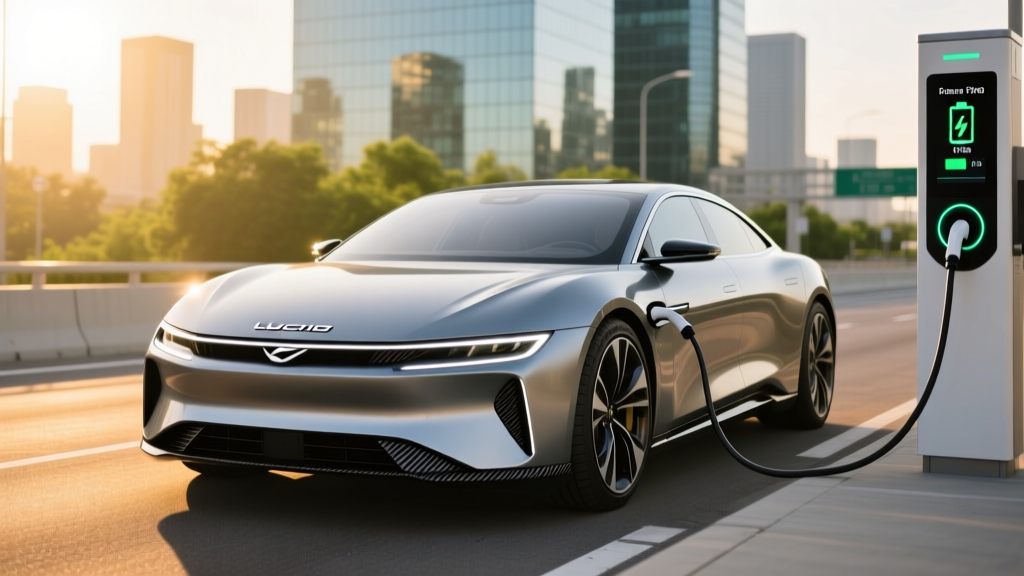
The Lucid Air didn't just enter the luxury electric-sedan market — it redefined what an EV powertrain could achieve in efficiency and distance. When a Lucid Air Grand Touring completed a single-charge drive exceeding 700 miles under monitored conditions, it earned a Guinness World Record for the longest distance driven by a production electric vehicle on one charge. That headline achievement wasn't a stripped-down hypermiling special; it was a stock, street-legal Air Grand Touring. For 2026, the question isn't whether the Air can set records — it's whether its combination of class-leading range, blistering charging speeds, and executive-class interior justifies a six-figure price tag in a market now crowded with rivals from Tesla, BMW, Mercedes-Benz, and Porsche.
Below, we break down every number that matters: real-world range versus the EPA sticker, sustained DC fast-charging curves, battery chemistry and degradation expectations, federal tax-credit eligibility under current IRS §30D rules, and the ownership realities that spec sheets don't reveal.
Range and Efficiency: What the Guinness Record Actually Means
The Lucid Air Grand Touring carries an EPA-estimated range of 516 miles on its 112 kWh battery pack — the highest EPA figure of any production EV sold in the United States. The Air Pure (RWD) achieves an EPA-estimated 419 miles from a smaller 88 kWh pack, while the performance-oriented Air Sapphire posts 427 miles despite its 1,234-horsepower tri-motor setup.
The Guinness World Record run demonstrated that under ideal low-speed, moderate-temperature, hyper-efficient driving conditions, the Air Grand Touring's powertrain can extract over 700 miles from a single charge. That's a validation of Lucid's motor and inverter efficiency — but it is not what buyers should expect on a Tuesday commute.
EPA Estimate (Grand Touring): 516 miles
Expected highway (70 mph, moderate temps): ~390–430 miles
Expected mixed city/highway commute: ~440–480 miles
Cold-weather (below 32°F, cabin heat): ~330–380 miles
The Air's heat pump and advanced thermal management minimize cold-weather losses compared to many competitors, but physics still applies. Expect a 20–30% range reduction in sustained sub-freezing driving.
Efficiency is where Lucid truly separates from the pack. The Air Grand Touring achieves an EPA-rated 131 MPGe combined (approximately 26 kWh per 100 miles). That's meaningfully better than the Tesla Model S Long Range (~120 MPGe) and far ahead of the Mercedes EQS (~97 MPGe). Lucid's proprietary miniaturized drive units and 900-volt electrical architecture reduce resistive losses throughout the system.
Battery Specs, Chemistry, and Longevity
| Spec | Air Pure | Air Touring / Grand Touring | Air Sapphire |
|---|---|---|---|
| Battery (usable) | 88 kWh | 112 kWh | 118 kWh |
| Chemistry | NMC (Nickel Manganese Cobalt) | NMC | NMC (high-performance tune) |
| Voltage Architecture | 900V nominal | 900V nominal | 900V nominal |
| EPA Range | 419 mi | 516 mi (GT) | 427 mi |
| Efficiency (combined) | 136 MPGe / 25 kWh/100mi | 131 MPGe / 26 kWh/100mi | 110 MPGe / 30 kWh/100mi |
Lucid uses NMC lithium-ion cells across the Air lineup. NMC chemistry offers higher energy density than LFP (lithium iron phosphate), which is essential for fitting over 110 kWh into a sedan floorpan without compromising cabin space. The trade-off is that NMC cells are more sensitive to sustained high state-of-charge storage and extreme heat — Lucid's liquid thermal management system actively mitigates this, but owners should still follow the 20–80% daily charging guideline for longest battery life.
The battery and powertrain are covered by Lucid's warranty for 8 years or 100,000 miles, with a capacity-retention threshold of 70%. The basic vehicle warranty runs 6 years or 75,000 miles. Full battery-pack replacement costs are not publicly listed by Lucid but industry estimates for packs of this size place out-of-warranty replacement in the $20,000–$28,000 range based on current cell pricing trajectories.
Charging Speed: 900V Architecture in Practice
The Air's 900-volt electrical architecture is one of the highest in production, enabling DC fast-charging rates that rival the Porsche Taycan and exceed most competitors. Here's what that means in real charging sessions:
| Charging Level | Max Power | Speed (mi/hr added) | Notes |
|---|---|---|---|
| Level 1 (120V, 12A) | ~1.4 kW | ~3–4 mi/hr | Emergency/trickle only |
| Level 2 (240V, 48A) | ~11.5 kW | ~30–35 mi/hr | ~15 hr for full 112 kWh pack |
| Level 2 (240V, 80A) | ~19.2 kW | ~50–55 mi/hr | Requires 100A circuit; ~9 hr full charge |
| DC Fast (350 kW station) | Up to ~300 kW peak | ~200 mi in ~12 min | 10–80% in approximately 15–20 min |
At a 350 kW Electrify America or Tesla Supercharger V4 stall (with NACS adapter), the Air Grand Touring can accept up to approximately 300 kW peak. However, as with all EVs, the charge curve tapers significantly above 80% state of charge. The 10–80% sprint takes roughly 15–20 minutes under optimal battery preconditioning — which the Air initiates automatically when a DC fast-charger is set as the navigation destination.
The 80–100% top-off can add another 25–35 minutes due to cell-balancing and thermal protection. For road trips, plan your stops around the 10–80% window to minimize time plugged in.
The Air uses the NACS (Tesla) connector natively on 2026 models, granting direct access to Tesla's Supercharger network — the most reliable DC fast-charging infrastructure in North America. CCS adapters are no longer required for most public networks, though Lucid includes a CCS1 adapter for legacy station compatibility.
Performance: From 430 HP to 1,234 HP
The Lucid Air lineup spans a remarkable performance range. The entry-level Air Pure delivers 430 horsepower from a single rear motor, achieving a 0–60 mph time of approximately 5.0 seconds. The dual-motor Air Touring produces 620 hp (0–60 in ~3.4 seconds), while the Grand Touring pushes 819 hp (0–60 in ~3.0 seconds).
At the top sits the Air Sapphire, a tri-motor AWD beast generating 1,234 horsepower and reaching 60 mph in a verified 1.89 seconds — making it one of the quickest production sedans ever built, regardless of powertrain. The Sapphire also features torque vectoring across the rear axle, carbon-ceramic brakes, and a track-tuned suspension.
All trims use Lucid's proprietary permanent-magnet and induction motor combination (permanent magnet rear, induction front on AWD models), allowing the front motor to freewheel with zero drag during coasting for improved efficiency.
Pricing, Trims, and Federal Tax Credit Eligibility
| Trim | Base MSRP | §30D Credit Eligible? | Effective Price (est.) |
|---|---|---|---|
| Air Pure | $69,900 | Yes — under $80K sedan cap | ~$62,400 (if qualified) |
| Air Touring | $87,400 | No — exceeds $80K sedan cap | $87,400 |
| Air Grand Touring | $125,600 | No — exceeds $80K sedan cap | $125,600 |
| Air Sapphire | $249,000 | No — exceeds $80K sedan cap | $249,000 |
Under current IRS §30D clean vehicle credit rules, the federal EV tax credit provides up to $7,500 — but eligibility hinges on three concurrent requirements:
- MSRP cap: Sedans must have an MSRP at or below $55,000. (Note: The Air Pure's $69,900 MSRP exceeds the sedan cap. If classified as an SUV by the IRS — which has an $80,000 cap — it may qualify. Check the latest IRS vehicle classification list.)
- Buyer income cap: Modified adjusted gross income must not exceed $150,000 (single), $225,000 (head of household), or $300,000 (joint filers).
- Battery sourcing: Critical minerals and battery components must meet escalating domestic-sourcing thresholds. Lucid's supply-chain compliance varies by model year — verify current eligibility on fueleconomy.gov.
The point-of-sale transfer option allows qualified buyers to apply the credit as an immediate discount at the dealership rather than waiting for a tax refund. Consult a tax professional to confirm your personal eligibility before purchasing.
Interior Space, Technology, and Driver Assistance
The Air's cabin is a study in minimalist luxury. The sedan offers 110.5 cubic feet of total passenger volume with generous rear legroom of 37.6 inches — competitive with a BMW 7 Series. Cargo space includes a 32 cubic-foot trunk plus a 7.1 cubic-foot frunk, totaling nearly 40 cubic feet of storage — exceptional for a sedan.
The centerpiece is a 34-inch curved glass cockpit display spanning the driver's instrument cluster and infotainment, supplemented by a retractable lower touchscreen for climate and secondary controls. The system runs Lucid's proprietary software — responsive but lacking Apple CarPlay and Android Auto, a notable omission at this price point.
Driver assistance is handled by Lucid's DreamDrive Pro suite, which includes adaptive cruise control, lane-centering, automatic emergency braking, and blind-spot monitoring. DreamDrive Pro is a SAE Level 2 system — the driver must remain fully engaged with hands on the wheel and eyes on the road. It is not autonomous driving. Lucid has not yet released a hands-free highway driving feature comparable to GM's Super Cruise or Ford's BlueCruise, though the hardware (including lidar on Grand Touring and above) suggests future over-the-air upgrades are planned.
Who Should Buy the Lucid Air?
- You need maximum single-charge range for frequent 300+ mile road trips without charging stops
- You value sedan styling and interior space over SUV ride height
- You want class-leading electrical efficiency (kWh/100mi) to minimize charging costs
- You want access to Tesla Superchargers via native NACS without an adapter
- You need a vehicle under $55,000 to guarantee federal tax-credit eligibility
- You require Apple CarPlay/Android Auto integration
- You want hands-free Level 2+ highway driving (consider BMW i7 with Highway Assistant or Mercedes EQS with Drive Pilot in approved areas)
- You prefer SUV cargo flexibility (consider the Lucid Gravity or Rivian R1S)
Pros, Cons, and Competitor Comparison
- Highest EPA range of any production EV (516 mi, Grand Touring)
- Best-in-class efficiency (~26 kWh/100mi)
- Up to ~300 kW DC fast charging; 10–80% in ~15–20 min
- Native NACS connector for Tesla Supercharger access
- Massive interior and cargo space for a sedan
- Sapphire trim: sub-2-second 0–60 mph
- No Apple CarPlay or Android Auto
- Federal tax credit eligibility uncertain for most trims
- Limited service center network vs. Tesla or legacy luxury brands
- DreamDrive Pro lacks hands-free highway capability
- High insurance premiums (luxury EV class)
- Starting price above $69K; Grand Touring exceeds $125K
Against the Tesla Model S Long Range (EPA 402 mi, ~$79,990), the Air Grand Touring offers 28% more range and a more refined interior, but the Model S wins on charging-network convenience (Superchargers are now shared, but Tesla's integrated ecosystem remains tighter) and has a longer track record of over-the-air updates. The BMW i7 eDrive50 (EPA 318 mi, ~$105,700) offers superior hands-free driving tech and brand-dealer service infrastructure but can't touch the Air's range or efficiency. The Mercedes EQS 580 (EPA 371 mi, ~$104,400) provides a more opulent cabin but trails significantly in MPGe.
Frequently Asked Questions
What is the real-world range of the Lucid Air Grand Touring?
The EPA rates the Air Grand Touring at 516 miles. In real-world highway driving at 70 mph in moderate temperatures, expect approximately 390–430 miles. In mixed city/highway commuting, owners report 440–480 miles. In sustained sub-freezing conditions, plan for 330–380 miles. The Guinness World Record run of 700+ miles was achieved under hypermiling conditions not replicable in daily driving.
How fast does the Lucid Air charge at home and on the road?
On a Level 2 home charger at 48 amps (11.5 kW), the Air adds roughly 30–35 miles of range per hour — a full 112 kWh pack charges in about 15 hours. At 80 amps (19.2 kW, requiring a 100A circuit), that improves to ~50–55 mi/hr. On a 350 kW DC fast charger, the Air peaks at approximately 300 kW, achieving a 10–80% charge in roughly 15–20 minutes with battery preconditioning active.
Does the Lucid Air qualify for the $7,500 federal EV tax credit?
It depends on the trim and your tax situation. Under current IRS §30D rules, the credit is available for new EVs that meet MSRP caps ($55,000 for sedans, $80,000 for SUVs/vans/trucks), buyer income limits, and battery-sourcing requirements. The Air Pure at $69,900 may qualify if the IRS classifies it as an SUV; the Touring, Grand Touring, and Sapphire all exceed the applicable MSRP caps and do not qualify. Always verify current eligibility on fueleconomy.gov and consult a tax professional.
Is the Lucid Air worth buying over the Tesla Model S?
If maximum range, interior refinement, and efficiency are your priorities, the Air Grand Touring is the stronger vehicle. If you value a mature service network, frequent OTA feature additions, and tighter software integration, the Model S still has advantages. Both now use NACS, so Supercharger access is no longer a Tesla-exclusive benefit.
What battery chemistry does the Lucid Air use?
All Lucid Air trims use NMC (nickel manganese cobalt) lithium-ion cells. NMC provides the high energy density needed for 500+ mile range in a sedan form factor. For longest battery life, Lucid recommends daily charging to 80% and avoiding prolonged storage above 90% or below 10% state of charge.
Does the Lucid Air have Apple CarPlay or Android Auto?
No. Lucid uses its proprietary infotainment system with a 34-inch curved glass cockpit display. While the native system is responsive and feature-rich, the absence of smartphone mirroring is a significant drawback for buyers who rely on CarPlay or Android Auto for navigation and media.
Sources: EPA range and efficiency data from fueleconomy.gov; Lucid Air specifications from Lucid Motors official site; IRS §30D tax credit rules from irs.gov.