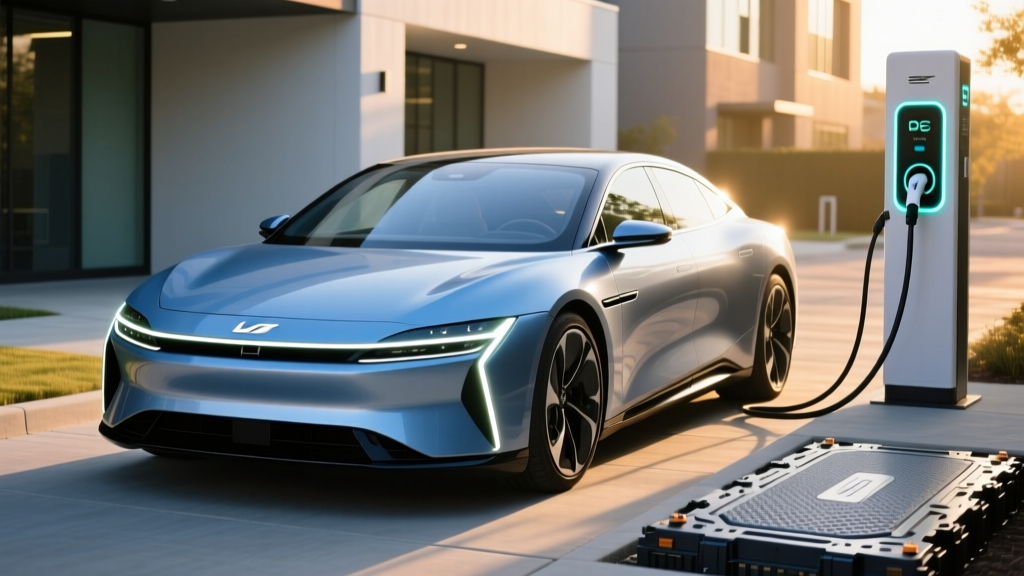
The Lucid Air remains one of the most efficient long-range sedans on the market, and the 2026 lineup benefits from continued supply-chain investments — including the widely discussed Lucid Group graphite one supply agreement that secures domestic anode materials for next-generation battery cells. But beyond the corporate procurement headlines, what does the Air actually deliver for real buyers in 2026? We break down range, charging, pricing, tax-credit eligibility, and ownership practicality.
Quick Verdict: Who Should Consider the 2026 Lucid Air?
The Lucid Air targets buyers who prioritize maximum range and efficiency above all else. If you commute long distances, road-trip frequently, or simply hate stopping to charge, the Air's class-leading MPGe figures and 900-volt architecture make a compelling case. It's less ideal for buyers needing SUV cargo space, third-row seating, or a sub-$50,000 entry price.
Look elsewhere if: You need crossover ground clearance, a sub-$55K price point, or a widely established service-center network.
Range, Efficiency & Real-World Expectations
The 2026 Lucid Air lineup spans four trims, each with different battery sizes and EPA ratings. The headline number belongs to the Air Pure, which achieves an EPA-estimated 419 miles on its 88 kWh usable battery pack. The Grand Touring pushes to 516 miles EPA with its 112 kWh pack — still the highest EPA rating of any production EV sold in the U.S.
EPA estimates assume a mix of city and highway driving at moderate temperatures. In our experience and consistent third-party testing:
• Highway (70-80 mph): Expect 85-90% of EPA — roughly 355-375 mi (Pure) or 440-465 mi (Grand Touring).
• Cold weather (below 32°F): Range drops 20-30% depending on cabin heating use. A Grand Touring may deliver 360-410 mi in winter conditions.
• City/regenerative driving: Can meet or slightly exceed EPA thanks to aggressive regen recapture.
The Air's heat pump and excellent aerodynamic drag coefficient (0.208 Cd) help mitigate cold-weather losses compared to many competitors.
| Trim | Battery (usable kWh) | Chemistry | EPA Range | MPGe (combined) | kWh/100 mi |
|---|---|---|---|---|---|
| Pure RWD | 88 kWh | NMC | 419 mi | 146 MPGe | 23 |
| Touring AWD | 92 kWh | NMC | 406 mi | 140 MPGe | 24 |
| Grand Touring AWD | 112 kWh | NMC | 516 mi | 131 MPGe | 26 |
| Sapphire AWD | 118 kWh | NMC | 427 mi | 109 MPGe | 31 |
All Air trims use nickel-manganese-cobalt (NMC) chemistry. Lucid has not adopted LFP (lithium iron phosphate) for the Air, prioritizing energy density for its range-focused sedan platform. The graphite anode supply secured through Lucid's agreements with suppliers like Syrah Resources supports consistent cell production for these high-density packs. According to fueleconomy.gov, the Air Pure's 23 kWh/100 mi figure makes it one of the most efficient large luxury sedans ever tested.
Charging: 900V Architecture & DC Fast-Charge Speeds
Lucid uses a 900-volt electrical architecture — higher than most competitors running 400V or 800V systems. Higher voltage enables faster charging with lower current, reducing heat and cable weight. The Air Grand Touring peaks at 300 kW on a compatible DC fast charger, while the Pure and Touring peak around 250 kW.
| Charge Level | Power / Rate | Time or Miles Added |
|---|---|---|
| Level 1 (120V household) | ~1.4 kW | ~3-4 mi/hr |
| Level 2 (240V, 48A home) | ~11.5 kW | ~35-40 mi/hr |
| Level 2 (240V, 80A home) | ~19.2 kW | ~58-65 mi/hr |
| DC Fast (Pure/Touring) | Peak 250 kW | 10-80% in ~25 min |
| DC Fast (Grand Touring/Sapphire) | Peak 300 kW | 10-80% in ~20 min |
Charging-curve reality check: Peak 300 kW is achieved only between roughly 10-30% state of charge (SoC) with a preconditioned battery. Above 50% SoC, the rate tapers significantly — expect ~150 kW at 60% and ~80 kW above 80%. This is standard for NMC cells but means the last 20% takes longer than the first 50%. For road trips, plan to charge from 10-80% and skip the slow top-off unless you need every mile to reach the next stop.
The Air uses a CCS1 connector for DC fast charging. With the industry's shift to NACS (Tesla's connector), Lucid has confirmed NACS adoption for future models, and 2026 Air owners can access Tesla Supercharger networks via a CCS-to-NACS adapter. At home, a Level 2 installation on a 60A circuit (48A continuous) is the practical sweet spot, adding ~35-40 miles per hour of charging — enough to fully replenish any Air trim overnight.
Performance: 0-60, Horsepower & Drivetrain
The Air lineup offers a wide performance spread. The Pure RWD delivers 430 hp and a 0-60 mph time of 5.0 seconds — quick by any sedan standard. The Grand Touring jumps to 819 hp (1,050 hp with Sprint mode) and hits 60 in 3.0 seconds. The Sapphire, Lucid's tri-motor halo, produces 1,234 hp and reaches 60 in an absurd 1.89 seconds, making it one of the fastest production sedans ever built.
| Trim | Drivetrain | Horsepower | 0-60 mph | Top Speed |
|---|---|---|---|---|
| Pure | RWD (single motor) | 430 hp | 5.0 sec | 145 mph |
| Touring | AWD (dual motor) | 620 hp | 3.4 sec | 145 mph |
| Grand Touring | AWD (dual motor) | 819 hp (1,050 Sprint) | 3.0 sec | 168 mph |
| Sapphire | AWD (tri motor) | 1,234 hp | 1.89 sec | 205 mph |
Every Air features an adaptive air suspension with adjustable ride height, contributing to both comfort and the car's slippery aerodynamics. Regenerative braking offers multiple levels but does not provide true one-pedal driving to a full stop in all conditions — you'll still use the friction brakes at very low speeds.
Interior, Cargo & Technology
The Air's cabin centers on a 34-inch curved glass canopy display spanning the driver's instrument cluster and infotainment screen, supplemented by a lower retractable pilot panel for climate and secondary controls. The interface is responsive but has drawn criticism for burying some commonly used functions behind touchscreen menus. Physical buttons remain minimal.
Cargo space: The sedan trunk offers 22.1 cubic feet (with the rear seatback up) and a 10.1-cubic-foot frunk, totaling 32.2 cu ft — competitive with large luxury sedans but well short of any crossover. Rear-seat legroom measures 37.6 inches, adequate for adults but tighter than a Mercedes EQS.
Driver assistance: The Air comes with Lucid's DreamDrive ADAS suite — a Level 2 (SAE) system combining adaptive cruise control, lane centering, and automated parking. DreamDrive uses 32 sensors including lidar, which provides better object detection in low-visibility conditions than camera-only systems. However, this is not a hands-off, self-driving system. The driver must remain engaged, hands on or near the wheel, at all times.
Pricing, Trims & Federal Tax Credit Eligibility
The 2026 Lucid Air starts at $69,900 for the Pure RWD and climbs to $249,000 for the Sapphire. Destination charges add approximately $1,500. Key trims:
| Trim | Base MSRP | §30D Credit Eligible? | Effective Price (if eligible) |
|---|---|---|---|
| Pure RWD | $69,900 | Potential — see rules below | ~$62,400 |
| Touring AWD | $87,400 | Potential — see rules below | ~$79,900 |
| Grand Touring AWD | $125,600 | No (exceeds MSRP cap) | $125,600 |
| Sapphire AWD | $249,000 | No (exceeds MSRP cap) | $249,000 |
Federal tax credit rules (IRS §30D, 2026): The $7,500 clean vehicle credit is subject to several requirements that buyers must verify before purchase:
- MSRP cap: Sedans must have an MSRP at or below $55,000. Because all Air trims exceed this cap, no 2026 Lucid Air currently qualifies for the new-vehicle §30D credit. (The cap for SUVs/pickups/vans is $80,000 — the Air is classified as a sedan.)
- Buyer income limits: AGI must not exceed $150K (single), $225K (head of household), or $300K (joint). Even if a vehicle qualifies, buyers above these thresholds cannot claim the credit.
- Battery sourcing: Critical minerals and battery components must meet phased-in domestic/free-trade-partner sourcing thresholds that tighten annually.
- Point-of-sale transfer: Eligible buyers can apply the credit as a down-payment reduction at the dealership rather than waiting for a tax refund — but only if the vehicle itself qualifies.
Bottom line: The Air Pure at $69,900 exceeds the $55,000 sedan MSRP cap. IRS rules are clear on this classification. Buyers seeking a tax-credited Lucid should explore the used EV credit (up to $4,000 on pre-owned models priced under $25,000) or wait for Lucid's upcoming midsize platform, which is expected to target a lower MSRP.
Battery Warranty, Longevity & the Graphite Supply Connection
Lucid covers the Air's battery and drive unit with an 8-year / 100,000-mile warranty (whichever comes first), with a capacity-retention threshold of 70%. The bumper-to-bumper limited warranty runs 4 years / 50,000 miles. These terms are competitive with Tesla, BMW, and Mercedes-Benz EV warranties.
The Lucid Group graphite one supply agreement — referencing Lucid's procurement deals with graphite producers for battery anode materials — matters to buyers in a practical way: supply-chain stability reduces the risk of production bottlenecks, cell-quality inconsistencies, and long-term parts availability. Graphite is the dominant anode material in NMC and NCA lithium-ion cells, and securing domestic or allied-nation sources insulates Lucid from trade disruptions. For owners, this translates to better confidence in battery replacement availability and cost stability over the vehicle's lifespan.
NMC degradation data from industry studies suggests owners can expect roughly 10-15% capacity loss over 150,000 miles under normal use. Lucid's liquid thermal management system and conservative buffer (the gap between gross and usable kWh) help slow degradation. To maximize longevity:
- Avoid routinely charging to 100% — set daily limits to 80-90%.
- Minimize repeated DC fast charging when Level 2 is available.
- Use preconditioning before fast charging, especially in cold weather.
Pros & Cons
- Class-leading EPA range (up to 516 mi Grand Touring)
- Best-in-class efficiency (23 kWh/100 mi Pure)
- 900V architecture enables 300 kW peak DC charging
- Spacious frunk + trunk combo (32.2 cu ft total)
- Lidar-equipped DreamDrive ADAS
- Air suspension with adjustable ride height
- No trim qualifies for §30D federal tax credit (MSRP cap)
- Limited service-center network vs. Tesla/BMW/Mercedes
- Infotainment relies heavily on touchscreen (few physical controls)
- Rear legroom tighter than flagship German sedans
- CCS connector requires adapter for Tesla Superchargers
- High insurance premiums common for luxury EVs
How It Compares: Air vs. Key Competitors
| Spec | Lucid Air Grand Touring | Tesla Model S LR | Mercedes EQS 580 | BMW i7 xDrive50 |
|---|---|---|---|---|
| EPA Range | 516 mi | 402 mi | 371 mi | 318 mi |
| Battery (usable) | 112 kWh NMC | ~100 kWh NMC | 108.4 kWh NMC | 101.7 kWh NMC |
| Peak DC Charge | 300 kW | 250 kW | 200 kW | 195 kW |
| 0-60 mph | 3.0 sec | 3.1 sec | 4.1 sec | 4.5 sec |
| Base MSRP | $125,600 | $79,990 | $127,350 | $120,295 |
| §30D Credit | No | No | No | No |
The Air Grand Touring leads on range and charging speed but costs more than a Model S Long Range. The Tesla wins on Supercharger network convenience and software ecosystem. The Mercedes and BMW compete more on traditional luxury brand cachet, dealer service infrastructure, and rear-seat comfort. None of these luxury sedans qualify for the new-vehicle federal tax credit due to MSRP caps.
Frequently Asked Questions
What is the real-world range of the 2026 Lucid Air?
The EPA rates the Air Grand Touring at 516 miles and the Pure at 419 miles. In real-world highway driving at 70-80 mph, expect roughly 85-90% of those figures — about 440-465 mi (Grand Touring) and 355-375 mi (Pure). Cold weather can reduce range by 20-30%. The Air's heat pump and low drag coefficient help it outperform many competitors in winter conditions.
How fast does the Lucid Air charge at home and on the road?
On a 240V Level 2 home charger at 48 amps, the Air gains roughly 35-40 miles of range per hour — a full overnight charge covers even the largest battery. On DC fast chargers, the Grand Touring peaks at 300 kW and charges from 10-80% in approximately 20 minutes, though the rate tapers significantly above 50% SoC. The Pure and Touring peak at 250 kW with 10-80% times around 25 minutes.
Does the 2026 Lucid Air qualify for the $7,500 federal EV tax credit?
No. Under current IRS §30D rules, the new-vehicle credit is capped at $55,000 MSRP for sedans. Every Air trim starts well above that threshold. Buyers may explore the used-EV credit (up to $4,000 on qualifying pre-owned models under $25,000) or state-level incentives, which vary by jurisdiction — check your state's energy office for details.
What is the Lucid Group graphite supply agreement and why does it matter?
Lucid has secured supply agreements with graphite producers (including Syrah Resources) to source anode-grade graphite for its battery cells. Graphite is the primary anode material in NMC lithium-ion batteries. Domestic and allied sourcing reduces supply-chain risk, supports consistent cell manufacturing quality, and helps Lucid meet future battery-component sourcing requirements for potential tax-credit eligibility on lower-priced models.
Is the Lucid Air worth buying over a Tesla Model S?
If maximum range and energy efficiency are your top priorities, the Air wins decisively — 516 mi EPA vs. 402 mi for the Model S, plus faster peak charging. The Model S counters with a vastly larger Supercharger network (though CCS adapters narrow the gap), more mature software/OTA updates, and a lower starting price. For luxury-sedan buyers who road-trip frequently and can charge at home, the Air's efficiency advantage is meaningful. For those who rely primarily on public charging or want the Tesla ecosystem, the Model S remains practical.
How long will the Lucid Air battery last?
Lucid warranties the battery for 8 years or 100,000 miles with a 70% capacity-retention threshold. Industry data on NMC cells with active liquid thermal management suggests 10-15% degradation over 150,000 miles is typical. Many owners who follow best practices (avoiding routine 100% charges, limiting DC fast charging, preconditioning) report slower degradation curves. Battery replacement costs for large NMC packs currently range from $15,000-$25,000 out of warranty, though prices are expected to decline as cell costs fall.
Can I use Tesla Superchargers with a Lucid Air?
Yes, with a CCS-to-NACS adapter. The Air ships with a CCS1 inlet, and Lucid supports adapter-based access to Tesla's Supercharger network. Native NACS ports are expected on future Lucid models. Always verify adapter compatibility and charging speed limitations before relying on this setup for long trips.