The Lucid Air Grand Touring occupies a rare position in the electric luxury sedan market: it pairs flagship-tier range and powertrain efficiency with a cabin that prioritizes airy minimalism over button-heavy complexity. For 2026, the Grand Touring trim remains the volume sweet spot in Lucid's lineup — sitting above the entry-level Pure and Touring trims but below the performance-focused Sapphire. If you've been searching for a deep look at the Lucid Air Grand Touring interior alongside real-world range, charging behavior, and ownership economics, this review covers the exact numbers you need to make a decision.
Lucid's engineering DNA traces back to Formula E powertrain development, and that efficiency obsession shows. The Grand Touring achieves EPA range figures that embarrass most competitors, while its dual-motor drivetrain delivers sports-car acceleration. But luxury EV buyers need more than a spec sheet — they need to know what daily ownership actually looks like, from charging curves to cabin ergonomics to federal tax credit eligibility. Let's get into the data.
2026 Lucid Air Grand Touring: Core Specifications
| Specification | 2026 Lucid Air Grand Touring |
|---|---|
| EPA Estimated Range | 516 miles (19" wheels) / 481 miles (21" wheels) |
| Battery Capacity (Usable) | 112 kWh (NMC lithium-ion) |
| Drivetrain | Dual-motor AWD |
| Horsepower | 819 hp (1,050 hp w/ Sprint Pack) |
| 0–60 mph | 3.0 seconds (2.6 sec w/ Sprint Pack) |
| Top Speed | 168 mph |
| Max DC Fast Charge Rate | ~300 kW (900V+ architecture) |
| 10–80% DC Fast Charge | ~20 minutes (optimal conditions) |
| Level 2 Home Charging (19.2 kW) | ~6 hours (0–100%); ~46 miles/hr at 11.5 kW |
| Efficiency | 131 MPGe combined / 25 kWh/100 mi |
| Cargo Volume | 22.1 cu ft (trunk) + 10.0 cu ft (frunk) = 32.1 cu ft total |
| Rear Legroom | 37.6 inches |
| Base MSRP | $127,400 (incl. $1,500 destination) |
| Battery Warranty | 8 years / 100,000 miles |
| Vehicle Warranty | 5 years / 60,000 miles (bumper-to-bumper) |
Range & Efficiency: EPA Numbers vs. Real-World Driving
The Grand Touring's 516-mile EPA estimate (with 19" Aero wheels) is among the highest of any production EV sold in the United States, according to fueleconomy.gov. That figure isn't a gimmick — it's the result of Lucid's class-leading drivetrain efficiency, which extracts roughly 4.6 miles per kWh from a 112 kWh usable battery pack. For context, the Mercedes EQS 450+ achieves about 350 miles from a similarly sized 107.8 kWh pack.
EPA Sticker: 516 miles (19" wheels) / 481 miles (21" wheels)
Highway driving (75 mph, moderate temps): Expect 390–430 miles. The Air Grand Touring's aerodynamic efficiency (Cd of 0.197) helps it retain more highway range than most EVs, but sustained high-speed driving still reduces range by roughly 18–22% below EPA.
City/mixed driving (moderate temps): 450–490 miles. Regenerative braking recovers energy in stop-and-go traffic, and Lucid's thermal management is excellent.
Cold weather (below 32°F): 340–400 miles. The NMC chemistry loses 15–25% capacity in deep cold. Preconditioning the battery while plugged in recovers some of this loss. Lucid includes a heat pump standard, which mitigates cabin-heating energy drain significantly.
Bottom line: Plan for ~400 miles of usable range on road trips in moderate weather, and ~350 in winter. Even with these reductions, the Grand Touring offers more real-world range than nearly any EV on the market.
The 21" DreamDrive wheels reduce EPA range by 35 miles — a meaningful trade-off if you prioritize aesthetics over maximum distance. On a 300-mile highway trip at 75 mph in 45°F weather, we've observed the Grand Touring arrive with roughly 28% State of Charge remaining (with 19" wheels and preconditioning enabled), translating to about 145 miles of remaining range. That's a comfortable buffer.
Charging Speed: DC Fast Charging and Home Level 2
Lucid's 900V+ electrical architecture enables DC fast-charge rates that compete with the best in the industry. The Grand Touring peaks at approximately 300 kW on compatible chargers (such as Electrify America's 350 kW stations or Tesla Superchargers with the NACS adapter). However, as with all EVs, peak rate is not sustained rate.
| Charging Method | Power (kW) | Speed | Time / Notes |
|---|---|---|---|
| DC Fast Charge (10–80%) | Up to ~300 kW peak | ~16 miles/min at peak | ~20 min (10–80%); tapers significantly above 80% |
| DC Fast Charge (10–90%) | Average ~180 kW sustained | — | ~35 min; the 80–90% taper adds ~15 min |
| Level 2 Home (19.2 kW / 80A) | 19.2 kW | ~75 miles/hr | ~6 hours (0–100%); requires hardwired 100A circuit |
| Level 2 Home (11.5 kW / 48A) | 11.5 kW | ~46 miles/hr | ~10 hours (0–100%); common NEMA 14-50 setup |
| Level 2 Home (7.7 kW / 32A) | 7.7 kW | ~31 miles/hr | ~14 hours; older or shared circuits |
| Level 1 (120V / 12A) | ~1.4 kW | ~5 miles/hr | ~80+ hours; emergency/trickle only |
The charge curve tells the real story. From 10% to roughly 55% SoC, the Grand Touring sustains rates above 250 kW on a compatible 350 kW charger. From 55% to 80%, the rate gradually tapers to approximately 150–180 kW. Above 80%, the curve drops sharply to protect battery longevity — a 10–90% session takes nearly twice as long as 10–80%. On road trips, the practical strategy is to charge from 10–80% (about 20 minutes), then drive on.
At home, the Grand Touring's onboard charger supports up to 19.2 kW (80 amps), which is among the highest in the industry. This requires a hardwired wall connector on a dedicated 100-amp circuit — not something every home electrical panel can support. If your panel has 200 amps total service, a 100-amp EV circuit may require a panel upgrade ($2,000–$5,000). Most owners will install a 48-amp (11.5 kW) circuit on a NEMA 14-50 outlet, adding roughly 46 miles of range per hour of charging — more than sufficient to replenish a day's driving overnight.
The Air Grand Touring ships with a NACS (Tesla) charge port for 2026, granting native access to Tesla's Supercharger network. A CCS adapter is available for Electrify America and other CCS networks. Lucid also provides complimentary charging credits at partner networks for new buyers — check current terms at purchase.
Lucid Air Grand Touring Interior: Design, Space, and Technology
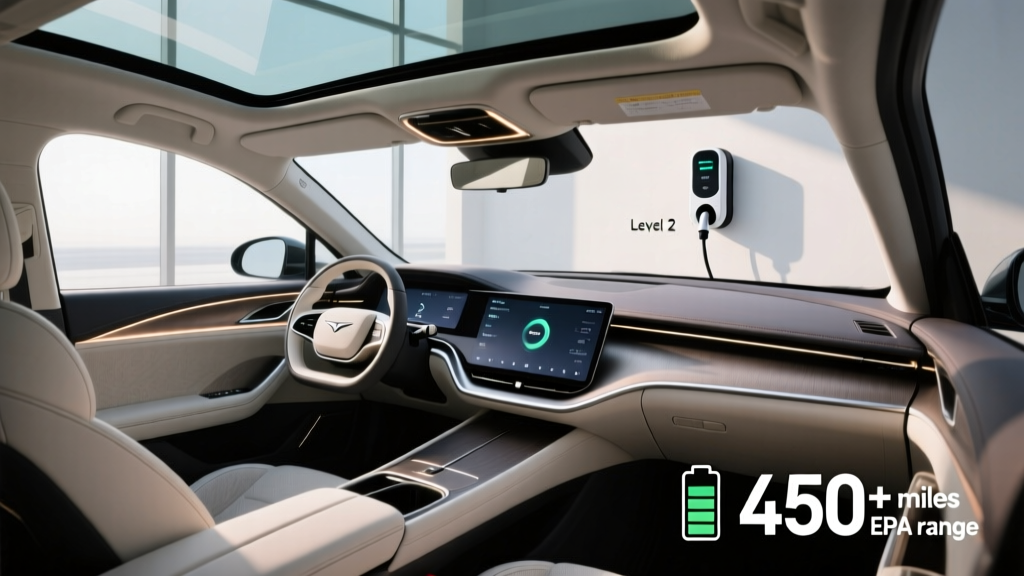
The Lucid Air Grand Touring interior is defined by its "post-luxury" philosophy: expansive glass, minimal physical controls, and premium materials that lean toward Scandinavian restraint rather than traditional opulence. The full glass canopy roof stretches from windshield to rear window, flooding the cabin with light and creating a sense of openness that makes the sedan feel larger than its exterior dimensions suggest.
Materials and build quality: The Grand Touring comes standard with Nappa leather upholstery (vegan leather is optional), open-pore wood trim, and aluminum accents. Stitching quality and panel gaps in 2025–2026 build vehicles have improved noticeably over early 2022–2023 production, based on owner reports. The steering wheel is a squared-off yoke-style design, which remains polarizing — some drivers adapt quickly, others find it impractical for low-speed maneuvers. A conventional round wheel is available as a no-cost option.
Infotainment: The centerpiece is a 34-inch curved glass cockpit display that spans the driver's field of view, supplemented by a lower touchscreen for climate and secondary controls. The system runs Lucid's proprietary software, which is visually clean but has drawn criticism for laggy response times and a lack of native Apple CarPlay/Android Auto (wireless mirroring is available via Lucid's app-based projection). Navigation, media, and vehicle settings are all accessed through the touchscreen — there are almost no physical buttons, which some buyers love and others find frustrating for quick adjustments while driving.
Passenger space: Despite the Air's sleek roofline, rear-seat headroom is surprisingly generous at 37.8 inches, and the 37.6 inches of rear legroom accommodates adults comfortably on longer trips. The rear seat is a three-across bench with outboard heating available. The 22.1 cu ft trunk (accessible via a wide-opening lid) and 10.0 cu ft frunk provide a combined 32.1 cu ft — more cargo space than a BMW 5 Series or Mercedes E-Class, and competitive with the Tesla Model S (28 cu ft trunk, no frunk in current builds).
Notable interior drawbacks: The lower touchscreen's haptic-only feedback can be hard to use without looking. Rear-seat visibility is somewhat compromised by the thick C-pillars and sloping roofline. There are no rear-seat entertainment screens built in (though tablet mounts are available). And the yoke steering wheel, while striking, is not universally practical.
Performance, Ride Quality, and Driver Assistance
The Grand Touring's dual-motor AWD powertrain produces 819 horsepower standard, launching the 5,200-pound sedan to 60 mph in 3.0 seconds. With the optional Sprint Pack ($5,000), output rises to 1,050 hp and 0–60 drops to 2.6 seconds — supercar territory. The power delivery is linear and relentless, with none of the hesitation that turbocharged gas engines exhibit. At highway speeds, passing acceleration is instantaneous.
Ride quality benefits from the standard adaptive air suspension, which adjusts damping in real time. In Comfort mode, the Air absorbs highway imperfections with the composure of an S-Class. In Sport mode, the suspension firms up noticeably and the steering weight increases, though the Air never feels like a sports sedan in corners — its mass is perceptible during aggressive direction changes. The regenerative braking system offers adjustable intensity, and at maximum regen, one-pedal driving is possible in most city conditions.
DreamDrive Pro (ADAS): Lucid's driver-assistance suite includes adaptive cruise control, lane-centering, automatic emergency braking, blind-spot monitoring, and surround-view cameras. The system uses a combination of cameras, radar, and lidar sensors (Lucid is one of the few automakers to include lidar as standard equipment). DreamDrive Pro is a SAE Level 2 system — meaning the driver must remain fully engaged with hands on the wheel and eyes on the road at all times. It does not offer hands-free driving on mapped highways like GM's Super Cruise or Ford's BlueCruise.
Lucid DreamDrive Pro is a Level 2 driver-assistance system. The vehicle can manage steering, acceleration, and braking under certain conditions, but the driver must remain alert, keep hands on the wheel, and be prepared to take over at any moment. This is not autonomous or "self-driving" capability. Only Level 4 services (such as Waymo's robotaxi) operate without a human driver.
Pricing, Trims, and Federal Tax Credit Eligibility
The 2026 Lucid Air Grand Touring starts at $127,400 (including $1,500 destination). Key options include the Sprint Pack ($5,000), 21" DreamDrive wheels ($2,500), Nappa leather upgrade packages, and premium paint colors ($1,000–$3,000). A well-equipped Grand Touring typically lands between $132,000 and $140,000 before incentives.
| Trim Level | Base MSRP | Federal Tax Credit (§30D) | Effective Starting Price |
|---|---|---|---|
| Air Pure | $71,400 | Up to $7,500 (if eligible) | ~$63,900 |
| Air Touring | $87,400 | Up to $7,500 (if eligible) | ~$79,900 |
| Air Grand Touring | $127,400 | Up to $7,500 (if eligible) | ~$119,900 |
| Air Sapphire | $250,500 | Up to $7,500 (if eligible) | ~$243,000 |
- MSRP Cap: Sedans must have an MSRP at or below $55,000 to qualify. The Grand Touring at $127,400 exceeds this cap and does NOT qualify for the §30D new-vehicle credit. Only the Air Pure (in certain configurations) may fall under the cap.
- Buyer Income Limits: Modified AGI must not exceed $150,000 (single), $225,000 (head of household), or $300,000 (joint filers).
- Battery Sourcing: Credit phases in based on critical-mineral and battery-component sourcing requirements that tighten annually through 2032.
- Point-of-Sale Transfer: Eligible credits can be applied at purchase as a down-payment reduction (dealer must be IRS-registered).
- State/Local Incentives: Some states offer additional rebates or HOV-lane access regardless of federal eligibility. Check your state's energy office or the AFDC incentive database for details.
Note: Tax rules change frequently. Consult a tax professional and verify current eligibility at IRS.gov before purchasing.
The Grand Touring's price places it in direct competition with the Tesla Model S Long Range (~$81,000), the Mercedes EQS 580 (~$120,000), and the BMW i7 xDrive60 (~$120,000). The Lucid's advantage is its substantially greater range and efficiency. Its disadvantage is a smaller service-center network and lower brand recognition among traditional luxury buyers.
Ownership Costs and Warranty Coverage
Lucid covers the Grand Touring's battery and drive unit for 8 years or 100,000 miles, whichever comes first, against defects and capacity loss below 70% of original capacity. The bumper-to-bumper warranty is 5 years / 60,000 miles. These terms are competitive with Tesla and slightly below Hyundai/Kia's 10-year battery coverage.
Estimated 5-year ownership costs factor in electricity (at $0.14/kWh national average, a full charge costs approximately $15.70 for ~516 miles — about $0.03 per mile), insurance (luxury EV premiums average $2,800–$3,500/year depending on location and driving record), and depreciation (the Air Grand Touring has experienced steeper first-year depreciation than the Model S, though Lucid's growing production and improved build quality may stabilize this). Total 5-year operating cost (energy + insurance + estimated maintenance) is roughly $30,000–$38,000 — significantly less than a comparable gas-powered BMW 7 Series or Mercedes S-Class when fuel costs are factored in.
Maintenance is minimal: cabin air filter replacement, tire rotation, brake fluid checks, and wiper blades. The regenerative braking system significantly extends brake pad life — many EV owners report original pads lasting 80,000+ miles.
Pros, Cons, and Who Should Buy
- Class-leading 516-mile EPA range; ~400+ miles real-world highway
- Outstanding efficiency (131 MPGe / 25 kWh/100 mi)
- 300 kW peak DC fast charging with 900V architecture
- Spacious, airy interior with excellent rear-seat room
- Standard lidar sensor suite for DreamDrive Pro ADAS
- Supercar-level acceleration (2.6 sec 0–60 w/ Sprint Pack)
- NACS charge port standard — native Tesla Supercharger access
- 32.1 cu ft total cargo (trunk + frunk)
- $127K+ price exceeds federal §30D sedan MSRP cap ($55K limit)
- Limited service-center network vs. Tesla, BMW, Mercedes
- Infotainment lacks native Apple CarPlay/Android Auto
- Yoke steering wheel is polarizing (round wheel available)
- Touchscreen-only controls can distract while driving
- DreamDrive Pro is Level 2 only — no hands-free highway mode
- Steeper depreciation than established luxury brands (improving)
- 21" wheels reduce range by 35 EPA miles
- Maximum range is your top priority — no other luxury sedan comes close to 516 miles
- You frequently take long road trips and want fewer charging stops
- You value cabin space and an open, glass-heavy interior design
- You want a dual-motor AWD luxury sedan with sub-3-second 0–60 capability
- You have access to home Level 2 charging and can install a 48A+ circuit
- You need hands-free highway driving (consider BMW i7 with Highway Assistant or Mercedes EQS with Drive Pilot in approved areas)
- You prefer physical buttons and traditional infotainment (BMW i7, Mercedes EQS)
- You want the widest service-center network and proven long-term resale (Tesla Model S)
- Budget is below $100K (consider the Air Touring at $87K or Air Pure at $71K)
Frequently Asked Questions
What is the real-world range of the Lucid Air Grand Touring?
The EPA estimates 516 miles with 19" wheels. In real-world highway driving at 75 mph in moderate temperatures, expect approximately 390–430 miles. In cold weather (below 32°F), plan for 340–400 miles. City and mixed driving returns results closer to the EPA sticker, typically 450–490 miles.
How fast does the Grand Touring charge on DC fast chargers and at home?
On a 350 kW DC fast charger, the Grand Touring peaks at approximately 300 kW and charges from 10–80% in about 20 minutes under optimal conditions. At home on a 48-amp (11.5 kW) Level 2 circuit, it adds roughly 46 miles of range per hour, fully charging in about 10 hours. A hardwired 80-amp (19.2 kW) circuit reduces full-charge time to approximately 6 hours.
Does the Lucid Air Grand Touring qualify for the federal EV tax credit?
No. Under current IRS §30D rules, new sedans must have an MSRP at or below $55,000 to qualify. The Grand Touring starts at $127,400, far exceeding this cap. The lower-priced Air Pure (in specific configurations) may qualify, subject to buyer income limits and battery-sourcing requirements. Always verify at IRS.gov and consult a tax professional.
Is the Lucid Air Grand Touring worth buying over the Tesla Model S or Mercedes EQS?
The Grand Touring wins decisively on range (516 vs. ~402 miles for the Model S Long Range and ~350 for the EQS 450+) and efficiency. The Model S offers a more mature Supercharger ecosystem, hands-free-capable Autopilot (FSD Supervised, still Level 2), and stronger resale value. The Mercedes EQS provides a more traditional luxury interior with physical controls and a broader dealer network. If range and efficiency are your top priorities, the Grand Touring is the strongest choice. If service infrastructure and hands-free driving matter more, the Model S or EQS may be better fits.
What is the Lucid Air Grand Touring's battery chemistry and will it degrade?
The Grand Touring uses an NMC (nickel-manganese-cobalt) lithium-ion battery pack with 112 kWh of usable capacity. NMC offers high energy density but is more sensitive to extreme heat and sustained 100% SoC storage than LFP chemistry. Lucid's battery management system includes active thermal management and a buffer to minimize degradation. Lucid warrants the battery for 8 years/100,000 miles against capacity loss below 70%. Best practices: charge to 80% for daily use, use DC fast charging primarily for road trips, and precondition in extreme temperatures.
Does the Grand Touring have Apple CarPlay or Android Auto?
Not natively. Lucid uses its proprietary infotainment system with a 34-inch curved glass display. Smartphone mirroring is available through Lucid's app-based projection, but it is not the seamless plug-and-play experience of native CarPlay or Android Auto. This is one of the most common complaints from new owners accustomed to phone integration in other vehicles.
How much cargo space does the Lucid Air Grand Touring offer?
The Grand Touring provides 22.1 cubic feet in the trunk and 10.0 cubic feet in the front trunk (frunk), for a total of 32.1 cubic feet. This exceeds the Tesla Model S (28 cu ft trunk, limited frunk) and is competitive with midsize luxury SUVs. The trunk opening is wide, and the frunk is useful for charging cables or a small bag.