Quick Verdict: The Efficiency King Still Holds the Crown
The Lucid Air remains the most energy-efficient long-range sedan in the U.S. market. Whether you're looking at the entry-level Lucid Air Pure or the range-topping trims that evolved from the original Lucid Founders Edition reservation program, this car delivers numbers that still embarrass competitors costing tens of thousands more. For 2026, Lucid has streamlined the lineup into Pure, Touring, and Grand Touring trims, but the engineering DNA from those early Founders reservation models — miniaturized drive units, a 900V+ architecture, and class-leading aerodynamics — persists across the range.
The Pure starts at $69,900 and delivers up to 419 miles of EPA range. The Grand Touring pushes past 500 miles. But spec sheets don't tell the full story. Below, we break down what real-world ownership actually looks like: highway range loss, charging-curve behavior, tax-credit eligibility, and whether this car makes sense versus a Tesla Model S, Mercedes EQS, or BMW i5.
Range & Efficiency: EPA Numbers vs. the Real World
Real-World Expectation: ~340–370 mi at sustained 75 mph highway speeds; ~280–310 mi in sub-30°F winter conditions with cabin heat. The Air's 0.197 Cd drag coefficient helps it hold efficiency better than most at highway speed, but cold still cuts any EV's range 15–25%.
The Air Pure's efficiency is where Lucid's engineering shows its depth. At roughly 3.6–4.0 miles per kWh in mixed driving (per fueleconomy.gov), the Air sips electrons at a rate that makes a 118 kWh battery feel much larger. For comparison, the Mercedes EQS 450+ manages about 3.2 mi/kWh with a similarly sized pack. That efficiency delta means fewer charging stops on road trips and lower electricity costs over ownership.
The Grand Touring, with its larger 118 kWh usable battery and dual-motor AWD, achieves an EPA-estimated 516 miles — still the highest EPA range of any production EV sold in the U.S. as of 2026. Expect roughly 420–450 mi in real-world highway driving for the Grand Touring, and around 350 mi in deep winter.
| Trim | Drivetrain | Battery (usable kWh) | EPA Range | MPGe (combined) | mi/kWh |
|---|---|---|---|---|---|
| Pure RWD | Rear-Wheel Drive | 88 kWh | 419 mi | 146 MPGe | ~4.0 |
| Touring AWD | Dual-Motor AWD | 118 kWh | 425 mi | 131 MPGe | ~3.6 |
| Grand Touring AWD | Dual-Motor AWD | 118 kWh | 516 mi | 131 MPGe | ~4.4 |
Note: MPGe and mi/kWh figures are approximate based on EPA testing. Actual efficiency varies with driving style, temperature, and terrain. Source: fueleconomy.gov
Battery Chemistry & Longevity
The Lucid Air uses NMC (nickel manganese cobalt) lithium-ion cells in a structural pack. The Pure's 88 kWh usable pack and the Touring/Grand Touring's 118 kWh pack both use 2170-format cylindrical cells. Lucid has not switched to LFP chemistry in any Air trim as of 2026 — the energy-density advantage of NMC is critical for hitting 400+ mile targets in a sedan form factor.
NMC trade-offs versus LFP: higher energy density (more range per pound), but slightly faster calendar degradation and a recommendation to keep daily charge between 20–80% for longevity. Lucid's battery management system includes a robust thermal management loop that preconditions and actively cools the pack, which historically correlates with slower degradation curves.
Charging: DC Fast Charge, Home Level 2 & Real-World Curves
Lucid's 900V+ electrical architecture is the backbone of its charging performance. Higher voltage means the car can accept more power at a given amperage, which translates to faster charging at compatible stations — and less heat generation in the cables and pack.
| Charging Level | Power / Rate | Speed | Notes |
|---|---|---|---|
| Level 1 (120V household) | ~1.4 kW | ~3–4 mi/hr | Emergency/trickle only |
| Level 2 (240V home, 48A) | ~11.5 kW | ~38–42 mi/hr | Fills 88 kWh pack in ~8 hrs |
| DC Fast Charge (peak) | Up to 200 kW (Pure) / 250 kW (GT) | 10–80% in ~20 min (Pure), ~22 min (GT) | Requires 350 kW CCS or NACS station; curve tapers significantly above 80% |
Charging-curve reality check: The Air peaks near 200–250 kW only between roughly 10–40% state of charge. From 40–60%, it sustains around 150–170 kW, and above 80%, it drops to under 50 kW. This is normal for NMC packs with protective BMS protocols, but it means the advertised "20-minute 10–80%" figure assumes ideal conditions: a preconditioned battery, a station capable of delivering sustained power, and moderate ambient temperature. On a cold battery without preconditioning, add 5–10 minutes.
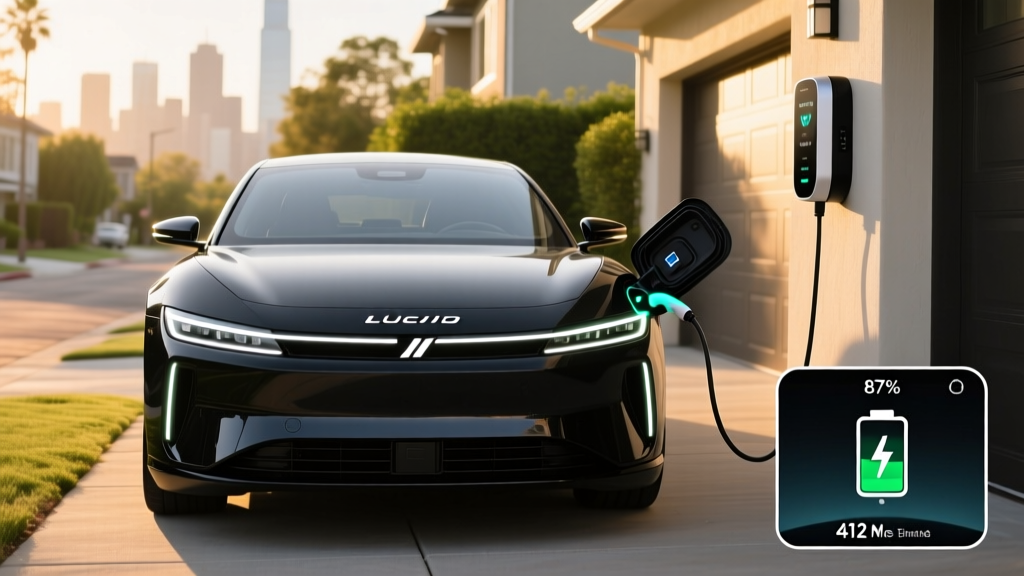
For home charging, a 48-amp Level 2 wall connector on a 60-amp breaker circuit delivers roughly 11.5 kW. That's enough to fully replenish the Pure overnight. The Grand Touring's 118 kWh pack takes roughly 10–11 hours from near-empty on Level 2 — fine for overnight, but worth knowing if your commute eats 100+ miles daily.
Lucid uses the CCS1 connector on current Air models. With the industry's shift toward NACS (Tesla's connector), Lucid has confirmed a NACS port is coming in future model years, and current CCS owners will have adapter access. As of 2026, a CCS-to-NACS adapter is available for Supercharger access.
Performance & Driving Dynamics
| Trim | Horsepower | 0–60 mph | Drivetrain | Top Speed |
|---|---|---|---|---|
| Pure RWD | 430 hp | 5.0 sec | Rear-Wheel Drive | 145 mph |
| Touring AWD | 620 hp | 3.4 sec | Dual-Motor AWD | 168 mph |
| Grand Touring AWD | 819 hp | 3.0 sec | Dual-Motor AWD | 168 mph |
Even the base Pure hits 60 mph in 5.0 seconds — brisk for a full-size luxury sedan. The Touring and Grand Touring enter supercar territory, with the GT's 819 hp and 3.0-second sprint rivaling a Porsche Taycan Turbo. Lucid's miniaturized drive units (each roughly the size of a carry-on suitcase) contribute to the car's low center of gravity and generous interior space.
Ride quality is air-suspended on Touring and Grand Touring trims; the Pure uses a steel-spring setup that's still comfortable but slightly less adaptive. Steering is precise and well-weighted across the lineup, and regenerative braking offers adjustable levels — though Lucid does not offer true one-pedal driving with a complete stop-and-hold function the way some competitors do.
Interior, Tech & Cargo
The Air's cabin leans minimalist-luxury, with a curved 34-inch glass canopy display spanning the driver's cluster and infotainment. There's no traditional center stack screen — climate controls and media live in the glass canopy and a small lower touchscreen. The interface is visually clean but occasionally requires more taps than rival systems for common tasks like adjusting fan speed.
Passenger space is genuinely impressive for the exterior footprint:
- Front legroom: 46.2 inches
- Rear legroom: 40.9 inches (class-leading — rivals like the Model S and EQS trail by 1–3 inches)
- Rear headroom: 37.8 inches
Cargo capacity: 32.0 cubic feet in the trunk (the Air uses a traditional sedan trunk, not a hatchback or liftback), plus a 10.0 cubic-foot front trunk (frunk). Total: ~42 cu ft. This trails the Tesla Model S's hatchback layout (~28 cu ft rear + hatch + frunk), which is more practical for bulky items despite a lower number on paper.
Driver assistance: Lucid's DreamDrive Pro system uses 32 sensors including lidar, cameras, and radar. It provides highway lane-centering, adaptive cruise, and automatic lane changes — an SAE Level 2 system. The driver must keep hands on or near the wheel and remain engaged. It is not autonomous driving. DreamDrive Pro is competent and smooth but not as assertive as Tesla's FSD (Supervised) or GM's Super Cruise in hands-free zones.
Pricing, Trims & Federal Tax Credit Eligibility
| Trim | Base MSRP | As-Tested (typical) | §30D Federal Credit Eligible? |
|---|---|---|---|
| Pure RWD | $69,900 | $72,000–$75,000 | Potentially — see rules below |
| Touring AWD | $87,400 | $92,000–$98,000 | No — exceeds $55,000 sedan MSRP cap |
| Grand Touring AWD | $125,600 | $130,000–$145,000 | No — exceeds $55,000 sedan MSRP cap |
Critical §30D tax credit context: The IRS classifies the Lucid Air as a sedan, which means the MSRP cap is $55,000 (per irs.gov). Only the Pure RWD at its base $69,900 price is in the conversation — and even then, it exceeds the cap. As of 2026, the Pure does not qualify for the full $7,500 new-vehicle credit under §30D because its MSRP is above $55,000.
Buyer income limits also apply: modified AGI cannot exceed $150,000 (single), $225,000 (head of household), or $300,000 (joint). Battery component sourcing and critical-mineral requirements add further eligibility layers. Always verify current rules on irs.gov and consult a tax professional before purchase. Point-of-sale transfer of the credit is available for eligible vehicles — but eligibility is the threshold question here, and the Air's pricing is the main obstacle.
Used EV credit (IRC §25E): A pre-owned Lucid Air may qualify for up to $4,000 (30% of sale price, capped) if the used sale price is $25,000 or less, buyer income is within limits, and the vehicle is at least two model years old. As of early 2026, some 2022–2023 Air Pure models are approaching this price on the used market.
Pros & Cons
Pros
- Class-leading EPA range (up to 516 mi on Grand Touring)
- Best-in-class energy efficiency (~4.0 mi/kWh on Pure)
- Spacious rear seat with 40.9" legroom
- 900V architecture enables strong DC fast-charge speeds
- Refined ride quality, especially with air suspension
- Understated, elegant design inside and out
Cons
- Does not qualify for §30D new-vehicle tax credit (MSRP cap)
- Sedan trunk limits cargo versatility vs hatchback rivals
- Infotainment requires learning curve; no physical knobs
- CCS port requires adapter for Tesla Supercharger access
- Limited service center network outside major metros
- No one-pedal driving to a full stop
Who Should Buy the Lucid Air?
Choose the Lucid Air Pure if: You want maximum range per dollar, primarily drive solo or with one passenger, commute 40–80 miles daily, and can charge at home. The Pure's 419-mile EPA range means most owners will charge once per week on a standard commute.
Choose the Touring or Grand Touring if: You need dual-motor AWD for snow-belt climates, want sub-3.5-second 0–60 performance, and budget is flexible above $90,000. The GT is a legitimate grand-tourer that can cross the country on fewer stops than any rival.
Look elsewhere if: You need hatchback cargo versatility (Tesla Model S, Porsche Taycan Sport Turismo), hands-free highway driving in approved zones (GM Super Cruise), or a vehicle that qualifies for the $7,500 federal credit (consider the BMW i5 eDrive40, Hyundai Ioniq 6, or Tesla Model 3).
Lucid Air vs. Key Competitors
| Attribute | Lucid Air Pure | Tesla Model S LR | Mercedes EQS 450+ | BMW i5 eDrive40 |
|---|---|---|---|---|
| EPA Range | 419 mi | 402 mi | 390 mi | 295 mi |
| Battery (usable) | 88 kWh | ~100 kWh | 108 kWh | 84 kWh |
| DC Fast Charge Peak | 200 kW | 250 kW | 200 kW | 205 kW |
| 0–60 mph | 5.0 sec | 3.1 sec | 5.9 sec | 5.7 sec |
| Base MSRP | $69,900 | $79,990 | $104,400 | $66,800 |
| §30D Credit Eligible | No (MSRP cap) | No (MSRP cap) | No (MSRP cap) | No (MSRP cap) |
| Rear Legroom | 40.9" | 40.9" | 42.0" | 36.6" |
The Air Pure wins on range and efficiency. The Model S wins on performance and charging infrastructure access (native NACS + Supercharger network). The EQS wins on rear-seat luxury and space. The i5 wins on price and driving dynamics but gives up 120+ miles of range. None of these sedans clear the $55,000 §30D MSRP cap — if the credit is a dealbreaker, you'll need to look at the compact/midsize segment.
Frequently Asked Questions
What is the real-world range of the Lucid Air?
The Pure RWD delivers an EPA-estimated 419 miles. In real-world highway driving at 75 mph, expect 340–370 miles. In winter conditions below 30°F, plan for 280–310 miles. The Grand Touring's 516-mile EPA rating translates to roughly 420–450 miles on the highway in moderate weather.
How fast does the Lucid Air charge?
On a 350 kW CCS DC fast charger, the Air Pure peaks at around 200 kW and charges from 10–80% in approximately 20 minutes with a preconditioned battery. At home on a 48-amp Level 2 charger (11.5 kW), a full charge takes about 8 hours for the Pure and 10–11 hours for the Grand Touring.
Does the Lucid Air qualify for the federal EV tax credit?
As a new vehicle, no. The IRS §30D credit caps sedan MSRPs at $55,000, and the cheapest Air Pure starts at $69,900. However, a qualifying used Air (2+ model years old, sale price ≤$25,000, buyer within income limits) may be eligible for up to $4,000 under the §25E used-EV credit. Always verify on irs.gov.
Is the Lucid Air worth buying vs. a Tesla Model S?
If range and efficiency are your top priorities, yes — the Air delivers more miles per kWh and a smoother ride. If charging infrastructure, over-the-air updates, and performance-per-dollar matter more, the Model S has the edge. The Air also has a more spacious rear seat. Test-charge both on your most common routes before deciding.
What happened to the Lucid Founders Edition?
The Founders Edition was Lucid's initial limited-run reservation model for early backers, featuring unique badging, exclusive colors, and fully loaded Grand Touring specs. Lucid has since transitioned to its standard Pure/Touring/Grand Touring trim structure. The engineering and specification of today's Grand Touring is the direct successor to those original Founders Edition vehicles.
How reliable is the Lucid Air?
Lucid is a young automaker, and long-term reliability data is still maturing. Early owner surveys (Consumer Reports, J.D. Power) have flagged build-quality inconsistencies and software bugs in 2022–2023 models. Lucid has issued multiple OTA updates and service campaigns to address these. The 8-year/100,000-mile battery and powertrain warranty provides a meaningful safety net.