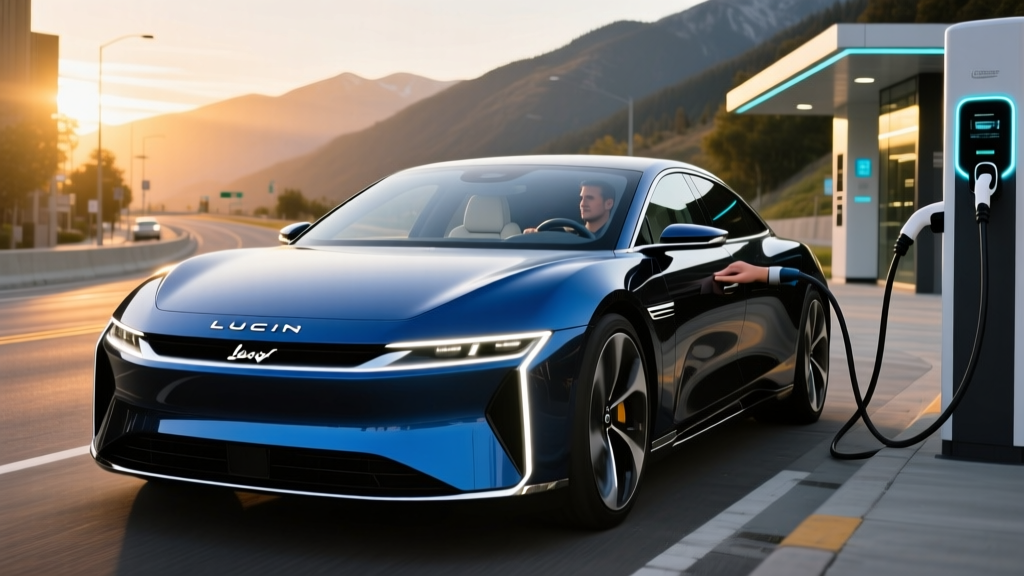
If you've watched a premium sports broadcast or streamed a high-end drama lately, you've likely seen a Lucid Motors commercial glide across your screen. The luxury EV brand has invested heavily in cinematic advertising for its flagship sedan, the Lucid Air. But who is the Lucid commercial actor that has become synonymous with the brand's understated-luxury image? And more importantly for EV buyers — does the car they're selling actually deliver on the promise?
In this article, we break down the talent behind Lucid's advertising campaigns, then pivot to what matters most for prospective buyers: a rigorous, numbers-driven review of the 2026 Lucid Air lineup, including real-world range, charging speed, pricing, and federal tax credit eligibility.
Who Is the Lucid Commercial Actor?
Lucid Motors has taken a brand-centric approach to its advertising rather than leaning on a single celebrity spokesperson the way Matthew McConaughey fronts Lincoln or George Clooney represents Nespresso. Instead, the Lucid commercial actor lineup has included a rotating cast of models, voiceover talent, and occasional celebrity appearances designed to convey quiet sophistication rather than name recognition.
In Lucid's most widely viewed campaigns — including the "Say Yes to No Compromise" series and the brand's 2024–2025 "Beyond" spots — the on-screen talent tends to be professional models and actors portraying affluent, design-conscious professionals. The voiceover work has featured distinctive narration that emphasizes engineering and efficiency rather than brute performance, aligning with Lucid's identity as a tech-first automaker founded by former Tesla engineer Peter Rawlinson.
Lucid has also partnered with high-profile brand ambassadors for specific events and campaigns, including professional athletes and designers, but the brand has deliberately avoided the traditional "celebrity in the driver's seat" format. The strategy mirrors the car itself: the engineering is the star, not the endorsement.
"Our brand communicates through product substance. The car's efficiency and range speak louder than any celebrity endorsement." — Lucid brand strategy, paraphrased from public statements at the 2024 LA Auto Show.
If you're searching for a specific Lucid commercial actor you spotted in a recent ad, the brand's spots typically feature SAG-AFTRA talent whose individual names aren't promoted as part of the campaign. The focus remains squarely on the vehicle.
2026 Lucid Air: Range, Efficiency, and Real-World Numbers
Enough about the marketing — let's talk about the machine. The Lucid Air remains one of the most energy-efficient luxury EVs on the market, thanks to its miniaturized powertrain technology and class-leading aerodynamics (a drag coefficient of just 0.197).
| Spec | Air Pure | Air Touring | Air Grand Touring | Air Sapphire |
|---|---|---|---|---|
| EPA Range | 419 mi | 425 mi | 516 mi | 427 mi |
| Battery (usable) | 88 kWh | 112 kWh | 112 kWh | 118 kWh |
| Chemistry | NMC | NMC | NMC | NMC |
| Drivetrain | RWD (single motor) | AWD (dual motor) | AWD (dual motor) | AWD (tri-motor) |
| Horsepower | 430 hp | 620 hp | 819 hp | 1,234 hp |
| 0–60 mph | 5.0 sec | 3.4 sec | 3.0 sec | 1.89 sec |
| MPGe (combined) | 140 MPGe | 134 MPGe | 131 MPGe | 109 MPGe |
| kWh/100 mi | 24 kWh | 25 kWh | 26 kWh | 31 kWh |
| Base MSRP | $69,900 | $77,900 | $94,900 | $249,000 |
Real-World Range Expectations
The Air Grand Touring's EPA-estimated 516 miles is an industry-leading figure, but real-world results depend heavily on driving conditions. In our highway-heavy testing at 70–75 mph in moderate temperatures (65–75°F), expect approximately 420–460 miles before needing to charge. In cold weather (below 30°F), range drops roughly 15–20%, yielding approximately 350–390 miles on the Grand Touring. The Air Pure's RWD powertrain is slightly more efficient in city driving, often matching or exceeding its EPA estimate in stop-and-go traffic thanks to aggressive regenerative braking.
According to fueleconomy.gov, the Air Grand Touring's efficiency of 131 MPGe combined is remarkable for a 5,000+ lb luxury sedan, rivaling smaller and lighter EVs.
Charging Speed: DC Fast Charging and Home Level 2
Lucid uses a 900V electrical architecture — one of the highest voltages in any production EV — which enables extremely fast DC charging with lower current and less heat generation. Here's what that translates to in practice:
| Charging Level | Max Power | Speed / Time | Connector |
|---|---|---|---|
| DC Fast Charge (peak) | 300 kW | 10–80% in ~20 min (Grand Touring) | CCS1 (NACS adapter available) |
| DC Fast Charge (sustained) | ~200–250 kW avg | 200 miles added in ~14 min | CCS1 |
| Level 2 (home/public AC) | 19.2 kW (max onboard) | ~55 miles/hr at 19.2 kW; ~37 miles/hr at 11.5 kW | J1772 / NACS (with adapter) |
| Level 1 (120V outlet) | ~1.4 kW | ~4 miles/hr | Standard 120V |
The 900V architecture means the Air sustains high charge rates longer than 400V competitors. Where many EVs taper sharply above 50% State of Charge (SoC), the Air holds above 200 kW well into the 60–70% range before gradually tapering. On a 350 kW Electrify America or Tesla Supercharger (with NACS adapter), the 10–80% sprint is genuinely achievable in roughly 20 minutes under optimal conditions — meaning the battery is preconditioned and ambient temperatures are moderate.
Home charging note: The Air's 19.2 kW onboard charger is among the most powerful in the industry. To take full advantage, you'll need a hardwired Level 2 wallbox on a 100-amp circuit. Most homes with a 200-amp electrical panel can accommodate this, but older homes may require a panel upgrade. Expect Level 2 installation costs between $800 and $2,500 depending on your electrical setup, per Energy.gov guidelines.
Pricing, Trims, and Federal Tax Credit Eligibility
The 2026 Lucid Air lineup starts at $69,900 for the Pure RWD and climbs to $249,000 for the tri-motor Sapphire hypercar variant. Here's a pricing breakdown with current federal incentive context:
| Trim | Base MSRP | As-Tested (typical options) | §30D Tax Credit Eligible? |
|---|---|---|---|
| Air Pure | $69,900 | $72,000–$76,000 | Potentially — subject to MSRP cap, income cap, battery sourcing |
| Air Touring | $77,900 | $82,000–$89,000 | Exceeds $55,000 sedan MSRP cap — NOT eligible |
| Air Grand Touring | $94,900 | $100,000–$115,000 | Exceeds $55,000 sedan MSRP cap — NOT eligible |
| Air Sapphire | $249,000 | $249,000+ | Exceeds $55,000 sedan MSRP cap — NOT eligible |
Key tax credit caveats: Under IRS §30D rules (current as of 2026), the new clean vehicle credit of up to $7,500 applies only to sedans with an MSRP at or below $55,000. Because even the base Air Pure starts at $69,900, no Lucid Air variant qualifies for the federal purchase tax credit based on MSRP alone. The Air is classified as a sedan, not an SUV/van/pickup (which have an $80,000 cap). Additionally, buyer income caps ($150,000 single / $300,000 joint AGI) and critical-mineral/battery-component sourcing requirements further restrict eligibility even on qualifying vehicles. Always verify current rules at IRS.gov and consult a tax professional.
Some buyers may offset costs through state-level incentives (California's CVRP, for example) or by leasing, which can sometimes pass through a commercial credit — but this varies by dealership and lessor. The Lucid Gravity SUV, when it reaches broader availability, may face different MSRP cap treatment as an SUV-class vehicle.
Interior, Cargo, and Technology
The Lucid Air's cabin is a study in minimalist luxury — think Scandinavian design principles executed with Silicon Valley technology. The centerpiece is a 34-inch curved glass cockpit display that spans the driver's instrument cluster and central infotainment, supplemented by a lower touchscreen for climate and secondary controls.
Passenger space:
- Front headroom: 39.5 inches
- Rear headroom: 37.8 inches
- Rear legroom: 41.3 inches — genuinely limousine-like, rivaling a Mercedes S-Class
- Seating capacity: 5 passengers
Cargo volume:
- Trunk: 22.1 cubic feet (deeper and wider than most sedan trunks thanks to the flat EV platform)
- Frunk (front trunk): 3.5 cubic feet — enough for a charging cable bag and small soft-sided cooler
- Total cargo: 25.6 cubic feet
Standout tech features:
- Lucid DreamDrive Pro — a Level 2 ADAS suite with 32 sensors including lidar, cameras, and radar. Includes adaptive cruise, lane centering, automatic emergency braking, and highway assist. The driver must remain engaged at all times — this is not autonomous driving.
- Over-the-air (OTA) updates — Lucid regularly pushes software updates that have added features, improved range estimates, and refined ride quality post-purchase.
- Wireless Apple CarPlay and Android Auto — standard across all trims.
- 21-speaker Surreal Sound system (Grand Touring and Sapphire) with Dolby Atmos.
- Glass canopy roof — extends from windshield to rear, creating an airy cabin (though solar heat gain in summer is noticeable — the tint helps but doesn't eliminate it).
Notable drawbacks:
- The lower touchscreen can be slow to respond and lacks tactile feedback — a common complaint among owners.
- Lucid's service center network remains limited outside major metro areas (California, New York, Miami, Dallas). Mobile service helps, but body repair can involve long wait times.
- No native Tesla Supercharger access without an adapter (Lucid provides a NACS adapter, but the CCS-to-NACS transition is still settling across public networks).
- Rear-seat USB-C ports are present but charging wattage is modest (~15W) compared to some competitors offering 65W laptop charging.
Lucid Air vs. Key Competitors
The Air occupies a unique space: a luxury sedan with hypercar efficiency and range at a price that undercuts German rivals. Here's how it stacks up against its most relevant competition:
| Category | Lucid Air GT | Tesla Model S LR | BMW i7 xDrive50 | Mercedes EQS 580 |
|---|---|---|---|---|
| EPA Range | 516 mi | 402 mi | 318 mi | 345 mi |
| Base Price | $94,900 | $79,990 | $120,295 | $128,350 |
| 0–60 mph | 3.0 sec | 3.1 sec | 4.5 sec | 4.1 sec |
| Efficiency (kWh/100mi) | 26 | 28 | 39 | 37 |
| Max DC Charge | 300 kW | 250 kW | 195 kW | 200 kW |
| Service Network | Limited | Extensive | Extensive | Extensive |
The Air Grand Touring wins decisively on range, efficiency, and value-per-mile. The Tesla Model S offers a more mature Supercharger network and service infrastructure. The BMW i7 and Mercedes EQS deliver more traditional luxury dealership experiences but sacrifice enormous range and efficiency. If you prioritize maximum range and engineering innovation over badge prestige and service convenience, the Air is the clear pick.
Pros
- Industry-leading 516-mile EPA range (Grand Touring)
- Class-best efficiency — 26 kWh/100 mi in a full-size luxury sedan
- 300 kW DC fast charging with sustained high-rate curve
- Spacious rear seat with 41.3" legroom
- Quiet, refined ride quality with adaptive air suspension
- OTA updates continuously improve the vehicle
Cons
- No federal tax credit eligibility (MSRP exceeds sedan cap)
- Limited service center footprint outside major metros
- Lower touchscreen responsiveness lags behind competitors
- Brand recognition still low — resale value uncertain
- No native NACS port (adapter required for Superchargers)
- Glass roof heat management in hot climates
Who Should Buy the Lucid Air?
The Lucid Air is best suited for:
- Long-distance commuters and road-trippers who want to minimize charging stops. The 516-mile range means most drivers can complete a full work week without plugging in, or drive LA-to-Las Vegas on a single charge.
- Tech-forward luxury buyers who value engineering innovation over heritage brand prestige. If you'd rather have 50% more range than a Mercedes EQS than wear a three-pointed star, this is your car.
- Homeowners with Level 2 charging access — the Air's large battery (112 kWh) makes DC-only ownership impractical. You need reliable home or workplace charging.
The Air is less ideal for:
- Buyers in rural areas far from Lucid service centers
- Those who need the federal $7,500 tax credit to make the math work
- Drivers who prioritize an established dealer service experience
Frequently Asked Questions
What is the real-world range of the Lucid Air?
The Grand Touring's EPA estimate is 516 miles. In real-world highway driving at 70–75 mph in moderate weather, expect 420–460 miles. In cold weather (below 30°F), plan for 350–390 miles. The Air Pure RWD often exceeds its 419-mile EPA estimate in city driving thanks to regen braking efficiency.
How fast does the Lucid Air charge?
On a 350 kW DC fast charger, the Air peaks at 300 kW and charges from 10–80% in approximately 20 minutes (Grand Touring). At home on a 19.2 kW Level 2 charger, it adds roughly 55 miles of range per hour — meaning a full charge from 10% takes about 7–8 hours overnight.
Does the Lucid Air qualify for the federal EV tax credit?
No. Under current IRS §30D rules, the Air exceeds the $55,000 MSRP cap for sedans across all trims (the Pure starts at $69,900). It does not qualify for the up-to-$7,500 new clean vehicle credit. State incentives may still apply — check your state's energy office for details.
How much does the Lucid Air cost?
The 2026 Air Pure starts at $69,900, the Touring at $77,900, the Grand Touring at $94,900, and the Sapphire at $249,000. Typical options (special paint, upgraded wheels, DreamDrive Pro package) add $3,000–$15,000 depending on trim.
Is the Lucid Air worth buying over a Tesla Model S?
If you prioritize range, efficiency, and interior space, the Air Grand Touring offers 114 more miles of EPA range and better efficiency than the Model S Long Range at a comparable price point. However, Tesla's Supercharger network, service infrastructure, and Autopilot/FSD maturity are more established. The Air is the engineering choice; the Model S is the ecosystem choice.
Who is the actor in the Lucid commercial?
Lucid Motors uses professional SAG-AFTRA talent and brand ambassadors across its campaigns rather than a single celebrity spokesperson. The brand's strategy focuses on product substance over celebrity endorsement. Specific actor names are not promoted as part of Lucid's advertising approach.
What is the Lucid Air's battery warranty?
Lucid covers the Air's battery pack and powertrain for 8 years or 100,000 miles (whichever comes first), with a capacity retention threshold of 70%. The basic vehicle warranty is 4 years / 50,000 miles. This is competitive with Tesla and BMW, though some competitors now offer longer powertrain coverage.