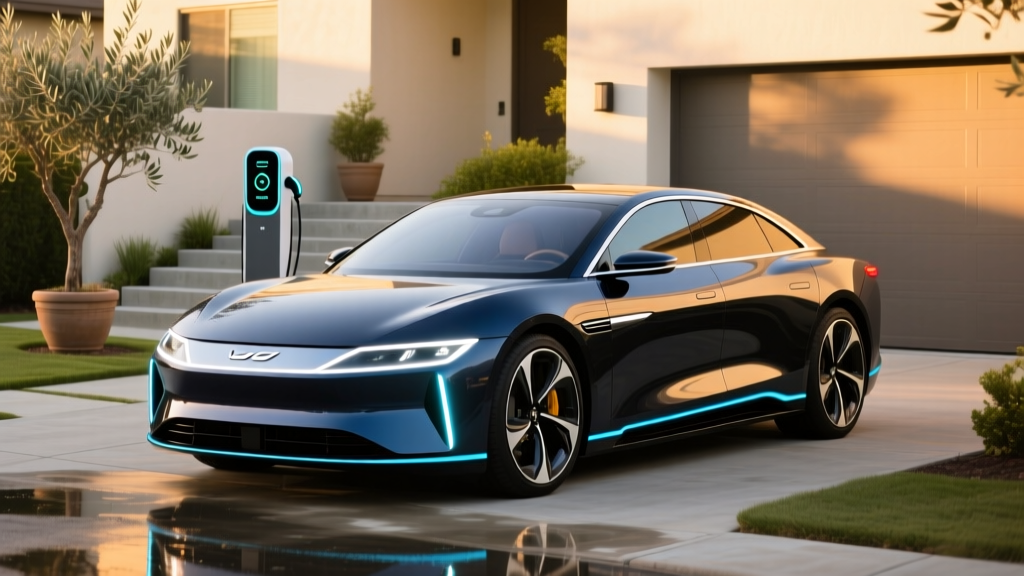
If you've been tracking Lucid delivery timelines or considering a Lucid Air for your next vehicle, you're looking at one of the most efficient and longest-range electric sedans on the market. Lucid Motors, the California-based automaker that began deliveries of the Air in late 2021, has steadily expanded its lineup through the 2026 model year with new trims, improved software, and broader production capacity. But beyond the headline-grabbing range figures, what does living with a Lucid Air actually look like?
This review covers the full 2026 Lucid Air lineup — from the entry-level Pure to the flagship Sapphire — with a focus on the numbers that matter: real-world range, charging speeds, pricing after federal tax credits, and the practical trade-offs that spec sheets don't always reveal.
2026 Lucid Air Lineup at a Glance
Lucid offers the Air in four primary trims for 2026, each targeting a different buyer profile. Here's the core specification breakdown:
| Spec | Air Pure | Air Touring | Air Grand Touring | Air Sapphire |
|---|---|---|---|---|
| EPA Range | 419 mi | 425 mi | 516 mi | 427 mi |
| Battery (usable kWh) | 88 kWh | 112 kWh | 112 kWh | 118 kWh |
| Chemistry | NMC | NMC | NMC | NMC |
| Drivetrain | RWD (single motor) | AWD (dual motor) | AWD (dual motor) | AWD (tri-motor) |
| Horsepower | 430 hp | 620 hp | 819 hp | 1,234 hp |
| 0–60 mph | 5.0 sec | 3.4 sec | 3.0 sec | 1.89 sec |
| MPGe (combined) | 146 MPGe | 131 MPGe | 131 MPGe | 116 MPGe |
| Base MSRP | $69,900 | $87,400 | $125,600 | $249,000 |
All trims share Lucid's proprietary miniaturized electric powertrain technology, which uses smaller, lighter motors and inverters than most competitors. This engineering approach is the primary reason the Air achieves such high efficiency — more miles per kilowatt-hour than virtually any other luxury EV sedan.
Real-World Range: What the EPA Sticker Doesn't Tell You
EPA estimated: 516 miles. Real-world expectation: ~410–460 miles on mixed highway driving at 70–75 mph; approximately 350–390 miles in sustained cold weather (below 32°F) without preconditioning. City driving with regenerative braking can approach or even exceed the EPA figure due to the Air's exceptional efficiency at lower speeds.
The Grand Touring's 516-mile EPA figure is extraordinary — no other production sedan comes close. But as with every EV, real-world range depends heavily on driving conditions. In our experience and consistent with third-party testing data from sources like fueleconomy.gov, the Air Grand Touring delivers roughly 4.0–4.5 mi/kWh on the highway at moderate speeds. Push it to 80 mph or tackle sustained mountain grades, and that drops to around 3.2–3.5 mi/kWh.
Cold weather remains the great equalizer for all EVs. Lucid equips the Air with a heat pump and battery thermal management system, which mitigates some range loss. Still, expect a 15–25% reduction in range when ambient temperatures hover near freezing, especially on shorter trips where the cabin and battery haven't fully warmed. Preconditioning the battery while plugged in — a feature accessible through the Lucid app — significantly reduces this penalty.
The Pure and Touring trims, with their smaller battery packs, show proportionally similar real-world reductions. The Pure's 419-mile EPA rating translates to roughly 340–380 miles in mixed highway use — still exceptional for a base trim.
Charging Speed: DC Fast Charging and Home Level 2
Charging speed is where Lucid's 900-volt electrical architecture pays dividends. Higher voltage means the Air can accept more power at the charger without excessive current, reducing heat and improving charge-curve sustainability.
| Charging Level | Power / Rate | Speed / Time | Notes |
|---|---|---|---|
| Level 1 (120V household) | ~1.4 kW | ~3–4 mi/hr | Emergency/trickle only |
| Level 2 (240V home, 48A) | 11.5 kW | ~38–42 mi/hr; full charge in ~10–12 hrs | Standard home setup with Lucid Mobile Charger or Wall Connector |
| Level 2 (240V, 80A) | 19.2 kW | ~65–70 mi/hr; full charge in ~6 hrs | Requires 100A circuit; panel upgrade likely |
| DC Fast Charge (peak) | Up to 300 kW | 10–80% in ~20 min (Grand Touring); ~16 min (Pure) | Requires 350 kW CCS or NACS station |
| DC Fast Charge (sustained avg) | ~180–220 kW avg | 10–80% realistic avg | Peak 300 kW tapers above 50% SoC |
The critical nuance here is the charge curve. While the Air Grand Touring can peak at 300 kW on a compatible DC fast charger (such as Electrify America's 350 kW stalls), that peak only holds roughly between 10% and 40% state of charge. Beyond 50%, the rate tapers progressively — a characteristic of all lithium-ion NMC batteries. The 10–80% time of approximately 20 minutes is competitive with the Porsche Taycan and faster than the Mercedes EQS, though it trails the Hyundai Ioniq 5's ultra-fast 18-minute curve on smaller batteries.
For home charging, most Air owners install a 240V / 48A Level 2 circuit, which adds roughly 40 miles of range per hour of charging. An overnight charge (10 hours) replenishes about 400 miles — more than enough for daily use. Expect home installation costs of $800–$2,500 depending on your electrical panel's capacity and the run distance from panel to garage. If your home has a 200A panel with available capacity, the install is straightforward. Older homes with 100A service may need a panel upgrade ($2,000–$4,000 additional).
Lucid has adopted the NACS (Tesla) charging port for newer model-year vehicles and provides a CCS-to-NACS adapter for legacy compatibility. Access to Tesla's Supercharger network via adapter or native NACS port significantly expands road-trip charging options, particularly in rural corridors where Electrify America coverage is sparse.
Performance and Driving Dynamics
The Lucid Air lineup covers an unusually wide performance spectrum. The single-motor Pure is a relaxed, efficient cruiser — 430 horsepower is more than adequate for highway merging and passing, and the rear-wheel-drive layout gives it a lighter, more nimble feel than its dual-motor siblings. Curb weight for the Pure is approximately 4,400 lbs, making it one of the lighter full-size luxury EV sedans available.
The dual-motor Touring and Grand Touring add all-wheel drive and substantial power. The Grand Touring's 819 hp and 3.0-second 0–60 time place it firmly in sports-sedan territory, competitive with the BMW i7 M70 and well ahead of the Mercedes EQS 580. Power delivery is instant and linear — the hallmark of electric drivetrains — and Lucid's torque-vectoring rear axle on AWD models provides confident cornering behavior.
The Sapphire sits in a category of its own. With 1,234 horsepower from its tri-motor setup and a 1.89-second 0–60 time, it competes directly with the Tesla Model S Plaid and Rimac Nevera in the hypercar-EV segment. Lucid has also equipped the Sapphire with a dedicated track mode, carbon-ceramic brakes, and a specially tuned suspension. This is a low-volume halo trim, not a volume seller, but it demonstrates the ceiling of Lucid's powertrain technology.
Ride quality across the lineup is firm but well-damped. The Air uses a multi-link front and rear suspension with available adaptive air springs (standard on Grand Touring and Sapphire, optional on Touring). Road noise isolation is excellent, though some owners report that the low-rolling-resistance tires can produce noticeable tread noise on coarse-grain asphalt.
Interior, Tech, and Cargo Practicality
The Air's cabin design follows a minimalist, screen-forward philosophy. A curved 34-inch glass cockpit display spans the driver's instrument cluster and infotainment system, supplemented by a lower retractable touchscreen for climate and secondary controls. The infotainment system runs Lucid's proprietary software, which has improved substantially through over-the-air updates but still lacks the app ecosystem breadth of Tesla's platform or the familiar interface of Apple CarPlay / Android Auto — neither of which is offered.
Material quality is high, particularly on the Grand Touring and Sapphire, where Nappa leather, open-pore wood, and aluminum trim are standard. The Pure uses a high-quality vegan leather that holds up well but feels a tier below the upper trims.
Passenger and cargo dimensions:
- Front legroom: 42.4 inches
- Rear legroom: 36.6 inches (competitive with the BMW 7 Series, tighter than the Mercedes EQS)
- Trunk (rear): 22.1 cu ft (class-leading for a sedan, aided by the absence of a rear differential housing intrusion)
- Frunk (front trunk): 8.1 cu ft
- Total cargo: 30.2 cu ft
The rear seat is comfortable for two adults on longer trips, though the sloping roofline reduces headroom for passengers over 6 feet tall. The trunk opening is a conventional sedan lid rather than a hatchback, which limits loading flexibility compared to the Tesla Model S's liftgate design.
Driver assistance: The Air comes equipped with Lucid's DreamDrive Pro ADAS suite, which includes adaptive cruise control, lane-centering, automatic emergency braking, and blind-spot monitoring. DreamDrive Pro uses a combination of cameras, radar, and LiDAR (a roof-mounted unit on higher trims). This is a SAE Level 2 driver-assistance system — meaning the driver must remain fully attentive with hands on the wheel at all times. Lucid has not yet released a hands-free highway driving feature comparable to GM's Super Cruise or Ford's BlueCruise, though the hardware is capable of future upgrades via OTA software.
Pricing, Tax Credits, and Total Cost
| Trim | Base MSRP | Federal §30D Credit | Effective Price (est.) | Notes |
|---|---|---|---|---|
| Air Pure | $69,900 | Up to $7,500 | ~$62,400 | Eligible if buyer income and battery sourcing requirements are met |
| Air Touring | $87,400 | $0 | $87,400 | Exceeds $55,000 sedan MSRP cap for §30D new-vehicle credit |
| Air Grand Touring | $125,600 | $0 | $125,600 | Exceeds $55,000 sedan MSRP cap |
| Air Sapphire | $249,000 | $0 | $249,000 | Exceeds $55,000 sedan MSRP cap |
The federal EV tax credit under IRS §30D has strict eligibility rules that significantly affect the Lucid Air lineup:
- MSRP cap for sedans: $55,000. Only the Air Pure ($69,900 base) comes close, and even it exceeds the cap at base MSRP. However, if a buyer negotiates or if Lucid offers a lower-priced Pure variant, eligibility could apply. As of 2026, the Pure's base MSRP disqualifies it from the new-vehicle §30D credit.
- Buyer income limits: Modified AGI must not exceed $150,000 (single), $225,000 (head of household), or $300,000 (joint filing).
- Battery sourcing: Critical minerals and battery component sourcing must meet escalating domestic/free-trade thresholds. Lucid's supply chain sourcing is subject to annual compliance updates — verify current eligibility on fueleconomy.gov.
- Point-of-sale transfer: Eligible buyers can transfer the credit to the dealer at purchase, reducing the out-of-pocket price immediately rather than waiting for a tax refund.
Bottom line on incentives: As of 2026, most Lucid Air trims do not qualify for the federal new-vehicle tax credit due to the $55,000 sedan MSRP cap. Buyers should check the latest eligibility on fueleconomy.gov before assuming credit availability. Some states offer additional rebates or HOV-lane access that may partially offset the cost — consult your state's energy office for specifics.
On the ownership-cost side, the Air's exceptional efficiency translates directly to lower charging costs. At a national average electricity rate of $0.16/kWh and the Grand Touring's efficiency of roughly 3.4 mi/kWh (real-world highway), the cost per mile is approximately $0.047 — roughly one-quarter the per-mile fuel cost of a comparable BMW 7 Series at 22 mpg combined.
Warranty and Long-Term Battery Confidence
Lucid provides the following warranty coverage for the 2026 Air:
- Basic vehicle warranty: 4 years / 50,000 miles
- Battery and powertrain warranty: 8 years / 100,000 miles (whichever comes first), with a capacity retention threshold of 70% of original capacity
- Roadside assistance: 4 years / 50,000 miles
The battery warranty terms are in line with industry standards (Tesla, BMW, and Mercedes offer similar 8-year coverage). The 70% capacity retention threshold means Lucid will repair or replace the battery if it degrades below 70% of its original kWh capacity within the warranty period. Based on current NMC chemistry degradation data from high-mileage Lucid fleet vehicles and comparable platforms, most owners can expect 10–15% total degradation over 100,000 miles under normal use — well within the warranty buffer.
Lucid's battery packs use a module-based architecture, which theoretically allows individual module replacement rather than a full pack swap if a single module fails. Full battery replacement costs, should they ever be needed out of warranty, are estimated in the $15,000–$25,000 range based on current NMC cell pricing and Lucid's pack architecture — though this figure should be expected to decline as cell costs continue their long-term downward trend.
Who Should Buy the Lucid Air?
The Air is best suited for buyers who prioritize range and efficiency above all else in a luxury EV sedan, appreciate distinctive design, and have reliable home charging access. It's less ideal for buyers who need maximum cargo versatility, hands-free driving features, or the service-center density of the Tesla network.
Pros, Cons, and the Bottom Line
- Class-leading EPA range (516 mi on Grand Touring)
- Best-in-class energy efficiency (up to 146 MPGe on Pure)
- Spacious rear trunk for a sedan (22.1 cu ft + 8.1 cu ft frunk)
- 900V architecture enables 300 kW peak DC charging
- Refined ride quality with available air suspension
- Distinctive, head-turning design
- No Apple CarPlay or Android Auto
- No hands-free driving mode (Level 2 only)
- Most trims exceed the §30D federal tax credit MSRP cap
- Service center network still limited vs. Tesla or legacy luxury brands
- Sedan trunk opening limits cargo loading vs. hatchback competitors
- High starting prices; even the "entry" Pure is nearly $70,000
The 2026 Lucid Air remains the efficiency and range benchmark in the luxury EV sedan segment. If your driving routine involves long highway commutes, multi-state road trips, or simply a desire to minimize charging stops, no competitor matches the Air Grand Touring's real-world distance capability. The trade-offs — limited driver-assist features, no phone-mirroring, and a still-growing service network — are real but manageable for most buyers in this price bracket.
Frequently Asked Questions
What is the real-world range of the Lucid Air?
The EPA rates the Air Grand Touring at 516 miles, the Touring at 425 miles, the Pure at 419 miles, and the Sapphire at 427 miles. In real-world mixed highway driving at 70–75 mph, expect roughly 80–90% of the EPA figure — approximately 410–460 miles for the Grand Touring. Cold weather (below freezing) can reduce range an additional 15–25% on short trips without preconditioning.
How fast does the Lucid Air charge at home and on the road?
On a DC fast charger rated at 350 kW, the Air can peak at 300 kW and charge from 10–80% in approximately 20 minutes (Grand Touring) or 16 minutes (Pure with smaller battery). At home on a 240V / 48A Level 2 charger, the Air adds roughly 38–42 miles of range per hour, fully recharging overnight in 10–12 hours.
Does the Lucid Air qualify for the $7,500 federal EV tax credit?
Under current IRS §30D rules, the new-vehicle credit has a $55,000 MSRP cap for sedans. As of 2026, the Air Pure's base MSRP of $69,900 exceeds this cap, making it ineligible. All other trims also exceed the cap. Eligibility rules are subject to change — always verify on fueleconomy.gov before purchasing. Some state-level incentives may still apply.
Is the Lucid Air worth buying over the Tesla Model S or Mercedes EQS?
It depends on your priorities. The Air Grand Touring offers significantly more EPA range than the Model S (516 vs. ~405 mi) and the EQS (~390 mi). The Tesla Model S offers a more mature Supercharger network, hands-free-capable Autopilot/FSD, and a hatchback liftgate. The Mercedes EQS offers a more traditional luxury interior and broader dealer service network. If range and efficiency are paramount, the Air wins. If charging convenience and service infrastructure matter more, the Model S or EQS may be more practical.
What are the biggest drawbacks of owning a Lucid Air?
The most-cited owner concerns include the lack of Apple CarPlay/Android Auto (Lucid uses a proprietary system), the still-expanding service center network (fewer locations than Tesla or BMW), the absence of a hands-free driving mode, and the sedan-style trunk opening that limits loading large items. Additionally, most trims do not qualify for the federal tax credit due to MSRP caps.
How long will the Lucid Air battery last?
Lucid warranties the battery for 8 years / 100,000 miles with a 70% capacity retention guarantee. Based on NMC chemistry degradation patterns observed in similar platforms, most owners can expect 85–90% capacity retention at 100,000 miles with normal charging habits (avoiding frequent 100% charges and DC fast-charging exclusively). Many EV batteries remain functional well beyond 150,000 miles, though gradual range reduction is expected over time.