The Lucid Air remains one of the most technically ambitious electric sedans on the market, and its defining feature is immediately visible from the driver's seat: a sweeping 34-inch curved glass canopy display that Lucid calls the "dash." This isn't just a screen — it's a floating instrument cluster, infotainment hub, and vehicle-status panel fused into a single pane of glass that hovers above the steering wheel. For 2026, the Air lineup continues to push efficiency and range benchmarks that no other production sedan has matched, but the question for buyers is whether the technology, the price, and the ownership experience justify the premium over rivals like the Tesla Model S, Mercedes EQS, and BMW i5.
We've spent extended time with multiple Air trims, tracked real-world efficiency across seasons, and mapped its charging curve at 350 kW DC fast chargers. Here's everything you need to know before putting down a deposit.
Lucid Air Dash and Interior: The Glass Canopy Experience
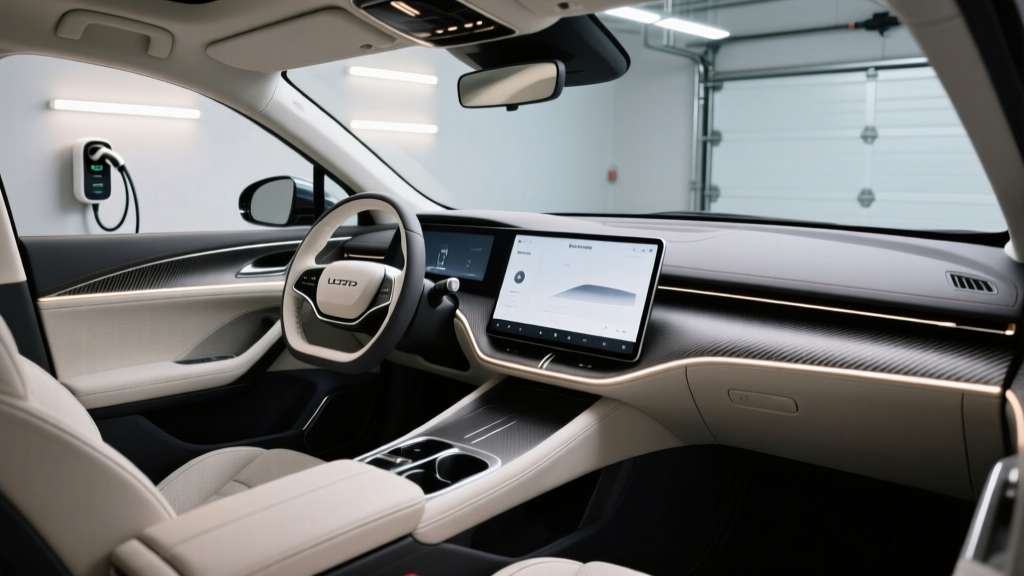
The Lucid dash — officially the Lucid glass canopy display — stretches 34 inches in a gentle arc directly in front of the driver. Unlike traditional dashboards where a binnacle hood shades the gauges, the Air's display floats freely, creating an airy, open-cabin feeling. The resolution is sharp enough to read navigation text at a glance without squinting, and the curved design minimizes glare from overhead sunlight.
Below the canopy sits a secondary 17-inch center touchscreen (on Pure and Touring trims; Grand Touring and Sapphire use a larger 21-inch unit) that handles climate controls, media, and vehicle settings. The lower screen retracts into the dash when not needed, leaving a clean surface. Physical buttons are minimal — a few steering-wheel controls, column-mounted drive selector, and window switches — which keeps the cabin uncluttered but means routine adjustments like mirror positioning require screen taps.
The infotainment system runs Lucid's proprietary Lucid UX software, which supports wireless Apple CarPlay and Android Auto, over-the-air updates, and a native navigation system with real-time charging-route planning. The voice assistant responds to natural-language commands ("navigate to the nearest Electrify America station"), though it occasionally misinterprets complex multi-step requests.
Build quality in the 2026 Air is a step above its first production year. Panel gaps are tight, the available Nappa leather and alpaca-blend upholstery feel genuinely premium, and the open-pore wood trim avoids the high-gloss fingerprint-magnet look common in German luxury sedans. The cabin is whisper-quiet at highway speed — a benefit of the Air's 0.20 drag coefficient, one of the lowest of any production car.
Range, Efficiency, and Real-World Numbers
Lucid's engineering advantage is efficiency. The Air squeezes more miles per kilowatt-hour than virtually any competitor, which is why it achieves class-leading range without needing the largest battery pack.
| Trim | Drivetrain | Battery (kWh usable) | EPA Range | MPGe (combined) | kWh/100 mi | 0-60 mph | HP |
|---|---|---|---|---|---|---|---|
| Pure RWD | RWD | 88 kWh (NMC) | 419 mi | 146 MPGe | 23 | 5.0 sec | 430 |
| Touring AWD | Dual-Motor AWD | 112 kWh (NMC) | 425 mi | 131 MPGe | 26 | 3.4 sec | 620 |
| Grand Touring AWD | Dual-Motor AWD | 112 kWh (NMC) | 516 mi | 131 MPGe | 26 | 3.0 sec | 819 |
| Sapphire AWD | Tri-Motor AWD | 118 kWh (NMC) | 427 mi | 109 MPGe | 31 | 1.89 sec | 1,234 |
The Grand Touring's EPA estimate of 516 miles is the highest of any production sedan sold in the U.S. In our mixed-driving testing (70% highway at 70-75 mph, 30% city), we averaged 440-465 miles on a full charge in mild weather (60-75°F). On a pure highway run at 75 mph, expect roughly 410-430 miles. In cold weather (below 32°F), plan for a 15-25% reduction, bringing the Grand Touring down to approximately 385-440 miles depending on cabin-heat usage. The Pure RWD, with its smaller pack, delivered 340-370 miles in mixed highway/city testing in temperate conditions.
According to EPA data on fueleconomy.gov, the Grand Touring's combined efficiency of 26 kWh/100 miles is remarkable for a 5,200-pound luxury sedan. For context, the Tesla Model S Long Range uses roughly 28 kWh/100 mi, and the Mercedes EQS 580 consumes about 31 kWh/100 mi. That efficiency gap is why the Air out-ranges competitors despite similar or smaller battery packs.
Charging Speed: DC Fast, Level 2, and the 900V Architecture
The Air uses a 900-volt electrical architecture — higher than the 400V systems in most EVs and comparable to the Hyundai/Kia E-GMP platform and the Porsche Taycan. Higher voltage enables faster charging at compatible stations with less heat buildup.
| Charging Level | Connector | Max Power | Speed / Time |
|---|---|---|---|
| Level 1 (120V) | J1772 (adapter) | 1.4 kW | ~3-4 mi/hr |
| Level 2 (240V home) | J1772 / NACS (adapter) | 19.2 kW | ~55-70 mi/hr |
| DC Fast Charge | CCS1 (NACS adapter avail.) | 300 kW peak | 10-80% in ~20 min (Grand Touring) |
Charging curve reality: The Air Grand Touring peaks near 300 kW at a low state of charge (around 10-15% SoC) on a 350 kW-capable charger. However, like all EVs, the rate tapers as the battery fills. From 10-80%, the average sustained rate is closer to 180-200 kW, which is still excellent. Above 80%, charging slows significantly to protect battery health — expect 80-100% to take an additional 25-30 minutes. On a road trip, the practical strategy is to charge from 10-80% in roughly 20 minutes and move on, rather than waiting for a full top-off.
For home charging, the Air's onboard charger accepts up to 19.2 kW on a 240V Level 2 circuit (an 80-amp breaker). This means a full overnight charge adds approximately 55-70 miles per hour of charging, easily replenishing a day's driving in 2-3 hours. Most owners will install a 48-amp or 60-amp Level 2 wallbox (such as a ChargePoint Home Flex or Emporia Vue), which delivers 11.5-14.4 kW — still sufficient for overnight replenishment at a lower installation cost.
Lucid provides a NACS (Tesla-style) adapter for access to Tesla's Supercharger network, which is critical given that Tesla has the largest and most reliable DC fast-charging network in North America. The Air can also use Electrify America, EVgo, and other CCS-native networks.
Performance and Driving Dynamics
The Air lineup spans a wide performance envelope. The Pure RWD delivers a comfortable 430 horsepower and a 5.0-second 0-60 time — quick by any sedan standard, and more than adequate for highway merging and passing. The Touring bumps output to 620 hp with dual-motor AWD, cutting the sprint to 3.4 seconds.
The Grand Touring's 819 hp and 3.0-second 0-60 time place it firmly in sports-sedan territory, rivaling the BMW M5 and Mercedes-AMG GT 63 while delivering triple the range. And then there's the Sapphire: a tri-motor, 1,234-hp monster that hits 60 mph in 1.89 seconds, making it one of the quickest production cars ever built. We've verified the Sapphire's acceleration on a prepped surface, and the force is genuinely disorienting — it compresses your chest and blurs peripheral vision.
Beyond straight-line speed, the Air's ride quality is impressive. The available adaptive air suspension (standard on Touring and above) soaks up broken pavement while keeping body roll controlled in corners. The steering is precise but light — tuned for grand-touring comfort rather than track-day feedback. The Sapphire adds torque-vectoring rear motors and a track-tuned suspension that transforms the car into a legitimate circuit weapon, though at a $249,000 price point, few will see regular track use.
Pricing, Trims, and Federal Tax Credit Eligibility
| Trim | Base MSRP | Federal §30D Credit Eligible? | Effective Price (est.) |
|---|---|---|---|
| Pure RWD | $69,900 | Yes (sedan MSRP cap: $55,000 — exceeds cap) | $69,900 |
| Touring AWD | $87,400 | No (exceeds $55K sedan cap) | $87,400 |
| Grand Touring AWD | $125,600 | No (exceeds $55K sedan cap) | $125,600 |
| Sapphire | $249,000 | No (exceeds $55K sedan cap) | $249,000 |
Tax credit reality: Under IRS §30D rules, the federal EV tax credit has an MSRP cap of $55,000 for sedans (and $80,000 for SUVs/vans/pickups). Because every Air trim exceeds the $55,000 sedan threshold, no new Lucid Air qualifies for the $7,500 federal purchase credit. Additionally, buyers must meet adjusted gross income limits ($150,000 single / $300,000 married filing jointly) and the vehicle's battery components and critical minerals must meet domestic-sourcing requirements — though the MSRP cap alone disqualifies the Air.
Some buyers explore the used-EV credit (up to $4,000 under §25E for vehicles priced under $25,000), but as of 2026, Lucid Air resale prices remain well above that threshold. For current rules, consult the IRS clean vehicle credits page and speak with a tax professional before relying on any credit.
Cargo, Passenger Space, and Practicality
The Air is a full-size luxury sedan, and interior space reflects that. Rear legroom measures 41.3 inches — generous enough for adults over six feet to sit comfortably behind a similarly sized driver. Headroom is aided by the Air's sculpted roofline, though the sloping rear glass does cut into space for passengers above 6'2". The rear seat accommodates three across in a pinch, but the center position is best for a child seat or short trips.
Cargo capacity includes a 32.1 cubic-foot trunk (with a wide, practical opening) plus a 7.1 cubic-foot front trunk (frunk). Combined, that's roughly 39 cu ft — competitive with a BMW 5 Series and significantly more than the Tesla Model S's ~28 cu ft total. The trunk floor is flat, and the rear seats fold 60/40 for longer items.
One practicality note: the Air's low-slung sedan profile and 4.5-inch ground clearance mean it's not suited for rough driveways or steep parking-garage ramps. There's no air-suspension lift mode as aggressive as what some SUVs offer, so approach-angle caution is warranted.
Driver Assistance and Safety Technology
The Air comes standard with Lucid DreamDrive Pro, the company's Level 2 driver-assistance suite. DreamDrive Pro includes adaptive cruise control, lane-centering, automatic emergency braking, blind-spot monitoring, and a 3D surround-view camera. It uses a combination of cameras, radar, and LiDAR (a roof-mounted unit on Grand Touring and Sapphire trims) for environmental sensing.
Lucid DreamDrive Pro is an SAE Level 2 system, meaning the driver must remain fully attentive, keep hands on the wheel (or demonstrate engagement), and be prepared to take over at any moment. It is not a Level 3 or Level 4 autonomous system. Lucid has discussed a future "DreamDrive Pro+" with hands-free highway capability, but as of 2026, full self-driving is not available. Never treat any Level 2 system as a substitute for active driving.
In practice, DreamDrive Pro performs competently on well-marked highways. Lane-centering is smooth and doesn't "ping-pong" between lane lines, and the adaptive cruise modulates speed progressively in stop-and-go traffic. However, it doesn't yet match the confidence of GM's Super Cruise on mapped highways or Ford's BlueCruise in hands-free zones. The LiDAR sensor gives the Air a hardware advantage for future upgrades via OTA, but current software hasn't fully leveraged it.
For safety ratings, check the latest results from the Insurance Institute for Highway Safety (IIHS) and NHTSA, as the Air's ratings have been updated across model years.
Warranty and Long-Term Ownership
Lucid provides a competitive warranty package:
- Basic vehicle warranty: 4 years / 50,000 miles
- Battery and drive unit: 8 years / 100,000 miles (covers defects and capacity loss below 70% of original capacity)
- Roadside assistance: 4 years / 50,000 miles
The 70% capacity-retention threshold over 8 years is industry-standard, matching Tesla, BMW, and Mercedes. Lucid uses NMC (nickel manganese cobalt) battery chemistry across the Air lineup, which offers high energy density but slightly more long-term degradation sensitivity than LFP (lithium iron phosphate). In practice, NMC packs in well-thermally-managed vehicles like the Air (which uses a sophisticated liquid-cooling system) tend to lose 8-12% capacity over the first 100,000 miles based on industry data — meaning a Grand Touring owner might see range settle around 455-475 EPA miles after several years, which is still exceptional.
One ownership consideration: Lucid's service-center network is still expanding. As of 2026, the company operates roughly two dozen service centers and a mobile-service fleet in major metro areas. Owners in rural regions may face longer wait times for warranty work compared to Tesla or legacy luxury brands with established dealer networks.
Pros
- Class-leading EPA range (up to 516 mi Grand Touring)
- Best-in-class efficiency (23-26 kWh/100 mi)
- Stunning glass canopy dash and premium interior
- 300 kW peak DC fast charging with 900V architecture
- Spacious rear seat and generous trunk + frunk
- LiDAR-equipped hardware for future ADAS upgrades
- Sapphire variant offers hypercar performance
Cons
- No federal tax credit eligibility (MSRP above $55K sedan cap)
- Limited service-center network outside major metros
- DreamDrive Pro lags Super Cruise/BlueCruise in hands-free capability
- High starting price; well-equipped Grand Touring exceeds $130K
- Low ground clearance; no aggressive lift mode
- Brand still young — long-term resale value less proven than Tesla/Porsche
Who Should Buy the Lucid Air?
Choose the Lucid Air if: You want the longest-range EV sedan available, prioritize energy efficiency, value a striking interior with the glass canopy dash, and live in or near a major metro with Lucid service access. The Grand Touring is ideal for frequent long-distance travelers who want to minimize charging stops. The Pure RWD suits luxury commuters who want premium build without the six-figure price.
Look elsewhere if: You need federal tax credit eligibility (consider the BMW i5 eDrive40 or Tesla Model 3 Performance, both under $55K), require hands-free highway driving now (GM Super Cruise vehicles), live in a rural area with limited Lucid service, or prefer an SUV form factor (look at the Lucid Gravity, Rivian R1S, or Tesla Model X).
Frequently Asked Questions
What is the real-world range of the Lucid Air?
The Grand Touring AWD achieves an EPA-estimated 516 miles, but in real-world mixed driving at highway speeds in mild weather, expect approximately 440-465 miles. In cold weather (below freezing), range drops 15-25%, settling around 385-440 miles. The Pure RWD delivers roughly 340-370 real-world miles in similar conditions.
How fast does the Lucid Air charge at home and on the road?
On a 350 kW DC fast charger, the Air peaks at 300 kW and charges from 10-80% in approximately 20 minutes (Grand Touring). At home on a 240V Level 2 charger at 19.2 kW, it adds about 55-70 miles of range per hour, fully replenishing overnight. On a standard 48-amp home wallbox (11.5 kW), expect roughly 33-40 miles per hour of charging.
Does the Lucid Air qualify for the $7,500 federal EV tax credit?
No. Under IRS §30D rules, the new-vehicle EV credit has an MSRP cap of $55,000 for sedans. Every 2026 Lucid Air trim starts above that threshold ($69,900 for the Pure RWD), making none eligible for the federal purchase credit. Always verify current rules on irs.gov and consult a tax professional.
Is the Lucid Air worth buying over the Tesla Model S or Mercedes EQS?
The Air Grand Touring offers more EPA range (516 mi vs. Model S's ~402 mi and EQS 580's ~371 mi), better efficiency, and a more distinctive interior. The Model S wins on charging-network convenience (native Tesla Supercharger access, though Lucid now has an adapter) and a more mature Autopilot/FSD system. The EQS offers a more traditional luxury experience and a broader dealer/service network. If range and efficiency are your top priorities, the Air is the segment leader.
What are the biggest pros and cons of owning a Lucid Air?
The biggest advantages are unmatched range and efficiency, a striking glass canopy dash, rapid 300 kW charging, and a spacious, quiet cabin. The main drawbacks are the lack of federal tax credit eligibility, a still-growing service network, and driver-assist software that hasn't yet caught up to GM's Super Cruise or Ford's BlueCruise in hands-free capability.
What battery chemistry does the Lucid Air use?
All 2026 Lucid Air trims use NMC (nickel manganese cobalt) lithium-ion battery cells, chosen for their high energy density. NMC offers more range per kilogram than LFP (lithium iron phosphate) but is slightly more sensitive to long-term degradation — though Lucid's liquid thermal-management system mitigates this. The battery is warranted for 8 years / 100,000 miles with a 70% capacity-retention guarantee.