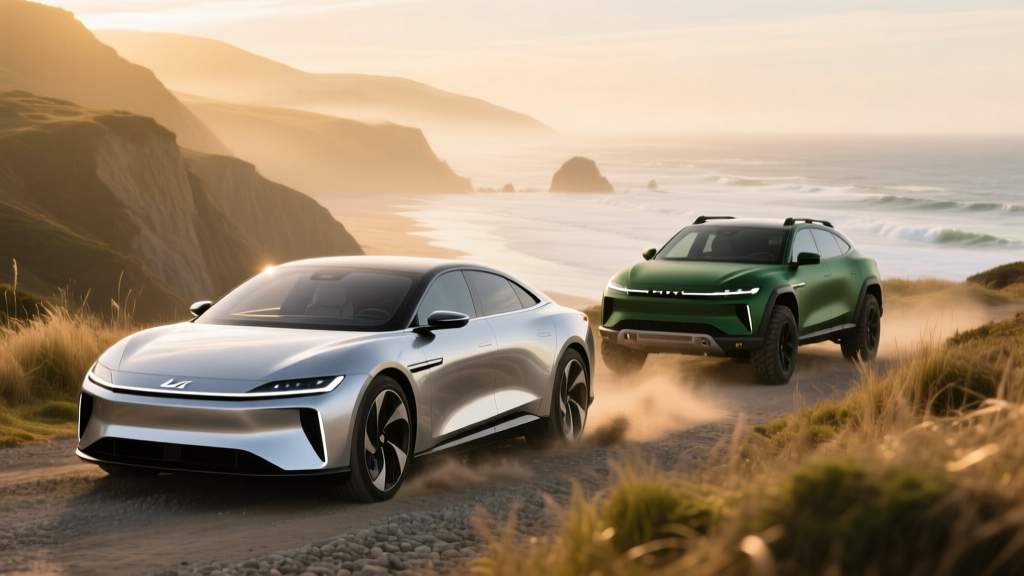
The Lucid Air continues to set the efficiency benchmark in the luxury electric sedan segment. For 2026, Lucid has restructured its trim strategy around thematic editions — notably the Cosmos and Earth design packages — while retaining the core Air platform that delivers class-leading range and an industry-best energy consumption figure. Whether you're drawn to the Cosmos edition's darkened aesthetic and performance tuning or the Earth edition's sustainability-focused interior materials, the underlying engineering remains the story: a 900-volt architecture, segment-topping MPGe, and a usable battery that stretches past 500 miles on the EPA cycle.
This review covers every number that matters — real-world range expectations, DC fast-charge curves, federal tax credit nuances under IRS §30D, and how the Air stacks up against the Tesla Model S, Mercedes EQS, and BMW i7 in 2026.
Range, Efficiency, and the Real-World Reality
The 2026 Lucid Air Pure (the base configuration available with the Earth edition) carries an EPA-estimated 419 miles of range from its 88 kWh usable battery pack. The Air Grand Touring, eligible for the Cosmos edition package, pushes that to an EPA-estimated 512 miles thanks to its 112 kWh usable pack and dual-motor efficiency tuning.
EPA Sticker: 419 mi (Pure/Earth) | 512 mi (Grand Touring/Cosmos)
Highway (70-75 mph, moderate climate): Expect ~350-370 mi (Pure) and ~430-450 mi (Grand Touring). The Air's exceptional drag coefficient (0.20 Cd) narrows the highway penalty versus city driving compared to most EVs.
Cold Weather (below 30°F): Plan for 25-30% range reduction — roughly 290-315 mi (Pure) and 360-385 mi (Grand Touring). The standard heat pump helps, but lithium-ion chemistry inherently loses capacity in deep cold. Preconditioning the battery while plugged in recovers some of this loss.
Efficiency is where the Air genuinely separates itself. The Pure returns an EPA-rated 146 MPGe combined (approximately 23 kWh/100 mi), making it one of the most efficient large sedans ever sold in the U.S. The Grand Touring achieves 131 MPGe combined (~26 kWh/100 mi). For context, the Mercedes EQS 450+ sits at 97 MPGe, and the BMW i7 xDrive60 at 82 MPGe. According to fueleconomy.gov, the Air's efficiency advantage translates directly into lower charging costs per mile — a meaningful differentiator at scale.
Battery Chemistry and Platform Specs
Lucid uses NMC (nickel manganese cobalt) lithium-ion cells in a structural pack. The 900-volt electrical architecture — shared across all Air trims — enables faster charging and thinner, lighter wiring harnesses compared to the more common 400V systems. The battery is liquid-cooled with active thermal management, critical for sustaining fast-charge rates and long-term health.
| Spec | Air Pure (Earth Edition) | Air Grand Touring (Cosmos Edition) |
|---|---|---|
| EPA Range | 419 mi | 512 mi |
| Usable Battery | 88 kWh (NMC) | 112 kWh (NMC) |
| Drivetrain | RWD, single motor | AWD, dual motor |
| Horsepower | 430 hp | 819 hp |
| 0-60 mph | 5.0 sec | 3.0 sec |
| MPGe (combined) | 146 MPGe | 131 MPGe |
| kWh/100 mi | 23 | 26 |
| Max DC Fast Charge | 220 kW | 300 kW |
| 10-80% DC Time | ~25 min | ~20 min |
| Level 2 Home Rate | 19.2 kW (~75 mi/hr) | 19.2 kW (~75 mi/hr) |
| Base MSRP | $77,400 | $125,600 |
Charging: DC Fast, Level 2, and the 900V Advantage
The Air's 900-volt architecture is the key to its charging performance. Higher voltage means the car can accept more power at lower current, reducing heat buildup and sustaining peak charge rates longer. The Grand Touring peaks at 300 kW on a compatible DC fast charger — among the fastest rates available on any production sedan in 2026.
| Charging Level | Power / Voltage | Miles Added per Hour | Notes |
|---|---|---|---|
| Level 1 (120V household) | ~1.4 kW | ~4-5 mi/hr | Emergency/trickle only; a full charge takes days |
| Level 2 (240V home) | 19.2 kW max | ~75 mi/hr | Requires a 100A circuit for full rate; most homes install 48A (~11.5 kW, ~45 mi/hr) |
| DC Fast Charge | 220-300 kW peak | ~1,000-1,200 mi/hr (peak) | 10-80% in 20-25 min; tapers significantly above 80% SoC |
Charging curve reality check: The 300 kW peak on the Grand Touring is sustained roughly between 10-40% State of Charge. Beyond 50%, the rate tapers to ~180 kW, and above 80% it drops to under 60 kW. This is normal lithium-ion behavior to protect cell longevity, but it means charging from 80-100% on a road trip adds disproportionate time. Plan to charge to 80% and drive on.
At home, the Air's 19.2 kW onboard charger is among the most powerful in the segment. To take full advantage, you'll need a hardwired wall connector on a dedicated 100-amp circuit — most residential panels can support this, but older 100-amp whole-home panels may require a $2,000-$4,000 upgrade to a 200-amp service. Most buyers opt for a 48-amp circuit delivering 11.5 kW, which still replenishes ~45 miles of range per hour and is sufficient for overnight charging.
Performance and Driving Dynamics
The Air Pure's 430 hp and 5.0-second 0-60 time are brisk by any sedan standard. The Grand Touring's 819 hp and 3.0-second sprint put it firmly in supercar territory. Both versions benefit from Lucid's miniaturized motor design — each drive unit weighs under 70 lbs and fits in a carry-on bag, enabling a lower center of gravity and more interior space than competitors using bulkier motors.
Ride quality leans comfort-oriented with adaptive air suspension standard on Grand Touring and available on the Pure. Steering is precise but light — this is a grand tourer, not a track car, despite the Sapphire variant's existence higher in the lineup. Regenerative braking offers a moderate one-pedal driving experience, though it doesn't quite bring the car to a full stop at very low speeds like some competitors.
Cosmos and Earth Editions: What's Actually Different?
The Earth edition emphasizes natural and recycled interior materials — open-pore wood trim, plant-based leather alternatives, and a warm color palette. It pairs naturally with the Pure's RWD efficiency and lower entry price. Exterior accents lean toward matte and brushed finishes.
The Cosmos edition brings a darker, more technical aesthetic: gloss black exterior trim, carbon fiber interior accents, a starfield-inspired headliner, and sport-tuned suspension calibration. It's available on Grand Touring and above, complementing the performance hardware.
Neither edition changes the powertrain, battery, or range. They are trim-level design packages — think of them as curated interior/exterior themes rather than mechanical upgrades.
Pricing, Tax Credits, and Total Cost
The 2026 Lucid Air starts at $77,400 for the Pure (before destination) and climbs to $125,600 for the Grand Touring. The Cosmos and Earth edition packages add approximately $3,000-$5,000 depending on configuration.
| Trim | Base MSRP | §30D Credit Eligible? | Effective Price (if eligible) |
|---|---|---|---|
| Air Pure (Earth) | $77,400 | No — exceeds $55,000 sedan MSRP cap | $77,400 |
| Air Grand Touring (Cosmos) | $125,600 | No — exceeds $55,000 sedan MSRP cap | $125,600 |
Critical tax credit note: Under IRS §30D rules, the federal EV tax credit of up to $7,500 is subject to an MSRP cap of $55,000 for sedans (the cap is $80,000 for SUVs, pickups, and vans). Because the Lucid Air is classified as a sedan and all trims exceed $55,000, no Air variant qualifies for the new-vehicle federal tax credit in 2026. This is confirmed by IRS guidelines on clean vehicle credits. Buyers should also verify income caps ($150K single / $300K joint for §30D) and battery critical-mineral sourcing requirements, though the MSRP cap alone disqualifies the Air.
However, the Air may qualify for state-level incentives — California's CVRP rebate, Colorado's state tax credit, and various utility-company charging rebates can collectively offset $2,000-$7,500 depending on your jurisdiction. Always check your state's energy office and local utility for current programs.
Interior Space, Technology, and Driver Assistance
The Air's cabin is genuinely spacious. Rear legroom measures 41.5 inches — more than the Mercedes S-Class — thanks to the compact motor packaging and flat floor. Cargo volume totals 32 cubic feet combined (trunk + front trunk/frunk), with the frunk offering 4.5 cu ft of secure, weatherproof storage.
The infotainment system centers on a 34-inch curved glass cockpit display running Lucid's proprietary OS. Wireless Apple CarPlay and Android Auto are standard. The available Surreal Sound Pro audio system uses 21 speakers with Dolby Atmos. Over-the-air updates continue to add features post-purchase.
On the driver-assistance front, the Air comes equipped with DreamDrive Pro, which includes adaptive cruise control, lane centering, automatic emergency braking, and blind-spot intervention. This is an SAE Level 2 system — it requires continuous driver supervision and is not a self-driving or hands-off system. Lucid has not yet launched a hands-free highway driving feature comparable to GM's Super Cruise or Ford's BlueCruise.
DreamDrive Pro is an SAE Level 2 driver-assist system. You must keep your hands on the wheel and eyes on the road at all times. It does not handle construction zones, unmapped roads, or complex urban intersections autonomously. It is not "self-driving."
Warranty and Long-Term Ownership
Lucid provides a competitive warranty package:
- Basic vehicle: 4 years / 50,000 miles
- Battery and drive unit: 8 years / 100,000 miles (with a minimum 70% capacity retention threshold)
- Roadside assistance: 4 years / 50,000 miles
The 8-year/100,000-mile battery warranty is standard for the segment. The 70% retention threshold means Lucid will repair or replace the pack if it degrades below 70% of original capacity within the warranty period. Based on NMC chemistry data from similar high-voltage architectures, expect roughly 8-12% total degradation over the first 100,000 miles under normal use — well above the warranty floor. Battery replacement cost, if out of warranty, is estimated at $15,000-$22,000 based on current pack pricing, though costs are trending downward.
Pros and Cons
- Class-leading EPA range (512 mi Grand Touring)
- Best-in-class efficiency (146 MPGe Pure)
- 900V architecture enables 300 kW DC fast charging
- Exceptional rear-seat legroom (41.5 in)
- 19.2 kW onboard charger — fastest home charging in segment
- Quiet, refined ride with adaptive air suspension
- No federal tax credit eligibility (MSRP exceeds $55K sedan cap)
- DreamDrive Pro lags behind Super Cruise/BlueCruise in hands-free capability
- Limited service center network outside major metros
- High entry price — $77,400 base, $125,600+ for Grand Touring
- Regenerative braking doesn't enable full one-pedal stop
- Cold-weather range loss of 25-30% is significant for a 500-mi vehicle
Who Should Buy the Lucid Air (Cosmos or Earth)?
Choose the Air Pure with Earth edition if: You prioritize efficiency and range above all else, commute 40+ miles daily, have access to Level 2 home charging, and want a luxury sedan that costs under $4/month in electricity for a 40-mile round trip. The Pure's 419-mile range and 146 MPGe make it the efficiency champion of the luxury segment.
Choose the Air Grand Touring with Cosmos edition if: You want 500+ mile range and 819-hp supercar performance in one vehicle, regularly take road trips where 300 kW DC charging saves 10-15 minutes per stop, and the $125K+ price point fits your budget. The Cosmos package's sport-tuned suspension and darkened aesthetic complement the Grand Touring's dual-motor capability.
Look elsewhere if: Federal tax credit eligibility is a dealbreaker (consider the Tesla Model 3, Hyundai Ioniq 6, or BMW i4), you need hands-free highway driving (GM Super Cruise or Ford BlueCruise), or you live far from a Lucid service center.
Frequently Asked Questions
What is the real-world range of the 2026 Lucid Air?
In mixed driving at moderate temperatures, expect ~370-390 miles from the Pure (Earth) and ~460-480 miles from the Grand Touring (Cosmos). Highway driving at 75 mph reduces this to ~350-370 and ~430-450 miles respectively. In sub-freezing weather, plan for 25-30% less.
How fast does the Lucid Air charge at home and on the road?
On a DC fast charger, the Grand Touring peaks at 300 kW and charges 10-80% in roughly 20 minutes; the Pure peaks at 220 kW and takes about 25 minutes. At home on Level 2, both accept up to 19.2 kW (~75 mi/hr), though most home installations deliver 11.5 kW (~45 mi/hr).
Does the Lucid Air qualify for the $7,500 federal EV tax credit?
No. Under current IRS §30D rules, the federal credit for new EVs has a $55,000 MSRP cap for sedans. All Lucid Air trims exceed this cap, making them ineligible. State and utility incentives may still apply — check your local programs.
Is the Lucid Air worth it vs. the Tesla Model S or Mercedes EQS?
The Air beats both on range and efficiency. The Model S offers a more mature Supercharger network and lower starting price (~$74,990 for Long Range) but less interior space and lower MPGe. The EQS offers a more luxurious cabin and hands-free-capable Drive Pilot (in limited areas) but trails significantly on range (390 mi) and efficiency (97 MPGe). If range and efficiency are your top priorities, the Air wins.
What's the biggest drawback of owning a Lucid Air?
Service infrastructure. Lucid's service center and mobile-service footprint is growing but remains limited compared to Tesla, BMW, or Mercedes-Benz. If you live outside a major metro area, warranty service may require a long drive or a multi-day mobile visit. Factor this into your purchase decision.
What battery chemistry does the Lucid Air use?
The Air uses NMC (nickel manganese cobalt) lithium-ion cells in a structural pack with liquid cooling. NMC offers higher energy density than LFP chemistry, which is how Lucid achieves 512 miles in a sedan form factor. The trade-off is that NMC is more sensitive to sustained 100% SoC storage — Lucid recommends daily charging to 80-90% and reserving 100% for road trips.