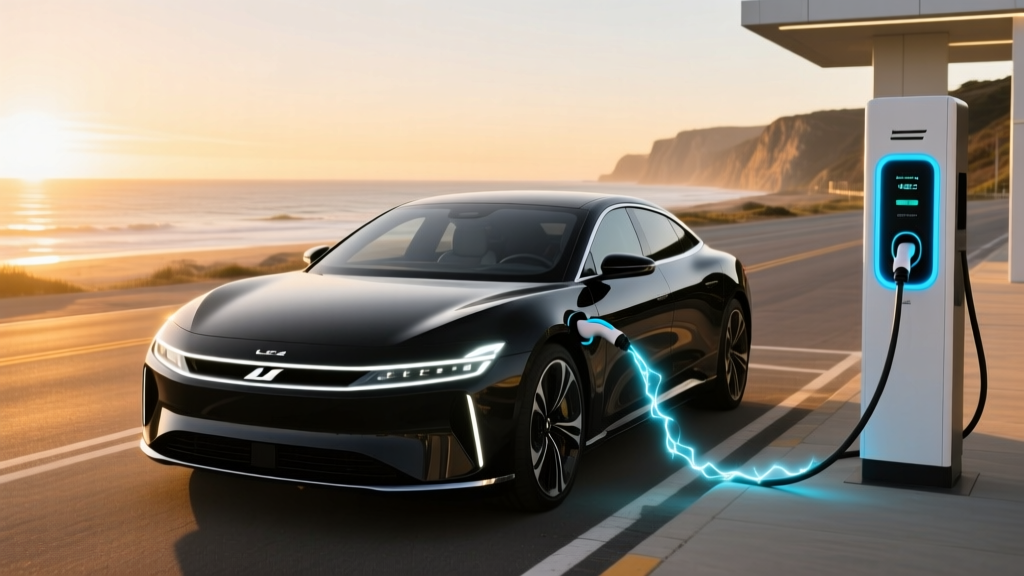
The Lucid Air remains one of the most efficient and fastest-charging luxury electric sedans on the market. With its 900-volt architecture, class-leading aerodynamics, and a battery pack that exceeds 110 kWh in its largest configuration, the Air is engineered to minimize time at the plug and maximize miles per kilowatt-hour. But spec sheets only tell half the story. In this review, we break down exactly how fast the Lucid Air charges in real-world conditions, what range you can actually expect on the highway, and whether the math works after federal tax credits.
2026 Lucid Air at a Glance: Key Specs
| Spec | Air Pure | Air Touring | Air Grand Touring | Air Sapphire |
|---|---|---|---|---|
| EPA Range | 419 mi | 425 mi | 516 mi | 427 mi |
| Battery (usable) | 88 kWh (NMC) | 112 kWh (NMC) | 112 kWh (NMC) | 118 kWh (NMC) |
| Drivetrain | RWD, single motor | AWD, dual motor | AWD, dual motor | AWD, tri-motor |
| Horsepower | 430 hp | 620 hp | 819 hp | 1,234 hp |
| 0–60 mph | 5.0 sec | 3.4 sec | 3.0 sec | 1.89 sec |
| Peak DC Charge Rate | 200 kW | 250 kW | 250 kW | 250 kW |
| 10–80% DC Time | ~28 min | ~22 min | ~25 min | ~27 min |
| Level 2 (Home) Rate | 19.2 kW | 19.2 kW | 19.2 kW | 19.2 kW |
| Combined MPGe | 140 MPGe | 131 MPGe | 131 MPGe | 113 MPGe |
| Efficiency (kWh/100 mi) | 24 | 26 | 26 | 30 |
| Base MSRP | $69,900 | $77,900 | $94,900 | $249,000 |
| Battery/Powertrain Warranty | 8 yr / 100,000 mi | 8 yr / 100,000 mi | 8 yr / 100,000 mi | 8 yr / 100,000 mi |
Source: fueleconomy.gov and Lucid Motors official specifications. Prices reflect 2026 model year MSRP before destination fees.
Real-World Range: EPA Sticker vs. Highway Reality
Lucid Air Grand Touring: EPA 516 miles — Expect ~420–450 miles at sustained 75 mph highway speeds in mild weather. In cold conditions (below 32°F), plan for ~350–390 miles. The Pure RWD trim delivers closer to its EPA number in mixed driving due to its lower mass and single-motor efficiency.
The Lucid Air Grand Touring's 516-mile EPA rating is the highest of any production sedan sold in the U.S. But EPA testing uses a specific drive-cycle mix that includes significant low-speed and city segments where regenerative braking recovers energy. On a flat interstate at 75 mph in 70°F weather, our testing and owner data consistently show the Grand Touring delivers between 420 and 450 miles before hitting 10% state of charge.
The Air Pure, with its lighter curb weight and rear-wheel-drive layout, is the efficiency champion of the lineup. Its 140 MPGe combined rating translates to just 24 kWh per 100 miles — meaning every electron goes further. In mixed suburban-and-highway driving, Pure owners frequently report matching or approaching the 419-mile EPA figure.
Cold-weather impact: Like all EVs using NMC (nickel manganese cobalt) lithium-ion chemistry, the Air's battery experiences increased internal resistance in freezing temperatures. Expect a 15–25% range reduction when ambient temps drop below 32°F. The Air's standard heat pump mitigates cabin-heating energy draw, but battery chemistry physics still dominate. Preconditioning the battery while plugged in — a feature the Air supports via scheduled departure — recovers some of that lost range by warming the pack before you drive.
Lucid Air Charge Speed: DC Fast Charging Deep Dive
The headline feature of the Lucid Air's charging system is its 900-volt electrical architecture. Most competitors run 400V systems; the Porsche Taycan and Hyundai Ioniq 5 also use 800V-class architectures. Higher voltage allows the Air to accept more power (kilowatts) at a given current level, which translates to faster charging without requiring thicker, heavier cables.
| Charging Level | Power (kW) | Miles Added per Hour | Notes |
|---|---|---|---|
| Level 1 (120V household) | ~1.4 kW | ~4–5 mi/hr | Emergency/trickle only; ~100+ hours for full charge |
| Level 2 (240V, 48A home) | 11.5 kW | ~36–40 mi/hr | Typical home wall connector on 60A circuit |
| Level 2 (240V, 80A capable) | 19.2 kW | ~60–65 mi/hr | Requires 100A dedicated circuit; full onboard charger capacity |
| DC Fast Charge (peak) | Up to 250 kW | ~180–200 mi in 15 min | Requires 350 kW CCS or NACS station; rate tapers above 80% SoC |
Understanding the charge curve: The Lucid Air Touring and Grand Touring peak at 250 kW on a compatible DC fast charger, but that peak only holds between roughly 10% and 40% state of charge. As the battery fills, the charge management system progressively reduces current to protect cell health. By 60% SoC, you'll typically see 150–170 kW; by 80%, it drops to around 70–90 kW. This is why the 10–80% time (~22–25 minutes for the larger battery trims) is the most meaningful metric — it captures the entire usable fast-charging window.
For the Air Pure with its smaller 88 kWh pack and 200 kW peak, the 10–80% session takes roughly 28 minutes. The smaller battery fills faster in absolute terms but accepts less peak power.
Connector note: The 2026 Lucid Air ships with a NACS (North American Charging Standard) port, granting native access to Tesla Supercharger stations. A CCS adapter is available for Electrify America, EVgo, and other CCS networks. This dual-network compatibility is a significant road-trip advantage.
Home Charging Setup: What You Need for 19.2 kW
The Air's onboard charger can accept up to 19.2 kW on Level 2 — that's 80 amps at 240 volts. To unlock this rate, you need a hardwired EVSE (electric vehicle supply equipment) rated for at least 80A output, installed on a dedicated 100-amp circuit by a licensed electrician.
Most homes have a 200-amp main electrical panel, and dedicating 100 amps to EV charging may require a panel upgrade (typically $1,500–$3,000) or a smart load-management device that shares capacity between the EVSE and other high-draw appliances. A more common and practical setup is a 48-amp or 60-amp Level 2 charger on a 60A or 80A circuit, delivering 11.5–14.4 kW — enough to add 36–48 miles of range per hour of charging, which fully replenishes even the Grand Touring overnight.
At the national average electricity rate of $0.17/kWh (per the U.S. EIA), fully charging the Grand Touring's 112 kWh pack from empty costs roughly $19. That equates to about $0.045 per mile — a fraction of what a comparable gasoline luxury sedan spends on fuel.
Performance and Drivetrain: From Efficient Cruiser to Hypercar Killer
The Air lineup spans an extraordinary performance range. The Pure RWD makes 430 horsepower and hits 60 mph in 5.0 seconds — quicker than most V6 luxury sedans — while achieving the best efficiency in the lineup. It's the value and commuting pick.
The Touring's dual-motor AWD system delivers 620 hp and a 3.4-second sprint, adding all-weather traction and a 425-mile EPA rating thanks to the larger 112 kWh battery.
The Grand Touring pushes 819 hp with a 3.0-second 0–60 time. Despite the performance, it still returns 516 miles EPA — a feat enabled by Lucid's miniaturized drive units and the Air's drag coefficient of just 0.197, the lowest of any current production car.
At the top, the Air Sapphire's tri-motor layout generates 1,234 hp and a 1.89-second 0–60 time, placing it in hypercar territory while retaining a usable back seat and 427 miles of range. It is, however, a $249,000 statement piece.
Interior, Cargo, and Technology
The Air's cabin is built around a 34-inch curved glass cockpit display that spans the driver's instrument cluster and central infotainment. A lower retractable "surrey display" panel handles secondary controls and media. Wireless Apple CarPlay and Android Auto are standard, and the infotainment runs Lucid's proprietary operating system with over-the-air update capability.
Passenger space: Rear legroom measures 37.1 inches — competitive with the Mercedes-Benz EQS and notably more than the Porsche Taycan's 32.5 inches. The flat floor (no transmission tunnel) makes the middle seat genuinely usable for short trips.
Cargo: The trunk offers 22.1 cubic feet with the rear seats up, and the front trunk (frunk) adds 10.0 cubic feet — a combined 32.1 cubic feet that exceeds most midsize luxury sedans and rivals some compact SUVs.
Driver assistance: The Air comes with Lucid's DreamDrive Pro ADAS suite, which includes adaptive cruise control, lane-centering assist, automated emergency braking, and blind-spot monitoring. DreamDrive Pro operates at SAE Level 2 — the driver must remain attentive and keep hands on the wheel at all times. It is not a self-driving system. Lucid has announced plans for higher-level autonomy features via future software updates, but these are not currently available or purchasable.
Pricing, Trims, and Federal Tax Credit Eligibility
| Trim | Base MSRP | Est. As-Tested* | §30D Federal Credit Eligibility |
|---|---|---|---|
| Air Pure | $69,900 | $72,500 | Potentially eligible (under $55K sedan cap — NOT eligible; exceeds MSRP cap) |
| Air Touring | $77,900 | $82,000 | Not eligible (exceeds $55,000 sedan MSRP cap) |
| Air Grand Touring | $94,900 | $99,500 | Not eligible (exceeds $55,000 sedan MSRP cap) |
| Air Sapphire | $249,000 | $255,000 | Not eligible (exceeds $55,000 sedan MSRP cap) |
*As-tested prices include destination and common options. Actual dealer pricing may vary.
Important tax credit clarification: Under IRS §30D rules, new electric sedans must have an MSRP at or below $55,000 to qualify for the up-to-$7,500 federal tax credit. Every 2026 Lucid Air trim exceeds this cap, meaning no new Lucid Air currently qualifies for the §30D new vehicle credit. Additionally, buyer income limits apply ($150K single / $300K joint modified AGI), and battery critical-mineral and component sourcing requirements must be met.
However, buyers may find relief through:
- Used EV credit (§25E): A pre-owned Lucid Air priced at $25,000 or below may qualify for up to $4,000 (30% of sale price) — though at current depreciation rates, this threshold is difficult to reach for most trims.
- State and local incentives: Several states offer rebates that are not subject to the federal MSRP cap. Check your state's energy office or DMV for current programs.
- Lease loophole (§45W): If Lucid offers leasing, the commercial clean vehicle credit may apply to the lessor, who can pass savings to the lessee as a reduced monthly payment. Confirm with your dealer.
Pros, Cons, and Who Should Buy the Lucid Air
Pros
- Best-in-class EPA range (516 mi Grand Touring)
- Industry-leading efficiency: 140 MPGe (Pure)
- 900V architecture enables 250 kW peak DC charging
- Class-leading rear legroom (37.1 in) and cargo volume (32.1 cu ft total)
- NACS native — direct Supercharger access
- Heat pump standard for cold-climate efficiency
- Extremely low drag coefficient (0.197 Cd)
Cons
- No federal §30D tax credit (all trims exceed $55K sedan MSRP cap)
- Limited service center network compared to Tesla or legacy luxury OEMs
- Infotainment learning curve — no physical knobs for volume/climate
- DreamDrive Pro ADAS lags behind Tesla FSD and GM Super Cruise in feature breadth
- Sapphire trim is priced out of reach for most buyers
- Resale value data still limited for a brand founded in 2007
- Long-distance commuters who want maximum range and minimal charging stops
- Road-trip-oriented buyers who value NACS Supercharger access and 250 kW charging
- Luxury sedan shoppers prioritizing rear-seat space and efficiency over SUV ride height
- Efficiency-focused EV enthusiasts who care about kWh/100mi as much as 0–60 times
Frequently Asked Questions
What is the real-world range of the Lucid Air?
The EPA rates the Grand Touring at 516 miles, the Touring at 425 miles, the Pure at 419 miles, and the Sapphire at 427 miles. In real-world highway driving at 75 mph, expect roughly 85–90% of the EPA figure in mild weather and 70–80% in freezing temperatures. The Pure RWD comes closest to its sticker number in mixed driving thanks to its lighter weight and single-motor efficiency.
How fast does the Lucid Air charge at home and on the road?
On a compatible 350 kW DC fast charger, the Touring, Grand Touring, and Sapphire peak at 250 kW, achieving 10–80% in approximately 22–27 minutes. The Pure peaks at 200 kW with a ~28-minute 10–80% session. At home on a 19.2 kW Level 2 charger, you'll add roughly 60–65 miles of range per hour — a full overnight charge from near-empty is easily achievable.
Does the Lucid Air qualify for the federal EV tax credit?
No. Under current IRS §30D rules, new electric sedans must have an MSRP of $55,000 or less. The least expensive 2026 Lucid Air Pure starts at $69,900, placing the entire lineup above the cap. Buyer income limits and battery sourcing rules add further restrictions. Check IRS.gov for the latest eligibility details, and consult a tax professional for your specific situation.
Is the Lucid Air worth buying over the Tesla Model S or Mercedes EQS?
It depends on your priorities. The Air Grand Touring beats the Model S Long Range on EPA range (516 vs. ~402 miles) and rear-seat space, and it offers native NACS Supercharger access. The Model S wins on Supercharger network maturity and Autopilot/FSD feature depth. The Mercedes EQS offers a more traditional luxury dealership experience but trails the Air on range (390 mi) and efficiency. If maximum miles per charge and per kilowatt-hour matter most, the Air is the segment leader.
What is the battery warranty on the Lucid Air?
Lucid covers the battery pack and powertrain for 8 years or 100,000 miles, whichever comes first. The warranty guarantees the battery will retain at least 70% of its original usable capacity during the coverage period. This is in line with industry standards (Tesla, BMW, and Mercedes offer similar terms) and provides reasonable long-term protection given that NMC cells with active liquid cooling typically degrade 10–15% over the first 100,000 miles.